
CA vs ACCA in 2026: Salary, Global Scope & Who Indian Firms Prefer
Admission alerts for this course will appear here as official notifications are published.
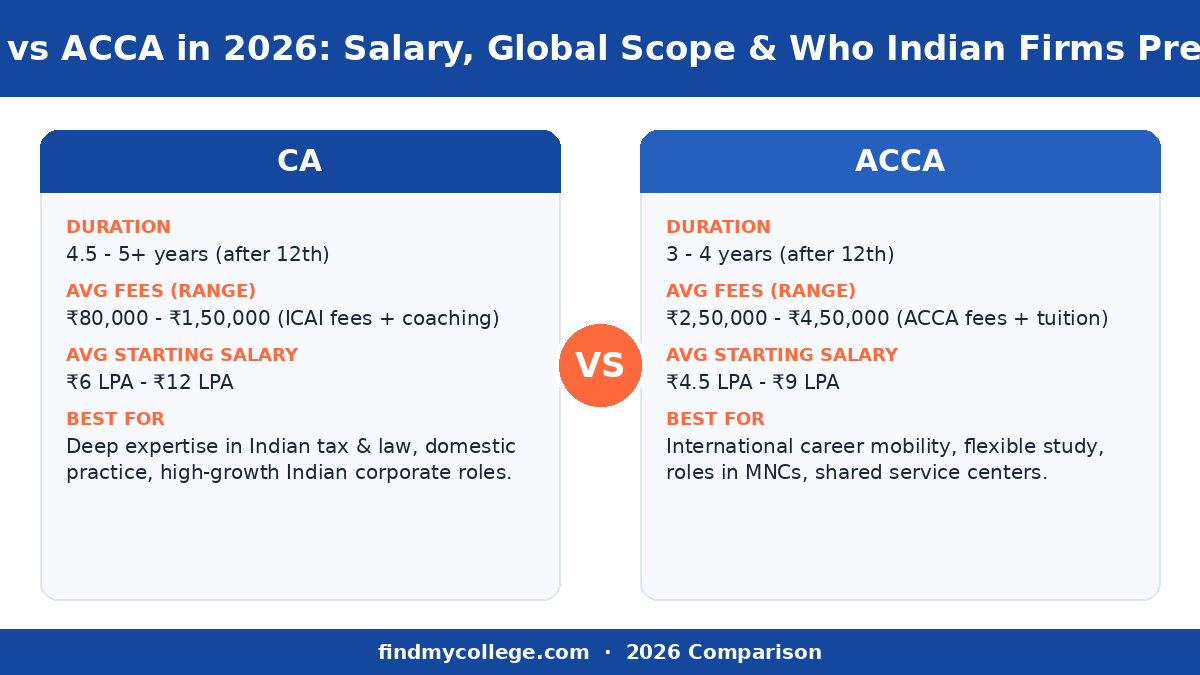
Deciding between Chartered Accountancy (CA) and the Association of Chartered Certified Accountants (ACCA) in 2026 is a pivotal choice for aspiring finance professionals in India. While CA remains the gold standard for traditional auditing and taxation within India, ACCA offers a globally recognized qualification with broader international career prospects and greater flexibility. Your ideal path hinges on your career aspirations, risk tolerance, and preferred learning style.
CA vs ACCA: Quick Comparison (2026)
| Duration | Eligibility | Admission / Entrance | Avg Fees (range) | Top Careers | Avg Starting Salary | Best For | |
|---|---|---|---|---|---|---|---|
| CA (India) | 4.5 – 5+ years (after 12th) | 10+2 (any stream) or Graduate | ICAI Foundation/Direct Entry | ₹80,000 – ₹1,50,000 (ICAI fees + coaching) | Auditor, Tax Consultant, Financial Controller, CFO (India-focused) | ₹6 LPA – ₹12 LPA | Deep expertise in Indian tax & law, domestic practice, high-growth Indian corporate roles. |
| ACCA (Global) | 3 – 4 years (after 12th) | 10+2 (with specific subjects) or Graduate | Direct registration (exemptions possible) | ₹2,50,000 – ₹4,50,000 (ACCA fees + tuition) | Financial Analyst, Management Accountant, Internal Auditor, Global Finance Roles | ₹4.5 LPA – ₹9 LPA | International career mobility, flexible study, roles in MNCs, shared service centers. |
Curriculum & focus
The CA curriculum is deeply rooted in Indian accounting standards, taxation laws, corporate law, and auditing practices. It provides an intensive, comprehensive understanding of the Indian financial ecosystem, making its holders indispensable for compliance and advisory within the country. In contrast, ACCA’s curriculum is globally benchmarked, focusing on International Financial Reporting Standards (IFRS), International Standards on Auditing (ISA), and global business practices. This makes ACCA holders versatile for roles in multinational corporations and across different geographies. The verdict: CA for Indian regulatory mastery, ACCA for global accounting principles.
Difficulty & workload
CA is widely regarded as significantly more challenging due to its vast syllabus, rigorous examination pattern, and historically low pass percentages. It often demands extensive self-study, long hours, and immense dedication, with many students requiring multiple attempts. ACCA, while still demanding, is generally perceived as more flexible and manageable. Its modular structure allows students to attempt papers individually, and the pass rates are typically higher. The verdict: CA demands extreme resilience, ACCA offers structured flexibility.
Fees & ROI
From a direct cost perspective, CA is considerably more affordable in India, with ICAI registration and examination fees being relatively low. Coaching costs form the bulk of the expense. ACCA, however, is a more expensive qualification, involving higher registration, examination, and tuition fees, especially if pursued through approved learning partners. While CA has a lower upfront cost, its higher earning potential in top Indian firms can lead to a strong ROI. ACCA’s ROI is realized through global opportunities and potentially faster completion, though initial Indian salaries might be lower. The verdict: CA is budget-friendly upfront, ACCA is a higher investment for global access.
Placements & salary
In the Indian job market, CAs traditionally command higher starting salaries and have a clear advantage in core auditing, taxation, and statutory compliance roles within Indian firms, including the Big 4. The demand for CAs in India remains robust. ACCA holders find strong placements in multinational corporations (MNCs), shared service centers, and global consulting firms operating in India, where IFRS knowledge is highly valued. Their starting salaries might be slightly lower than CAs in purely Indian roles but can quickly grow with international experience. The verdict: CA dominates traditional Indian finance, ACCA excels in global corporate roles.
Higher studies & abroad scope
A CA qualification is highly respected for pursuing higher studies like MBA or specialized finance programs, both in India and abroad, often providing exemptions or fast-tracking. For direct work abroad, while CA is recognized in some Commonwealth countries through mutual recognition agreements, it often requires additional local qualifications. ACCA, being a globally recognized qualification, offers superior mobility for working abroad. It has strong recognition in over 180 countries, making it a direct passport to international finance careers without needing extensive local re-qualification. The verdict: CA for academic progression, ACCA for direct international work.
Government-job scope
For government jobs in India, particularly those requiring expertise in Indian accounting, auditing, and taxation, the CA qualification holds significant weight and is often a mandatory requirement for senior positions in public sector undertakings (PSUs), government audit departments (like CAG), and various ministries. ACCA, while a strong qualification, generally has limited direct applicability or preference for traditional Indian government roles, which are heavily geared towards domestic regulatory frameworks. The verdict: CA is preferred for Indian government roles, ACCA has minimal direct relevance.
What students actually say (community insights)
- Many students acknowledge that CA is undeniably a tougher course, demanding extreme dedication and long study hours, often leading to multiple attempts. However, a significant number believe its difficulty is sometimes overhyped by those who haven’t experienced both.
- There’s a strong consensus that ACCA offers greater flexibility and a more structured, student-friendly examination pattern, making it a more manageable option for those balancing studies with other commitments or seeking a less stressful path.
- A recurring theme is the cost difference: CA is seen as significantly cheaper, making it accessible to a broader demographic in India, while ACCA is viewed as a substantial financial investment.
- While CA is perceived to have a higher ceiling and more job openings in the traditional Indian market, especially for audit and tax, some argue that ACCA provides decent opportunities in India, particularly within MNCs and global firms.
- The debate often highlights ACCA’s clear advantage for international career aspirations, with many seeing it as a direct route to working abroad, whereas CA’s global recognition is more nuanced and often requires additional steps.
- Some students who switched from CA to ACCA report finding the latter more aligned with managing corporate work alongside studies, appreciating its practical, knowledge-based approach to papers.
Which one should you choose?
Your choice between CA and ACCA in 2026 should be a strategic one, aligned with your personal and professional goals:
- Choose CA if: You aspire to build a career primarily within India, focusing on traditional auditing, taxation, and statutory compliance. You are prepared for a rigorous, demanding academic journey and seek the highest recognition in the Indian financial sector. You prioritize a lower upfront cost and aim for top roles in Indian corporates or practice.
- Choose ACCA if: You envision a career with international mobility, working for multinational corporations, shared service centers, or abroad. You prefer a more flexible, modular study approach and value a globally recognized qualification. You are comfortable with a higher investment for broader global opportunities and a potentially faster completion time.
- Consider both if: You want the best of both worlds. Many CAs pursue ACCA for global recognition, and some ACCA holders pursue CA to deepen their Indian regulatory expertise. This dual qualification can open up a wider array of opportunities.
Frequently Asked Questions
Is ACCA recognized by Indian firms?
Yes, ACCA is increasingly recognized by Indian firms, especially multinational corporations (MNCs), shared service centers, and global consulting firms operating in India. These firms value ACCA’s global curriculum and IFRS expertise. However, for traditional Indian audit and tax roles, CA remains the preferred qualification.
Can I pursue CA and ACCA simultaneously?
While technically possible, pursuing both simultaneously is extremely challenging due to the demanding nature and vast syllabi of both qualifications. Most students choose one and then consider the other later, often leveraging exemptions.
Which qualification offers better job security in India?
Both offer good job security in their respective domains. CA offers strong security in traditional Indian finance roles due to its statutory recognition. ACCA offers security in global finance roles within MNCs and international organizations, which are growing segments in India.
Are there exemptions for CA students in ACCA, or vice versa?
Yes, CAs often receive significant exemptions (up to 9 papers) in ACCA, allowing them to complete the qualification faster. Similarly, ACCA affiliates/members may receive some exemptions in CA, though typically fewer and subject to ICAI’s discretion.
What is the average time to complete each qualification?
CA typically takes 4.5 to 5+ years after 12th grade, including articleship. ACCA can be completed in 3 to 4 years after 12th grade, depending on exemptions and study pace, as it doesn’t have a mandatory articleship equivalent in the same structure.
Which is better for starting my own practice in India?
For starting an independent practice in India, especially in auditing, taxation, and statutory compliance, the CA qualification is indispensable and legally required for many services. ACCA does not provide the same legal standing for independent practice in India.
Does ACCA have an articleship equivalent in India?
ACCA requires 36 months of practical experience (PER) which can be gained in various finance roles, including those in India. This is more flexible than CA’s mandatory articleship, which is a structured training period under a practicing CA firm.
Is the CA pass rate really that low?
Yes, the CA pass rates are historically low, often in the single digits or low teens for intermediate and final levels, reflecting the high difficulty and competitive nature of the exams. ACCA pass rates are generally higher, though still challenging.