Courses in Cardiology: Degree List, Eligibility and Duration
Course fees vary from ₹1,000 to ₹60,000 per year in government institutions like AIIMS and JIPMER to ₹1,50,000 to ₹2,50,000 per year in private universities.
Students can enter cardiology through clinical medical pathways or allied health paramedical tracks. Below is complete information regarding academic degrees, eligibility criteria, duration, fees, top institutions, career opportunities, and admission procedures.
| Parameter | Details |
|---|---|
| Available Program Levels | UG Diploma, B.Sc Degree, PG Diploma, M.Sc, MD, DM, M.Ch, and Certificate Fellowships |
| Eligibility (UG Courses) | 10+2 with Physics, Chemistry, and Biology (PCB) with minimum 50% aggregate marks |
| Minimum Age Limit | 17 years as of December 31 of the admission year |
| B.Sc Cardiology Duration | 3 years of academic study plus 6 to 12 months compulsory clinical internship |
| MD / DM Duration | 3 years full-time program post-MBBS or Post-MD |
| Government College Fee Range | ₹1,000 to ₹60,000 per year |
| Private College Fee Range | ₹80,000 to ₹2,50,000 per year (Up to ₹20 Lakh total for PG medical degrees) |
| Starting Salary Range | ₹2.5 LPA – ₹4.5 LPA for Technologists; ₹8 LPA – ₹20 LPA for Medical Cardiologists |
List of Cardiology
Cardiology degrees in India span undergraduate diplomas, bachelor’s degrees, postgraduate diplomas, master’s degrees, and doctoral super-specialities. The table below outlines available programs across Indian universities.
| Course Name | Course Level | Duration | Eligibility Criteria | Average Fee Range |
|---|---|---|---|---|
| Diploma in Cardiovascular Technology | UG Diploma | 1 – 2 Years | 10+2 PCB (Min 50%) | ₹26,000 – ₹1,06,000 |
| B.Sc in Cardiology and Thoracic Science | Undergraduate Degree | 3 – 4 Years | 10+2 PCB (Min 50%) | ₹2 Lakh – ₹20 Lakh total |
| PG Diploma in Clinical Cardiology | Postgraduate Diploma | 2 Years | MBBS / Relevant Graduate Degree | ₹56,000 – ₹1,00,000 |
Eligibility and Duration
Eligibility requirements and program durations differ significantly between paramedical allied health courses and postgraduate medical qualifications.
For undergraduate options such as B.Sc in Cardiac Care Technology or Diploma in Cardiovascular Technology, candidates must complete 10+2 with Physics, Chemistry, and Biology (PCB) securing at least 50% aggregate marks (45% for SC/ST candidates) and reach a minimum age of 17 years by December 31. Admission to B.Sc in Cardiac Care Technology at most Indian universities does not require clearing NEET, relying instead on Class 12 board marks, CUET-UG, or institutional tests such as the AIIMS Paramedical Entrance Exam. Diploma programs last 1 to 2 years, whereas B.Sc degrees require 3 years of study plus a 1-year internship or 3 to 4 years total duration.
Medical PG programs require 3 years of full-time residency.
Fees
| College | City | Ownership | Total course fee |
|---|---|---|---|
| All India Institute of Medical Sciences New Delhi | Delhi | Government | ₹6,050 |
| Post Graduate Institute of Medical Education & Research | Chandigarh | Government | ₹8,510 |
| Kurnool Medical College | Kurnool | Government | ₹12,000 |
| Jawaharlal Nehru Medical College Ajmer | Ajmer | Government | ₹18,150 |
| Banaras Hindu University | Varanasi | Government | ₹20,850 |
| Nilratan Sircar Medical College & Hospital | Kolkata | Government | ₹36,000 |
| R. G. Kar Medical College and Hospital | Kolkata | Government | ₹36,000 |
| Calcutta National Medical College | Kolkata | Government | ₹48,000 |
| Kolkata Medical College | Kolkata | Government | ₹48,000 |
| Gauhati Medical College and Hospital | Guwahati | Government | ₹49,200 |
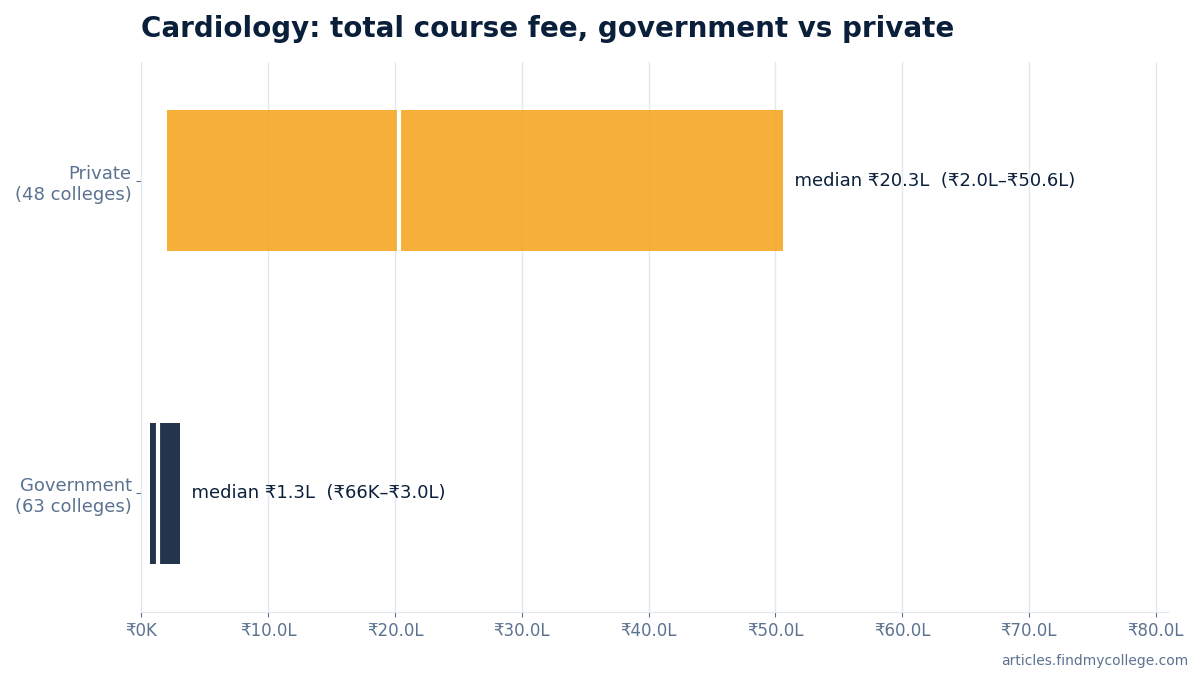
At least 253 colleges offer cardiology programs in India, including 77 government institutions. Government medical colleges maintain a median total course fee of ₹1.26 lakh, with the middle half ranging from ₹66,239 to ₹3.00 lakh across 63 reporting colleges.
| College | City | Ownership | Total course fee | NIRF rank |
|---|---|---|---|---|
| All India Institute of Medical Sciences New Delhi | Delhi | Government | ₹6,050 | 1 (Medical, 2025) |
| Post Graduate Institute of Medical Education & Research | Chandigarh | Government | ₹8,510 | 2 (Medical, 2025) |
| Christian Medical College Vellore | Vellore | Private | ₹2.41 lakh | 3 (Medical, 2025) |
| Jawaharlal Institute of Post Graduate Medical Education and Research | Pondicherry | Government | ₹1.19 lakh | 4 (Medical, 2025) |
| Sanjay Gandhi Postgraduate Institute of Medical Sciences | Lucknow | Government | ₹1.71 lakh | 5 (Medical, 2025) |
| Banaras Hindu University | Varanasi | Government | ₹20,850 | 6 (Medical, 2025) |
| King George’s Medical University | Lucknow | — | ₹77,000 | 8 (Medical, 2025) |
| Kasturba Medical College Manipal | Manipal | Private | ₹88.48 lakh | 10 (Medical, 2025) |
| Saveetha Institute of Medical and Technical Sciences | Chennai | — | ₹24.00 lakh | 11 (Medical, 2025) |
Top NIRF-ranked institutions display wide fee variations based on ownership structure. Private colleges report a median total course fee of ₹20.28 lakh, with the middle half spanning ₹1.98 lakh to ₹50.60 lakh across 48 reporting colleges.
| City | Colleges | Fee range | Well-known options |
|---|---|---|---|
| Bangalore | 12 | ₹94,620 – ₹45.00 lakh | Rajiv Gandhi University of Health Sciences, Ramaiah Medical College |
| Chennai | 12 | ₹90,000 – ₹87.00 lakh | Madras Medical College, Saveetha Institute of Medical and Technical Sciences |
| Lucknow | 11 | ₹77,000 – ₹1.71 lakh | King George’s Medical University, Sanjay Gandhi Postgraduate Institute of Medical Sciences |
| Bhopal | 9 | ₹1.20 lakh – ₹3.82 lakh | LNCT University, Rabindranath Tagore University |
| Delhi | 9 | ₹6,050 – ₹2.82 lakh | All India Institute of Medical Sciences New Delhi, Vardhman Mahavir Medical College |
| Jaipur | 8 | ₹51,535 – ₹63.47 lakh | Mahatma Jyoti Rao Phoole University, SMS Medical College |
| Mumbai | 7 | ₹1.72 lakh – ₹4.01 lakh | Seth GS Medical College, Grant Medical College and Sir J. J. Group of Hospitals |
| Kolkata | 6 | ₹36,000 – ₹56,150 | West Bengal University of Health Sciences, Calcutta National Medical College |
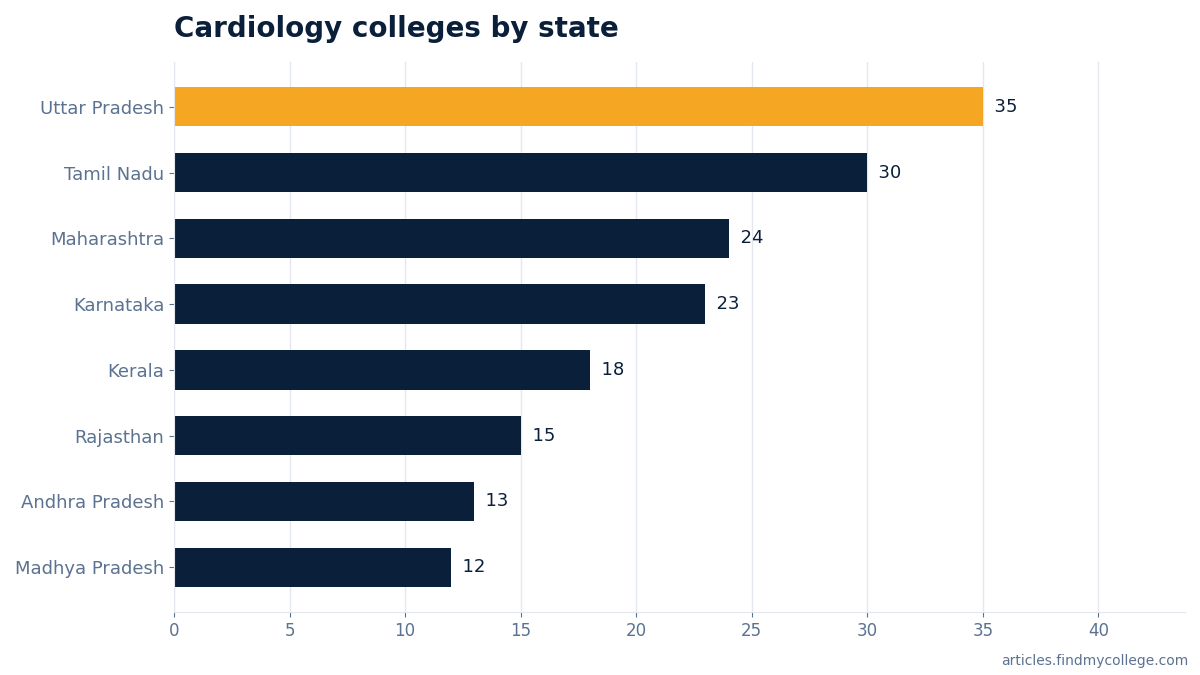
Cardiology seat distribution varies across major Indian states and metropolitan cities. Uttar Pradesh features 35 colleges, Tamil Nadu has 30, Maharashtra has 24, Karnataka has 23, Kerala has 18, and Rajasthan has 15.
How to Choose
Selecting a cardiology academic program depends on career intent—whether aiming to practice as a licensed medical doctor or working as an allied health diagnostic technician. B.Sc Cardiac Care Technology is suited for candidates seeking direct technical training to operate cath lab equipment and diagnostic tools without completing a full medical degree. In comparison, B.Sc Nursing provides broader general clinical employment across diverse healthcare wards.
If the objective is to diagnose conditions, prescribe medical treatment, or perform cardiac operations, clearing NEET-UG to complete an MBBS followed by NEET-PG or NEET-SS for MD, DM, or M.Ch specializations is mandatory. Doctors seeking sub-speciality training can choose Post-DM or Post-DNB Interventional Cardiology Fellowships (2 years duration with average packages near ₹18 LPA), while short modules like MediCOLL Learning’s 6-month Certificate in Clinical Cardiology offer targeted clinical learning for MBBS graduates.
People Also Read

How to Apply for Cardiology Admission in 2026: Step by Step
- Verify Eligibility Criteria: Ensure completion of 10+2 with Physics, Chemistry, and Biology (PCB) with at least 50% aggregate marks (45% for SC/ST) and minimum age of 17 years by December 31.
- Select Career Path & Exam Target: Decide between the medical route (NEET-UG for MBBS followed by NEET-PG/SS for MD/DM) or the paramedical route (B.Sc Cardiac Technology via AIIMS Paramedical, CUET-UG, or institutional merit).
- Register for Entrance Examinations: Apply online for relevant exams such as NEET-UG for MBBS, AIIMS Paramedical Entrance Exam for AIIMS seats, or university-specific tests like SRMJEEE.
- Participate in Counselling & Seat Allocation: Attend state-level paramedical/medical counselling or institute-level allotment processes based on entrance test ranks or 10+2 PCB merit marks.
- Submit Required Documents: Provide Class 10 & 12 marksheets, Transfer Certificate, Migration Certificate, Caste/Category Certificate (if applicable), Aadhaar Card, Recent Photos, and Medical Fitness Certificate.
- Confirm Admission & Pay Course Fees: Complete document verification and pay the required first-year tuition fee (ranging from ₹1,000 in AIIMS to ₹2,50,000 in private colleges) to secure the seat.
| What to do | Where | Link |
|---|---|---|
| Compare colleges, fees and cutoffs | Cardiology colleges in India | findmycollege.com |