EEE Subjects: B.Tech Electrical & Electronics Syllabus
Nishit Kumar is a senior EdTech industry leader with over a decade of experience in building and scaling education platforms, shaping their product, content, and growth strategy. At…
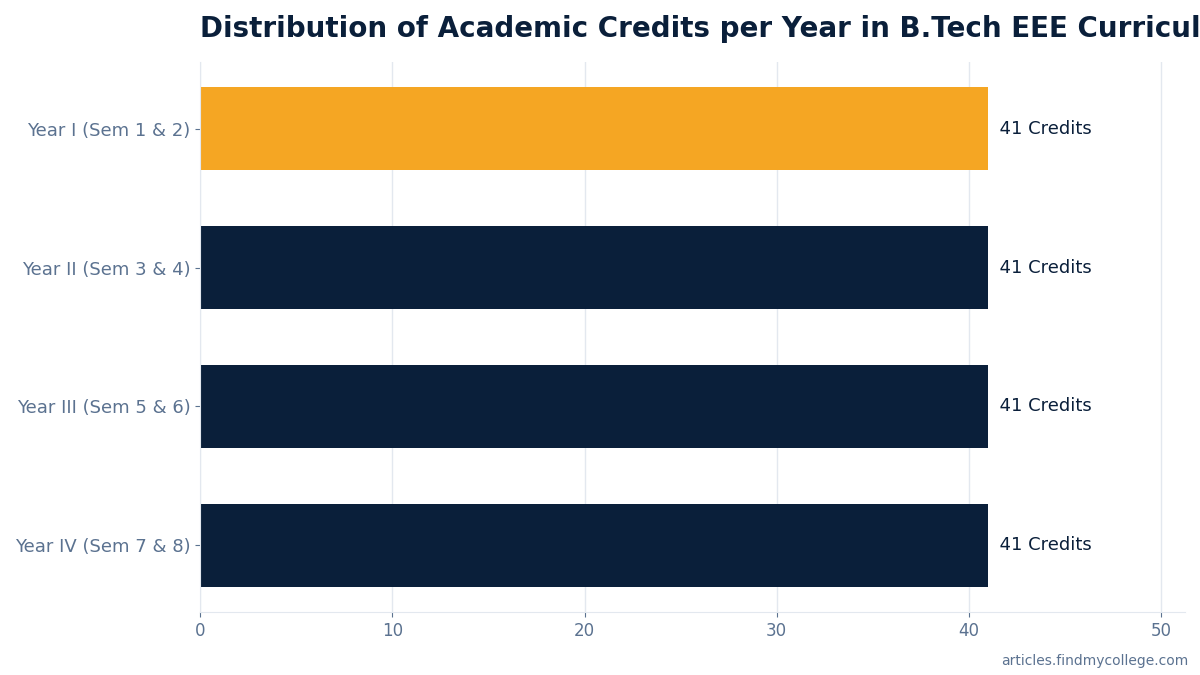
B.Tech Electrical and Electronics Engineering (EEE) is a 4-year undergraduate program spread across 8 semesters. The syllabus covers fundamental sciences, circuit analysis, electrical machines, power systems, power electronics, control systems, and microcontrollers, alongside practical labs, skill development courses, and specialized electives.
With at least 1080 colleges offering the course in India and a median average placement package of 3.46 LPA, students can expect median total fees of ₹1.56 lakh in government institutes and ₹1.95 lakh in private colleges. Below is a detailed breakdown of the semester-wise syllabus, core subjects, electives, lab practicals, recommended books, top colleges, and admission procedures.
| Parameter | Details |
|---|---|
| Course Duration | 4 Years (8 Semesters) |
| Eligibility | 10+2 with Physics, Chemistry, and Mathematics (PCM) |
| Major Entrance Exams | JEE Main, JEE Advanced, WBJEE, VITEEE, SRMJEEE |
| Top Recruiters | Schneider Electric, Siemens, Crompton Greaves, Alstom India, Adani Power |
B.Tech EEE Subjects Year-wise
The academic progression of B.Tech EEE systematically advances from basic engineering principles to complex power and electronic systems. The first year focuses on essential sciences, engineering graphics, basic programming in C and Python, and introductory electrical circuits, forming the foundation for subsequent technical modules.
During the second and third years, students complete core departmental modules in Electrical Machines, Power Systems, Electronic Devices, Digital Electronics, Control Systems, Power Electronics, and Microcontrollers. The fourth year focuses on industry applications, including renewable energy systems, electric vehicle technology, professional electives, and a dedicated major project.
| Semester | Theory Subject Title | Subject Category | Associated Laboratory / Practical | Credits |
|---|---|---|---|---|
| Semester I | Physics | Basic Science Course | Physics Laboratory | 3 + 1 |
| Semester I | C Programming | Computer Science Course | C Programming Laboratory | 3 + 1 |
| Semester I | Computer Aided Engineering Graphics | Mechanical Engineering Course | Engineering Graphics Lab | 3 |
| Semester I | English for Skill Enhancement | Humanities & Science | English Language Skills Lab | 3 + 1 |
| Semester II | Engineering Chemistry | Basic Science Course | Engineering Chemistry Lab | 3 + 1 |
| Semester II | Python Programming | Computer Science Course | Python Programming Lab | 3 + 1 |
| Semester II | Data Structures | Engineering Science Course | Data Structures Lab | 3 + 1 |
| Semester II | Electrical Circuits – II | Department Core | Electrical Circuits Lab | 3 + 1 |
| Semester | Subject Title | Course Type | Practical Lab / Skill Component | Credits |
|---|---|---|---|---|
| Semester III | Electrical Machines – I | Department Core | Electrical Machines – I Lab | 3 + 1 |
| Semester III | Electronic Devices and Circuits | Department Core | Electronic Devices and Circuits Lab | 3 + 1 |
| Semester III | Electrical Measurements and Sensors | Department Core | Electrical Measurements & Sensors Lab | 2 + 1 |
| Semester III | Design of Electrical Systems using AutoCAD | Skill Development Course 1 | AutoCAD Practical Lab | 1 |
| Semester IV | Numerical Methods and Complex Variables | Basic Science Course | Computational Mathematics Lab | 3 + 1 |
| Semester IV | Electrical Machines – II | Department Core | Electrical Machines – II Lab | 3 + 1 |
| Semester IV | Digital Electronics | Department Core | Digital Electronics Lab | 3 + 1 |
| Semester IV | Control Systems | Department Core | Control Systems Lab | 3 + 1 |
| Semester IV | PCB Design | Skill Development Course 2 | PCB Design Practical Lab | 1 |
| Semester | Subject Title | Course Type | Practical Lab / Skill Component | Credits |
|---|---|---|---|---|
| Semester V | Power Electronics | Department Core | Power Electronics Laboratory | 3 + 1 |
| Semester V | Microprocessors and Microcontrollers | Department Core | Microprocessors & Microcontrollers Lab | 3 + 1 |
| Semester V | Power System Protection | Department Core | Power System Laboratory | 3 + 1 |
| Semester V | Robotics and Automation | Skill Development Course 3 | Robotics Lab | 1 |
| Semester V | Field-Based Project / Internship | Practical Internship | Field / Industry Project Work | 2 |
| Semester VI | Power System Operation and Control | Department Core | Power System Simulation Lab | 3 + 1 |
| Semester VI | Signals and Systems | Department Core | Signals and Systems Lab | 3 + 1 |
| Semester VI | Electrical and Electronics Design | Department Laboratory | Design Laboratory | 1 |
| Semester VI | Design of Solar Power System | Skill Development Course 4 | Solar System Design Lab | 1 |
| Semester | Subject Title | Type of Course | Credit Allocation |
|---|---|---|---|
| Semester VII | Power Electronics for Renewable Energy Systems | Department Core + Lab | 3 Theory + 1 Lab |
| Semester VII | Hybrid Electric Vehicles | Department Core + Lab | 3 Theory + 1 Lab |
| Semester VII | Professional Elective – III | Department Elective | 3 Credits |
| Semester VII | Professional Elective – IV | Department Elective | 3 Credits |
| Semester VII | Open Elective – III | Interdisciplinary Elective | 2 Credits |
| Semester VII | Industry Oriented Mini Project / Summer Internship | Industry Internship | 2 Credits |
| Semester VIII | Professional Elective – V | Department Elective | 3 Credits |
| Semester VIII | Professional Elective – VI | Department Elective | 3 Credits |
| Semester VIII | Major Project Work | Core Research / Implementation | 14 Credits |
B.Tech EEE Electives and Specialisations
Professional electives in B.Tech EEE allow students to specialize in emerging technological domains and tailor their academic trajectory towards targeted industry careers. These elective options span sustainable energy systems, industrial automation, modern power grid management, microchip design, and artificial intelligence integration in power systems.
Students can select elective tracks aligned with clean technology and modern transportation, including Battery Management Systems, EV Charging Infrastructure, Smart Grid Technologies, and High Voltage Direct Current (HVDC) Transmission. Other popular elective streams focus on VLSI Design, Programmable Logic Controllers (PLCs), Power Quality, and Embedded Systems.
B.Tech EEE Practicals and Projects
Hands-on practical training is an essential component of the B.Tech EEE curriculum, bridging theoretical principles with real-world engineering applications. Practical training is delivered through dedicated laboratory sessions, skill development courses, and field internships that build operational proficiency in designing, testing, and troubleshooting electrical infrastructure.
Core laboratory modules and practical components integrated across the curriculum include:
- Skill Development Courses: Industry-focused practical modules including Design of Electrical Systems using AutoCAD, PCB Design, Robotics and Automation, and Design of Solar Power Systems.
- Core Engineering Laboratories: Practical lab sessions for Electrical Machines, Control Systems, Power Electronics, Power Systems Simulation, and Electric Vehicles.
- Industry Internships and Projects: Field-based project work, summer internships, industry-oriented mini projects, and a 14-credit major project work in the final semester.
Books for B.Tech EEE
Selecting standard textbooks and reference materials is crucial for mastering analytical models and practical concepts in B.Tech EEE. Prescribed literature covers key areas including power systems analysis, industrial power electronics, control theory, electric machines, microprocessors, and digital protection relays.
Academic institutions prescribe standard engineering textbooks written by internationally recognized authors to support semester coursework and competitive engineering examinations. Below is the list of recommended textbooks for core EEE subjects.
| Core Subject | Book Title | Author(s) |
|---|---|---|
| Power Systems Analysis | Modern Power Systems Analysis | D.P. Kothari and I.J. Nagrath |
| Power Electronics | Power Electronics | Ned Mohan |
| Control Systems | Modern Control Engineering | Katsuhiko Ogata |
| Electrical Machines | Electrical Machines, Drives, and Power Systems | Theodore Wildi |
| Digital Relaying & Protection | Digital Power System Protection | S.R. Bhide |
| Microprocessors | Advanced Microprocessors and Peripherals | A.K. Ray and K.M. Bhurchandi |
| Programmable Controllers | Programmable Logic Controllers | Frank D. Petruzella |
| High Voltage Engineering | High Voltage Engineering | C.L. Wadhwa |
Top Colleges Offering B.Tech EEE and Fee Structure
| College | City | Ownership | Total course fee | NIRF rank |
|---|---|---|---|---|
| Manipal University Manipal | Manipal | — | ₹3.29 lakh | 3 (Overall, 2025) |
| Indian Institute of Technology Kharagpur | Kharagpur | Government | ₹8.74 lakh | 6 (Overall, 2025) |
| Indian Institute of Technology Roorkee | Roorkee | — | ₹2.48 lakh | 6 (Overall, 2025) |
| Amrita Vishwa Vidyapeetham | Coimbatore | — | ₹14.10 lakh | 8 (Overall, 2025) |
| SRM Institute of Technology | Kanchipuram | Private | ₹11.10 lakh | 11 (Overall, 2025) |
| Indian Institute of Technology Guwahati | Guwahati | Government | ₹9.04 lakh | 11 (Overall, 2025) |
| Vellore Institute of Technology Vellore | Vellore | — | ₹6.92 lakh | 14 (Overall, 2025) |
| Siksha ‘O’ Anusandhan University | Bhubaneswar | — | ₹7.05 lakh | 15 (Overall, 2025) |
| Kalinga Institute of Industrial Technology | Bhubaneswar | — | ₹10.50 lakh | 17 (Overall, 2025) |
| Amity University Noida | Noida | — | ₹6.93 lakh | 22 (Overall, 2025) |
| College | City | Ownership | Total course fee |
|---|---|---|---|
| Rashtrakavi Ramdhari Singh Dinkar College of Engineering | Begusarai | Government | ₹12,200 |
| Visvesvaraya Technological University | Belgaum | Government | ₹17,420 |
| Shershah College of Engineering | Sasaram | Government | ₹20,000 |
| JNTUA College of Engineering Kadapa | Kadapa | Government | ₹28,580 |
| Government Engineering College Thiruvananthapuram | Thiruvananthapuram | Government | ₹32,425 |
| Government Engineering College Thrissur | Thrissur | Government | ₹32,900 |
| Government College of Engineering Kannur | Kannur | Government | ₹34,600 |
| Nalanda College of Engineering | Chandi | Government | ₹43,980 |
| JNTUA College of Engineering Kalikiri | Kalikiri | Government | ₹47,200 |
| Rajiv Gandhi Institute of Technology Kottayam | Kottayam | Government | ₹61,590 |
Government colleges report a median course fee of ₹1.56 lakh (middle half ₹89,650 to ₹1.80 lakh), while private colleges report ₹1.95 lakh. Across 70 reporting colleges, the median average placement package is 3.46 LPA, led by Andhra Pradesh with 258 colleges.
How to Apply for B.Tech EEE Admission in 2026: Step by Step
- Check Eligibility Criteria: Verify completion of 10+2 with Physics, Chemistry, and Mathematics.
- Register for Entrance Exams: Apply for entrance examinations such as JEE Main, JEE Advanced, WBJEE, VITEEE, or SRMJEEE.
- Submit College Applications: Register for target university or college admission portals using your entrance test scores.
- Select B.Tech EEE Branch Choice: Choose Electrical and Electronics Engineering during course preference entry.
- Document Verification and Fee Payment: Submit required academic certificates and pay the admission fee to secure your seat.
| What to do | Where | Link |
|---|---|---|
| Compare colleges, fees and cutoffs | B.Tech EEE colleges in India | findmycollege.com |
Government B.Tech EEE colleges have a median total course fee of ₹1.56 lakh, whereas private colleges have a median total course fee of ₹1.95 lakh.
FAQs
Is electrical engineering EEE?
EEE stands for Electrical and Electronics Engineering. While traditional Electrical Engineering focuses primarily on heavy electrical power, EEE combines power systems, electrical machinery, and electronic devices like microcontrollers and power electronics.
How many subjects are in BTech 4th year EEE?
In the 4th year of B.Tech EEE under JNTUH regulations, students typically study 2 core subjects, 4 professional electives, 1 open elective, complete 2 practical labs, an industry mini-project, and a 14-credit major project work.
What are all the main subjects in EEE?
Core subjects in EEE include Electrical Circuit Analysis, Electromagnetic Fields, Electrical Machines, Power Systems, Electronic Devices & Circuits, Digital Electronics, Control Systems, Power Electronics, Signals & Systems, and Microprocessors. These subjects build thorough technical knowledge across heavy electrical systems and modern electronic circuits.
What is the average starting salary for EEE graduates?
Graduates securing engineering roles in core electrical industries or tech firms command higher entry-level packages.
What practical skill courses are taught in B.Tech EEE?
Key skill development courses integrated into the B.Tech EEE curriculum include Electrical Systems Design using AutoCAD, PCB Design, Robotics and Automation, and Design of Solar Power Systems. These courses build practical hands-on proficiency.
Which entrance exams offer admission to B.Tech EEE?
Admission to B.Tech EEE programs across engineering colleges in India is granted through national and state-level entrance exams like JEE Main, JEE Advanced, WBJEE, VITEEE, and SRMJEEE. Candidates participate in centralized counselling post results.