EEE Engineering Courses: Duration, Core Subjects and Scope
Nishit Kumar is a senior EdTech industry leader with over a decade of experience in building and scaling education platforms, shaping their product, content, and growth strategy. At…
B.Tech in Electrical and Electronics Engineering (EEE) is an undergraduate program with a standard duration of 4 years across 8 semesters, or 3 years (6 semesters) for lateral entry diploma and B.Sc. holders. Eligibility requires passing 10+2 with Physics, Chemistry, and Mathematics with at least 45%–50% aggregate marks, leading to entry-level starting salaries ranging from ₹3 LPA to ₹8 LPA across core sectors.
At least 1080 colleges offer B.Tech EEE in India, giving prospective engineering students diverse opportunities across government and private institutions. This complete guide details course eligibility, admission procedures, semester syllabus, fees, top colleges, and career scope.
| Parameter | Details |
|---|---|
| Course Duration | 4 Years (8 Semesters) for regular B.Tech/B.E.; 3 Years (6 Semesters) for Lateral Entry / Diploma holders |
| Degree Level | Undergraduate (UG) Degree (B.Tech / B.E.) |
| Eligibility Criteria | Passed 10+2 with Physics, Chemistry, and Mathematics with minimum 45%-50% aggregate marks |
| Primary Entrance Exams | JEE Main, JEE Advanced, WBJEE, VITEEE, KEAM, BITSAT |
| Average Course Fees | INR 2,00,000 to INR 4,50,000 (up to INR 3 – 9 LPA depending on institute type) |
What is B.Tech EEE
- Program Duration: Regular B.Tech EEE programs span 4 academic years divided into 8 semesters, while lateral entry programs for diploma and B.Sc. graduates run for 3 years across 6 semesters.
- Core Subjects: Key curriculum modules cover Electrical Machines, Analog Electronic Circuits, Electromagnetic Fields, Control Systems, Microprocessors, and Power Systems.
- Career Focus: EEE focuses on power systems, electrical machinery, and energy alongside electronics, making it ideal for power grid, EV, and industrial automation roles.
B.Tech in Electrical and Electronics Engineering is an undergraduate program covering circuits, power systems, and electronics. It prepares students for technical roles across power plants, automation, and core engineering sectors.
B.Tech EEE Eligibility
Candidates seeking admission to the 4-year B.Tech EEE program must have completed 10+2 or equivalent examination with Physics, Chemistry, and Mathematics as core subjects, securing a minimum aggregate mark between 45% and 50%.
For lateral entry admission directly into the second year (third semester), diploma holders require a minimum of 45% aggregate marks (40% for reserved categories) in a 3-year Diploma in Engineering & Technology. B.Sc. graduates require at least 45% aggregate marks (40% for reserved categories) and must have studied Mathematics at the 10+2 level. Foundational subjects in the first year cover Engineering Mathematics, Physics, Chemistry, Mechanics, and basic programming tools like C and Python.
B.Tech EEE Syllabus and Subjects
The academic structure of B.Tech EEE covers fundamental engineering sciences, basic programming, and core electrical domain subjects across eight semesters. Core subjects taught in Year 2 and Year 3 cover Electrical Machines, Analog Electronic Circuits, Electromagnetic Fields, Control Systems, Microprocessors, and Power Systems.
In the final years, students select advanced professional electives covering IoT Applications, Electric & Hybrid Vehicles, Smart Grid Technologies, High Voltage Engineering (HVDC Transmission), AI Techniques, and Renewable Energy Systems alongside practical simulation labs and industry projects.
| Year | Semester | Core Academic Subjects and Practical Labs |
|---|---|---|
| First Year | Semester I & II | Matrices & Calculus, Applied Physics, Engineering Chemistry, C Programming & Data Structures, Electrical Circuit Analysis-I & II, Applied Python Lab |
| Second Year | Semester III & IV | Electrical Machines-I & II, Power Systems-I & II, Analog Electronic Circuits, Electromagnetic Fields, Measurements & Instrumentation, Digital Electronics |
| Third Year | Semester V & VI | Power Electronics, Control Systems, Microprocessors & Microcontrollers, Digital Signal Processing, Power System Protection, Industry Mini-Project |
| Fourth Year | Semester VII & VIII | Power Electronic Applications to Renewable Energy, Professional & Open Electives, Renewable Energy Simulation Lab, Project Stage I & II, Seminar |
| Specialisation Domain | Key Elective Modules Offered |
|---|---|
| Power Systems & Energy | High Voltage Engineering, HVDC Transmission, Power System Reliability, Power Quality & FACTS, Smart Grid Technologies |
| Automation & EV Technology | Electric and Hybrid Vehicles, Charging Infrastructure for EV, Power Semiconductor Drives, Solar Power Batteries |
| Embedded & Intelligent Systems | IoT Applications in EEE, Cyber-Physical Systems, Embedded Systems Applications, AI & ML Applications in EEE |
| Renewable Energy Technologies | Wind and Solar Energy Systems, Solar PV Systems, Energy Storage Systems, Renewable Energy Sources |
B.Tech EEE Fees
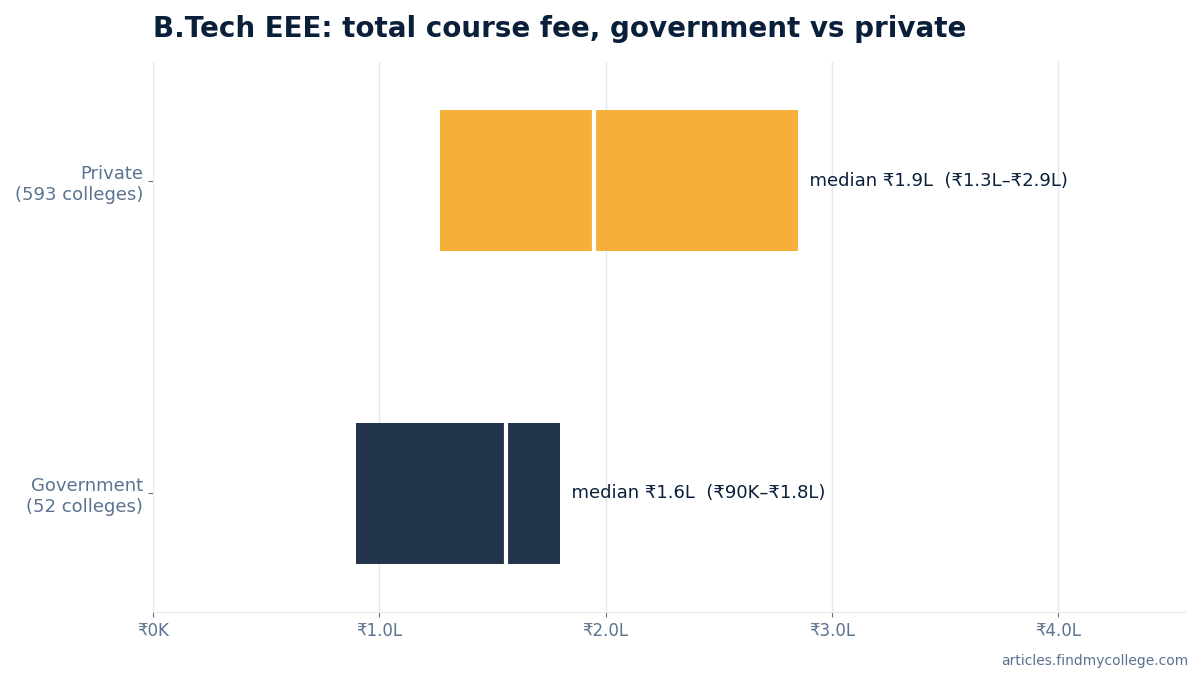
At least 1080 colleges offer B.Tech EEE programs in India, comprising 55 government institutes and 616 private institutions. Government engineering colleges maintain a median total course fee of ₹1.56 lakh, with the middle half ranging between ₹89,650 and ₹1.80 lakh based on fee data from 52 government colleges.
| College | City | Ownership | Total course fee |
|---|---|---|---|
| Rashtrakavi Ramdhari Singh Dinkar College of Engineering | Begusarai | Government | ₹12,200 |
| Visvesvaraya Technological University | Belgaum | Government | ₹17,420 |
| Shershah College of Engineering | Sasaram | Government | ₹20,000 |
| JNTUA College of Engineering Kadapa | Kadapa | Government | ₹28,580 |
| Government Engineering College Thiruvananthapuram | Thiruvananthapuram | Government | ₹32,425 |
| Government Engineering College Thrissur | Thrissur | Government | ₹32,900 |
| Government College of Engineering Kannur | Kannur | Government | ₹34,600 |
| Nalanda College of Engineering | Chandi | Government | ₹43,980 |
| JNTUA College of Engineering Kalikiri | Kalikiri | Government | ₹47,200 |
| Rajiv Gandhi Institute of Technology Kottayam | Kottayam | Government | ₹61,590 |
Top B.Tech EEE Colleges
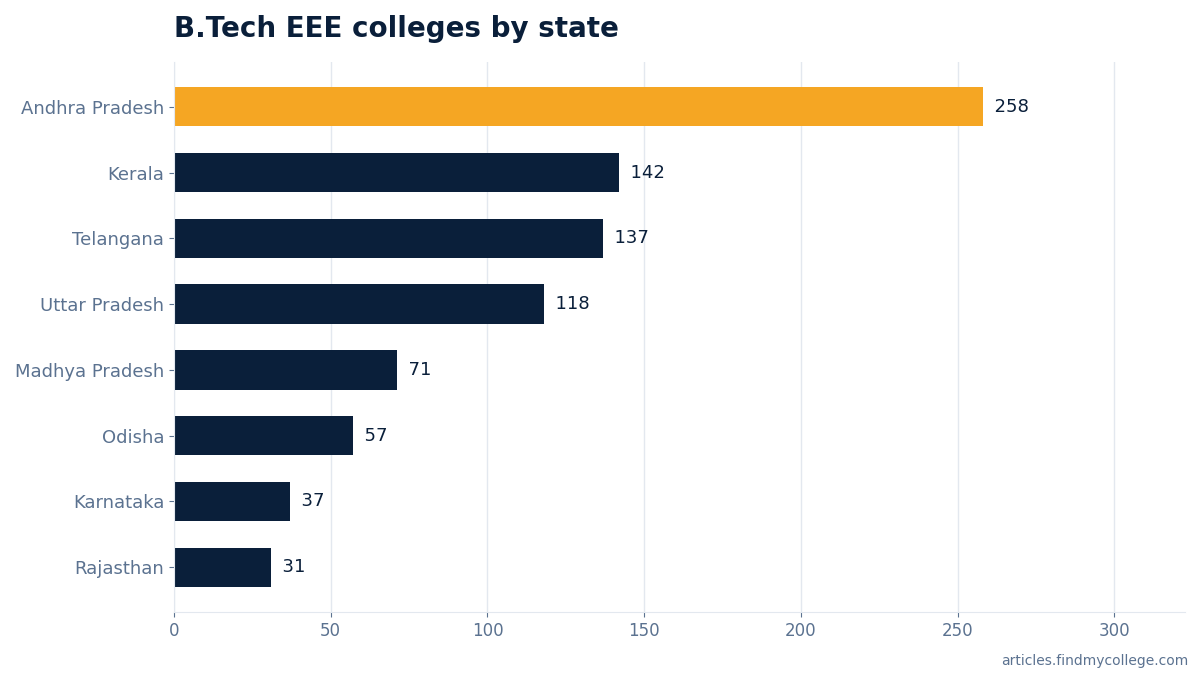
Prospective students can choose from a wide range of NIRF-ranked institutions, premier government institutes, and reputed private universities equipped with modern power systems and embedded labs. By state distribution, Andhra Pradesh features 258 colleges, Kerala 142, Telangana 137, Uttar Pradesh 118, Madhya Pradesh 71, and Odisha 57.
Across 70 colleges with placement reporting, the median average placement package stands at 3.46 LPA. Top private and state technical institutions also deliver strong career outcomes across major industrial hubs.
| College | City | Ownership | Total course fee | NIRF rank |
|---|---|---|---|---|
| Manipal University Manipal | Manipal | — | ₹3.29 lakh | 3 (Overall, 2025) |
| Indian Institute of Technology Kharagpur | Kharagpur | Government | ₹8.74 lakh | 6 (Overall, 2025) |
| Indian Institute of Technology Roorkee | Roorkee | — | ₹2.48 lakh | 6 (Overall, 2025) |
| Amrita Vishwa Vidyapeetham | Coimbatore | — | ₹14.10 lakh | 8 (Overall, 2025) |
| SRM Institute of Technology | Kanchipuram | Private | ₹11.10 lakh | 11 (Overall, 2025) |
| Indian Institute of Technology Guwahati | Guwahati | Government | ₹9.04 lakh | 11 (Overall, 2025) |
| Vellore Institute of Technology Vellore | Vellore | — | ₹6.92 lakh | 14 (Overall, 2025) |
| Siksha ‘O’ Anusandhan University | Bhubaneswar | — | ₹7.05 lakh | 15 (Overall, 2025) |
| Kalinga Institute of Industrial Technology | Bhubaneswar | — | ₹10.50 lakh | 17 (Overall, 2025) |
| Amity University Noida | Noida | — | ₹6.93 lakh | 22 (Overall, 2025) |
| College | City | Ownership | Total course fee | Average package |
|---|---|---|---|---|
| Bhagwan Parshuram Institute of Technology | Delhi | Private | ₹6.63 lakh | 6.25 LPA |
| BVRIT Hyderabad College of Engineering for Women | Hyderabad | Private | ₹3.69 lakh | 5.96 LPA |
| Galgotias College of Engineering and Technology | Greater Noida | Private | ₹3.47 lakh | 5.76 LPA |
| Aditya Institute of Technology and Management | Tekkali | Private | ₹3.18 lakh | 5.15 LPA |
| Vidya Jyothi Institute of Technology | Hyderabad | Private | ₹4.40 lakh | 5.12 LPA |
| TKM College of Engineering | Kollam | Private (aided) | — | 4.83 LPA |
| Gayatri Vidya Parishad College of Engineering | Visakhapatnam | Private | ₹3.15 lakh | 4.79 LPA |
| HMR Institute of Technology & Management | Delhi | Private | ₹6.00 lakh | 4.66 LPA |
| Tula’s Institute | Dehradun | Private | ₹3.53 lakh | 4.61 LPA |
| Gokaraju Rangaraju Institute of Engineering and Technology | Hyderabad | Private | ₹5.01 lakh | 4.38 LPA |
| City | Colleges | Fee range | Well-known options |
|---|---|---|---|
| Hyderabad | 65 | ₹1.36 lakh – ₹9.38 lakh | Jawaharlal Nehru Technological University Hyderabad, Anurag Group of Institutions |
| Bhopal | 42 | ₹67,600 – ₹9.45 lakh | Laxmipati Institute of Science and Technology, Bhabha University |
| Guntur | 35 | ₹62,000 – ₹7.36 lakh | Acharya Nagarjuna University, Vignan’s Foundation for Science, Technology, and Research |
| Bhubaneswar | 35 | ₹66,000 – ₹11.27 lakh | Indian Institute of Technology Bhubaneswar, Kalinga Institute of Industrial Technology |
| Visakhapatnam | 27 | ₹70,000 – ₹3.36 lakh | Vignan’s Institute of Engineering for Women, Andhra University |
| Thiruvananthapuram | 24 | ₹32,425 – ₹5.25 lakh | APJ Abdul Kalam Technological University, University of Kerela |
| Bangalore | 20 | ₹1.85 lakh – ₹13.60 lakh | Alliance University, Jain University |
| East Godavari | 20 | ₹70,000 – ₹4.80 lakh | Kakinada Institute of Technological Sciences Ramachandrapuram, Aditya Engineering College East Godavari |
B.Tech EEE Career Scope and Salary
Major recruiters in the public and private sectors include BHEL, NTPC, ISRO, Wipro Lighting, Bajaj Electricals, Schneider Electric, Adani Power, and Tata Electric.
Engineering graduates can also clear the Engineering Services Examination (ESE) or GATE to secure technical roles in government Public Sector Undertakings (PSUs) or gain admission to M.Tech programs. Typical starting salary ranges by job role include:
- Control Systems Engineers earn an average annual package ranging from ₹4 LPA to ₹8 LPA.
- Embedded Systems Engineers earn an average annual salary ranging from ₹3.5 LPA to ₹7 LPA.
- Power Systems Engineers and Automation Engineers receive annual compensation between ₹4 LPA and ₹7 LPA.
- Electrical Design Engineers and Electronics Engineers start with annual packages between ₹3 LPA and ₹6 LPA.
How to Apply for B.Tech EEE Admission in 2027: Step by Step
- Check Eligibility Criteria: Candidates must pass 10+2 with Physics, Chemistry, and Mathematics (45%–50% aggregate marks) or hold a 3-year Diploma or B.Sc. degree with at least 45% marks (40% for reserved categories) for lateral entry.
- Register for Engineering Entrance Exams: Apply for national or state-level entrance tests such as JEE Main, JEE Advanced, WBJEE, KEAM, or VITEEE depending on target institutions.
- Appear for Entrance Examinations: Sit for the scheduled entrance test to obtain a valid score or rank.
- Participate in Counselling and Admission Rounds: Join institutional or state counselling, personal interviews, or group discussions as required by the university.
- Check Merit List and Complete Admission: Review the final selection list released by the institute and complete reporting formalities to finalize enrollment.
| What to do | Where | Link |
|---|---|---|
| Compare colleges, fees and cutoffs | B.Tech EEE colleges in India | findmycollege.com |
Admissions to B.Tech EEE programs are conducted through merit-based selection or entrance examinations. Candidates must fulfill basic academic eligibility before participating in counselling and university reporting procedures.
FAQs
What is B.Tech in Electrical and Electronics Engineering (EEE)?
B.Tech in EEE is a 4-year undergraduate degree that combines heavy electrical power engineering with microelectronics, covering power systems, circuit theory, electrical machines, control systems, and digital electronic design.
What is the duration of an EEE engineering course?
The standard B.Tech / B.E. EEE program duration is 4 years divided into 8 semesters. Lateral entry programs for diploma or B.Sc. graduates take 3 years (6 semesters).
What are the key specialisations available in EEE?
Specialisations include Smart Grid Technologies, Electric Vehicles & Battery Systems, IoT Applications, Power Electronics & Drives, High Voltage Engineering, and AI/ML applications in power systems.
What is the average starting salary for an EEE graduate?
Average entry-level salaries for EEE graduates range between ₹3 LPA and ₹8 LPA across job roles like Electrical Design Engineer, Control Systems Engineer, Power Systems Engineer, and Embedded Systems Engineer.
Which is better, ECE or EEE?
EEE focuses heavily on power systems, electrical machinery, and energy alongside electronics, making it ideal for power grid, EV, and industrial automation roles. ECE focuses more on telecommunication and semiconductor devices.
How to get a job after BTech EEE?
Graduates can apply for campus placements in private automation and electronics firms, take GATE/ESE exams for Public Sector Undertakings (PSUs) like BHEL and NTPC, or enter core engineering roles in renewable energy and EV design.