Librarian Course Details: Eligibility, Types, Duration and Scope
Librarian courses in India range from 6-month Certificate and 1-year Diploma programs after Class 12, to 1-year Bachelor of Library and Information Science (BLIS) degrees after graduation with 50% marks, and 1- to 2-year Master’s (MLIS) degrees.
Understanding eligibility criteria, entrance exams, syllabus topics, fee variations across institutions, top colleges, and employment opportunities provides clarity for planning a career in library and information science.
| Parameter | Details |
|---|---|
| Course Types & Duration | Certificate (6 Months), Diploma (1 Year), BLIS (1 Year / 2 Semesters), MLIS (1 to 2 Years) |
| Eligibility for BLIS | Graduation in any discipline with minimum 50% aggregate marks |
| Eligibility for Diploma / Certificate | Class 10+2 / Higher Secondary Education from a recognized board |
| Popular Entrance Exams | CUET UG, URATPG, IUET |
What is Library Science
Library Science, often structured as Library and Information Science (LIS), focuses on the selection, organization, preservation, and dissemination of information resources. Academic programs in this domain range from short-term certificate courses to doctoral research degrees. A Bachelor of Library Science (B.Lib.Sc or BLIS) is a 1-year professional degree program divided into 2 semesters that trains students in both traditional library administration and modern digital information processing.
Students learn practical and theoretical methods to manage physical books, electronic databases, institutional repositories, and archives.
Library Science Eligibility
Eligibility requirements for library science programs vary according to the level of the course:
- Certificate and Diploma Courses: Candidates must have completed Class 10+2 / Higher Secondary education from a recognized board in any stream.
- Bachelor of Library and Information Science (BLIS / B.Lib.Sc): Applicants require a Bachelor’s degree in any discipline (Arts, Science, Commerce, or Engineering) from a recognized university with a minimum of 50% aggregate marks.
- Master of Library and Information Science (MLIS): Applicants must possess a BLIS or B.Lib.Sc degree from a recognized university.
Library Science Admission Process
Admission into library science programs in India is conducted through two primary routes: entrance examinations and direct merit-based selection.
National and university-level entrance exams accepted for B.Lib.Sc and related admissions include CUET UG, URATPG, and IUET. Alternatively, many central, state, and private universities grant direct merit-based admission calculated from marks obtained in qualifying examinations (Class 12 for diplomas or graduation percentage for BLIS) without requiring a separate entrance test.
Library Science Syllabus and Subjects
Core subjects covered across undergraduate and postgraduate LIS curricula include:
- Cataloguing systems and standards
- Library classification (Theory and Practice)
- Documentation and information retrieval
- Collection management and development
- Information architecture and database management
- Advanced information technology and digital libraries
- Archives management and conservation
- Research methodology in information science
Library Science Course Comparison: BLIS vs MLIS Programs
Graduates with at least 50% aggregate marks from any stream can pursue the 1-year BLIS program covering theoretical and practical library operations. Admission to the 1 to 2-year MLIS degree requires a completed bachelor’s degree in Library Science or a related field.
How to Apply for Library Science Admission in 2026: Step by Step
- Check Course Eligibility: Verify that you have passed 10+2 for Certificate/Diploma programs, or completed a Bachelor’s degree in any stream with at least 50% marks for BLIS.
- Identify Admission Mode and Entrance Exams: Check if your chosen college requires entrance exams like CUET UG, URATPG, or IUET, or admits candidates directly on merit.
- Submit Online Application Form: Fill out registration forms on respective university portals (e.g. IGNOU, Jamia Millia Islamia, or Mangalayatan portal) with personal and academic details.
- Appear for Entrance Test / Qualification Merit List: Take entrance examinations where applicable or wait for merit rank lists calculated from Class 12 or graduation marks.
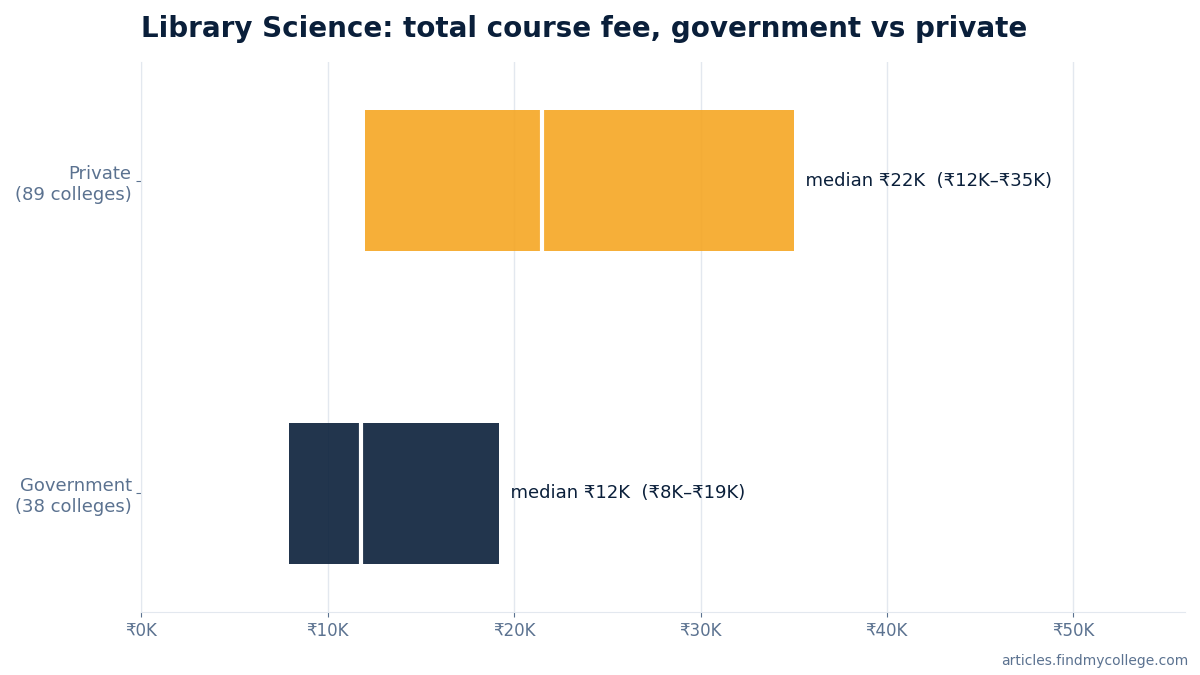
- Pay Course Fee and Secure Seat: Pay applicable program fees (ranging from INR 1,000 to INR 30,000 per year at govt universities) to finalize admission.
| What to do | Where | Link |
|---|---|---|
| Compare colleges, fees and cutoffs | Library Science colleges in India | findmycollege.com |