
B.Sc Botany Course Details: Duration, Eligibility and Scope
Nishit Kumar is a senior EdTech industry leader with over a decade of experience in building and scaling education platforms, shaping their product, content, and growth strategy. At…
- 13 May 2025CUET UG exam scheduled for B.Sc Botany admissions
The CUET UG entrance examination for university B.Sc Botany admissions is scheduled between May 13 and June 3, 2025.
B.Sc Botany is a 3-year undergraduate degree program focusing on plant biology, microbiology, anatomy, genetics, and ecology. Students who have completed 10+2 in the Science stream with Physics, Chemistry, and Biology/Mathematics with at least 50% aggregate marks are eligible to apply.
Below is detailed information regarding B.Sc Botany eligibility criteria, entrance examinations, semester-wise syllabus, university course fees, top colleges, and career opportunities after graduation.
| Parameter | Details |
|---|---|
| Course Duration | 3 Years (6 Semesters) / 4 Years (Honours with Research under NEP 2020) |
| Course Level | Undergraduate |
| Eligibility | 10+2 with Physics, Chemistry, and Biology/Mathematics (Minimum 50% aggregate marks) |
| Popular Entrance Exams | CUET UG, JET, NPAT, BHU UET, SUAT |
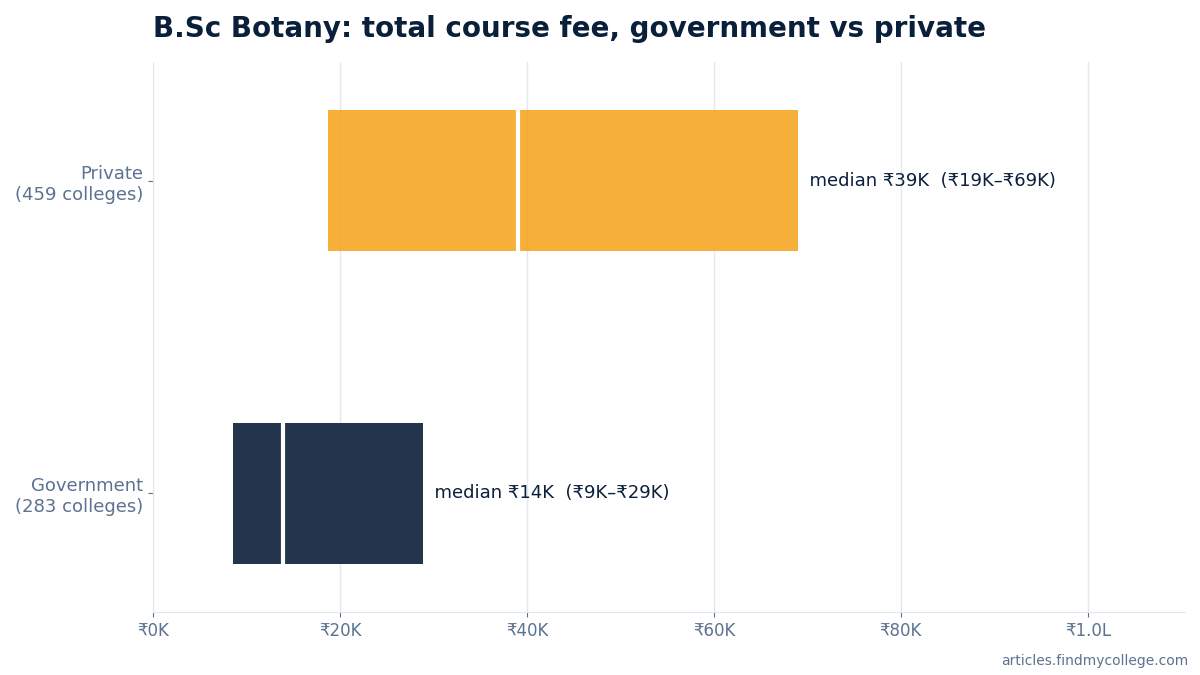
| Average Course Fee | INR 1,950 to INR 1.09 Lakhs |
| Average Starting Salary | INR 2.5 LPA to INR 5.1 LPA |
| Top Colleges | Hindu College, Miranda House, Hansraj College, Fergusson College, Ramjas College, St. Xavier’s College |
What is B.Sc Botany
B.Sc Botany (Bachelor of Science in Botany) is an undergraduate program spread across six academic semesters. Certain institutions, such as the University of Calcutta, offer a 4-year B.Sc Botany Honours + Research program under NEP 2020 requiring 172 total credits.
The academic curriculum covers plant diversity, microbiology, algae, fungi, plant pathology, archegoniate, plant anatomy, embryology, genetics, molecular biology, and plant physiology. Students gain theoretical knowledge and practical laboratory experience in plant tissue culture, biofertilizers, biopesticides, and plant-microbe interactions.
B.Sc Botany Admission Process
Admission to B.Sc Botany is conducted through 10+2 merit scores or entrance exams like CUET UG, held by the National Testing Agency (NTA) for central universities. Candidates require 10+2 in Science with Physics, Chemistry, and Biology or Mathematics.
| College | City | Total course fee |
|---|---|---|
| Sri Krishnadevaraya University, Center for Distance Education | Ananthapur | ₹16,200 |
| School of Studies in Distance Education, Jiwaji University | Gwalior | ₹10,500 |
| Jaipur National University | Jaipur | ₹54,000 |
| Tamil Nadu Open University | Chennai | ₹22,000 |
| Venkateshwara Open University | Naharlagun | ₹72,000 |
| Uttar Pradesh Rajarshi Tandon Open University | Allahabad | ₹20,400 |
| Andhra University | Visakhapatnam | ₹23,300 |
B.Sc Botany Syllabus and Subjects
The standard B.Sc Botany curriculum is structured across six semesters. Core subjects include Plant Diversity, Microbiology, Algae, Fungi, Plant Pathology, Archegoniate, Plant Anatomy, Embryology, Genetics, and Plant Physiology. University of Delhi structures its core subjects around Microbiology and Plant-Microbe Interactions, Plant Resources and Economic Botany, and Plant Systematics.
Discipline Specific Electives cover Analytical Techniques in Plant Sciences, Bioinformatics, Stress Biology, Plant Breeding, and Natural Resource Management. Ability Enhancement Courses include Environmental Science, English/MIL Communication, Biofertilizers, Herbal Technology, and Nursery and Gardening.
| Semester | Theory Papers & Core Subjects | Practical / Skill Subjects |
|---|---|---|
| Semester I | Microbiology and Phycology, Biomolecules and Cell Biology, Biodiversity | Microbiology & Phycology Lab, Cell Biology Lab |
| Semester II | Mycology and Phytopathology, Archegoniate, Plant Physiology & Metabolism | Mycology Lab, Archegoniate Lab, Plant Physiology Lab |
| Semester III | Anatomy of Angiosperms, Economic Botany, Genetics, Plant Ecology & Taxonomy | Anatomy Lab, Economic Botany Lab, Genetics Lab |
| Semester IV | Molecular Biology, Plant Ecology & Phytogeography, Plant Systematics | Molecular Biology Lab, Phytogeography Lab, Systematics Lab |
| Semester V | Reproductive Biology of Angiosperms, Plant Physiology, Analytical Techniques | Reproductive Biology Lab, Analytical Techniques Lab |
| Semester VI | Plant Metabolism, Plant Biotechnology, Horticulture & Post Harvest Technology | Metabolism Lab, Biotechnology Lab, Project Work / Dissertation |
| Semester | Discipline Specific Core (DSC) | Skill Enhancement Course (SEC) / Elective |
|---|---|---|
| Semester 1 | Plant Diversity (Theory + Practical) | Mushroom Cultivation Technology |
| Semester 2 | Plant Systematics (Theory + Practical) | Biofertilizer & Biopesticides |
| Semester 3 | Economic Botany, Plant Anatomy & Embryology | Plant Tissue Culture and Horticultural Practices |
| Semester 4 | Phycology, Archegoniates, Palaeobotany, Pharmacognosy & Ethnobotany | Minor Elective / Summer Internship |
| Semester 5 | Mycology, Microbiology, Biochemistry, Cell & Molecular Biology | Economic Botany (Minor) |
| Semester 6 | Phytopathology, Plant Physiology, Genetics | Pharmacognosy & Ethnobotany (Minor) |
| College | City | Ownership | Total course fee |
|---|---|---|---|
| Government Model Science College | Gwalior | Government | ₹5,082 |
| Markham College of Commerce | Hazaribagh | Government | ₹5,200 |
| Durgapur Government College Durgapur | Bardhaman | Government | ₹5,205 |
| Government Degree College Pulwama | Pulwama | Government | ₹5,290 |
| Gore Lal Mehta College | Purnea | Government | ₹5,400 |
| Sardar Bhagat Singh Government Post Graduate College | Rudra pur | Government | ₹5,469 |
| Ram Lakhan Singh Yadav College Ranchi | Ranchi | Government | ₹5,612 |
| Government Degree College Baramulla | Baramulla | Government | ₹5,628 |
| Government DB Girl’s Post Graduate College | Raipur | Government | ₹5,695 |
| Dhakuakhana College | Lakhimpur | Government | ₹5,780 |
| College | City | Ownership | Total course fee | NIRF rank |
|---|---|---|---|---|
| Hindu College New Delhi | Delhi | University | ₹93,255 | 1 (Overall, 2025) |
| Miranda House | Delhi | Government | ₹60,300 | 2 (Overall, 2025) |
| Hans Raj College | Delhi | Government | ₹96,845 | 3 (Overall, 2025) |
| Punjab Agricultural University | Ludhiana | — | ₹3.29 lakh | 3 (Overall, 2025) |
| Kirori Mal College | Sonipat | Private | ₹67,720 | 4 (Overall, 2025) |
| Delhi University | Delhi | Government | — | 5 (Overall, 2025) |
| Ramakrishna Mission Vivekananda Centenary College Rahara | Kolkata | — | ₹39,000 | 6 (Overall, 2025) |
| Banaras Hindu University | Varanasi | Government | ₹8,526 | 6 (Overall, 2025) |
| PSGR Krishnammal College for Women | Coimbatore | Private (aided) | ₹13,500 | 9 (Overall, 2025) |
| Aligarh Muslim University | Aligarh | — | ₹35,700 | 10 (Overall, 2025) |
| City | Colleges | Fee range | Well-known options |
|---|---|---|---|
| Kolkata | 48 | ₹6,717 – ₹1.19 lakh | Derozio Memorial College, Vivekananda College Kolkata |
| Jaipur | 34 | ₹7,030 – ₹3.56 lakh | University of Rajasthan, Banasthali Vidyapith |
| Patna | 27 | ₹6,182 – ₹1.22 lakh | Patliputra University, Patna University |
| Pune | 25 | ₹9,230 – ₹1.55 lakh | Fergusson College, Sir Parashurambhau College |
| Bhopal | 25 | ₹11,860 – ₹84,500 | Bhabha University, IES University |
| Bangalore | 23 | ₹12,986 – ₹3.72 lakh | Visveswarapura College of Science, Mount Carmel College |
| Mumbai | 23 | ₹7,086 – ₹84,063 | Wilson College, Thakur College of Science and Commerce |
| Delhi | 22 | ₹17,400 – ₹5.02 lakh | Delhi University, Indira Gandhi National Open University |
B.Sc Botany Career Scope and Salary
B.Sc Botany graduates work across agriculture, plant biotechnology, environmental consultancy, forestry, and scientific research.
Core professional profiles include:
- Botanist: Focuses on improving crop quality and productivity as well as developing plant-based medicines in labs, greenhouses, and natural habitats.
- Horticulturist: Applies scientific knowledge to propagate and cultivate plants, while investigating pests and plant diseases.
- Agronomist: Specializes in studying soil, crop management, and genetic alteration of plants to improve agricultural production and crop durability.
- Other Roles: Farm Manager, Agriculture Officer, Conservationist, and Ecologist.
Key recruiters hiring Botany graduates include National Chemical Laboratory, Indian Institute of Ecology, and Wildlife Conservation Society.
| College | City | Ownership | Total course fee | Average package |
|---|---|---|---|---|
| Ramnarain Ruia Autonomous College | Mumbai | Private (aided) | ₹33,361 | 5.43 LPA |
| Sree Kerala Varma College | Thrissur | Private (aided) | — | 5.33 LPA |
| Fergusson College | Pune | Private (aided) | — | 5.02 LPA |
| R. K. Talreja College of Arts, Science and Commerce | Mumbai | Private (aided) | ₹19,893 | 5 LPA |
| K J Somaiya College of Science and Commerce | Mumbai | Private (aided) | ₹49,105 | 4.91 LPA |
| St. John’s College | Agra | Private (aided) | ₹17,350 | 4.84 LPA |
| St. Xavier’s College | Ahmedabad | Private (aided) | ₹28,705 | 4.59 LPA |
| St. Albert’s College | Ernakulam | Private (aided) | ₹12,685 | 4.42 LPA |
| Parvatibai Chowgule College of Arts and Science | Salcete | Private (aided) | ₹98,385 | 4.18 LPA |
| St. Francis College for Women | Hyderabad | Private (aided) | ₹1.79 lakh | 4.12 LPA |
How to Apply for B.Sc Botany Admission in 2026: Step by Step
- Check Eligibility Criteria: Verify that you have passed 10+2 in the Science stream with Physics, Chemistry, and Biology/Mathematics with at least 50% aggregate marks (5% relaxation for reserved categories).
- Register for Entrance Examinations: Apply for national or university-level entrance tests such as CUET UG, JET, NPAT, BHU UET, or SUAT.
- Fill Application Form: Apply online through the official college website or visit the institution directly, fill out the admission form, upload required documents, and pay the registration fees.
- Complete Selection Process: Appear for written entrance examinations, group discussions (GD), and personal interviews (PI) where required, or await merit-based lists generated from 10+2 marks.
- Confirm Admission and Pay Fees: Complete physical document verification and pay the requisite course fees, which range from INR 1,950 to INR 1.09 Lakhs depending on the institution.
| What to do | Where | Link |
|---|---|---|
| curriculum | Department of Higher Education Odisha Portal | dhe.odisha.gov.in |
| Compare colleges, fees and cutoffs | B.Sc Botany colleges in India | findmycollege.com |
Admission to B.Sc Botany is conducted through 10+2 merit scores or entrance exams like CUET UG. Course fees range from INR 1,950 to INR 1.09 Lakhs across government and private institutions.
FAQs
-
What is the full form of BSc Botany?
The full form of B.Sc Botany is Bachelor of Science in Botany, an undergraduate degree focused on plant biology, plant anatomy, physiology, and ecological systems.
-
Is BSc Botany a good career option?
Yes, B.Sc Botany offers rewarding career paths in research, agriculture, environmental consultancy, and forestry with roles such as Botanist, Horticulturist, Agronomist, Farm Manager, Conservationist, and Ecologist.
-
What subjects are included in the BSc Botany program?
Core subjects include Microbiology, Phycology, Mycology, Plant Pathology, Archegoniate, Plant Anatomy, Embryology, Genetics, Molecular Biology, Plant Physiology, and Economic Botany.
-
Which college is best for BSc Botany?
Top colleges for B.Sc Botany include Hindu College, Miranda House, Hansraj College, Ramjas College in New Delhi, Fergusson College in Pune, and St. Xavier’s College.
-
What are the best courses to pursue after graduation in Botany?
Students can pursue higher studies such as M.Sc in Botany or M.Sc in Environmental Science, or build practical skills in Mushroom Cultivation Technology, Biofertilizers & Biopesticides, and Plant Tissue Culture.
B.Sc Botany provides strong foundational knowledge and technical skills for diverse academic and professional pathways in plant sciences and environmental management.