CSE vs ECE vs EEE: The Branch With the Best Package in 2026
Admission alerts for this course will appear here as official notifications are published.
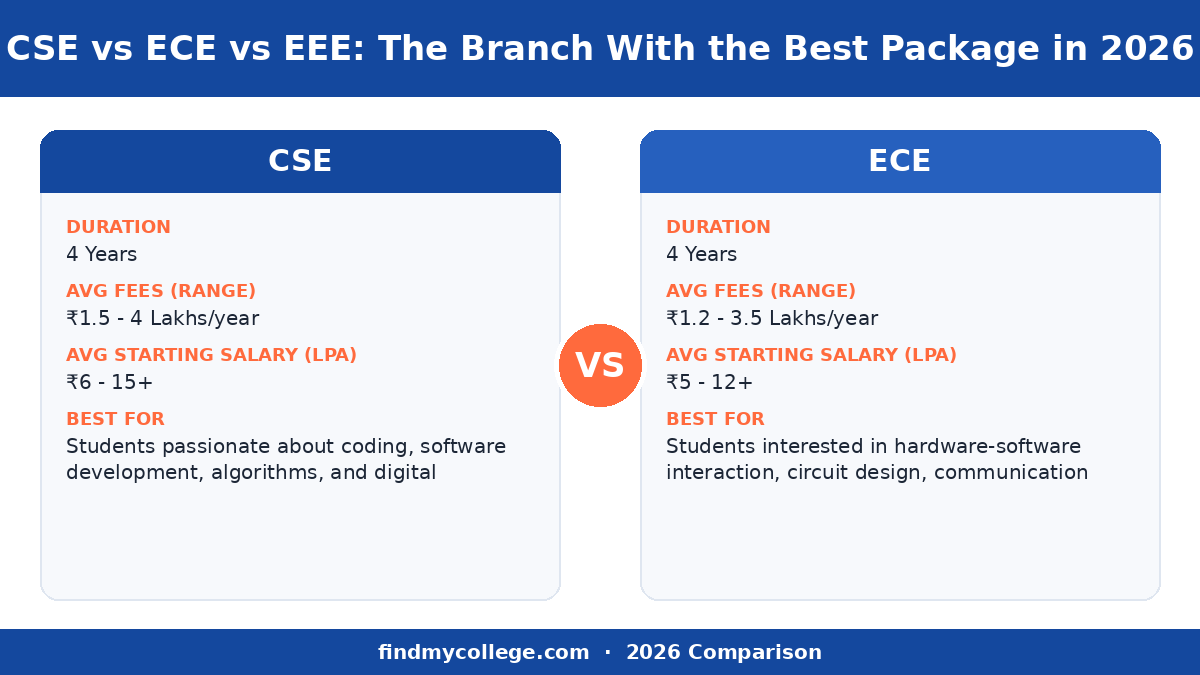
Choosing between Computer Science Engineering (CSE), Electronics and Communication Engineering (ECE), and Electrical and Electronics Engineering (EEE) is a pivotal decision for Indian students and parents aiming for a strong career in 2026. While CSE often leads with the highest average starting packages in software-centric roles, ECE offers diverse opportunities spanning hardware, software, and embedded systems, with significant growth in specialized fields like VLSI. EEE, the foundational branch, provides a robust understanding of power systems and electrical machinery, with steady demand in core industries and emerging areas like renewable energy.
CSE vs ECE vs EEE: Quick Comparison (2026)
| Branch | Duration | Eligibility | Admission / Entrance | Avg Fees (range) | Top Careers | Avg Starting Salary (LPA) | Best For |
|---|---|---|---|---|---|---|---|
| CSE | 4 Years | 10+2 with Physics, Chemistry, Maths (PCM) ~50-60% | JEE Main/Advanced, State CETs, COMEDK, BITSAT | ₹1.5 – 4 Lakhs/year | Software Developer, Data Scientist, AI/ML Engineer, Cybersecurity Analyst, Cloud Engineer | ₹6 – 15+ | Students passionate about coding, software development, algorithms, and digital innovation. |
| ECE | 4 Years | 10+2 with Physics, Chemistry, Maths (PCM) ~50-60% | JEE Main/Advanced, State CETs, COMEDK, BITSAT | ₹1.2 – 3.5 Lakhs/year | Embedded Systems Engineer, VLSI Design Engineer, Telecom Engineer, IoT Developer, Signal Processing Engineer, Software Developer | ₹5 – 12+ | Students interested in hardware-software interaction, circuit design, communication systems, and microelectronics. |
| EEE | 4 Years | 10+2 with Physics, Chemistry, Maths (PCM) ~50-60% | JEE Main/Advanced, State CETs, COMEDK, BITSAT | ₹1 – 3 Lakhs/year | Power Systems Engineer, Electrical Design Engineer, Control Systems Engineer, Renewable Energy Engineer, Automation Engineer | ₹4 – 9+ | Students keen on electrical power generation, transmission, distribution, control systems, and heavy electrical machinery. |
Curriculum & Focus
CSE focuses heavily on theoretical computer science, programming languages, algorithms, data structures, software development, and emerging fields like AI/ML and cybersecurity. It’s primarily software-oriented. ECE bridges hardware and software, covering analog and digital electronics, communication systems, signal processing, embedded systems, and VLSI design. It’s a versatile blend. EEE delves into the fundamentals of electricity, electromagnetism, power systems, electrical machines, control systems, and power electronics. It’s the core electrical engineering discipline. Verdict: CSE for pure software, ECE for hardware-software integration, EEE for core electrical and power.
Difficulty & Workload
Many students perceive ECE as having a higher academic workload and being more challenging due to its blend of complex theoretical concepts (like electromagnetics, signal processing) and practical lab work. EEE also demands a strong grasp of physics and mathematics, with intricate circuit analysis and machine design. CSE, while requiring strong logical and problem-solving skills, is often considered comparatively easier to score well in, especially if one enjoys coding, as resources are abundant. Verdict: ECE and EEE generally have a higher perceived difficulty than CSE.
Fees & ROI
The average fees for all three branches are broadly similar across institutions, ranging from ₹1 to 4 Lakhs per year, depending on whether it’s a government, private, or deemed university. The Return on Investment (ROI) is often highest for CSE due to its typically higher average starting salaries and a broader range of entry-level software jobs. However, specialized roles in ECE (e.g., VLSI) and EEE (e.g., power sector PSUs) can also offer excellent long-term ROI, especially from top-tier colleges. Verdict: CSE often offers quicker ROI, but ECE/EEE can provide strong long-term returns in niche areas.
Placements & Salary
In 2026, CSE continues to dominate in terms of the sheer volume of placement opportunities and the highest average starting packages, particularly from IT services, product-based companies, and startups. Roles like Software Developer, Data Scientist, and AI/ML Engineer are highly sought after. ECE graduates find opportunities in semiconductor companies, telecom, embedded systems, and increasingly in software development roles (after upskilling in coding). While core ECE packages might be slightly lower than top CSE offers, specialized VLSI roles can command very high salaries. EEE placements are strong in core manufacturing, power generation/distribution, PSUs, and automation industries, offering stable careers, though often with slightly lower initial packages compared to top CSE roles. Verdict: CSE generally offers the highest average packages and more abundant opportunities, but ECE and EEE have strong niche markets.
Higher Studies & Abroad Scope
All three branches offer excellent avenues for higher studies, both in India and abroad. CSE graduates frequently pursue MS in Computer Science, Data Science, or AI in top global universities, leading to high-paying international careers. ECE provides a strong foundation for MS in Electrical Engineering, Telecommunications, VLSI Design, Embedded Systems, or even Computer Science (with relevant coursework). EEE students often opt for MS in Power Systems, Control Systems, Renewable Energy, or Robotics. The interdisciplinary nature of ECE and EEE can be particularly appealing for research-oriented higher studies. Verdict: All branches offer robust higher study options, with CSE often leading to more direct software-focused international careers.
Government-Job Scope
EEE and ECE traditionally have a strong presence in government jobs and Public Sector Undertakings (PSUs). EEE graduates are highly sought after in organizations like NTPC, PGCIL, BHEL, DRDO, ISRO, and various state electricity boards. ECE graduates find roles in ISRO, DRDO, BEL, BSNL, and other communication-related government bodies. While CSE also has government opportunities (e.g., NIC, cybersecurity roles in defense), the volume is generally lower compared to the core engineering branches. Success in these roles often requires clearing competitive exams like GATE. Verdict: EEE and ECE offer more direct and numerous government job opportunities.
What students actually say (community insights)
- There’s a strong sentiment that CSE offers an easier path to good placements and higher initial salaries, especially for those who enjoy coding, and is generally less academically demanding than ECE.
- Many students perceive ECE as a significantly tougher branch, requiring deep understanding of complex hardware and theoretical concepts. However, a dedicated group believes ECE offers a more ‘real’ engineering experience and provides a broader foundation, making it easier to switch to software roles later than for CSE students to pick up core electronics.
- A recurring debate centers on whether ECE is a better long-term bet due to the perceived saturation of entry-level CSE jobs by AI, with some arguing ECE’s hardware focus offers more resilience. Conversely, many believe CSE’s adaptability and constant evolution will keep it dominant.
- While some parents and relatives push for ECE in a better college, believing CSE is ‘dying,’ students often prioritize CSE for its immediate job prospects and perceived lower workload, especially if they are not genuinely interested in electronics.
- There’s a consensus that choosing ECE without genuine interest in electronics can lead to significant academic struggle and regret, whereas a basic interest in coding can suffice for CSE.
- Students often highlight that for specialized core roles in ECE (like VLSI) or EEE (like power systems), a Master’s degree is often beneficial or even necessary to secure top packages, unlike many entry-level CSE roles.
Which one should you choose?
- Choose CSE if: You are passionate about coding, software development, algorithms, and problem-solving using computers. You want to work in IT, product development, AI/ML, data science, or cybersecurity. You prefer a field with abundant job opportunities and generally higher starting salaries.
- Choose ECE if: You have a strong interest in both hardware and software, enjoy understanding how electronic devices work, and are fascinated by communication systems, embedded systems, or microelectronics (VLSI). You are willing to put in the effort for a challenging curriculum and value versatility.
- Choose EEE if: You are intrigued by the generation, transmission, and utilization of electrical power, enjoy working with electrical machines, control systems, and renewable energy technologies. You are looking for stable careers in core industries, manufacturing, or government sectors.
- Consider your college tier: For ECE and EEE, pursuing these branches from top-tier colleges (IITs, NITs, top private institutions) significantly enhances core placement opportunities and packages. In lower-tier colleges, CSE often provides a safer bet for placements.
Frequently Asked Questions
Can an ECE student get a job typically offered to CSE graduates?
Yes, absolutely. Many ECE students successfully transition into software development, data science, and other IT roles by learning coding, data structures, and algorithms. Their strong analytical skills and understanding of hardware can even be an advantage in certain software domains like embedded systems or IoT.
Is CSE going to be dead in the next 10-20 years due to AI?
While AI will automate certain entry-level coding tasks, it’s highly unlikely to make CSE ‘dead.’ Instead, the field will evolve, requiring professionals to work with AI, develop AI systems, and manage AI-driven solutions. The demand for problem-solvers and innovators in software will remain strong, shifting towards more complex and creative roles.
Which branch is better for pursuing a career abroad?
All three branches offer excellent opportunities abroad. CSE often has a more direct path to software-centric roles in tech hubs globally. ECE and EEE graduates are also in high demand for specialized roles in semiconductor, automotive, aerospace, and power industries in developed countries, often after pursuing a Master’s degree.
Is it wise to choose ECE over CSE if I don’t enjoy coding?
If you genuinely dislike coding, choosing ECE might be a better fit, provided you have a strong interest in electronics and hardware. However, even ECE involves some programming (e.g., microcontrollers, embedded C). If you have no interest in either, you should reconsider engineering or explore other branches.
How important is the college tier when choosing between these branches?
The college tier is crucial, especially for ECE and EEE core placements. Top-tier colleges attract companies offering specialized core roles with good packages. For CSE, while a top college is always beneficial, the sheer volume of IT jobs means even graduates from decent colleges can secure good placements if they have strong skills.
Can EEE students also get into software jobs?
Yes, EEE students can certainly pivot to software roles, especially in areas like industrial automation, control systems software, or data analytics for power systems. However, they would need to proactively learn core CSE skills like data structures, algorithms, and relevant programming languages, as these are not extensively covered in the EEE curriculum.
Which branch offers better job security in the long run?
Job security is less about the branch and more about continuous learning and adaptability. While core EEE and ECE roles in PSUs or established industries offer stability, the dynamic nature of CSE means constant upskilling is required. All three fields are evolving, and professionals who stay updated with new technologies will have better long-term security.