CUET OBC Reservation Policy 2026: Criteria, Quotas, and Eligibility Details
The CUET 2026 reservation policy provides 27% reservation for Other Backward Classes – Non-Creamy Layer (OBC-NCL) candidates in Central Universities. Applicants must produce the OBC-NCL certificate (Annexure-IIA).
The CUET OBC reservation policy for 2026 mandates a significant 27% quota for Other Backward Classes (Non-Creamy Layer) candidates in central university admissions.This crucial provision directly impacts seat allocation across various undergraduate and postgraduate programs, offering a vital pathway for eligible students. Further, OBC-NCL students also pay an application fee of Rs. 900 (up to 3 subjects), as opposed to Rs. 1,000 for General category students. This article provides a comprehensive breakdown of the specific criteria, eligibility requirements, application process, and key differences for OBC applicants.
CUET UG 2026 OBC Reservation Policy: Key Criteria and Guidelines
For CUET UG 2026, the National Testing Agency (NTA) administers the CUET OBC reservation policy. Presently a reservation of 27% seats for OBC-NCL candidates is set for CUET.
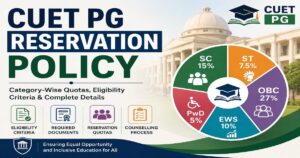
| Categories | CUET Reservation Percentage |
| Other Backward Classes (Non-creamy layer) | 27% |
| General Economically Weaker Sections (GEN-EWS) | 10% |
| Scheduled Castes (SC) | 15% |
| Scheduled Tribes (ST) | 7.50% |
| Persons with Disabilities | 5% in each category |
OBC-NCL Quota in CUET 2026: Eligibility & Documents
The OBC-NCL quota in CUET 2026 provides a 27% reservation for eligible candidates. This section details the specific requirements, documentation, and application process for students seeking to avail the CUET OBC reservation, ensuring clarity on eligibility and procedural steps for the upcoming academic year.
| Aspect | Details |
| OBC-NCL Reservation Percentage | 27% |
| OBC-NCL Eligibility Requirement | Non-Creamy Layer certificate required, i.e., family income below INR 8 LPA. |
| OBC-NCL Certificate Validity | Usually recent financial year validity |
| Required Document for OBC-NCL | OBC-NCL certificate (Annexure-IIA)
For admissions to many Central Universities, the certificate should be issued on or after 1 April 2026 (after 31 March 2026) |
| Alternative Document for OBC-NCL | Declaration in Lieu of OBC-NCL Certificate (Annexure-IIB) if unable to upload the certificate |
| Reference for OBC-NCL Guidelines | http://www.ncbc.nic.in for latest guidelines and updates on the Central List of State-Wide OBCs |
| Application Process for Quota | Students must select the desired quota under CUET reservation criteria 2026 while filling out the CUET application form 2026. |
| Document Proof at Application Stage | Not required at the initial application stage |
| Horizontal Reservation Impact on OBC-NCL | Persons with Disabilities (PwD) have a 5% horizontal reservation, applied within each category, including OBC-NCL. |
| Seat Variation by Institution | The number of seats available in each category differs by college and course. |
| University Adherence to Policy | Most universities adhere to CUET reservation policy, but it may differ by university. |
People Also Read

Applying for CUET OBC Reservation 2026
Applying for CUET OBC reservation in 2026 involves a structured process, beginning with understanding university-specific policies and securing the correct documentation. A significant 27% of seats in Central Universities are reserved for OBC (Non-Creamy Layer) candidates, making proper application crucial for eligibility.
| Aspect | Details |
| Step 1: Research University Policies | Applicants must check the reservation policies of each central university, as these policies vary and remain unaffected by CUET. |
| Step 2: Verify OBC-NCL Status | Confirm and verify your OBC status on the National Commission for Backward Classes (NCBC) website (http://www.ncbc.nic.in). |
| Step 3: Obtain Valid OBC-NCL Certificate | Secure an OBC-NCL certificate (Annexure-IIA) from the Central List of State-Wide OBCs, issued on or after April 1, 2025, for CUET 2026 admissions. |
| Step 4: Apply for CUET & Upload Documents | During the CUET (UG) 2026 online application, select the OBC-NCL category and upload the valid certificate or a declaration (Annexure-IIB) if unable to upload the certificate initially. |
| Step 5: Pay Application Fees | Pay the applicable CUET application fee for OBC (NCL) candidates: ₹700 (upto 3 subjects), ₹1400 (upto 7 subjects), and ₹1650 (upto 10 subjects), plus processing fees and GST. |
| Step 6: University Admission & Verification | After CUET results, apply to desired Central Universities; admissions, including document verification, are handled at the individual university level. |
| Category Change Restriction | The National Testing Agency (NTA) does not consider changes to categories or subcategories after the initial application form submission. |
CUET 2026 Application Fees for OBC & Other Applicants
The CUET 2026 application fee varies by category and the number of subjects selected. Candidates choosing more than three subjects must pay an additional fee for each extra subject (up to a maximum of five subjects).
| Category | Application Fee (Up to 3 Subjects) | Fee for Each Additional Subject |
| General (UR) | ₹1,000 | ₹400 |
| OBC-NCL / EWS | ₹900 | ₹375 |
| SC / ST / PwBD / Third Gender | ₹800 | ₹350 |
| Centres Outside India | ₹4,500 | ₹1,800 |
Avoiding Common Mistakes in CUET 2026 OBC Reservation Application
To avoid serious issues during CUET 2026 OBC reservation application, candidates must ensure accurate category selection and document submission. Errors in OBC/EWS quotas can lead to rejection, even if candidates qualify on merit, making careful verification crucial for securing benefits.
| Common Mistake | How to Avoid It |
| Submitting a State OBC certificate instead of a Central OBC-NCL certificate | Ensure your caste is listed in the Central OBC List and obtain a Central Government OBC-NCL certificate in the prescribed format before counselling. A state-only certificate is not valid for Central University admissions. |
| Using an outdated or invalid OBC-NCL certificate | Check the certificate validity requirements mentioned in the admission notification. If a fresh certificate is required for the current financial year, obtain it well before document verification to avoid losing reservation benefits. |
| Selecting the wrong reservation category or uploading incorrect documents | Carefully verify the category selected in the application form and ensure all uploaded documents match your claimed reservation. Cross-check the confirmation page before final submission and use the correction window, if available, to rectify errors. |
Frequently Asked Questions
1. What is the OBC reservation percentage in CUET 2026?
The CUET 2026 reservation policy provides 27% reservation for candidates belonging to the Other Backward Classes – Non-Creamy Layer (OBC-NCL) category in Central Universities. The reservation is applied during university admissions and counselling.
2. Who is eligible to claim the OBC-NCL reservation in CUET 2026?
Candidates must belong to an OBC community listed in the Central OBC List, satisfy the Non-Creamy Layer criteria, and possess a valid Central Government OBC-NCL certificate in the prescribed format during admission.
3. Is an OBC certificate issued by the state government valid for CUET reservation?
No. For admission to Central Universities through CUET, candidates must submit a Central Government OBC-NCL certificate. A certificate valid only under the State OBC List does not qualify for reservation benefits.
4. Can I apply for CUET 2026 without uploading my OBC-NCL certificate?
Yes. If the certificate is unavailable during application, candidates may upload the Declaration in Lieu of OBC-NCL Certificate (Annexure-IIB). However, a valid Central OBC-NCL certificate must be produced during document verification.
5. Is there any concession in the CUET 2026 application fee for OBC-NCL candidates?
Yes. OBC-NCL candidates pay a reduced application fee of ₹900 for up to three subjects, with ₹375 charged for each additional subject, compared to the General category fee.
6. Can I change my category to OBC-NCL after submitting the CUET application form?
No. The National Testing Agency generally does not allow changes to a candidate’s category or sub-category after the application form is submitted. Candidates should verify all details carefully before final submission.