CUET UG 2026 May 21 LIVE: Shift 1 Question Paper Analysis (OUT) & Memory-Based Questions, Difficulty Level
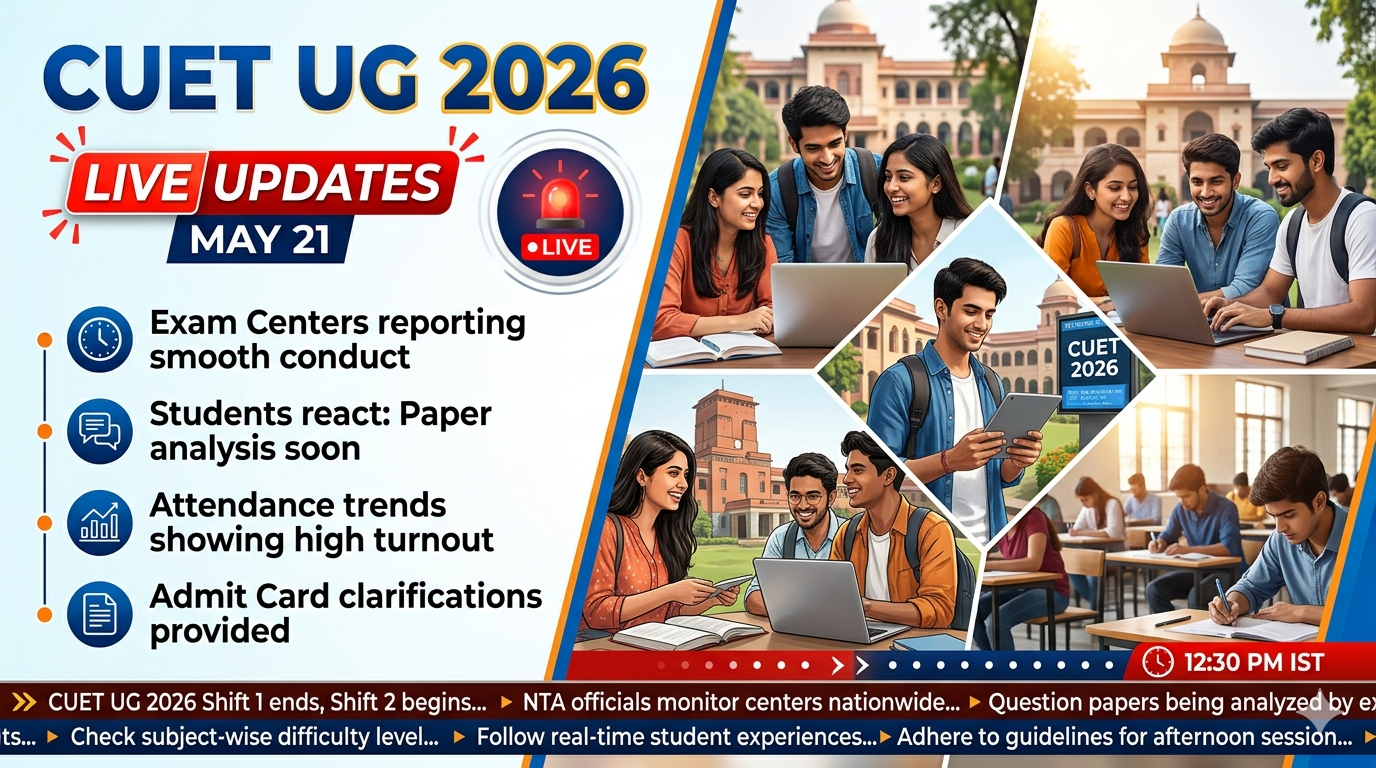
The Common University Entrance Test Undergraduate or CUET UG 2026 continued on May 21 across different examination centres in India. The National Testing Agency conducted the Shift 1 examination in computer-based mode for candidates seeking admission to central universities and participating institutions.
Students who appeared for the May 21 Shift 1 paper shared their first reactions soon after the examination ended. Based on student feedback and expert reviews, the overall difficulty level of the paper remained moderate. Some sections were considered lengthy, while a few subjects included direct NCERT-based questions.
The CUET UG 2026 examination has become one of the most important entrance tests for undergraduate admissions in India. Lakhs of students are appearing for the exam this year to secure seats in top universities.
This live update article includes the Shift 1 paper analysis, section-wise difficulty level, memory-based questions, expert reactions, expected good attempts, and what students can expect in the upcoming shifts.
CUET UG 2026 May 21 Shift 1 Exam Overview
The Shift 1 examination began in the morning session at various centres across the country. Candidates were advised to report early because of security checks and biometric verification procedures.
The paper included domain subjects, language tests, and the General Test depending on the courses selected by students during registration.
According to students, the exam interface worked smoothly in most centres. However, a few candidates reported minor delays during login and seating arrangements.
Experts who reviewed the paper said the questions mainly followed the NCERT pattern and syllabus. Students with strong conceptual clarity and regular practice found the paper manageable.
Overall Difficulty Level of CUET UG 2026 Shift 1
Based on the initial reactions from candidates and teachers, the overall paper difficulty was rated as:
| Section | Difficulty Level |
|---|---|
| Language Test | Easy to Moderate |
| General Test | Moderate |
| Domain Subjects | Moderate |
| Overall | Moderate |
Most students said the language section was easier compared to the General Test. The General Test included analytical reasoning, current affairs, quantitative aptitude, and logical reasoning questions that required careful reading.
Several domain subjects had direct theoretical questions, while some numerical and application-based questions were slightly tricky.
Subject-Wise Analysis of Shift 1
English Language Paper Analysis
Students who appeared for the English paper said the section was balanced and scoring. Reading comprehension passages were moderate in length and vocabulary-based questions were manageable.
Key topics included:
- Reading comprehension
- Synonyms and antonyms
- Para jumbles
- Grammar correction
- Vocabulary usage
Experts stated that students who practiced previous-year papers could attempt this section comfortably within time.
Expected good attempts in English were around 40 to 45 questions.
General Test Analysis
The General Test was considered slightly lengthy by many candidates. Some students found the reasoning section time-consuming.
Major topics asked were:
- Number series
- Coding-decoding
- Blood relations
- Current affairs
- Quantitative aptitude
- Profit and loss
- Percentage
- Data interpretation
Current affairs questions reportedly focused on sports events, government schemes, awards, and international developments from the last few months.
Students said time management became important in this section because several questions required calculations.
Experts suggested that a score above average may depend on accuracy rather than only attempts.
Physics Paper Analysis
Students who appeared for Physics shared mixed reactions. While some numerical questions were direct, a few conceptual questions required deeper understanding.
Important chapters covered included:
- Current electricity
- Ray optics
- Electrostatics
- Modern physics
- Magnetism
- Semiconductor electronics
Teachers noted that many questions were formula-based and directly linked to NCERT concepts.
The numerical questions were moderate in difficulty and required careful calculations.
Expected good attempts in Physics were between 35 and 40 questions.
Chemistry Paper Analysis
Chemistry was considered one of the easier domain subjects in Shift 1 according to many students.
The paper included balanced questions from physical, organic, and inorganic chemistry.
Topics asked included:
- Chemical bonding
- Coordination compounds
- Electrochemistry
- Organic reactions
- Biomolecules
- p-Block elements
Students said many questions were direct from NCERT textbooks. Assertion-reason questions also appeared in the paper.
Experts advised students appearing in future shifts to revise NCERT line by line.
Mathematics Paper Analysis
The Mathematics section was moderate to difficult for some students because of lengthy calculations.
Key chapters included:
- Probability
- Matrices
- Determinants
- Differential equations
- Application of derivatives
- Integration
- Vector algebra
Several students reported that while formulas were straightforward, solving the questions required more time.
Teachers said students with regular mock test practice would have performed better in this section.
Biology Paper Analysis
Students from the Biology stream found the paper mostly NCERT-based.
Important chapters included:
- Genetics
- Human physiology
- Ecology
- Biotechnology
- Reproduction
- Plant physiology
Most questions were theory-oriented and direct. Students who revised diagrams and NCERT facts found the paper easier.
Experts believe Biology may have a higher average score compared to Physics and Mathematics.
Memory-Based Questions Shared by Students
Here are some memory-based questions recalled by students after the examination:
English
- Identify the correctly spelled word.
- Choose the synonym of “rapid”.
- Rearrange the sentence in the correct order.
General Test
- A train travels 240 km in 4 hours. Find the speed.
- Identify the next number in the series.
- Questions related to recent sports tournaments.
Physics
- Question based on Ohm’s Law.
- Numerical from lens formula.
- Semiconductor-related concept question.
Chemistry
- Question from coordination compounds.
- pH value numerical.
- Organic reaction mechanism identification.
Mathematics
- Probability-based problem.
- Matrix determinant question.
- Differential equation solving question.
Biology
- DNA replication-related question.
- Human reproductive system concept.
- Ecology assertion-reason question.
Experts said these questions are memory-based and may not exactly match the original wording from the examination.
Student Reactions After the Exam
Many candidates came out of the examination hall feeling satisfied with their performance.
A student from Delhi said that the English and Chemistry sections were easier than expected. However, the General Test required more time.
Another candidate shared that Mathematics involved lengthy calculations, which made time management difficult.
Some students also said that mock tests helped them remain calm during the actual exam.
Overall, candidates who completed the syllabus thoroughly and revised NCERT books appeared more confident after the examination.
Expert Opinion on CUET UG 2026 Shift 1
Education experts who analysed the paper said the examination followed the expected pattern.
According to teachers:
- NCERT remained the most important source.
- Conceptual clarity was necessary for numerical subjects.
- Time management played a major role in the General Test.
- The paper was fair for students from all boards.
Experts also predicted that the cutoff for top universities may remain competitive because the paper was not extremely difficult.
Expected Good Attempts
Based on the initial paper review, the expected good attempts are:
| Subject | Good Attempts |
|---|---|
| English | 40-45 |
| General Test | 35-40 |
| Physics | 35-40 |
| Chemistry | 40-45 |
| Mathematics | 30-35 |
| Biology | 40-45 |
These figures are unofficial and may vary depending on normalization and overall student performance.
Important Advice for Upcoming Shift Candidates
Students appearing in upcoming CUET UG 2026 shifts should focus on quick revision and avoid stress.
Experts recommend:
- Revising NCERT textbooks carefully
- Practicing mock tests regularly
- Managing time during the examination
- Reading current affairs daily
- Avoiding guesswork in difficult questions
Candidates should also carry all required documents and reach the examination centre before reporting time.
What Happens After the Exam?
After the completion of all shifts, the National Testing Agency is expected to release:
- Provisional answer key
- Response sheet
- Objection window
- Final answer key
- CUET UG 2026 result
Students will be allowed to challenge answer key objections within the specified period after paying the required fee.
The final result will be prepared after reviewing all objections submitted by candidates.
Universities Accepting CUET UG Scores
Several central, state, and private universities are using CUET UG scores for undergraduate admissions.
Popular participating institutions include:
- University of Delhi
- Banaras Hindu University
- Jawaharlal Nehru University
- Aligarh Muslim University
- Jamia Millia Islamia
- Central University of Hyderabad
Admission cutoffs may vary depending on the course, category, and number of applicants.

📰 More Education News
- TANCET 2026 Final Answer Key OUT at Anna University; Download Link Available at tancet.annauniv.eduMay 20, 2026 • Simran
- SPPU Engineering May Exam 2026 Postponed After Student Protests; Check Revised ScheduleMay 20, 2026 • Simran
- SITEEE 2026 Result Out, Download Rank Card Now at set-test.orgMay 20, 2026 • Simran
- Symbiosis SET Exam Result 2026 OUT @set-test.org; Get Direct Link to Download ScorecardMay 20, 2026 • Simran