DEC Course: Duration, Eligibility, Syllabus and Career Scope
Nishit Kumar is a senior EdTech industry leader with over a decade of experience in building and scaling education platforms, shaping their product, content, and growth strategy. At…
- 13 Oct 2026IGNOU DECE July 2026 admission deadline extended
IGNOU extended the application submission deadline for the DECE July 2026 admission session to October 13, 2026. - 7 Oct 2026IGNOU DECE December 2026 TEE exam form window closed
The exam form submission window for the IGNOU DECE December 2026 Term-End Examination closed on October 7, 2026.
The DECE course (Diploma in Early Childhood Care and Education) is a 1 to 2-year diploma program designed to train educators in child development, healthcare, and early education for children from birth to 8 years. Candidates who have passed Class 10+2 with 45%–50% aggregate are eligible, and total program fees range from ₹2,000 to ₹50,000 across government distance platforms like IGNOU and private institutes.
Below is a complete guide covering DECE eligibility requirements, syllabus modules, fee comparisons, top institutes, career prospects, and the step-by-step application process for 2026.
| Parameter | Details |
|---|---|
| Course Duration | 1 to 2 Years (4 Semesters in some full-time modes) |
| Eligibility | 10+2 pass from a recognized board (45%–50% aggregate marks) |
| Average Fee Range | ₹2,000 to ₹50,000 total (IGNOU fee is ₹4,000 plus registration fees) |
| Starting Salary Range | ₹1.5 LPA to ₹5 LPA |
| Target Age Group | Children from birth to 6 or 8 years of age |
| Implementing Body | Ministry of Women and Child Development (MWCD) / NCTE & NEP 2020 aligned |
What is Diploma in Early Childhood Care and Education
The Diploma in Early Childhood Care and Education (DECE) is a specialized diploma program aimed at preparing educators to foster holistic development in children during their foundational learning years. The policy framework for early learning in India is overseen by the Ministry of Women and Child Development (MWCD).
Indira Gandhi National Open University (IGNOU) offers DECE as a 1-year Open Distance Learning (ODL) program under its School of Continuing Education.
Types and Specialisations of Early Childhood Education Diplomas
| Course / Specialisation | Offering Institute / Mode | Duration | Key Features |
|---|---|---|---|
| Diploma in Early Childhood Care and Education (DECE) | IGNOU (Open Distance Learning) | 1 Year | Aimed at training educators to foster holistic development in children aged 0 to 6 years. |
| ECCE Diploma / PG Diploma | upEducators (Live-Online / Distance) | 6 Months to 1 Year | Accredited by NCVET Skill India and NASSCOM with AI Educator training. |
| ECCE Diploma | Vidhyanidhi Education Society (Online / Distance) | Flexible | Evaluated on assignment-based modules without written examinations. |
Early childhood education diplomas are available in full-time, distance, and online formats from various institutes. Candidates can select a course based on program duration, accreditation, and examination structure.
Diploma in Early Childhood Care and Education Eligibility
To qualify for admission into a Diploma in Early Childhood Care and Education program, applicants must meet standard academic requirements set by distance universities and affiliated colleges:
- Educational Qualification: Candidates must have passed Class 10+2 from a recognized educational board.
- Minimum Marks: Unreserved general category candidates require at least 50% aggregate marks, while reserved category candidates (SC/ST/OBC) require a minimum of 45% aggregate marks.
- Age Limit: There is no upper age limit for IGNOU DECE admission, enabling working teachers, daycare staff, and mothers to enroll.
Diploma in Early Childhood Care and Education Syllabus and Subjects
The IGNOU DECE course structure comprises a 32-credits package divided across four core modules, including practical field experience in child care settings.
| Course Code | Course Title | Credits |
|---|---|---|
| DECE 1 | Organizing Child Care Services | 8 |
| DECE 2 | Child Health and Nutrition | 8 |
| DECE 3 | Services and Programmes for Children | 8 |
| DECE 4 | Project Work: Working with Young Children in a Child Care Setting | 8 |
| Total Credits | 32 Credits Package | 32 |
Full-time two-year programs, such as the University of Mumbai-affiliated DECCED offered by SIES, cover an expanded curriculum across eight theory papers:
| Paper Code | Paper Title | Focus Areas |
|---|---|---|
| Paper I | Evolution and Progress of ECCE | ECCE philosophies (national & international) and pre/post-independence evolution |
| Paper II | Development in First Six Years | Physical, motor, language, socio-emotional, cognitive, and behavioral aspects |
| Paper III | Programme Planning & Pedagogy (Preschool) | Preschool teaching strategies, engagement activities, evaluation tools |
| Paper IV | Health, Hygiene and Nutrition | Child health, preventive care, nutrition principles, school hygiene practices |
| Paper V | Organization of Preschool and Daycare Centers | Preschool administration, HR management, material resources, NGO networks |
| Paper VI | Development from Six Years to Eight Years | Learner diversity, primary-stage growth, personality development |
| Paper VII | Programme Planning & Pedagogy (Primary I & II) | Innovative practices in math, EVS, science, and language for Grades 1 & 2 |
| Paper VIII | Establishing Relations with Parents and Society | Parent-teacher networking, community outreach, social program planning |
Diploma in Early Childhood Care and Education Fees
- IGNOU Distance Learning Fee: The total fee for the 1-year IGNOU DECE program is ₹4,000, plus applicable registration and development fees.
- Skill Development Programs: upEducators offers a government-approved ECCE Diploma program accredited by NCVET Skill India and NASSCOM.
- Private Institutes Fee Examples: Total course fees across private institutes include ₹30,000 at Mahatma Jyoti Rao Phoole University, ₹34,260 at Kanya Mahavidyalaya, and ₹60,000 at Pradeep Memorial Comprehensive College of Education.
Program expenses vary depending on whether a student chooses a government distance platform, a skill-based online program, or a private training institute.
Top Diploma in Early Childhood Care and Education Colleges
| College | City | Ownership | Total course fee |
|---|---|---|---|
| Mahatma Jyoti Rao Phoole University | Jaipur | Private (aided) | ₹30,000 |
| Kanya Mahavidyalaya | Jalandhar | Private (aided) | ₹34,260 |
| Pradeep Memorial Comprehensive College of Education | Delhi | Private | ₹60,000 |
| Gannabathula Tulasamma Pedatata College of Education for Women | Godavari | Private | ₹40,000 |
| City | Colleges | Fee range | Well-known options |
|---|---|---|---|
| Mumbai | 4 | ₹25,000 – ₹27,000 | Hansraj Jivandas College of Education, Shri MD Shah Mahila College of Arts & Commerce |
| Lucknow | 4 | — | Integral University, Babasaheb Bhimrao Ambedkar University |
| Shillong | 2 | — | St. Mary’s College Shillong, CMJ University |
| Gorakhpur | 1 | ₹40,000 – ₹40,000 | Deen Dayal Upadhyaya Gorakhpur University |
| Delhi | 1 | ₹60,000 – ₹60,000 | Pradeep Memorial Comprehensive College of Education |
| Godavari | 1 | ₹40,000 – ₹40,000 | Gannabathula Tulasamma Pedatata College of Education for Women |
| Allahabad | 1 | — | Ruchi’s Institute of Creative Arts |
| Asansol | 1 | — | Banwarilal Bhalotia College |
| City / Region | Major Study Centres / Partner Institutes | State / UT |
|---|---|---|
| Hyderabad | Indira Priyadarshini Govt. College, Lal Bahadur College | Telangana |
| Bangalore | Nrupathunga University, St. Aloysius College (Mangalore) | Karnataka |
| Jaipur | Agrawal PG College, Govt Arts PG College Kota, Sophia Girls College Ajmer | Rajasthan |
| Lucknow | Lucknow Christian PG College, Dr. Ram Manohar Lohia Awadh University | Uttar Pradesh |
| Kolkata | Banwarilal Bhalotia College, Midnapur College, Durgapur Women’s College | West Bengal |
| Delhi | Kalindi College Delhi | Delhi NCR |
| Shimla | Government Degree Colleges (Kullu, Una, Chamba, Nahan) | Himachal Pradesh |
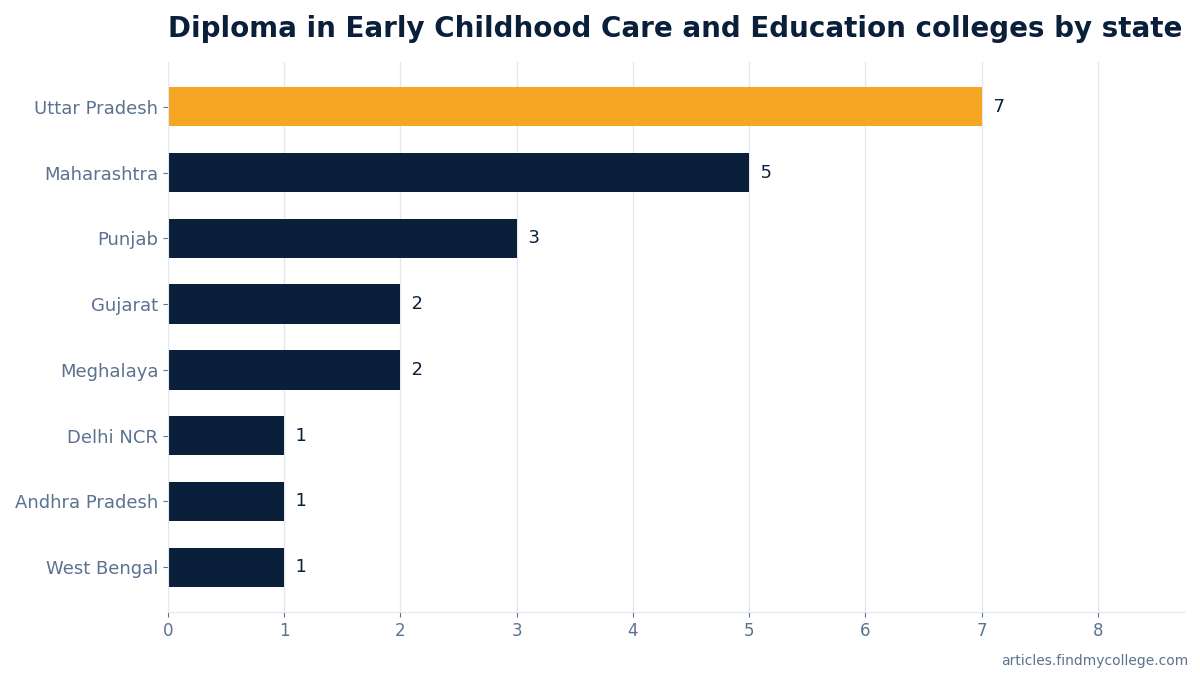
At least 28 colleges offer Diploma in Early Childhood Care and Education (government 2, private 9). Colleges by state include Uttar Pradesh 7, Maharashtra 5, Punjab 3, Gujarat 2, Meghalaya 2, and Delhi NCR 1.
DECE vs D.El.Ed vs NTT vs B.El.Ed: Detailed Comparison
Understanding the distinction between early childhood care diplomas and primary teacher credentials helps students select the appropriate career route.
| Course | Level & Duration | Primary Focus | Government School Eligibility |
|---|---|---|---|
| DECE (Diploma in Early Childhood Care & Education) | 1-Year Diploma | Child growth, health, nutrition, and preschool/creche education (0-6 yrs) | Preschool/Anganwadi roles; requires D.El.Ed/ITEP for primary government posts |
| D.El.Ed (Diploma in Elementary Education) | 2-Year Diploma | Elementary school teaching strategies and subject pedagogy (Class 1-8) | Eligible for primary teacher recruitment exams (CTET / State TET) |
| NTT (Nursery Teacher Training) | 1 to 2-Year Diploma | Pre-primary school teaching strategies and classroom management | Widely accepted by private preschools; limited direct government recognition |
| B.El.Ed / ITEP | 4-Year Integrated Degree | Comprehensive elementary teacher education from foundational to middle stage | Fully eligible for primary school teacher appointments |
Diploma in Early Childhood Care and Education Career Scope and Salary
- Preschool / Nursery Teacher: Introduces children aged 3 to 5 years to education and prepares them for kindergarten in pre-primary schools.
- Daycare & Creche Manager / Childcare Center Director: Oversees center operations, hires and trains staff, manages budgets, and develops educational standards.
- Education Entrepreneur: Establishes private preschools, launches daycare franchises, or sets up independent early learning facilities.
- Educational Resource Designer / Home Tutor: Creates learning materials or guides children at home to overcome learning difficulties.
DECE diploma holders earn an average salary ranging from INR 2 LPA to INR 5 LPA depending on experience and institution. Earnings can further increase with additional qualifications and field expertise.
How to Choose the Right College for Early Childhood Education
Selecting an appropriate institute requires evaluating official approvals, delivery flexibility, and evaluation formats:
- Accreditation and Recognition: Verify if the institute carries accreditation from statutory skills bodies like NCVET Skill India, NASSCOM, or university affiliation like the University of Mumbai.
- Evaluation Pattern: Determine whether assessment involves traditional written examinations or continuous assignment evaluation, such as at Vidhyanidhi Education Society (VES) where diploma options are evaluated on assignment-based modules.
- Practical Project Support: Ensure the curriculum includes mandatory field project work, such as IGNOU’s DECE 4 module, which requires direct working hours with young children in a preschool or daycare setting.
How to Apply for Diploma in Early Childhood Care and Education Admission in 2026: Step by Step
- Check Eligibility Criteria: Verify that you have completed Class 10+2 from a recognized board with at least 45%–50% aggregate marks.
- Register on the Admission Portal: Visit the official university portal (e.g., ignouadmission.samarth.edu.in for IGNOU or the respective institute website) and create an account with email ID and mobile number.
- Fill Application Form: Complete personal information, educational qualifications, select medium of instruction (English, Hindi, Odia, Tamil), and choose the preferred study centre.
- Upload Required Documents: Upload scanned copies of Class 10+2 mark sheet, identity proof (Aadhaar/Voter ID), passport-size photograph (under 100 KB), signature, and category certificate if applicable.
- Pay Application and Course Fee: Pay the course fee (₹4,000 for IGNOU plus ₹300 registration fee) online via Net Banking, Debit Card, or Credit Card.
- Track Admission Status: Check the DECE admission status online using your login credentials after completing the submission.
| What to do | Where | Link |
|---|---|---|
| application | IGNOU Samarth Admission Portal | ignouadmission.samarth.edu.in |
| Compare colleges, fees and cutoffs | Diploma in Early Childhood Care and Education colleges in India | findmycollege.com |
Applications for IGNOU DECE admission are accepted twice a year for the January and July academic sessions. Candidates with queries can contact the student service helpline numbers at 29572209 or 29572202.
FAQs
What is the full form and qualification for DECE?
DECE stands for Diploma in Early Childhood Care and Education. Candidates who have completed Class 10+2 with 45%–50% aggregate marks from any recognized stream are eligible to apply.
What are the fees for the IGNOU DECE course?
The IGNOU DECE total course fee is ₹4,000 for the 1-year program, in addition to applicable registration and development fees of ₹300.
What subjects are included in the ECCE curriculum?
ECCE covers organizing child care services, child growth and psychology, child health and nutrition, services/programmes for children, special needs inclusion, and a practical child-care project work.
What are the benefits of getting a diploma in Early Childhood Care and Education?
It equips learners to work in preschools, creches, and daycare centres, start a preschool franchise, work in child welfare NGOs, or gain specialized skills aligned with NEP 2020 early learning frameworks.
What is the difference between DECE and D.El.Ed?
DECE is a 1-year diploma focused on early care, nutrition, and education for children aged 0-6 years.
Is there any upper age limit for doing the DECE course?
No, there is no upper age limit for enrolling in the IGNOU DECE course, making it suitable for fresh 12th graduates, working educators, and parents.