Doctor of Pharmacy Degree: Course Details, Eligibility and Scope
Nishit Kumar is a senior EdTech industry leader with over a decade of experience in building and scaling education platforms, shaping their product, content, and growth strategy. At…
The Doctor of Pharmacy (Pharm.D) is a 6-year professional clinical doctoral degree (comprising 5 years of academic study and 1 year of mandatory hospital internship) regulated by the Pharmacy Council of India (PCI).
| Parameter | Details |
|---|---|
| Course Duration | 6 Years (5 Years Academic + 1 Year Internship) / 3 Years for Pharm.D (Post Baccalaureate) |
| Regulatory Body | Pharmacy Council of India (PCI) under Pharm.D Regulations, 2008 |
| Eligibility Criteria | 10+2 with Physics & Chemistry compulsory + Biology/Maths (min 50%) OR D.Pharm; B.Pharm for Post Baccalaureate |
| PCI Seat Intake Limit | 30 seats for Regular Pharm.D; 10 seats for Pharm.D (Post Baccalaureate) per college |
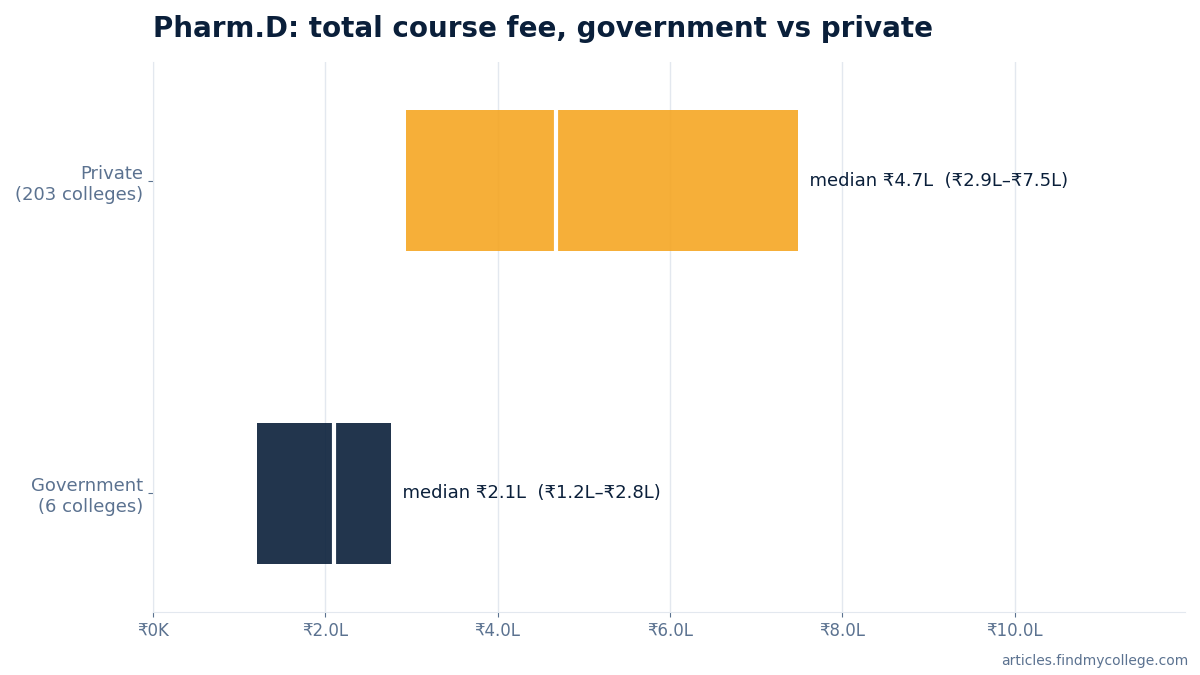
| Average Course Fees | INR 93,500 to INR 2.4 Lakh (Government) | INR 2.3 Lakh to INR 15.9 Lakh (Private) |
| Average Starting Salary | INR 3.5 LPA – INR 6 LPA (Freshers) |
Pharm.D: Latest Updates 2026
| Date | Update |
|---|---|
| Jul 2026 | Indira University Pharm.D program commencement scheduled for July 2026 batch. |
| 2026 | Key entrance exams accepted for Pharm.D admissions include TS EAMCET, AP EAMCET, KCET, MHT CET, GPAT, and CUET (UG). |
Indira University commences its Pharm.D batch in July 2026. Admissions across institutions accept state and national entrance tests such as TS EAMCET, KCET, GPAT, and CUET (UG).
How Many Years Is a Pharm.D Degree Course
| Year | Mandatory Subjects & Practical Modules |
|---|---|
| Year 1 | Human Anatomy & Physiology, Pharmaceutics, Medicinal Biochemistry, Pharmaceutical Organic Chemistry, Pharmaceutical Inorganic Chemistry, Remedial Mathematics/Biology |
| Year 2 | Pathophysiology, Pharmaceutical Microbiology, Pharmacognosy & Phytopharmaceuticals, Pharmacology-I, Community Pharmacy, Pharmacotherapeutics-I |
| Year 3 | Pharmacology-II, Pharmaceutical Analysis, Pharmacotherapeutics-II, Pharmaceutical Jurisprudence, Medicinal Chemistry, Pharmaceutical Formulations |
| Year 4 | Pharmacotherapeutics-III, Hospital Pharmacy, Clinical Pharmacy, Biostatistics & Research Methodology, Biopharmaceutics & Pharmacokinetics, Clinical Toxicology |
| Year 5 | Clinical Research, Pharmacoepidemiology & Pharmacoeconomics, Clinical Pharmacokinetics & TDM, Clerkship, Project Work (6 Months) |
| Year 6 | Compulsory Internship / Residency Training (Rotations in General Medicine, Paediatrics, Surgery, and Specialty Hospital Wards) |
Choose the 6-year regular route directly after Class 12 or the 3-year Post Baccalaureate track after B.Pharm.
Pharm.D Syllabus and Year-Wise Subjects
| Academic Year | Core Syllabus Subjects |
|---|---|
| Year 1 | Human Anatomy and Physiology, Pharmaceutics, Medicinal Biochemistry, Pharmaceutical Organic Chemistry, Pharmaceutical Inorganic Chemistry, Remedial Mathematics/Biology |
| Year 2 | Pathophysiology, Pharmaceutical Microbiology, Pharmacognosy & Phytopharmaceuticals, Pharmacology-I, Community Pharmacy, Pharmacotherapeutics-I |
| Year 3 | Pharmacology-II, Pharmaceutical Analysis, Pharmacotherapeutics-II, Pharmaceutical Jurisprudence, Medicinal Chemistry, Pharmaceutical Formulations |
| Year 4 | Pharmacotherapeutics-III, Hospital Pharmacy, Clinical Pharmacy, Biostatistics & Research Methodology, Biopharmaceutics & Pharmacokinetics, Clinical Toxicology |
| Year 5 | Clinical Research, Pharmacoepidemiology and Pharmacoeconomics, Clinical Pharmacokinetics & TDM, Clerkship, Project Work (6 Months) |
| Year 6 | Compulsory Internship / Residency Training (Clinical Postings in Paediatrics, General Medicine, and Surgery) |
Students without Class 12 Mathematics must complete Remedial Mathematics in Year 1, while non-Biology students take Remedial Biology. The six-year curriculum includes five years of academic study and a one-year internship.
| College | City | Ownership | Total course fee | NIRF rank |
|---|---|---|---|---|
| Manipal University Manipal | Manipal | — | ₹8.60 lakh | 3 (Overall, 2025) |
| JSS College of Pharmacy | Ooty | Private | ₹10.48 lakh | 4 (Pharmacy, 2025) |
| JSS Academy of Higher Education & Research | Mysore | — | ₹10.48 lakh | 7 (Pharmacy, 2025) |
| Manipal College of Pharmaceutical Sciences | Manipal | Private | ₹4.30 lakh | 8 (Pharmacy, 2025) |
| SRM Institute of Technology | Kanchipuram | Private | ₹7.60 lakh | 10 (Pharmacy, 2025) |
| SRM College of Pharmacy | Kanchipuram | — | ₹15.00 lakh | 14 (Pharmacy, 2019) |
| Chandigarh University | Chandigarh | Private | ₹7.49 lakh | 15 (Pharmacy, 2025) |
| Chitkara University | Patiala | Private | ₹7.02 lakh | 16 (Pharmacy, 2025) |
| Andhra University | Visakhapatnam | — | ₹21.93 lakh | 23 (Overall, 2025) |
| ISF College of Pharmacy | Moga | Private | ₹3.68 lakh | 25 (Pharmacy, 2025) |
| College | City | Ownership | Total course fee |
|---|---|---|---|
| Annamalai University | Chidambaram | Government | ₹81,780 |
| Rajiv Gandhi University of Health Sciences | Bangalore | Government | ₹1.34 lakh |
| Priyadarshini Institute of Pharmaceutical Education and Research | Guntur | Government | ₹1.80 lakh |
| Government College of Pharmacy Aurangabad | Aurangabad | Government | ₹2.41 lakh |
| Government College of Pharmacy Amravati | Amravati | Government | ₹2.42 lakh |
| Gujarat Technological University | Ahmedabad | Government | ₹3.80 lakh |
| City | Colleges | Fee range | Well-known options |
|---|---|---|---|
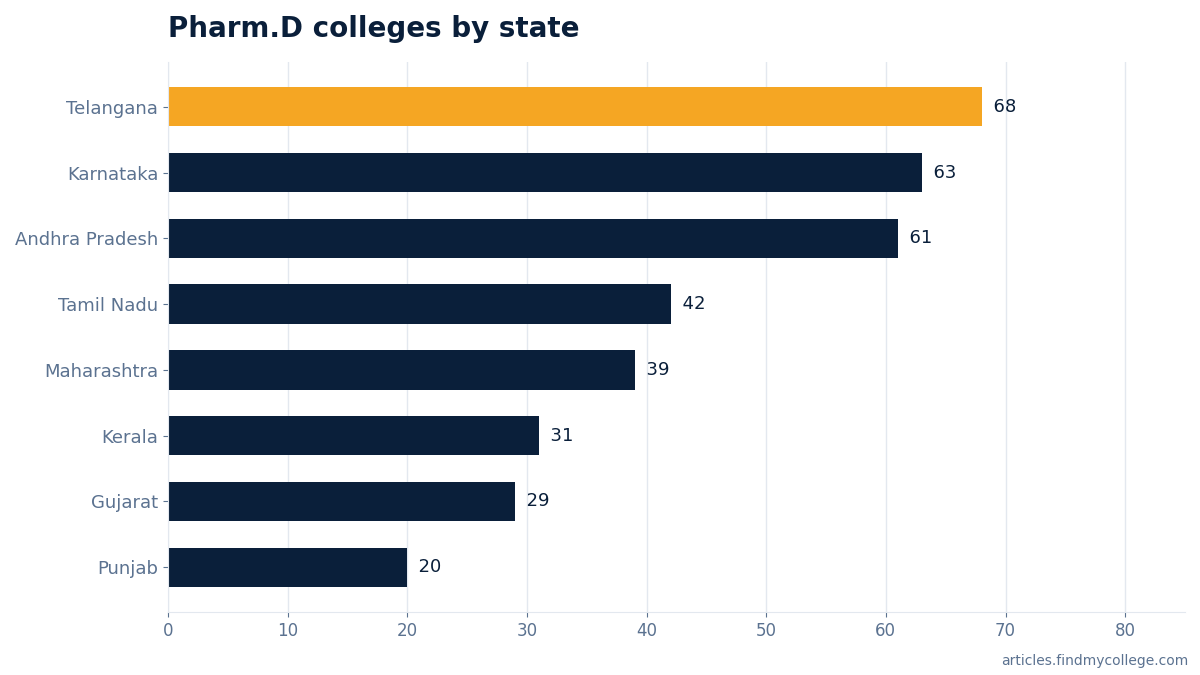
| Bangalore | 34 | ₹1.34 lakh – ₹27.12 lakh | Dayananda Sagar University, Rajiv Gandhi University of Health Sciences |
| Hyderabad | 30 | ₹2.04 lakh – ₹7.83 lakh | Anurag Group of Institutions, Bharat School of Pharmacy |
| Pune | 16 | ₹2.32 lakh – ₹13.50 lakh | MIT World Peace University, Poona College of Pharmacy |
| Warangal | 14 | ₹1.80 lakh – ₹10.80 lakh | Kakatiya University, Sahasra Institute of Pharmaceutical Sciences |
| Guntur | 13 | ₹1.61 lakh – ₹19.36 lakh | Chebrolu Hanumaiah Institute of Pharmaceutical Sciences, Vignan’s Foundation for Science, Technology, and Research |
| Coimbatore | 13 | ₹1.65 lakh – ₹18.18 lakh | PSG Institute of Medical Sciences and Research, Sree Abirami Institutions |
| Chennai | 11 | ₹2.70 lakh – ₹16.50 lakh | Sri Ramachandra Institute of Higher Education and Research, Sathyabama Institute of Science and Technology |
| Ahmedabad | 8 | ₹1.92 lakh – ₹10.85 lakh | Nirma University, Gujarat Technological University |
Pharm.D Eligibility Criteria and Entrance Exams for Admission
| Entrance Examination | Exam Level / Conducting Authority | Target States / Institutions Covered |
|---|---|---|
| TS EAMCET / TS PGECET | State Level (Telangana) | Pharm.D and Pharm.D (PB) seats in Telangana colleges |
| AP EAMCET / AP PGECET | State Level (Andhra Pradesh) | Pharm.D seats in Andhra Pradesh colleges |
Check state-specific eligibility rules requiring 10+2 with Physics, Chemistry, and Biology/Maths at 50% minimum aggregate.
Pharm.D vs B.Pharm: Clinical Doctorate vs Undergraduate Degree
| Criteria | Doctor of Pharmacy (Pharm.D) | Bachelor of Pharmacy (B.Pharm) |
|---|---|---|
| Course Duration | 6 Years (5 Years study + 1 Year internship) | 4 Years |
| Core Focus | Clinical Pharmacy, Pharmacotherapy, Patient Care & Hospital Wards | Drug Formulation, Manufacturing, QA/QC & Chemistry |
| Title & Level | Doctoral Degree (Prefix ‘Dr.’ allowed) | Undergraduate Degree |
| Fresher Starting Salary | ₹3.5 LPA – ₹6 LPA | ₹2.4 LPA – ₹4.5 LPA |
| Mid-Level Salary (3–6 Yrs) | ₹8 LPA – ₹15 LPA | ₹5 LPA – ₹9 LPA |
| Primary Career Roles | Clinical Pharmacist, Drug Safety Associate, Regulatory Manager, Medical Writer | Production Executive, QA/QC Analyst, Medical Representative |
| Global Licensing Scope | High global scope via international licensing exams (NAPLEX, PEBC, HAAD) | Moderate; usually requires additional bridge courses or Master’s degree |
Choose Pharm.D for patient-centric clinical practice, hospital ward care, and global practice via international licensing exams. Select B.Pharm if you aim for industrial pharmaceutical manufacturing or QA/QC laboratory roles.
| College | City | Ownership | Total course fee | Average package |
|---|---|---|---|---|
| Poona College of Pharmacy | Pune | Private (aided) | ₹6.39 lakh | 19.09 LPA |
| Manipal College of Pharmaceutical Sciences | Manipal | Private | ₹4.30 lakh | 6 LPA |
| JSS College of Pharmacy | Ooty | Private | ₹10.48 lakh | 5.6 LPA |
| Holy Mary Institute of Technology and Science | Hyderabad | Private | — | 3.8 LPA |
How to Start Your Pharm.D Admission in 2026: Step by Step
- Check Academic Eligibility: Pass 10+2 with Physics and Chemistry as compulsory subjects along with Biology or Mathematics (minimum 50% aggregate) or hold a D.Pharm qualification. For Pharm.D (Post Baccalaureate), hold a B.Pharm degree from a PCI-approved institution.
- Register & Appear for Entrance Examinations: Apply for state-level entrance exams (TS EAMCET, AP EAMCET/AP PGECET, KCET, MHT CET) or university/national level exams (GPAT, CUET-UG, NMIMS NPAT, PU CET) depending on your target university.
- Submit University / Institutional Application Forms: Complete online registrations on university portals (such as Indira University, Parul University, or Chandigarh University) or state counselling portals, uploading 10+2 mark sheets, scorecards, and identity certificates.
- Participate in State or Institutional Counselling: Attend merit-based seat allocation or counselling rounds conducted by state CET bodies or individual universities to lock in your college option based on rank.
- Complete Document Verification: Verify physical or digital copies of 10+2 mark sheets, entrance scorecards, caste/category certificates, and D.Pharm/B.Pharm completion certificates at the allocated institute.
| What to do | Where | Link |
|---|---|---|
| Compare colleges, fees and cutoffs | Pharm.D colleges in India | findmycollege.com |
FAQs
Is a Pharm.D considered a Doctor in India?
Yes, Pharm.D graduates can prefix ‘Doctor’ (Dr.) to their name. However, they are licensed clinical pharmacists and medication experts, not medical doctors (MBBS/MD), and cannot perform surgeries or independently diagnose diseases.
Does Doctor of Pharmacy (Pharm.D) have maths in the curriculum?
Yes, basic mathematics is involved for dosage calculations and pharmacokinetics. Students without Mathematics in Class 12 complete a compulsory Remedial Mathematics course in their first year, while Biology-deficient students take Remedial Biology.
How many years is a doctorate degree in pharmacy in India?
Regular Pharm.D takes 6 years (5 years of academic study plus 1 year of mandatory hospital internship). For B.Pharm graduates entering via Pharm.D (Post Baccalaureate), the course duration is 3 years.
What is the highest salary for Pharm.D graduates?
Senior Pharm.D professionals working as Directors of Clinical Trials can earn ₹25+ LPA, while R&D Project Managers and Global Pharmacovigilance Leads earn ₹15 to ₹20+ LPA in corporate and international positions.
Which course is best after Pharm.D in India?
Who earns more, MBBS or Pharm.D?
However, Pharm.D graduates earn competitive salaries (up to ₹20–25+ LPA) in global pharmacovigilance, regulatory affairs, clinical trial management, and overseas clinical practice.