Electronics and Computer Engineering Course: Eligibility and Scope
Electronics Engineering is a 4-year undergraduate or 2-year postgraduate program covering VLSI design, embedded systems, and circuit systems, requiring Class 12 PCM for eligibility. Course fees range from INR 1,800 to INR 62 lakh, offering an average starting salary of INR 4.4 LPA for fresh graduates.
Academic eligibility standards, complete fee structures, top NIRF-ranked institutions, core syllabus details, and salary prospects are outlined below.
| Parameter | Details |
|---|---|
| Course Levels | BTech, BE, MTech, ME, PhD, Diploma, Certification |
| UG Course Duration | 4 years |
| PG Course Duration | 2 years |
| UG Eligibility Criteria | Class 12 with PCM (50%-75% aggregate depending on college tier) |
| Course Fees Range | INR 1,800 to INR 62 lakh |
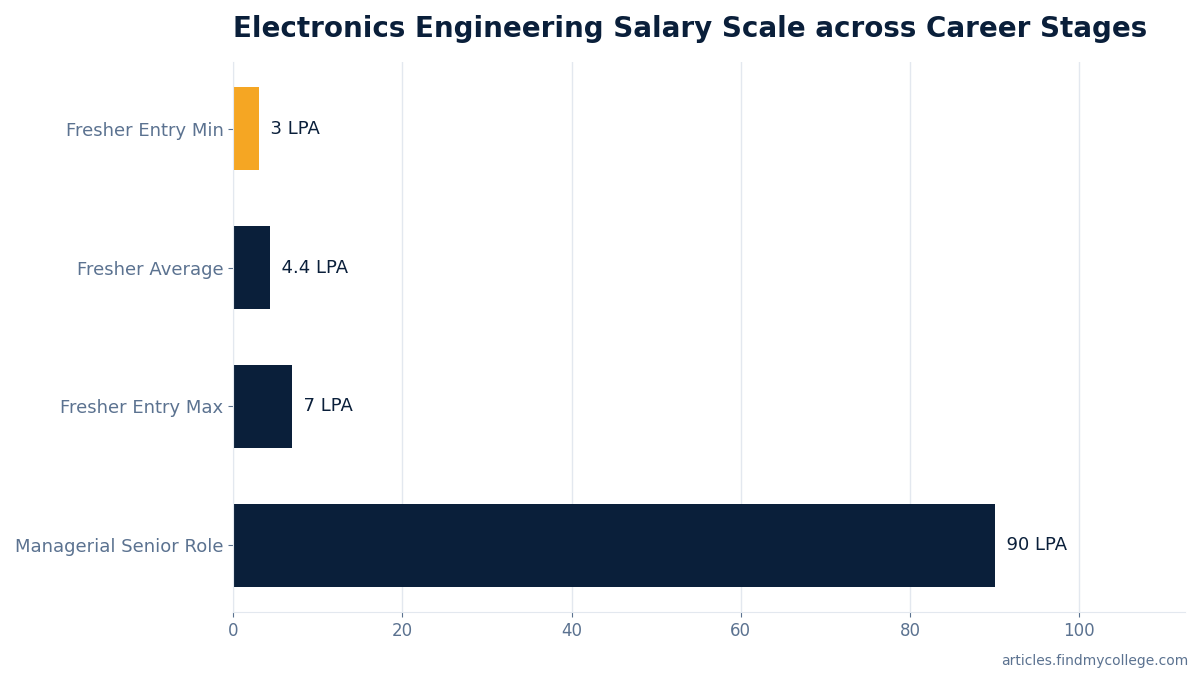
| Average Starting Salary | INR 4.4 LPA (Fresher range: INR 3 LPA – INR 7 LPA) |
| Key Entrance Exams | JEE Main, JEE Advanced, MHT CET, TNEA, BITSAT, VITEEE, SRMJEEE, GATE |
What is B.Tech Electronics and Computer Engineering
- UG (BTech/BE): 4 years
- PG (MTech/ME): 2 years
- Diploma: 3 years
- PhD: 3 to 6 years
- Key Specialisations: VLSI Design, Embedded Systems, Robotics & Automation, IoT, AI & ML, and Telecommunications
Students develop a foundational mindset for hardware and low-level software across degree, diploma, doctoral, and certification programs.
Electronics Engineering vs Electronics & Communication Engineering (ECE)
Understanding the distinction between core Electronics Engineering and combined ECE branches helps candidates select the appropriate academic pathway based on technical interest.
B.Tech Electronics and Computer Engineering Eligibility
Candidates applying for undergraduate programs must pass Class 12 or equivalent with Physics, Chemistry, and Mathematics (PCM) as core subjects. Admission qualification criteria vary according to institution ownership and ranking tier.
B.Tech Electronics and Computer Engineering Admission Process
- Qualifying Criteria: Candidates must pass Class 12 with Physics, Chemistry, and Mathematics (PCM).
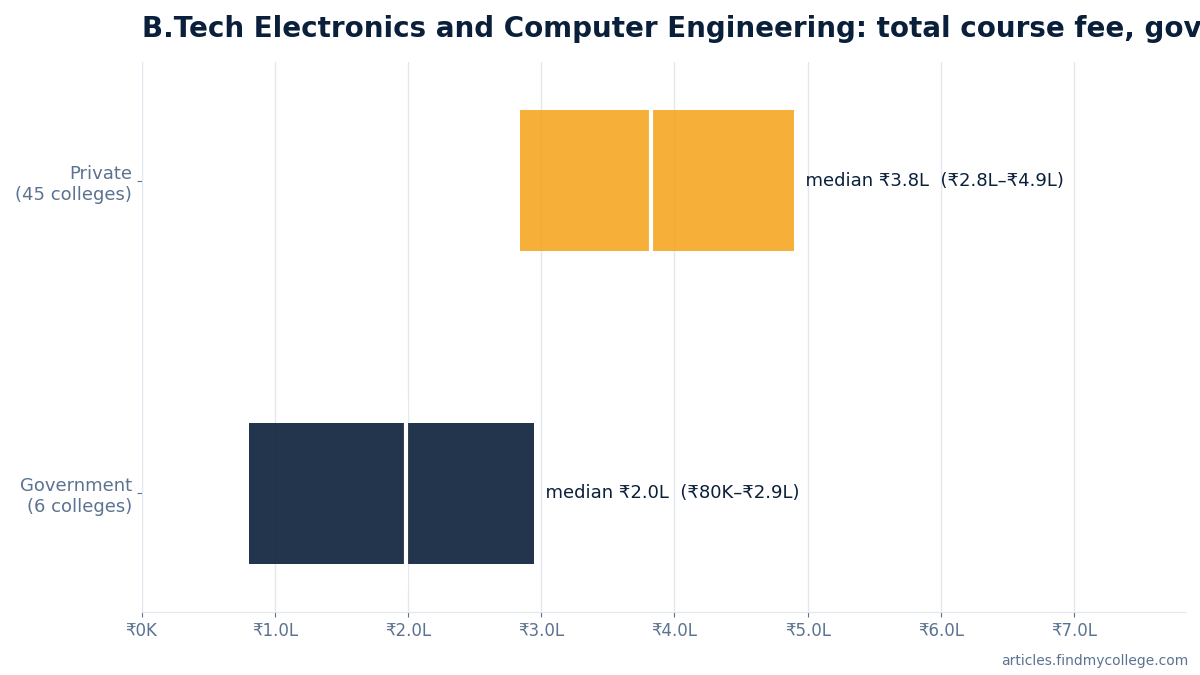
- Minimum Marks Requirement: Government and top-tier colleges require a 75% average in PCM (65% for SC/ST/PwD), while private colleges require a 50% to 60% average in PCM.
- Accepted Entrance Exams: Accepted national, state, and university exams include JEE Main, JEE Advanced, MHT CET, WBJEE, KCET, AP EAMCET, TNEA Counselling, BITSAT, VITEEE, and SRMJEEE.
UG engineering admissions depend on Class 12 PCM performance and entrance examination scores. Applicants must meet the required PCM percentage threshold based on whether they apply to government or private institutions.
Top B.Tech Electronics and Computer Engineering Colleges
Top government institutions offering Electronics Engineering include IIT Madras, IIT Bombay, IIT Delhi, IIT Kharagpur, DTU, NIT Trichy, and Jadavpur University. Renowned private and deemed universities include BITS Pilani, SRM Institute of Science and Technology, VIT Vellore, Raisoni Group of Institutions, Amity University Noida, and Mangalayatan University.
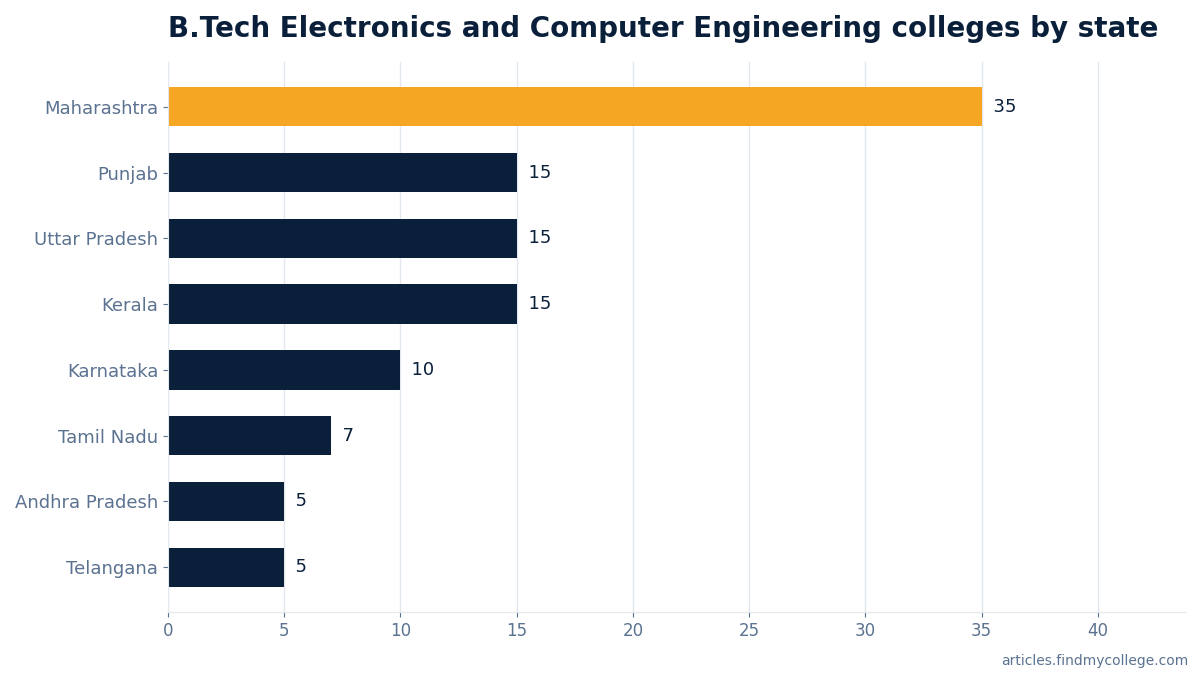
Regional distribution shows significant college clusters across major education hubs. At least 35 colleges operate in Maharashtra, 15 in Punjab, 15 in Uttar Pradesh, 15 in Kerala, 10 in Karnataka, and 7 in Tamil Nadu.
| College | City | Ownership | Total course fee | NIRF rank |
|---|---|---|---|---|
| Manipal University Manipal | Manipal | — | ₹15.37 lakh | 3 (Overall, 2025) |
| SRM Institute of Technology | Kanchipuram | Private | ₹11.10 lakh | 11 (Overall, 2025) |
| Kalinga Institute of Industrial Technology | Bhubaneswar | — | ₹14.00 lakh | 17 (Overall, 2025) |
| SASTRA University | Thanjavur | — | ₹6.80 lakh | 29 (Overall, 2025) |
| University of Petroleum and Energy Studies | Dehradun | — | ₹10.72 lakh | 45 (Overall, 2025) |
| Guru Nanak Dev University | Amritsar | — | ₹3.65 lakh | 48 (Overall, 2023) |
| Visvesvaraya Technological University | Belgaum | Government | ₹6,880 | 75 (Overall, 2024) |
| Sharda University | Noida | — | ₹7.10 lakh | 87 (Overall, 2025) |
| DY Patil University Navi Mumbai | Navi Mumbai | — | ₹18.30 lakh | 91 (Overall, 2025) |
| Anurag Group of Institutions | Hyderabad | — | ₹5.40 lakh | 101 (Overall, 2023) |
| College | City | Ownership | Total course fee | Average package |
|---|---|---|---|---|
| Progressive Education Society’s Modern College of Engineering | Pune | Private | ₹3.82 lakh | 4.79 LPA |
| Bhilai Institute of Technology Raipur | Raipur | Private | ₹3.10 lakh | 4.16 LPA |
| Raj Kumar Goel Institute of Technology | Ghaziabad | Private | ₹3.60 lakh | 3.79 LPA |
| Maharashtra Institute of Technology | Aurangabad | Private | ₹3.97 lakh | 3.61 LPA |
| Walchand Institute of Technology | Solapur | Private | ₹4.52 lakh | 3.46 LPA |
| Dronacharya Group of Institutions | Greater Noida | Private | ₹2.45 lakh | 3.42 LPA |
| Jhulelal Institute of Technology | Nagpur | Private | ₹2.49 lakh | 3.13 LPA |
| GS Mandal’s Marathwada Institute of Technology | Aurangabad | Private | ₹3.09 lakh | 2.95 LPA |
| Siliguri Institute of Technology | Darjeeling | Private | ₹4.84 lakh | 2.64 LPA |
| Mangalam College of Engineering Ettumanoor | Kottayam | Private | — | 2.49 LPA |
| City | Colleges | Fee range | Well-known options |
|---|---|---|---|
| Greater Noida | 7 | ₹2.45 lakh – ₹17.33 lakh | Dronacharya Group of Institutions, Bennett University |
| Bangalore | 7 | ₹7.62 lakh – ₹20.10 lakh | REVA University, Amrita Vishwa Vidyapeetham Bengaluru Campus |
| Pune | 7 | ₹3.30 lakh – ₹11.32 lakh | Pune Institute of Computer Technology, MIT Art, Design and Technology University |
| Aurangabad | 7 | ₹1.37 lakh – ₹4.85 lakh | PES College of Engineering Aurangabad, Mahatma Gandhi Mission University |
| Mohali | 6 | ₹2.77 lakh – ₹6.58 lakh | Rayat Bahra University, CGC College of Engineering |
| Hyderabad | 5 | ₹2.60 lakh – ₹31.52 lakh | Anurag Group of Institutions, J.B. Institute of Engineering & Technology |
| Kolhapur | 4 | ₹1.60 lakh – ₹5.00 lakh | Sharad Institute of Technology College of Engineering, Dr. Bapuji Salunkhe Institute of Engineering and Technology |
| Dehradun | 4 | ₹9.41 lakh – ₹11.99 lakh | Uttaranchal University, University of Petroleum and Energy Studies |
B.Tech Electronics and Computer Engineering Career Scope and Salary
Demand for skilled Electronics Engineers is increasing at a rate of 7% annually, with total job opportunities estimated to exceed 345,800 by 2026. Graduates find career avenues across semiconductor manufacturing, defense research, telecom networks, embedded system design, and tech development.
Fresh graduates start with an average entry salary of INR 4.4 LPA, with starter packages ranging between INR 3 LPA and INR 7 LPA. The median average placement package across 14 reporting colleges stands at 3.54 LPA. Experienced professionals reaching managerial roles, such as Instrumentation Managers or Technical Heads, command salaries ranging from INR 90 LPA to INR 1.5+ Crore per year.
| Job Role | Career Level | Salary Range |
|---|---|---|
| Electronics Engineer (Fresher) | Entry Level | INR 3 LPA – INR 7 LPA (Avg INR 4.4 LPA) |
| Instrumentation Manager / Technical Head | Managerial / Senior Level | INR 90 LPA – INR 1.5+ Crore per year |
| Network Planning Manager | Mid to Senior Level | Grows with expertise and experience |
| Communication System Operator | Mid Level | Grows with expertise and experience |
Prominent recruiters hiring engineering graduates include Intel, NVIDIA, Microsoft, Google, Meta, Siemens, Infosys, Nokia, and government defense or space organizations including DRDO, ISRO, BEL, NASA, and Antrix.
How to Apply for B.Tech Electronics and Computer Engineering Admission in 2026: Step by Step
- Register for engineering entrance examinations: Apply for national-level (JEE Main, JEE Advanced), state-level (MHT CET, KCET, AP EAMCET, WBJEE), or university-level exams (BITSAT, VITEEE, SRMJEEE).
- Appear for entrance tests: Take the designated entrance test to secure rank cutoffs required by participating engineering colleges.
- Participate in admission counselling: Engage in counselling processes such as TNEA Counselling or merit-based institute counselling rounds to get seat allotment.
- Document submission and fee payment: Complete document verification and pay admission fees, which vary between INR 1,800 and INR 62 lakh across institutes.
| What to do | Where | Link |
|---|---|---|
| Compare colleges, fees and cutoffs | B.Tech Electronics and Computer Engineering colleges in India | findmycollege.com |
FAQs
What is electronics and Computer Engineering?
Electronics Engineering focuses on designing, building, and testing electronic components, circuits, and systems. It encompasses specialization domains like VLSI Design, Embedded Systems, Robotics & Automation, IoT, AI & ML, and Telecommunications.
Is ECE good for placement?
Yes. Electronics and ECE graduates enjoy strong placements across top companies like NVIDIA, Intel, Google, Microsoft, DRDO, BEL, and ISRO, with freshers earning between INR 3 LPA and INR 7 LPA.
Which is tough, ECE or CSE?
Electronics engineering requires a strong foundational mindset for hardware and low-level software. ECE combines hardware and software aspects such as semiconductors, VLSI, and telecommunications, making it technically rigorous and versatile.
Which branch of ECE has more scope?
High-demand specialization domains in Electronics Engineering include VLSI Design, Embedded Systems, Robotics & Automation, IoT, AI & ML, and Telecommunications.
What are the fees of BTech in India?
BTech course fees for Electronics Engineering range between INR 1,800 and INR 62 lakh depending on whether the college is government-funded or private.
What is a B tech course salary?
The average starting salary for fresh Electronics Engineering graduates is INR 4.4 LPA (ranging between INR 3 LPA and INR 7 LPA), growing up to INR 90 LPA to INR 1.5+ Crore in managerial positions.