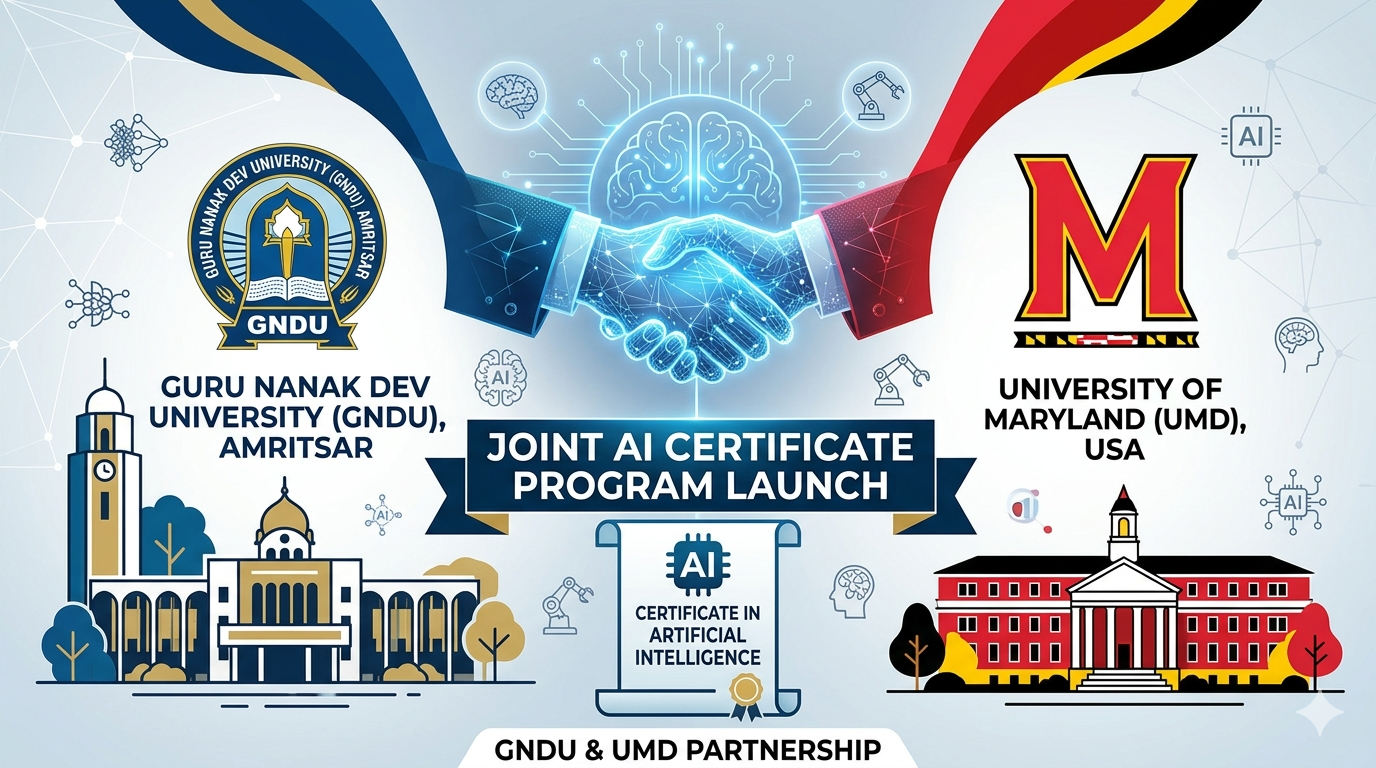
GNDU Launches AI Certificate Program in Collaboration with University of Maryland
In a significant step towards promoting advanced technology education, Guru Nanak Dev University (GNDU) has announced the launch of a new Artificial Intelligence (AI) Certificate Program in collaboration with the University of Maryland, USA. The initiative aims to provide students, researchers, and professionals with practical knowledge and skills in the rapidly growing field of artificial intelligence.
The partnership marks an important milestone for GNDU as it continues to expand its international academic collaborations and introduce industry-relevant courses for learners. The new certificate program is expected to help participants gain a deeper understanding of AI technologies and prepare them for future careers in technology-driven sectors.
Growing Importance of Artificial Intelligence
Artificial Intelligence has emerged as one of the most influential technologies in the modern world. From healthcare and education to finance and manufacturing, AI is transforming industries by improving efficiency, decision-making, and automation.
As organizations increasingly adopt AI-based solutions, the demand for trained professionals in this field has grown significantly. Educational institutions across the world are now introducing specialized programs to help students develop expertise in machine learning, data analytics, natural language processing, robotics, and other AI-related areas.
Recognizing this growing demand, GNDU has decided to introduce a structured certificate program that combines academic excellence with practical exposure. Through its collaboration with the University of Maryland, participants will gain access to international-level learning opportunities.
Collaboration with University of Maryland
The partnership between GNDU and the University of Maryland reflects the shared vision of both institutions to promote innovation and technological advancement. The collaboration is expected to facilitate academic exchanges, knowledge sharing, and joint learning initiatives.
University of Maryland is known for its strong research ecosystem and contributions to science, engineering, and technology education. By partnering with an internationally recognized institution, GNDU aims to provide students with global perspectives on emerging technologies.
Officials from both universities have expressed confidence that the program will strengthen academic cooperation and help learners understand real-world applications of artificial intelligence.
The initiative is also expected to encourage future collaborations in research, faculty development, and technology-based projects.
Objectives of the AI Certificate Program
The newly launched AI Certificate Program has been designed to equip learners with both theoretical and practical knowledge. The program will focus on developing analytical thinking, problem-solving abilities, and technical expertise.
Some of the key objectives of the program include:
- Introducing participants to the fundamentals of artificial intelligence.
- Providing hands-on experience with AI tools and technologies.
- Enhancing understanding of machine learning concepts.
- Building awareness of ethical and responsible AI practices.
- Preparing learners for careers in technology and innovation sectors.
- Encouraging interdisciplinary applications of AI across different fields.
The curriculum is expected to cover important topics that are relevant to current industry requirements.
Course Structure and Learning Areas
According to university officials, the certificate program will include a range of modules covering core AI concepts and practical applications.
Some of the major learning areas may include:
Introduction to Artificial Intelligence
Participants will learn about the history, evolution, and significance of AI. The module will help learners understand how intelligent systems work and how they are applied in various industries.
Machine Learning
Machine learning is one of the most important branches of AI. Learners will explore algorithms, predictive models, and data-driven decision-making processes.
Data Analytics
The course will introduce techniques for collecting, processing, and analyzing data. Since AI systems rely heavily on data, understanding analytics is considered essential.
Natural Language Processing
Natural Language Processing (NLP) enables computers to understand and interpret human language. Participants will learn how AI powers chatbots, translation tools, and virtual assistants.
Computer Vision
Computer vision focuses on enabling machines to analyze and understand visual information. This technology is widely used in healthcare, security, autonomous vehicles, and industrial automation.
Ethical AI
The program will also emphasize ethical considerations related to AI development and deployment. Topics such as privacy, transparency, fairness, and accountability are expected to be discussed.
Benefits for Students and Professionals
The AI Certificate Program offers several advantages for students and working professionals alike.
For students, the course provides an opportunity to gain specialized knowledge that can enhance employability in the competitive job market. AI skills are increasingly valued across industries, making such certifications highly beneficial.
For professionals, the program can serve as an upskilling opportunity. Individuals already working in technology, business, engineering, and related fields can update their knowledge and stay relevant in an evolving digital environment.
The international collaboration component is another major attraction. Learning from experts associated with both institutions can provide participants with broader exposure and valuable insights.
Focus on Practical Learning
One of the key highlights of the program is its emphasis on practical learning. Rather than focusing solely on theoretical concepts, the course aims to provide hands-on experience through projects, case studies, and interactive sessions.
Participants may have opportunities to work on real-world AI problems and explore applications across different domains. Such practical exposure can help learners understand how AI technologies are implemented in actual business and research environments.
Industry-oriented learning approaches are expected to make the program more effective and career-focused.
Strengthening International Academic Ties
The launch of the AI Certificate Program is also a reflection of GNDU’s commitment to expanding its international partnerships.
Over the years, universities around the world have increasingly recognized the importance of global collaborations in higher education. Such partnerships create opportunities for knowledge exchange, joint research, and academic innovation.
The association with the University of Maryland is expected to open new avenues for students and faculty members. It may also pave the way for future collaborative programs in other emerging fields such as data science, cybersecurity, and advanced computing.
Opportunities in the AI Sector
The global AI industry is witnessing rapid growth. Companies across sectors are investing heavily in artificial intelligence to improve productivity, enhance customer experiences, and drive innovation.
As a result, career opportunities in AI-related fields are expanding quickly. Professionals with AI expertise are in demand for roles such as:
- AI Engineer
- Machine Learning Specialist
- Data Scientist
- Data Analyst
- AI Research Associate
- Business Intelligence Analyst
- Robotics Engineer
- AI Consultant
By participating in the certificate program, learners can build foundational skills that may support future academic and professional growth.
GNDU’s Vision for Future-Ready Education
The introduction of the AI Certificate Program aligns with GNDU’s broader vision of preparing students for the future workforce. Universities today are increasingly focusing on emerging technologies to ensure that graduates possess relevant skills for modern industries.
Through initiatives such as this, GNDU aims to bridge the gap between academic learning and industry expectations. The university believes that technology-focused education will play a crucial role in shaping future leaders, innovators, and researchers.
Officials have emphasized that the program represents a step toward creating a strong ecosystem for digital learning and technological excellence.

📰 More Education News
- Nirma University Admission Registration 2026 Ongoing for UG Courses; Know More Details HereJun 3, 2026 • Simran
- DU NCWEB PG Admissions 2026: Bulletin Released, Delhi Women Can Apply Through CSASJun 3, 2026 • Simran
- AIL LET 2026 Registration to Close Soon; Check Last Date to ApplyJun 3, 2026 • Simran
- IIT Roorkee Placements 2025-26: First BTech Data Science and AI Batch Achieves 100% SuccessJun 3, 2026 • Simran