GNM Distance / Online Course in India 2026: Is It Valid? Real Rules Explained
Latest update: General Nursing and Midwifery 2026 admissions & dates are being updated. Read more ›
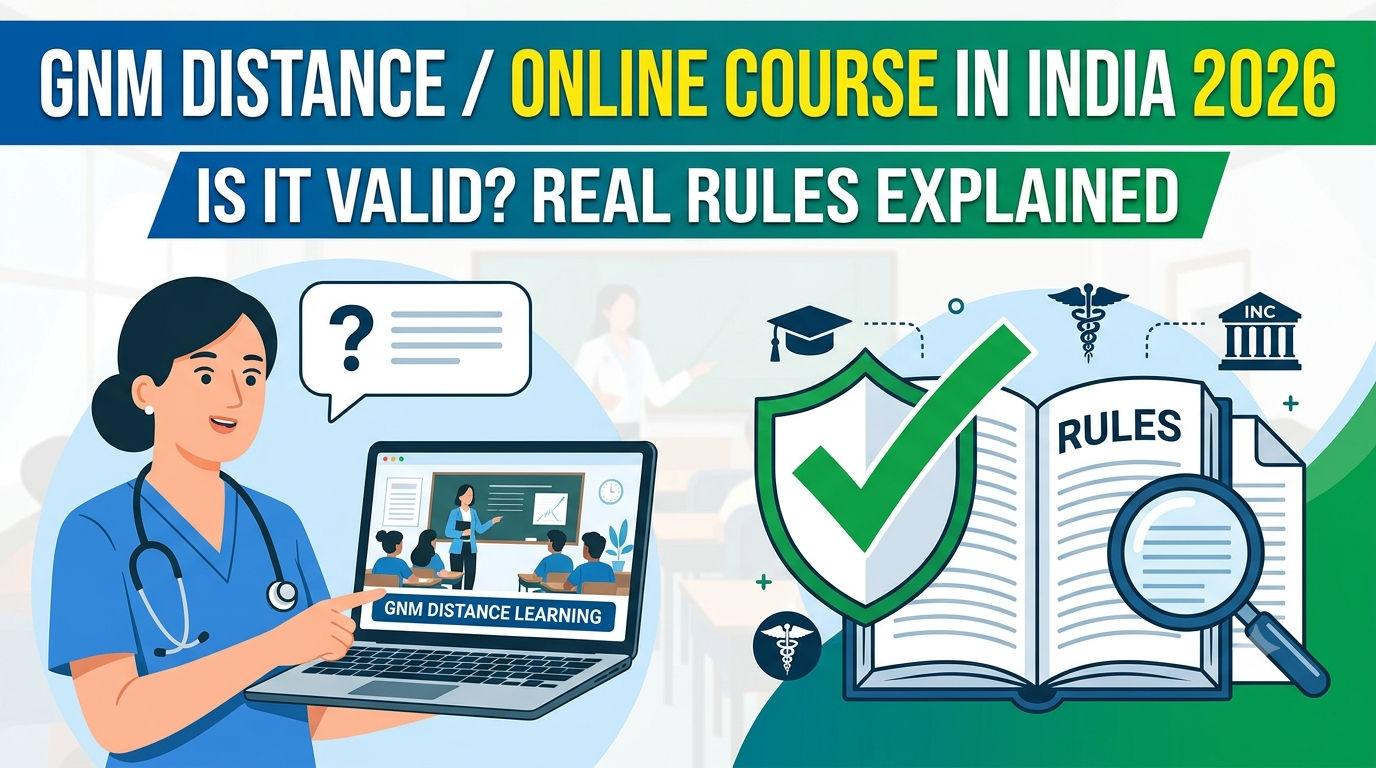
Looking for a GNM distance or online course in India? Here is the direct, factual answer for 2026 before you pay any institute: General Nursing and Midwifery (GNM) cannot be pursued through distance, correspondence or fully online mode in India. The Indian Nursing Council (INC) and the UGC do not recognise any distance/online GNM programme, because GNM is a clinical diploma that legally requires supervised hands-on nursing and midwifery practice. Any website advertising a “GNM distance course” or “online GNM diploma” is offering a qualification that will not be valid for nursing registration or jobs. This page explains the rules, why they exist, and the genuine distance-learning nursing pathways that are available.
Is GNM Available in Distance or Online Mode in 2026?
No. GNM (General Nursing and Midwifery) is not offered as a recognized distance, correspondence, or fully online nursing program in India. Students who want to pursue GNM must complete the program through the regular mode at a recognized nursing institution, where they receive classroom instruction as well as supervised clinical training.
GNM is a professional nursing program that involves practical training in areas such as medical-surgical nursing, community health nursing, child health nursing, mental health nursing, and midwifery. These components require students to work directly with patients under the supervision of qualified nursing faculty.
Therefore, the program cannot be completed entirely through online classes or distance education.
Students should also distinguish between online study materials or online classes offered by an institute and a formally recognized online GNM qualification. An institute may provide digital learning support, but this does not make a GNM program an approved online degree or diploma.
| GNM Mode | Status in India |
|---|---|
| Distance/correspondence GNM | Not recognized as a route to nursing registration |
| Fully online GNM | Not recognized |
| Regular full-time GNM | Recognized route through an approved institution |
| Online classes for selected theory topics | May be used as supplementary learning, subject to the institution’s rules |
| Distance study after GNM | Available through eligible nursing programs such as Post Basic B.Sc. Nursing |
Therefore, candidates should not select a GNM course simply because an institute advertises it as “online,” “distance,” “correspondence,” or “fast-track.” The important question is whether the qualification is recognized and whether it allows the student to obtain the required nursing registration.
Why is Distance/Online GNM Not Allowed?
GNM is different from many academic programs that can be studied primarily through books, lectures, and examinations. Nursing education requires students to develop practical skills by working with patients and healthcare professionals.
During GNM training, students are expected to gain experience in different clinical areas. They learn how to assess patients, provide nursing care, maintain records, assist with treatment, and respond to different healthcare situations. Midwifery training also requires practical exposure to pregnancy, childbirth, and postnatal care.
Clinical Training is an Essential Part of GNM
A major part of nursing education involves practical and clinical training. Students are required to complete postings in relevant healthcare settings as prescribed by the applicable nursing regulations and institution.
These postings help students develop skills that cannot be acquired through online lectures alone. For example, students need supervised experience in:
- Medical-surgical nursing
- Community health nursing
- Child health nursing
- Mental health nursing
- Midwifery
- Maternal and newborn care
- Basic patient-care procedures
- Hospital and clinical documentation
A student watching a procedure through an online video is not equivalent to performing that procedure under the supervision of a qualified healthcare professional.
Nursing Registration is Important
Completing a nursing qualification is not the only requirement for working as a registered nurse. Candidates must also meet the requirements for registration with the relevant State Nursing Council.
This is why students should check recognition before taking admission. A certificate issued by an institute does not automatically mean that the holder will be eligible for professional nursing registration.
Before paying admission fees, students should therefore verify:
- Whether the nursing institution is recognised by the relevant authorities.
- Whether the GNM programme is approved for the applicable academic session.
- Whether the course includes the required clinical training.
- Whether successful students can apply for nursing registration.
- Whether the qualification is accepted for the type of nursing job they intend to pursue.
Patient Safety Requires Supervised Training
Nurses work directly with patients, including children, elderly people, pregnant women, and patients requiring emergency or specialized care. Mistakes in clinical procedures can have serious consequences.
For this reason, practical nursing education is designed around supervised training rather than theoretical study alone. Students need opportunities to develop clinical judgement, communication skills, patient-care techniques, and professional responsibilities in real healthcare environments.
This practical requirement is one of the key reasons why candidates should be cautious about advertisements promising a very short or completely online GNM qualification.
Legitimate Distance / Online Nursing Pathways
Although GNM itself is not a distance/online qualification, distance learning is available for certain nursing programmes for candidates who already have the required nursing qualification and registration.
One important example is the Post Basic B.Sc Nursing programme offered through IGNOU’s open and distance learning system, subject to the eligibility and admission rules applicable to the programme.
This distinction is important:
Distance Post Basic B.Sc Nursing is not an alternative way to complete GNM.
The usual pathway is to first complete a recognised GNM programme through the regular mode. After obtaining the required nursing registration and meeting the eligibility conditions, an eligible nurse can pursue a higher qualification through an approved ODL route.
| Programme | Mode | Typical Eligibility | Purpose |
|---|---|---|---|
| GNM | Regular/full-time | As prescribed by the nursing regulator/institution | Initial nursing and midwifery qualification |
| Post Basic B.Sc Nursing | ODL/approved distance mode with practical requirements | Eligible GNM-qualified registered nurses | Academic and professional progression |
| Nursing-related PG programmes | Depends on programme | Relevant nursing qualification | Higher-level academic/professional development |
| Nursing administration/management courses | May be available through distance mode | Depends on university/course | Administrative and management skills |
Candidates should always check the latest eligibility, recognition, duration, practical requirements and fee structure on the concerned university’s official website before applying. Rules and admission conditions can change from one academic session to another.
How to Spot a Fake “GNM Distance/Online” Offer?
Students should be particularly careful when searching online because advertisements for nursing courses can use terms such as “distance GNM,” “online GNM,” “one-year GNM,” or “fast-track GNM.”
The presence of an advertisement does not establish that the qualification is recognized.
Check the Recognition Status
Before taking admission, visit the relevant regulator or official institution website and verify the program and institution. Do not rely only on a college’s website, social media advertisement or counsellor’s verbal assurance.
Ask the institution for clear information about:
- Recognition of the nursing institution
- Approval/recognition of the GNM programme
- Affiliation with the applicable State Nursing Council
- Clinical training arrangements
- Duration of the programme
- Eligibility for nursing registration after completion
Be Careful With Very Short GNM Courses
A regular nursing qualification involves prescribed academic and clinical training. Therefore, advertisements promising a GNM qualification in an unusually short period should be examined carefully.
Terms such as “1-year GNM”, “6-month GNM”, “fast-track GNM” or “direct GNM certificate” should not be accepted without verifying the programme’s recognition and registration eligibility.
Ask About Clinical Training
A genuine nursing programme should clearly explain where students will complete their clinical training.
If an institute claims that students can obtain a complete GNM qualification without attending clinical postings, candidates should verify the claim with the relevant nursing authority before paying any fees.
Confirm Registration Eligibility
One of the most important questions to ask is:
“After completing this programme, will I be eligible to apply for registration with the State Nursing Council?”
Get the answer in writing and independently verify it through the relevant authority. Do not rely solely on statements made by an admission counsellor.
What Should You Do Instead?
Students who want to build a career as a nurse should first identify the qualification they actually need and then select an institution that offers the recognised mode of study.
For students specifically interested in GNM, the usual route is to pursue the programme through the regular mode at a recognised nursing institution.
A typical pathway can be understood as follows:
Step 1: Check GNM Eligibility
Before applying, candidates should check the latest eligibility conditions for the academic session. Requirements can include educational qualifications, minimum marks, age conditions and other criteria prescribed by the relevant authority or institution.
Step 2: Choose a Recognised Nursing Institution
Candidates should verify the recognition and affiliation of the institution before paying the admission fee. It is advisable to check the official nursing regulator and State Nursing Council information rather than relying only on third-party admission websites.
Step 3: Complete Regular GNM Training
Students complete classroom learning along with practical and clinical training. The course covers different areas of nursing and midwifery and includes practical exposure in healthcare settings.
Step 4: Complete the Required Internship/Clinical Training
Clinical training gives students hands-on experience under supervision. Candidates must complete the practical requirements prescribed for their programme before moving to the next stage.
Step 5: Apply for Nursing Registration
After completing the recognised qualification and meeting the applicable requirements, candidates can apply for registration with the relevant State Nursing Council.
Step 6: Consider Higher Education
After GNM and registration, nurses can explore further education depending on their career goals. This may include Post Basic B.Sc Nursing, followed by other eligible postgraduate or specialised programmes.
This route allows students to use distance learning where it is actually permitted, rather than paying for an unrecognised online GNM certificate.
| Factor | Regular GNM | “Distance/Online GNM” |
|---|---|---|
| Mode | Classroom + clinical training | Advertised as distance/online |
| Practical training | Required | Cannot replace required clinical training through online study |
| Nursing recognition | Depends on approved institution/programme | Not established merely by an institute’s advertisement |
| Nursing registration | Subject to applicable requirements | Must be independently verified |
| Suitable for becoming a registered nurse | Yes, when completed through the recognised route | Do not assume eligibility |
| Best approach | Verify recognition before admission | Verify with nursing authorities before paying |