Government B.Ed Colleges 2026: Seat Intake, Fee Structure and Cutoff
Nishit Kumar is a senior EdTech industry leader with over a decade of experience in building and scaling education platforms, shaping their product, content, and growth strategy. At…
- 22 Oct 2026Karnataka BEd 2026 Application Process Begins Online
The Department of School Education and Literacy, Karnataka, releases the Karnataka BEd 2026 application form online with merit-based selection.
Across the country, at least 2,618 colleges offer B.Ed programs, including at least 125 government institutions and 1,606 private colleges.
This detailed guide covers the top government and private B.Ed colleges, seat matrix, fee structures, eligibility requirements, city-wise availability, and step-by-step admission procedures for 2026.
| Parameter | Details |
|---|---|
| Course Duration | 2 Years (4 Semesters) |
| General Eligibility | 50% aggregate in UG/PG degree; 55% for B.E./B.Tech |
| Reserved Category Eligibility | 45% aggregate for SC/ST candidates |
| Regulatory Body | National Council for Teacher Education (NCTE) |
Top B.Ed Colleges
Top B.Ed colleges across India are recognized for high academic standards, strong practical training, and NCTE approval. Major central and state universities like Jamia Millia Islamia University, Delhi University, Banaras Hindu University, and Jadavpur University feature prominently in national institutional rankings while maintaining affordable fee structures for candidates.
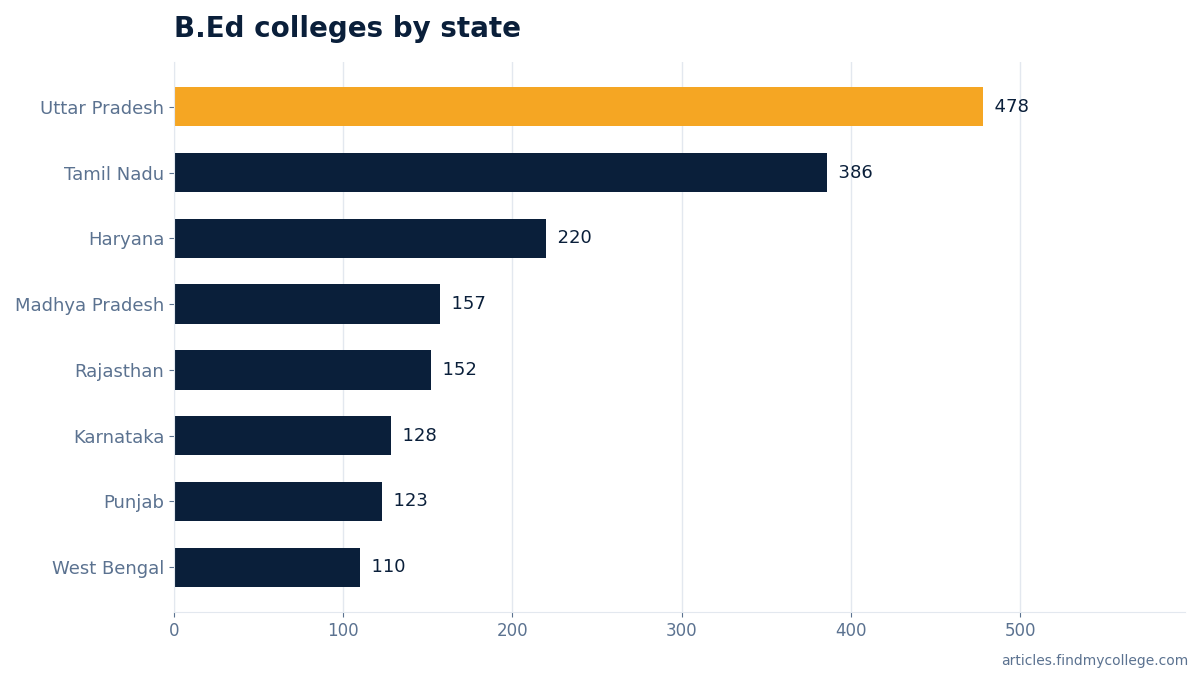
State distribution shows a strong concentration of institutions across North and South India. Uttar Pradesh leads with 478 colleges, followed by Tamil Nadu with 386, Haryana with 220, Madhya Pradesh with 157, Rajasthan with 152, and Karnataka with 128. Across reporting institutions, the median average placement package stands at 4.0 LPA.
| College | City | Ownership | Total course fee | NIRF rank |
|---|---|---|---|---|
| Jamia Millia Islamia University | Delhi | Government | ₹26,050 | 4 (Overall, 2025) |
| Delhi University | Delhi | Government | ₹15,868 | 5 (Overall, 2025) |
| Banaras Hindu University | Varanasi | Government | ₹8,000 | 6 (Overall, 2025) |
| Indian Institute of Technology Kharagpur | Kharagpur | Government | ₹86,700 | 6 (Overall, 2025) |
| St. Xavier’s College Kolkata | Kolkata | Private (aided) | ₹1.26 lakh | 8 (Overall, 2025) |
| Jadavpur University | Kolkata | Government | ₹12,520 | 9 (Overall, 2025) |
| Chandigarh University | Chandigarh | Private | ₹4.04 lakh | 19 (Overall, 2025) |
| Acharya Narendra Dev College | Delhi | University | ₹64,000 | 21 (Overall, 2025) |
Private B.Ed Colleges
| College | City | Ownership | Total course fee | Average package |
|---|---|---|---|---|
| Fairfield Institute of Management and Technology | Delhi | Private | ₹1.80 lakh | 4 LPA |
| CMD PG College | Bilaspur | Private (aided) | ₹60,540 | 4 LPA |
| Loreto College | Kolkata | Private (aided) | ₹83,000 | 2.4 LPA |
| Mahaveer Institute of Engineering & Technology | Meerut | Private | ₹1.12 lakh | 1.5 LPA |
| Parameter | Government B.Ed Colleges | Private B.Ed Colleges |
|---|---|---|
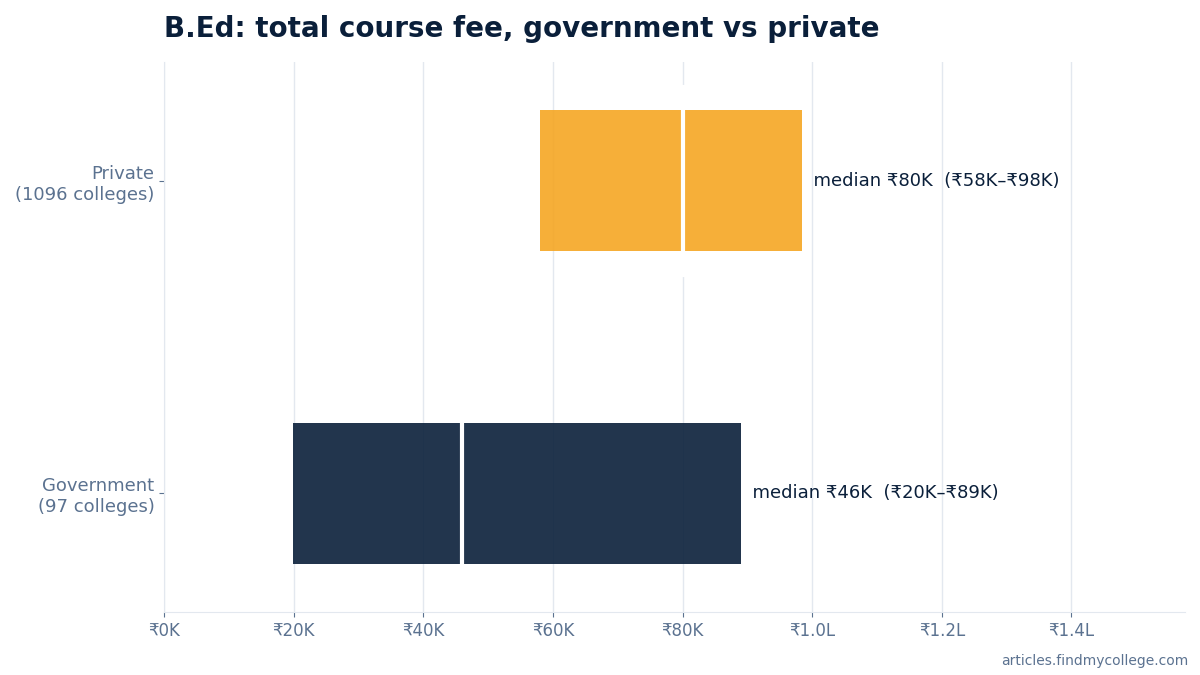
| Median Total Course Fee | ₹45,940 (Middle half: ₹19,872 – ₹89,000) | ₹80,000 (Middle half: ₹58,000 – ₹98,452) |
| Regulatory Approval | NCTE Approved | NCTE Approved |
| Example State Distribution (Maharashtra) | 18 Government Colleges | 251 Private Colleges |
Private institutions account for 1,606 of at least 2,618 B.Ed colleges in India, offering management quotas alongside government counseling seats. Across 1,096 private colleges with fee data, the median total course fee is ₹80,000, with the middle half ranging from ₹58,000 to ₹98,452.
B.Ed Admission Process
Admission to B.Ed courses across India is governed by guidelines established by the National Council for Teacher Education (NCTE). Candidates must hold a Bachelor’s or Master’s degree in Science, Social Sciences, or Humanities with at least 50% aggregate marks. Candidates with a B.E. or B.Tech degree specializing in Science and Mathematics require a minimum of 55% marks. SC and ST category applicants receive a 5% relaxation, requiring 45% marks in their qualifying degree.
Selection processes rely on state-level entrance tests or university CETs such as GGSIPU CET and MH CET B.Ed. Application fees vary by state; for instance, the Karnataka B.Ed application portal charges ₹300 for General applicants and ₹100 for SC, ST, and Category-1 candidates, while completely exempting disabled applicants.
| City | Colleges | Fee range | Well-known options |
|---|---|---|---|
| Meerut | 58 | ₹27,370 – ₹3.30 lakh | Swami Vivekanand Subharti University, Meerut College |
| Bhopal | 52 | ₹12,650 – ₹1.80 lakh | Bhabha University, Regional Institute of Education Bhopal |
| Lucknow | 47 | ₹13,940 – ₹2.61 lakh | Integral University, Babasaheb Bhimrao Ambedkar University |
| Jaipur | 45 | ₹26,540 – ₹3.20 lakh | University of Rajasthan, Banasthali Vidyapith |
| Delhi | 42 | ₹15,868 – ₹3.34 lakh | Jamia Millia Islamia University, Delhi University |
| Chennai | 38 | ₹18,455 – ₹1.56 lakh | Vels Institute of Science, Technology & Advanced Studies, Tamil Nadu Teachers Education University |
| Kolkata | 31 | ₹12,520 – ₹5.50 lakh | Jadavpur University, Amity University Kolkata |
| Bangalore | 29 | ₹35,000 – ₹14.75 lakh | Christ University, Bangalore University |
| College | City | Ownership | Total course fee |
|---|---|---|---|
| Dr. Babasaheb Ambedkar Open University | Ahmedabad | — | ₹40,000 |
| Directorate of Distance Education, University of Jammu | Jammu | — | ₹71,540 |
| University School of Open Learning, Panjab University | Chandigarh | — | ₹51,420 |
| Directorate of Distance Education, The University of Burdwan | Bardhaman | — | ₹84,400 |
| International Centre for Distance Education and Open Learning, Himachal Pradesh University | Shimla | — | ₹50,320 |
| Maulana Azad National Urdu University | Hyderabad | University | — |
| Yashwantrao Chavan Maharashtra Open University | Nashik | Government | ₹46,810 |
| Nalanda Open University | Patna | — | ₹50,000 |
People Also Read
-

-

-
 RGPV B.Tech IT Syllabus and Course Structure Computer Applications
-
How to Apply for B.Ed Admission in 2026: Step by Step
- Check Eligibility Criteria: Verify that you have at least 50% marks in UG/PG degree (45% for SC/ST reserved categories) or 55% in B.E./B.Tech.
- Register for Entrance Exam / Portal: Register on the university or state admission portal (e.g. GGSIPU CET, MH CET B.Ed, or Karnataka B.Ed Online Admission Portal).
- Submit Application and Pay Application Fee: Fill out personal and academic credentials, choose preference lists, and pay the registration fee (e.g. ₹300 for General, ₹100 for SC/ST in Karnataka).
- Attend Document Verification at Nodal Center: Report to assigned state nodal centers within one week of online submission to verify qualifying marksheets and certificates.
- Participate in Merit Counseling & Seat Allotment: Check state/university merit list publication, lock college preferences, and obtain formal seat allotment in government B.Ed college.
| What to do | Where | Link |
|---|---|---|
| application | SCERT Delhi B.Ed Portal | bed.delhi.gov.in |
| Compare colleges, fees and cutoffs | B.Ed colleges in India | findmycollege.com |
FAQs
Which type of course is BEd.?
B.Ed (Bachelor of Education) is a two-year regular, full-time undergraduate professional course divided into four semesters. It prepares candidates to teach upper primary (VI-VIII), secondary (IX-X), and senior secondary (XI-XII) school levels.
What are the eligibility criteria for government B.Ed colleges?
Candidates need at least 50% aggregate in Bachelor’s or Master’s degree in Science, Social Sciences, or Humanities, or 55% in B.E./B.Tech (Science & Maths). SC/ST reserved category candidates require 45%.
What is the fee structure for government B.Ed colleges?
What is the seat intake in major government B.Ed colleges?
Seat intake varies by institute and state norms.
How can I apply for BEd. in Karnataka online?
Apply online via the Department of School Education and Literacy portal, choose nodal centers, upload certificates, select college preferences, pay ₹300 fee (₹100 for SC/ST), and visit nodal centers for document verification.
Which entrance exams are accepted for government B.Ed admissions?
Admissions are conducted through state and university entrance tests such as GGSIPU CET, MH CET B.Ed, IPUCET, DU B.Ed, or merit lists based on qualifying degree marks as per state policies.