How to Become an Income Tax Officer in India: Exam and Steps
Nishit Kumar is a senior EdTech industry leader with over a decade of experience in building and scaling education platforms, shaping their product, content, and growth strategy. At…
To become an Income Tax Officer in India, candidates must hold a Bachelor’s degree in any stream and clear either the Staff Selection Commission Combined Graduate Level (SSC CGL) exam or the Union Public Service Commission Civil Services Examination (UPSC CSE). Qualifying SSC CGL recruits candidates as Income Tax Inspectors (Pay Level 7, basic pay ₹44,900), who get promoted to Income Tax Officers after 4–6 years, while qualifying UPSC CSE appoints candidates directly to the Indian Revenue Service (IRS) as Assistant Commissioners.
Candidates securing these posts earn an in-hand monthly salary between ₹57,407 and ₹61,888 depending on the official job location. Below is a detailed guide covering mandatory educational qualification, age limits, examination formats, training procedures, pay scales, and step-by-step career progression.
| Parameter | Details |
|---|---|
| Mandatory Qualification | Bachelor’s degree in any discipline from a recognized university |
| Primary Entrance Exams | SSC CGL (Group C/B) and UPSC CSE (IRS – Group A) |
| SSC CGL Age Limit (General) | 18 to 30 years (Relaxation: OBC +3 yrs, SC/ST +5 yrs, PwD +10 yrs) |
| UPSC CSE Age Limit (General) | 21 to 32 years (Relaxation: OBC +3 yrs, SC/ST +5 yrs) |
| Governing Body | Central Board of Direct Taxes (CBDT), Ministry of Finance |
| Starting Basic Pay (Pay Level 7) | ₹44,900 per month (Gross: ₹60,337 – ₹67,521 depending on city tier) |
| Training Institutes | DTRTI (for SSC CGL recruits) / NADT (for UPSC IRS recruits) |
Who is a Income Tax Officer
An Income Tax Officer operates under the administrative control of the Central Board of Direct Taxes (CBDT), which is part of the Department of Revenue within the Ministry of Finance. These officers are key authority figures responsible for administering direct tax laws across designated jurisdictions in India.
The core responsibilities of an Income Tax Officer include calculating tax liabilities, auditing financial statements and books of accounts, collecting direct taxes, and enforcing compliance among individual and corporate taxpayers. Additionally, officers execute search, seizure, and raid operations to investigate and curb tax evasion.
Eligibility to Become a Income Tax Officer
To be eligible for Income Tax Department recruitment, candidates must meet specific educational and age criteria mandated by the conducting examination bodies.
A Bachelor’s degree in any discipline (such as Arts, Science, Commerce, or Engineering) from a recognized university is mandatory. For the SSC CGL examination route, General category candidates must be between 18 and 30 years of age. SC and ST candidates receive a 5-year upper age relaxation (up to 35 years), OBC candidates receive a 3-year relaxation (up to 33 years), and PwD candidates receive a 10-year relaxation (up to 40 years).
| Parameter | SSC CGL Route (Inspector / ITO) | UPSC CSE Route (IRS Officer) |
|---|---|---|
| Entry Post | Income Tax Inspector (Promoted to ITO) | Assistant Commissioner of Income Tax |
| Educational Qualification | Bachelor’s Degree in any discipline | Bachelor’s Degree in any discipline |
| General Age Limit | 18 to 30 years | 21 to 32 years |
| OBC Age Relaxation | +3 years (Up to 33 years) | +3 years (Up to 33 years) |
| SC / ST Age Relaxation | +5 years (Up to 35 years) | +5 years (Up to 35 years) |
Courses to Become a Income Tax Officer
- A Bachelor’s degree in any discipline (Arts, Science, Commerce, Engineering) from a recognized university is mandatory.
- Candidates cannot become an Income Tax Officer directly after Class 12 and must complete an undergraduate degree first.
Graduates from any stream are eligible to sit for qualifying examinations such as SSC CGL or UPSC CSE. Completing an undergraduate degree is the essential requirement before applying through these exam routes.
How to Become an Income Tax Officer After 12th
- Earn a Bachelor’s Degree: Complete an undergraduate degree in any discipline (Arts, Science, Commerce, Engineering) from a recognized university.
- Appear for Competitive Exams: Sit for qualifying recruitment examinations such as SSC CGL or UPSC CSE after graduation.
Candidates cannot become an Income Tax Officer directly after Class 12. Completing a Bachelor’s degree from a recognized university is mandatory before sitting for the SSC CGL or UPSC CSE exams.
How to Become Income Tax Officer Without UPSC via SSC CGL
Candidates seeking an alternative to the UPSC exam can take the Staff Selection Commission Combined Graduate Level (SSC CGL) examination. Clearing SSC CGL recruits candidates to the post of Income Tax Inspector (Group C, Pay Level 7). After completing 4 to 6 years of service as an Inspector, officers are promoted to the rank of Income Tax Officer (Group B Gazetted).
The SSC CGL Tier I exam is a 60-minute computer-based test comprising 100 objective questions across Quantitative Aptitude, Reasoning, General Awareness, and English Comprehension, with a negative marking of 0.50 marks per incorrect response. Recruited candidates undergo specialized departmental training at the Direct Taxes Regional Training Institute (DTRTI).
| Exam Route | Stage | Format & Content | Duration / Marking |
|---|---|---|---|
| SSC CGL | Tier I (Prelims) | Objective Test: Reasoning, General Awareness, Quant, English | 60 mins (100 Qs), 0.50 negative mark |
| SSC CGL | Tier II (Mains) | CBT: Quant, English, Reasoning, General Studies, Statistics, Computer | 2 hours per paper |
| SSC CGL | Tier III & IV | Descriptive Paper (Essay/Letter) & Skill Test (DEST/CPT) + DV | Offline descriptive & document verification |
| UPSC CSE | Prelims | 2 Objective Papers: GS Paper-I & GS Paper-II (CSAT) | 33.33% negative marking |
| UPSC CSE | Mains | 9 Written Papers (2 Qualifying Language + 7 Merit Papers) | Descriptive subjective papers |
| UPSC CSE | Interview | Personality Test by UPSC Board | Final merit allocation based on Mains + Interview |
Becoming an Income Tax Officer via UPSC CSE Route
The UPSC Civil Services Examination provides direct recruitment into the senior administrative cadre of the Indian Revenue Service (IRS – Income Tax). Candidates selected through UPSC CSE join directly at the level of Assistant Commissioner of Income Tax, bypassing the junior inspector and officer ranks.
The UPSC selection process involves a Prelims exam with two objective papers (GS Paper-I and CSAT) featuring a 33.33% negative marking penalty. Candidates qualifying Prelims proceed to UPSC Mains, which consists of 2 qualifying language papers and 7 merit papers (Essay, 4 General Studies papers, and 2 Optional subject papers), followed by a Personality Test interview before the UPSC Board. IRS officers complete their professional officer training at the National Academy of Direct Taxes (NADT).
Income Tax Officer Salary
| Location | Basic Pay | Gross Earnings | Net Monthly Salary |
|---|---|---|---|
| City 1 | ₹44,900 | ₹67,521 | ₹61,888 |
| City 2 | ₹44,900 | ₹63,929 | ₹58,296 |
| City 3 | ₹44,900 | ₹60,337 | ₹57,407 |
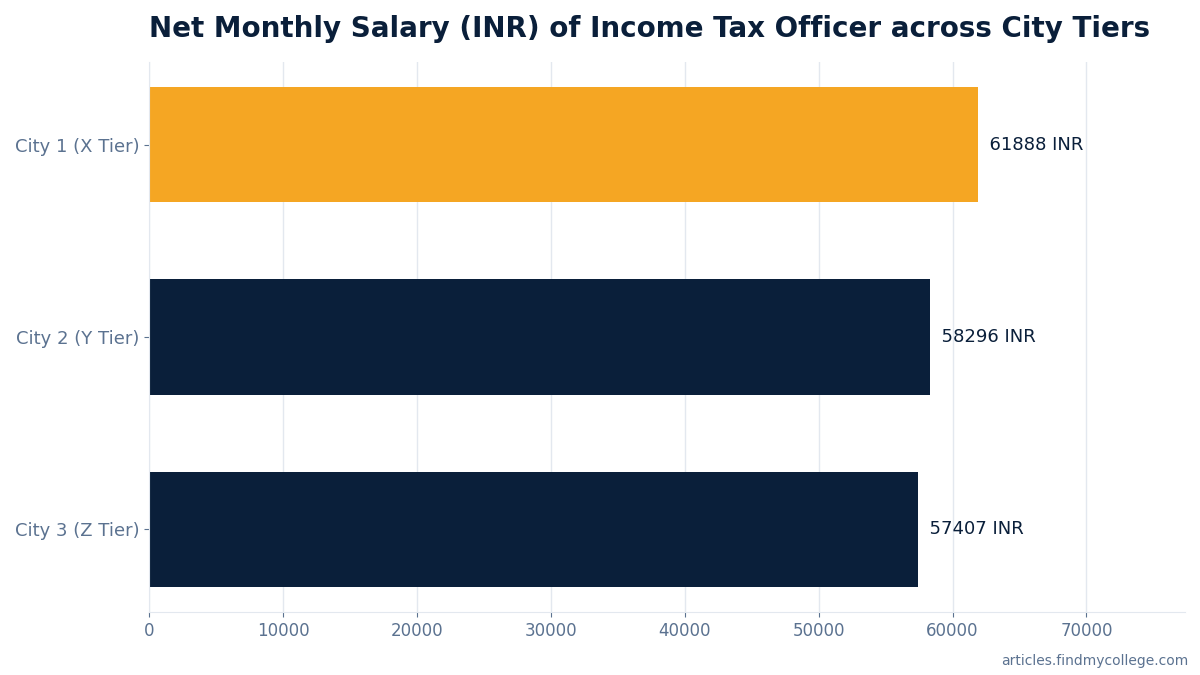
An entry-level Income Tax Inspector receives a basic pay of ₹44,900 per month under Pay Level 7. After adding allowances and subtracting standard deductions, the net monthly salary ranges from ₹57,407 in City 3 to ₹61,888 in City 1.
Career Growth
Career progression within the Central Board of Direct Taxes follows a structured hierarchy based on service tenure and departmental promotions. Candidates entering via SSC CGL start as Income Tax Inspectors and advance to Group B Gazetted Officers before reaching senior administrative roles.
| Hierarchy Level | Designation / Ranks | Entry Mode / Progression |
|---|---|---|
| Level 1 (Entry via SSC) | Income Tax Inspector (Group C) | Direct entry via SSC CGL |
| Level 2 | Income Tax Officer (ITO – Group B Gazetted) | Promoted after 4–6 years of service as Inspector |
| Level 3 (Entry via UPSC) | Assistant Commissioner of Income Tax | Direct entry via UPSC CSE (IRS) or promotion from ITO |
| Level 4 | Deputy Commissioner of Income Tax | Departmental promotion |
| Level 5 | Joint Commissioner of Income Tax | Departmental promotion |
| Level 6 & Above | Commissioner of Income Tax & Senior IRS Ranks | Senior executive promotions under CBDT |
Post-Selection Training and Probation Process
- SSC CGL recruited candidates undergo professional training at the Direct Taxes Regional Training Institute (DTRTI).
- UPSC IRS recruits undergo specialized officer training at the National Academy of Direct Taxes (NADT).
- Newly allocated Income Tax Officers undergo a probation period of approximately two years prior to final confirmation.
Newly allocated Income Tax Officers must complete their designated institutional training and a two-year probation period prior to final confirmation.
How to Start a Career as Income Tax Officer: Step by Step
- Complete Class 12 / Higher Secondary Education: Candidates cannot become an Income Tax Officer directly after Class 12 and must first complete an undergraduate degree to sit for SSC CGL or UPSC CSE.
- Obtain a Bachelor’s Degree: Earn a Bachelor’s degree in any discipline (Arts, Science, Commerce, Engineering) from a recognized university, which is mandatory to sit for ITO recruitment exams.
- Apply for Entrance Examinations: Register for either the SSC CGL examination (to join as an Income Tax Inspector) or the UPSC Civil Services Examination (for direct entry as an IRS Assistant Commissioner).
- Clear Selection Stages: Qualify all selection stages, including Tier I objective tests and Tier II CBT for SSC CGL, or Prelims, Mains, and the Personality Test for UPSC CSE.
- Undergo Document Verification & Background Check: Complete document verification to verify document authenticity and pass background checks ensuring required integrity and ethical standards.
- Receive Allotment and Complete Professional Training: Receive an official appointment letter and complete specialized training at the Direct Taxes Regional Training Institute (DTRTI) for SSC recruits or NADT for UPSC IRS officers.
- Complete Probation Period: Serve a probation period of approximately two years prior to final confirmation as an officer.
Candidates must earn a Bachelor’s degree in any discipline to qualify for SSC CGL or UPSC CSE examinations. Recruits undergo specialized training at DTRTI or NADT and complete a two-year probation period.
FAQs
How can we become an income tax officer?
You must earn a Bachelor’s degree from a recognized university and qualify either the SSC CGL exam (joining as Income Tax Inspector, promoted to ITO in 4–6 years) or the UPSC Civil Services Exam (joining directly as IRS Assistant Commissioner).
How to become income tax officer after 12th?
You cannot become an Income Tax Officer directly after Class 12. You must first complete an undergraduate degree in any discipline to become eligible for the SSC CGL or UPSC CSE exams.
What is the age limit for SC candidates to apply for SSC CGL?
The general age limit for SSC CGL is 18 to 30 years. SC candidates receive a 5-year upper age relaxation, making their age limit 18 to 35 years.
How to become income tax officer without upsc?
You can bypass UPSC by appearing for the SSC Combined Graduate Level (CGL) examination. Clearing SSC CGL recruits you as an Income Tax Inspector (Pay Level 7), with promotion to Income Tax Officer after 4 to 6 years.
What is the salary of an Income Tax Officer?
The basic pay for a Level 7 Income Tax Inspector/Officer is ₹44,900. Including allowances like HRA, DA, and TA, the gross salary ranges from ₹60,337 to ₹67,521, resulting in a net monthly in-hand salary of ₹57,407 to ₹61,888.
Income Tax Officer eligibility for Female?
Eligibility requirements include Indian citizenship, a Bachelor’s degree in any discipline, and an age limit of 18–30 years for SSC CGL or 21–32 years for UPSC CSE, alongside applicable category age relaxations.