IBM AI Engineering Professional Certificate: Program Structure, Top Platforms, Modules, and Career Impact 2026
IBM, in collaboration with Coursera, offers the updated IBM AI Engineering Professional Certificate, featuring its V3 curriculum for 2026. This professional certificate defines a structured learning pathway designed to equip individuals with practical skills in AI engineering. It directly addresses the surging demand in the global AI market, projected by Forbes to grow at a staggering 37.3% CAGR by 2030, with Generative AI alone seeing a 46% CAGR by 2030 (Statista). The program was accessible on Coursera at a promotional annual cost of $199 for the first year through February 2, 2026.
IBM AI Engineering Professional Certificate 2026: Program Overview
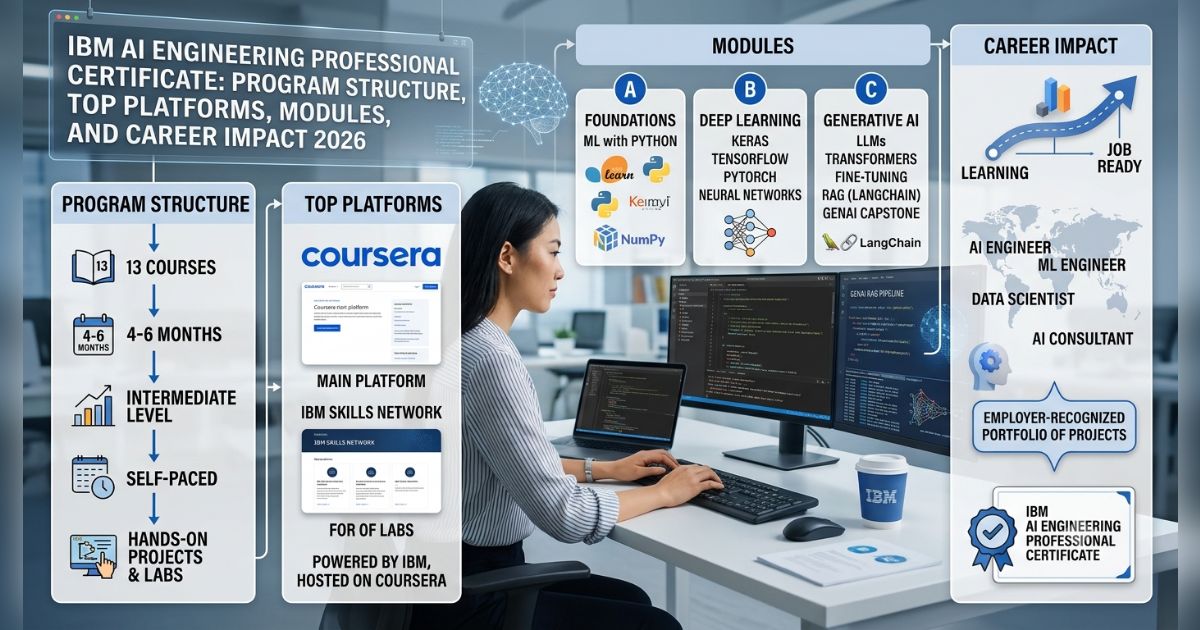
The IBM AI Engineering Professional Certificate, updated for 2026, is an intermediate-level program on Coursera. This comprehensive 13-course series helps you become a job-ready AI engineer, focusing on practical skills and portfolio building.
- Program Name: IBM AI Engineering Professional Certificate
- Platform: Coursera
- Program Level: Intermediate
- Structure: 13-course series
- Estimated Duration: 4 months at 10 hours/week (less than six months)
- Overall Rating: 4.6 out of 5 stars from 22,195 reviews
This program offers flexible, self-paced learning with hands-on labs in IBM Skills Network, awarding an IBM digital badge and shareable certificate. The V3 curriculum, updated for 2026, emphasizes Machine Learning, Deep Learning, and Generative AI, with expanded focus on LLMs and RAG.
| Aspect | Details |
| Total Enrollments | 258,789 already enrolled |
| Languages | Primary: English; Available in 19 languages |
| Core Curriculum Focus | Machine Learning (ML), Deep Learning (DL), Generative AI (GenAI) |
| Key Skills Gained | Supervised/unsupervised ML, deep learning models (CNNs, RNNs, autoencoders, transformers), GenAI applications (LLMs, RAG, fine-tuning, agentic workflows), computer vision, NLP. |
| Key Tools/Libraries | Python, SciPy, ScikitLearn, Keras, PyTorch, TensorFlow, Apache Spark, PySpark, Hugging Face, LangChain, Gradio, Vector Databases. |
| Practical Experience | Graded labs and projects, including an image classification model and an end-to-end GenAI RAG application, to build your portfolio. |
| Target Audience | Data scientists, ML engineers, software engineers, developers, and other technical specialists with basic Python and some data analysis experience, aiming to become job-ready AI engineers and build a portfolio. |
| Market Context | Global AI market projected 37.3% CAGR by 2030; Generative AI 46% CAGR by 2030; Deep Learning 23% annually to 2030. |
| Cost (Coursera Plus) | Approximately $59/month or $399/year. Promotional $199 for the first year was available through February 2, 2026. |
| Financial Aid | Available for eligible learners. |
IBM AI Engineering Professional Certificate: Top Platforms, Fees, Rankings, Admission 2026
The IBM AI Engineering Professional Certificate is one of the most recognised online credentials for building practical machine learning and deep learning skills. It is offered primarily through Coursera, is fully self-paced, and does not follow a traditional college admission cycle, which makes it a flexible option for students and working professionals in 2026.
| Platform | Access Type | Approx. Fee | Duration | Certification Provider |
| Coursera | Official primary platform | Around USD 39 to 49 per month through a Coursera subscription, or included in Coursera Plus | About 3 to 6 months at a recommended pace | IBM, issued through Coursera |
| IBM SkillsBuild | Free supporting platform | Free | Self-paced | IBM |
| Franklin University FranklinWorks Marketplace | Alternate access route | Around USD 35 per month subscription | 4 to 5 months | IBM delivered via Coursera content |
| Coursera audit mode | Free content access without a certificate | Free to learn, paid only for the certificate | Self-paced | Certificate not issued unless paid |
Eligibility
There is no formal academic degree requirement to enrol, since the program is designed as a professional upskilling certificate rather than a university degree. However, learners are expected to have basic Python programming knowledge before starting, since the courses build on foundational coding skills rather than teaching them from scratch.
Rankings and reputation
While this certificate does not have a traditional college ranking, IBM’s AI Engineering track is considered one of the strongest professional AI credentials on Coursera due to its brand recognition and depth of technical coverage. Industry commentary consistently places IBM among the top providers for enterprise-oriented AI engineering skills, alongside Google for beginner-friendly AI courses and Microsoft for Azure-based AI engineering.
Fees overview
Coursera pricing for the IBM AI Engineering Professional Certificate is subscription-based rather than a one-time fee, so total cost depends on how many months a learner takes to complete it. On average, most learners pay in the range of about USD 39 to 49 per month, meaning the total cost for a 3 to 6 month completion is usually in the range of roughly USD 120 to 300, depending on pace.
Comprehensive Curriculum: IBM AI Engineering Certificate Modules and Skills 2026
The ibm ai engineering professional certificate offers a comprehensive 13-course series, designed to equip you with essential skills in both classic machine learning and cutting-edge Generative AI. This intermediate-level program spans approximately four months, requiring about 10 hours per week.
| Course Number | Course Title | Estimated Hours |
| 1 | Machine Learning with Python | 20 hours |
| 2 | Introduction to Deep Learning & Neural Networks with Keras | 10 hours |
| 3 | Deep Learning with Keras and TensorFlow | 23 hours |
| 4 | Introduction to Neural Networks and PyTorch | N/A |
| 5 | Deep Learning with PyTorch | N/A |
| 6 | AI Capstone Project with Deep Learning | N/A |
| 7 | Generative AI and LLMs: Architecture and Data Preparation | N/A |
| 8 | GenAI Foundational Models for NLP & Language Understanding | N/A |
| 9 | Generative AI Language Modeling with Transformers | N/A |
| 10 | Generative AI Engineering and Fine‑Tuning Transformers | N/A |
| 11 | Generative AI Advanced Fine‑Tuning for LLMs | N/A |
| 12 | Fundamentals of AI Agents Using RAG and LangChain | N/A |
| 13 | Project: Generative AI Applications with RAG and LangChain | N/A |
The curriculum details 13 courses, progressing from foundational machine learning to advanced Generative AI and LLM applications, including a dedicated capstone project.
The program’s curriculum has evolved to blend classic machine learning with modern Generative AI and Large Language Models (LLMs), incorporating transformers, fine-tuning, RAG, and agentic workflows.
- Deep Architectures: Build, train, deploy CNNs, RNNs, autoencoders, and generative AI models.
- Machine Learning: Implement supervised and unsupervised machine learning models effectively.
- Library Application: Apply popular libraries like Keras, PyTorch, TensorFlow, SciPy, ScikitLearn.
- Generative AI Apps: Build Generative AI applications using LLMs, RAG, Hugging Face, LangChain.
You will engage with the learning environment through cloud-based, in-browser labs provided by IBM Skills Network, requiring no GPU.
- Image Classification: Develop an image classification model.
- Generative AI RAG: Create an end-to-end Generative AI RAG application.
- Deep Learning Capstone: Complete a comprehensive Deep Learning capstone project.
Upon completing the program, you will acquire a robust set of skills, including expertise in:
- Generative AI Agents: Design and implement AI agents.
- Large Language Modeling: Master large language model concepts.
- Retrieval-Augmented Generation: Apply RAG techniques effectively.
- Fine-tuning: Optimize models through fine-tuning.
- Generative Model Architectures: Understand various generative architectures.
- LLM Application: Develop practical LLM applications.
The program introduces you to essential tools and frameworks for AI engineering, such as:
- Hugging Face: Utilize for transformer models.
- LangChain: Build LLM-powered applications.
- PyTorch: Work with this machine learning library.
- TensorFlow: Apply this deep learning framework.
- Keras: Use for neural network development.
- Python Programming: Master core Python skills.
Course 1, “Machine Learning with Python,” focuses on fundamental skills like:
- Python Programming: Develop strong programming foundations.
- Supervised Learning: Implement various supervised algorithms.
- Unsupervised Learning: Apply unsupervised learning techniques.
- Scikit Learn: Utilize this machine learning library.
- Regression Analysis: Perform data regression analysis.
- Classification Algorithms: Understand and apply classification methods.
Course 2, “Introduction to Deep Learning & Neural Networks with Keras,” builds your expertise in areas such as:
- Deep Learning: Grasp core deep learning concepts.
- Keras: Work with the Keras neural network library.
- Convolutional Neural Networks: Implement CNN architectures.
- Recurrent Neural Networks (RNNs): Understand and apply RNNs.
- Artificial Neural Networks: Build foundational ANN models.
- Transfer Learning: Apply pre-trained models effectively.
Applied Learning Projects: Real-World AI Engineering Scenarios 2026
This section details the practical, hands-on learning experience offered by the ibm ai engineering professional certificate. You will engage in project work designed to build and showcase real-world AI engineering skills, preparing you for employment opportunities.
- Applied Learning Focus: Hands-on, practical projects showcase your skills to employers.
- Program Approach: Integrates labs and projects to build practical experience and fine-tune competencies.
- Real-World Scenarios: Apply popular libraries to industry problems like object recognition, NLP, and recommender systems.
- Generative AI Dev: Build Generative AI apps using LLMs and RAG with Hugging Face and LangChain.
- Employment Outcome: Create a portfolio demonstrating practical expertise to potential employers.
- Hands-on Datasets: Build and assess end-to-end ML solutions on real-world datasets through labs and evaluations.
Beyond these key areas, the certificate emphasizes a wide range of core project activities to ensure comprehensive skill development.
| Activity Area | Key Technologies/Concepts |
| Deep Learning Models | Keras, PyTorch, TensorFlow |
| Machine Learning & NLP | SciPy, ScikitLearn, positional encoding, attention, document classification |
| Large Language Model Creation | GPT, BERT |
| NLP Transfer Learning | LangChain, Hugging Face, PyTorch |
| Model Interaction & QA Bots | Gradio interface, LangChain, LLM |
How to Earn the IBM AI Engineering Professional Certificate on Coursera 2026
Embark on a journey to enhance your AI skills with the **ibm ai engineering professional certificate**. This section outlines key details about the program, helping you understand its structure, duration, and the valuable credentials you will earn upon completion. Discover how this flexible program can advance your career.
- Program Duration: Complete this program in 4 months, dedicating approximately 10 hours each week.
- Number of Courses: The program consists of a comprehensive 13-course series.
- Certificate Type: You will earn a shareable certificate upon successful completion.
- Credential Earned: This career credential demonstrates your expertise in AI engineering.
- Recognition: IBM provides this employer-recognized certificate, enhancing your professional standing.
- Learning Pace: Learn at your own pace with a flexible schedule that fits your life.
IBM Generative AI Engineering Professional Certificate 2026: Key Differences and Focus
The IBM Generative AI Engineering Professional Certificate is designed for beginners, offering comprehensive training in generative AI. This section details its core focus, learning outcomes, and key differences from the **ibm ai engineering professional certificate**, highlighting its relevance for future AI careers.
- Target Audience: Beginners with no prior AI, Python, or ML experience.
- Level: Beginner level.
- Core Focus: Develop job-ready generative AI skills, LLMs, and NLP.
- Duration: 6 months at 6 hours/week (flexible schedule).
- Average Rating: 4.7 from 100,183 reviews.
- Key Difference: Designed for beginners, unlike the other certificate for intermediate learners.
This certificate provides extensive practical experience and covers a wide array of tools, preparing you for the rapidly growing generative AI market. Its design aligns with the anticipated demand for AI expertise.
| Feature | Detail |
| Course Series Length | 16 course series |
| Current Enrollment | 155,342 already enrolled |
| Key Learning Areas | AI, gen AI, prompt engineering, data analysis, machine learning, deep learning using Python |
| Practical Experience | Hands-on labs, guided project to create real-world gen AI apps, generating text, images, code |
| Key Tools Learned | Flask, PyTorch, BERT, GPT, LLaMA, RAG, LangChain, Vector Databases, ChatGPT |
| Market Growth Projection | Generative AI market expected to grow over 46% CAGR to 2030 |
| Language Options | Taught in English, with 19 languages available |
| Credential Type | Employer-recognized professional certificate from IBM |
| 2026 Relevance | Addresses emerging fields like generative AI, aligning with anticipated demand for AI expertise |
IBM AI Engineering Certificate vs Self-Learning: Career Growth 2026
Obtaining an ibm ai engineering professional certificate significantly boosts your career prospects in the AI field. Certified professionals can expect up to 20% higher average salaries and find that 65% of AI job postings either require or prefer such credentials, underscoring its value for career growth by 2026.
- Salary Increase: You can achieve up to 20% higher average salaries.
- Job Postings: 65% of AI job postings prefer certified talent.
- Employer Preference: Employers actively seek proven, certified professionals.
- Credibility & Visibility: Digital credentials enhance your profile on professional networks like LinkedIn.
- Practical Experience: Build a strong portfolio demonstrating your practical expertise.
- Career Advancement: Accelerate your career growth and open doors to leadership roles.
Frequently Asked Questions
What is the IBM AI Engineering Professional Certificate and its main focus?
The IBM AI Engineering Professional Certificate is a 13-course series for technical specialists. It focuses on skills using Python, Spark, Keras, TensorFlow, and PyTorch, culminating in a capstone project.
What are the steps to enroll in and complete this IBM AI certificate?
Enroll in 6 self-paced courses, each taking 4-5 weeks, covering watsonx, machine learning, and deep learning. Completing these expert-led courses earns an IBM digital credential.
What are the prerequisites or prior experience needed for this IBM AI certificate?
No prior experience, AI, or programming knowledge is required for this IBM AI certificate. It is suitable for individuals with either a technical or non-technical background.
What career opportunities can I pursue after completing the IBM AI certificate?
You can pursue AI engineering roles, leveraging job-ready skills in AI technologies, generative AI, machine learning, deep learning, and watsonx gained from this IBM training.
How does this IBM AI Engineering certificate compare to other industry AI certifications?
The IBM AI Engineering certificate aligns with global AI standards, offering practical skills in under 6 months. It is preferred by employers seeking proven talent, leading to measurable career uplift.
What is the estimated time commitment to complete the IBM AI Engineering certificate?
The IBM AI Engineering Professional Certificate is estimated to take 13 months to complete. Each of the 13 courses typically requires 4-5 weeks.