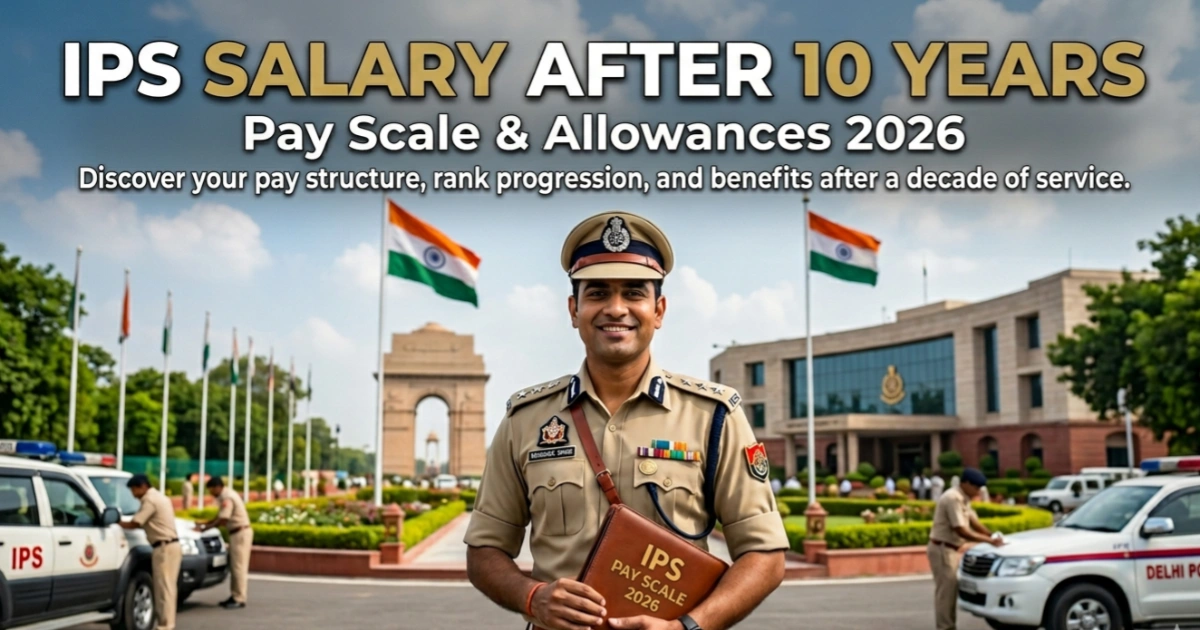
IPS Salary After 10 Years: Pay Scale, Allowances & Career Growth 2026
After a decade of dedicated service, an IPS officer experiences significant career progression and a substantial IPS Salary After 10 Years: Pay Scale & Career Growth, often reaching senior ranks with a monthly income well over ₹1,00,000. This reflects their enhanced responsibilities and the structured pay hikes under the 7th Pay Commission. Here, we explore the detailed pay structure, allowances, and the clear promotion path awaiting IPS officers in 2026.
IPS Salary After 10 Years: Pay Scale & In-Hand Income 2026
After 10 years of service, an IPS officer can expect a total monthly salary ranging from ₹1.35 lakh to ₹1.55 lakh, reflecting a significant IPS salary after 10 years. This section details the typical pay scale and in-hand income for officers at this career stage.
| Component | Amount (Approx.) |
| Basic Pay | ₹67,700 – ₹78,800 |
| Dearness Allowance (DA) | ₹34,000 – ₹40,000 |
| House Rent Allowance (HRA) | ₹18,000 – ₹21,000 |
| Transport Allowance | ₹7,200 |
| Other Allowances | ₹10,000 – ₹15,000 |
| Total Monthly Salary | ₹1.35 – ₹1.55 lakh |
This table illustrates the key components contributing to the total monthly IPS salary after 10 years, highlighting the substantial allowances in addition to the basic pay.
IPS Officer Rank-Wise Salary Structure & Pay Levels 2026
The IPS Officer salary structure for 2026, governed by the 7th Central Pay Commission, offers competitive remuneration across various ranks and pay levels. An entry-level officer starts with a basic pay of ₹56,100, while the apex level reaches ₹2,25,000 per month.
| IPS Rank | Basic Pay (₹/Month) | Approximate Monthly Salary (Including Allowances) (₹) |
| Deputy Superintendent of Police (DSP) | ₹56,100 – ₹1,77,500 (Level 10) | ₹79,000 |
| Additional Superintendent of Police (Addl. SP) | ₹67,700 – ₹2,08,700 (Level 11) | ₹94,000 |
| Superintendent of Police (SP) | ₹78,800 – ₹2,09,200 (Level 12) | ₹1,00,000+ |
| Deputy Inspector General of Police (DIG) | ₹1,31,100 – ₹2,16,600 (Level 13A) | ₹1,50,000+ |
| Inspector General of Police (IG) | ₹1,44,200 – ₹2,18,200 (Level 14) | ₹1,60,000+ |
| Additional Director General (ADG) | ₹1,82,200 – ₹2,24,400 (Level 15) | ₹2,00,000+ |
| Director General of Police (DGP) | ₹2,25,000 (Apex Scale) | ₹2,25,000+ (Fixed, top scale) |
| IPS Officer Initial and Maximum Salary: IPS Starting Salary | Assistant Superintendent of Police | Junior time scale | ₹56,100 —₹132,000 |
| IPS Officer Initial and Maximum Salary: Highest Salary of IPS Officer | Director General of Police | Apex Level | ₹225,000 |
This table provides a clear overview of the IPS Salary After 10 Years, with officers typically reaching the rank of Superintendent of Police (SP) and earning an approximate monthly salary of ₹1,00,000+. This progression highlights significant career growth and an improved Pay Scale over time.
IPS Officers Allowances, Perks & Benefits 2026
IPS officers receive a comprehensive package of allowances, perks, and benefits, significantly enhancing their overall compensation. The anticipated 8th Pay Commission in 2026 is expected to further revise these, impacting the IPS Salary After 10 Years, along with the pay scale and career growth prospects.
- Dearness Allowance (DA): Approximately 50% – 53% of Basic Pay, adjusted biannually.
- House Rent Allowance (HRA): 9% to 27% of basic pay, based on city classification.
- Medical Benefits: Free healthcare for officers and their dependents under CGHS.
- Official Accommodation: Government-provided bungalows or quarters, or nominal rent.
- Pension & Post-Retirement: Significant benefits, including a lifelong pension and gratuity.
- Official Vehicle: A government vehicle with a driver for official duties.
Beyond these core benefits, IPS officers also enjoy a range of additional perks and allowances that contribute to their quality of life and operational effectiveness, further shaping the IPS Salary After 10 Years and overall career trajectory.
| Benefit/Allowance | Description |
| Travel Allowance (TA) | Covers expenses incurred during official travel, fixed by city and rank. |
| Security and Staff | Senior officers get personal security and household staff/guards. |
| Subsidised Utilities | Electricity, water, telephone bills, and housing are often subsidised. |
| Club Memberships | Access to government clubs, gyms, and recreational facilities. |
| Special Duty Allowance | For postings in difficult or border areas. |
| Security Allowance | Based on threat perception. |
| Leave Travel Concession (LTC) | Reimbursed travel expenses for officers and their families. |
| Foreign Postings | Opportunities for deputation to international organizations or embassies. |
| Education Allowance | For children’s education, subject to certain conditions. |
| Access to Government Facilities | Priority access to various government services and facilities. |
| Special Security Allowance | Additional allowance for officers serving in central agencies like IB, CBI, or RAW. |
| 8th Pay Commission Impact (2026) | Anticipated to revise allowances, aligning with revised basic pay. |
IPS vs IAS Salary After 10 Years: A Comparative Analysis 2026
After 10 years of service, an IPS officer typically reaches the rank of Superintendent of Police (SP) or Senior Superintendent of Police (SSP), with a total monthly salary ranging from ₹1.35 to ₹1.55 lakh. This section details the comparative pay scales for IPS and IAS officers.
| Pay Level | Grade | Basic Pay (Rs./month) | Typical Post | Years of Service |
| Level 10 | Junior Time Scale (JTS) | 56,100 | Sub-Divisional Magistrate, Assistant Collector, ASP | 0–4 |
| Level 11 | Senior Time Scale (STS) | 67,700 | Under Secretary (GoI), Additional District Magistrate, SP | 4–9 |
| Level 12 | Junior Administrative Grade (JAG) | 78,800 | District Magistrate, Deputy Secretary (GoI), SSP/DIG | 9–13 |
| Level 13 | Selection Grade | 1,18,500 | DM (larger districts), Director (GoI), DIG | 13–16 |
| Level 14 | Senior Administrative Grade (SAG) | 1,44,200 | Commissioner, Joint Secretary (GoI), IG | 16–24 |
| Level 15 | Higher Administrative Grade (HAG) | 1,82,200 | Principal Secretary (state), Additional Secretary (GoI), ADG | 25–30 |
| Level 16 | HAG+ | 2,05,400 | Additional Chief Secretary, ADG | 30+ |
| Level 17 | Apex Scale | 2,25,000 (fixed) | Chief Secretary (state), Secretary (GoI), DGP | 30+ |
| Level 18 | Cabinet Secretary | 2,50,000 (fixed) | Cabinet Secretary of India | Top of service |
This table illustrates the structured progression of IPS Salary After 10 Years and beyond, showing how officers advance through different pay levels and ranks. It highlights the typical career growth path within the civil services.
Career Growth & Promotion Path for IPS Officers 2026
The career growth path for IPS officers is structured, leading to significant advancements in rank and remuneration. Officers typically see substantial progression, with the 8th Central Pay Commission in 2026 poised to further enhance IPS Salary After 10 Years — Pay Scale & Career Growth.
- Initial Designation: DySP or ACP
- Progression Path: From DySP to DGP, through various higher ranks.
- Advancement Basis: Seniority, performance, and departmental examinations.
- Rank After 5 Years: Typically achieve Senior Time Scale.
- Rank After 10 Years: SP or SSP, entering Junior Administrative Grade.
- Promotion Impact: Basic pay, allowances, authority, and benefits expand.
This structured progression ensures officers gain significant experience and responsibility, with promotions directly impacting their financial standing and administrative capabilities. The IPS Salary After 10 Years — Pay Scale & Career Growth is further influenced by periodic pay commission revisions.
| Aspect | Details |
| Future Pay Commission (2026) | 8th Central Pay Commission expected to enhance salaries and revise allowances for levels 10-18, effective January 2026. |
The upcoming 8th Central Pay Commission in 2026 is set to significantly improve the financial prospects for IPS officers across various experience levels.
Frequently Asked Questions
What is the salary of an IPS officer after 10 years of service?
After 10 years, an IPS officer typically reaches the rank of SP or SSP, with a basic pay of ₹78,800 to ₹1,18,500 per month. Including Dearness Allowance, HRA, and other allowances, the total monthly in-hand salary generally ranges between ₹1,35,000 and ₹1,55,000 per month.
What rank does an IPS officer hold after 10 years?
After 10 years of service, an IPS officer usually progresses to the rank of Superintendent of Police (SP) or Senior Superintendent of Police (SSP). This places them at Pay Level 12 or 13, with significantly higher basic pay and responsibilities compared to their entry-level posting.
What is the starting salary of an IPS officer in India?
An IPS officer begins their career as an Assistant Superintendent of Police (ASP) at a basic pay of ₹56,100 per month under Pay Level 10. After deductions, the approximate in-hand salary at entry level is around ₹54,000 to ₹76,000 per month, depending on city of posting.
What allowances do IPS officers receive over and above basic pay?
IPS officers receive Dearness Allowance at approximately 50% of basic pay, House Rent Allowance ranging from 9% to 27%, Transport Allowance, Medical Benefits under CGHS, and Special Duty Allowance for difficult postings. Senior officers also receive an official government vehicle, accommodation, and personal security staff.
What is the difference between IPS and IAS salary after 10 years?
Both IPS and IAS officers follow the same 7th Pay Commission pay matrix. The key difference is the maximum pay ceiling — an IAS officer can reach ₹2,50,000 per month at Cabinet Secretary level, while the IPS maximum is ₹2,25,000 per month at the DGP or equivalent level.
What is the highest salary an IPS officer can earn?
The Director General of Police (DGP) is the highest rank an IPS officer can achieve, drawing a fixed apex-scale pay of ₹2,25,000 per month. With allowances included, the total in-hand salary at this level can reach close to ₹3,10,000 per month, making it one of the top government pay scales.
Will the 8th Pay Commission affect IPS officer salaries in 2026?
Yes, the 8th Pay Commission is expected to revise IPS officer salaries upward across all pay levels. Based on a projected fitment factor of 2.0 to 2.25, entry-level basic pay could rise to approximately ₹67,320 per month, with proportional increases in DA, HRA, and other linked allowances.