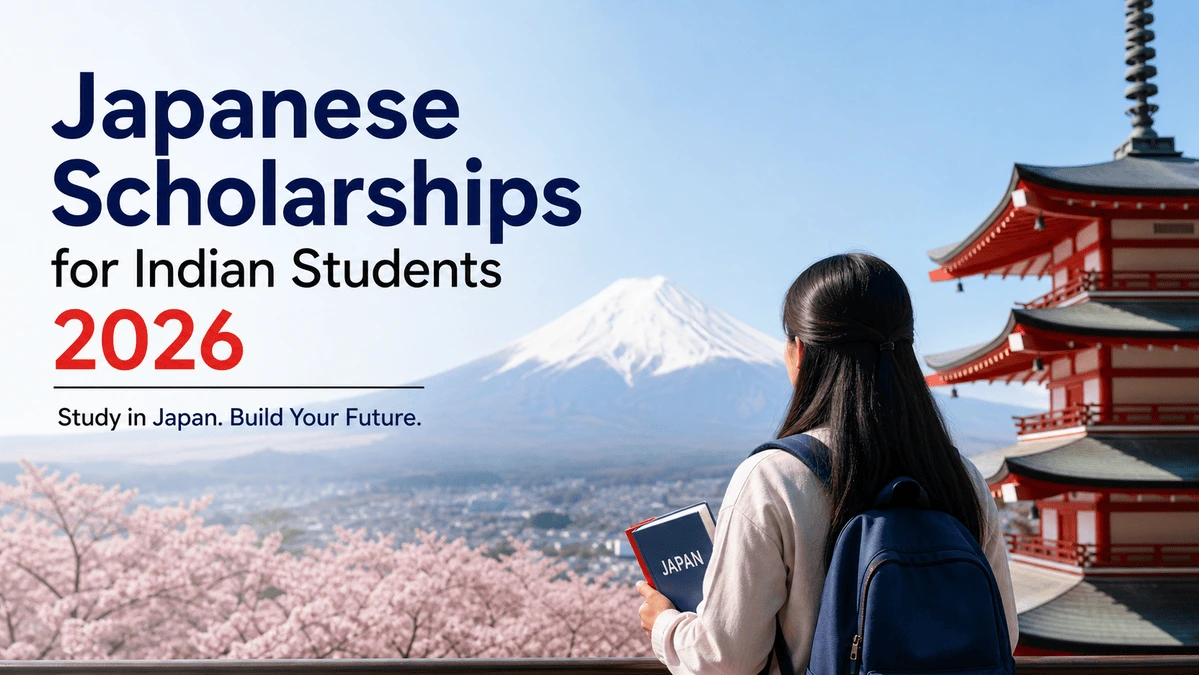
Japanese Scholarships for Indian Students 2026: Opportunities and Application
This guide covers major Japanese scholarships for Indian students in 2026, including MEXT, JASSO scholarships, Mitsui and Co Scholarship and more. Explore their eligibility, benefits, and application steps.
Aspiring Indian students can unlock world-class education through a variety of prestigious Japanese Scholarships For Indian Students, with numerous opportunities available for the 2026 academic year. Popular Japanese scholarships for Indian students include JASSO scholarships, MEXT scholarship, Mistui and Co. Scholarship, Honjo International Scholarship and many more. These fully-funded programs, from government-backed MEXT to private sector grants, typically cover tuition, living expenses, and travel, making studying in Japan a tangible reality. This article details the top scholarships, eligibility, application processes, and key distinctions between government and private funding for your 2026 journey.
Japanese Scholarships for Indian Students 2026–27 Overview
This section introduces the major scholarships available for Indian students planning to study in Japan for the 2026–27 academic cycle. These scholarships range from fully funded government programs to private and university-specific awards. Indian students can pursue these Japanese scholarships after graduation for their PG, PhD and other higher degrees.
Japan continues to expand opportunities for international students, with a target of hosting over 5,000 Indian students in the coming years.
Comprehensive List of Japanese Scholarships (2026)
| Scholarship | Funded By | Level | Monthly Stipend (Approx.) | Tuition | Airfare | Japanese Required |
| MEXT (Embassy Route) | Japanese Government | UG / PG / PhD / Research | ₹70,000 – ₹90,000 | Full waiver | Yes | No (preferred) |
| MEXT (University Route) | Japanese Government | PG / PhD / Research | ₹70,000 – ₹90,000 | Full waiver | Yes | No (preferred) |
| JASSO Honors Scholarship | Japan Student Services Org | UG / PG / PhD | ₹27,000 | No | No | Preferred |
| JASSO Exchange Program | Japan Student Services Org | Short-term Exchange | ₹46,000 | No | No | Depends |
| Honjo International Scholarship | Private Foundation | Master’s / PhD | ₹1,25,000 – ₹1,55,000 | No | No | No |
| ADB–Japan Scholarship | ADB + Japan Govt | Master’s | Living allowance | Full | Yes | No |
| World Bank–Japan Scholarship | World Bank + Japan | Master’s | Living allowance | Full | Yes | No |
| Mitsui & Co. India Scholarship | Mitsui & Co. | UG (Class 12 entry) | Covered | Full | Yes | Yes (training provided) |
| University-specific (UTokyo, Kyoto, etc.) | Individual Universities | UG / PG / PhD | Varies | Partial / Full | Varies | Varies |
JASSO Scholarships (Japan Student Services Organization)
The Japan Student Services Organization (JASSO) offers financial support to international students planning to study in Japan, including applicants from India. For Indian students, the two most relevant JASSO options are the Monbukagakusho Honors Scholarship for Privately-Financed International Students and the Student Exchange Support Program (Scholarship for Study in Japan under Agreement).
| JASSO Scholarship | Who It Is For | Study Level / Type | Monthly Stipend | Tuition Coverage | Airfare | Key Notes |
|---|---|---|---|---|---|---|
| Monbukagakusho Honors Scholarship for Privately-Financed International Students | Indian students who are self-funded and studying/admitted to a Japanese higher education institution | UG / PG / PhD / Japanese language schools | ¥48,000/month for university/graduate-level students; ¥30,000/month for Japanese language school students | No separate tuition waiver under JASSO | No | Intended for academically strong privately financed international students with financial need; support amount may vary by institution type/fiscal year. |
| Student Exchange Support Program (Scholarship for Study in Japan under Agreement) | Indian students going to Japan under a formal exchange agreement between their home institution and a Japanese institution | Short-term exchange (typically 8 days to 1 year) | ¥80,000/month | No separate tuition waiver under JASSO | No | Designed for exchange students accepted by Japanese higher education institutions under institutional agreements. |
JASSO Scholarships for Indian Students: Application Process
The application process for JASSO scholarships varies by scholarship type, as students usually do not apply directly to JASSO. Instead, applications are generally routed through the Japanese institution, language school, or exchange university.
| JASSO Scholarship | Application Process |
|---|---|
| Monbukagakusho Honors Scholarship for Privately-Financed International Students | Indian students can usually apply through their Japanese university or institution after admission. In some cases, students applying to undergraduate courses may also be considered through the EJU-linked reservation program before coming to Japan. The final recommendation is generally made by the institution to JASSO. |
| Student Exchange Support Program (Scholarship for Study in Japan under Agreement) | Students do not apply directly to JASSO. The scholarship is usually processed through the Indian home institution and Japanese host university under an official exchange agreement, with the host institution submitting the application to JASSO. |
MEXT Scholarship 2026 – Eligibility & Key Details
The MEXT Scholarship (Monbukagakusho) is one of the most prestigious fully funded scholarships offered by the Government of Japan. It supports Indian students pursuing undergraduate, postgraduate, and research-level studies.
- Monthly Stipend: ¥144,000 (≈ ₹84,700) for Master’s or Professional Degree/ ¥145,000 (≈ ₹85,300) for Doctoral Program
- Level: Master’s / PhD / Research Programs
- Age Limit: Under 35 years (Research students)
- Minimum Academic Requirement: Bachelor’s degree with 70% (Master’s), Master’s degree with 70% (PhD)
- Coverage: Full tuition waiver + airfare + monthly stipend
- Email: scholarship-india@nd.mofa.go.jp
- Phone: +91-11-46104865
- Address: Japan Information Centre, 50-G Shantipath, Chanakyapuri, New Delhi – 110021
MEXT Scholarship 2026 Application Timeline
| Stage | Date |
| Preliminary Application Deadline (Research) | May 13, 2026 |
| Preliminary Application Deadline (UG Path) | May 25, 2026 |
| Written Examination | June 28, 2026 |
| Interview Round | Early July 2026 |
MEXT Application Process (Simplified Steps)
This section explains how Indian students can apply for the MEXT scholarship.
Step 1: Preliminary Application: Submit your application via email with academic documents.
Step 2: Screening: Applications are shortlisted based on academic merit and eligibility.
Step 3: Written Test: Selected candidates appear for a written examination.
Step 4: Interview Round: Final shortlisted candidates are interviewed by the embassy.
Step 5: Final Selection: Successful candidates receive confirmation and visa guidance.
Mitsui & Co. Scholarship 2026 – Overview
The Mitsui & Co. Scholarship Program for India 2026 is a fully structured undergraduate scholarship designed for Indian students who wish to study in Japan. It includes language training, university education, and complete financial support.
The total program duration is 5.5 years, which includes Japanese language preparation followed by undergraduate study in Japanese universities.
| Parameter | Details |
|---|---|
| Scholarship Name | Mitsui & Co. Scholarship Program for India 2026 |
| Offered By | Mitsui & Co., Ltd. |
| Level | Undergraduate (Bachelor’s Degree) |
| Eligibility | Indian students applying for undergraduate study in Japan under the scholarship’s prescribed academic and age criteria |
| Total Duration | 5.5 Years (1.5 Years Language + 4 Years University) |
| Monthly Stipend | ¥145,000 (≈ ₹80,000 – ₹85,000) |
| Benefits | Full tuition fee coverage (entrance and annual fees), lodging subsidy of ¥5,000 per month during university years, free textbooks and study materials, round-trip airfare between India and Japan, travel expenses for training in India, and medical/accident insurance coverage |
| Application Window | February 10 – February 22, 2026 |
| Departure to Japan | October 2026 |
| University Enrollment | April 2028 |
| Application Mode | Online (Forms-based application) |
Key Benefits of Japanese Scholarships
Japanese scholarships offer strong financial and academic support for international students.
- Full or partial tuition fee waiver
- Monthly stipend for living expenses
- Airfare support (select scholarships)
- Access to top universities like University of Tokyo and Kyoto University
- Opportunity to work in Japan after graduation
- Exposure to advanced research and technology
Which Japanese Scholarship Should You Choose?
The right Japanese scholarship depends on your study level, funding needs, and whether you are applying before admission or after securing entry to a Japanese university.
| Scholarship Type | Best For | What It Covers |
|---|---|---|
| MEXT Scholarship | Students seeking fully funded undergraduate, postgraduate, or PhD studies in Japan | Tuition fees, monthly stipend, and airfare |
| JASSO Scholarships | Exchange students or privately financed students already studying in Japan | Monthly living stipend; usually does not cover full tuition or airfare |
| University Scholarships | Students applying to or already admitted to Japanese universities | May offer tuition waivers, stipends, or both, depending on the university |
| Private Scholarships | High-achieving, meritorious, or research-focused students | Varies by scholarship; often competitive and may offer substantial stipends |
| International Scholarships (ADB / World Bank) | Master’s students in development-related fields | Usually fully funded, including tuition, living allowance, and travel support |
Eligible and Ineligible Fields of Study
Japanese scholarships mainly support fields like science, engineering, technology, and social sciences. Some programs may restrict areas such as medicine, nursing, veterinary sciences, and arts.
Eligibility varies by scholarship, so applicants should always check specific requirements.
Eligible Fields
| Category | Subjects |
| Science & Engineering | Mathematics, Physics, Chemistry, Computer Science, Engineering, Agriculture |
| Commerce & Social Sciences | Economics, Management, Accounting, Finance, Marketing, Political Science, Law |
Ineligible Fields
- Medicine and Pharmaceutical studies
- Veterinary Sciences
- Nursing and caregiving
- Arts
- Physical Education
How to Apply for Japanese Scholarships from India (2026 Overview)
Indian students applying for Japanese scholarships (especially MEXT) generally follow two main application routes: Embassy Recommendation and University Recommendation.
- The Embassy Route is the most common pathway for Indian applicants.
- The University Route allows direct application through Japanese universities with professor supervision.
Early preparation is essential, as applications require academic documents, exams, and interviews spread across several months.
Application Routes, Timeline & Selection Process (2026)
| Aspect | Details |
| Application Routes | Embassy Recommendation / University Recommendation |
| Preliminary Deadline | May 13, 2026 (11:59 pm via email) |
| Written Exam | June 28, 2026 |
| Interview Round | Early July 2026 |
| Application Screening | May 2026 |
| Final Selection (Expected cycle reference) | November 2026 |
| Study Start (Approx.) | April or October (next academic cycle) |
| Preparation Time | Start 6–9 months in advance |
Key Notes:
- University route requires contacting professors at least 6 months before deadline
- Embassy route includes written exams + interview rounds
- Early preparation of SOP, documents, and academic transcripts is crucial
Embassy vs University Route (Key Exam Structure)
| Route | Exam Subjects | Notes |
| Embassy (Science) | Mathematics, Physics, Chemistry | Focus on technical subjects |
| Embassy (Humanities) | English, Mathematics, Japanese | Language-heavy focus |
| University Route | Varies by university | Often includes interviews + document screening |
Common Eligibility Criteria for Japanese Scholarships (2026)
Most Japanese scholarships have a few common eligibility conditions related to nationality, age, academic qualifications, and health, though exact criteria may vary by scholarship and study level.
| Category | Eligibility Details |
|---|---|
| Citizenship | Applicant must be a citizen of a country that has diplomatic relations with Japan, including India. |
| Medical Fitness | Applicant must be medically fit to study in Japan. |
| Japanese Language Requirement | Japanese language proficiency is generally not mandatory at the application stage, though it may be preferred for some scholarships/programs. |
| Academic Background | A strong academic record is required for most Japanese government and university scholarships. |
| Age Limit – Undergraduate | Usually under 25 years, though the exact age limit may vary slightly by scholarship. |
| Age Limit – Postgraduate / Research | Usually under 35 years for master’s, doctoral, and research-level scholarships. |
| Minimum Qualification for UG Entry | Completion of 12 years of formal education (Class 12 or equivalent) is generally required. |
| Master’s Eligibility | Bachelor’s degree with around 70% marks (sometimes 65% for humanities/social science applicants). |
| Doctoral Eligibility | Master’s degree with around 70% marks along with relevant academic/research background. |
| Research Student Eligibility | Generally requires 16 years of formal education. |
| College of Technology (KOSEN) Eligibility | Usually requires Class 10 completion or equivalent. |
| Teacher Training Eligibility | Applicant must have at least 5 years of teaching experience. |
Tips to Prepare Your Application for Japanese Scholarships
A well-prepared Japanese scholarship application depends on accuracy, strong supporting documents, and a clear academic purpose—not just good grades.
- Read the official scholarship guidelines carefully before filling the form
Check the latest eligibility rules, application route, required documents, and deadlines on the official scholarship page, as requirements can differ by scholarship and study level. - Write a focused study plan or statement of purpose
Clearly explain why you want to study in Japan, what you plan to study, how it connects to your academic background, and what you aim to do after the course. - Collect transcripts, certificates, and recommendation letters early
Official academic documents and recommendation letters often take time to arrange, and some scholarships require specific formats, sealed copies, or translations into English/Japanese. - Submit valid language scores and properly translated documents
If you are submitting IELTS, TOEFL, or Japanese language proof, ensure the scores are still valid and that any non-English documents are accompanied by official translations if required. - Review the full application before submission to avoid technical rejection
Recheck names, dates, signatures, document order, form versions, and missing attachments, because incomplete or inaccurate applications may be rejected even before academic evaluation.
FAQs
What types of Japanese scholarships are available for Indian students?
Indian students can apply for MEXT (Government of Japan), JASSO, private foundation scholarships, and university-specific scholarships. MEXT is the most popular fully funded option.
What are the minimum academic requirements for these scholarships?
Most scholarships require 60–75% marks or higher in the previous qualification, along with meeting the age criteria set by the program.
How can Indian students apply for MEXT scholarships?
Students can apply through the Japanese Embassy in India (Embassy Route) or University Recommendation, and submit applications before the deadline (around May 2026).
When is the application timeline for Japanese scholarships?
For MEXT 2026 intake, applications usually close around mid-May 2026, followed by exams in June and interviews in July.
What career opportunities are available after studying in Japan?
Students can work in IT, engineering, finance, and research sectors, and many receive job offers before graduation in Japan.
Are there age limits or field restrictions for applicants?
Yes. Undergraduate applicants are usually under 25, and research students under 35. Some scholarships also restrict eligible fields like medicine or nursing.