Jiwaji University B.Ed Syllabus 2026: Semester-Wise Subjects and Exam Pattern
Jiwaji University B.Ed syllabus includes subjects like Childhood & Growing Up, Education in India, Curriculum Development & School, Drama & Art in Education and others. Find detailed BEd syllabus in this article.
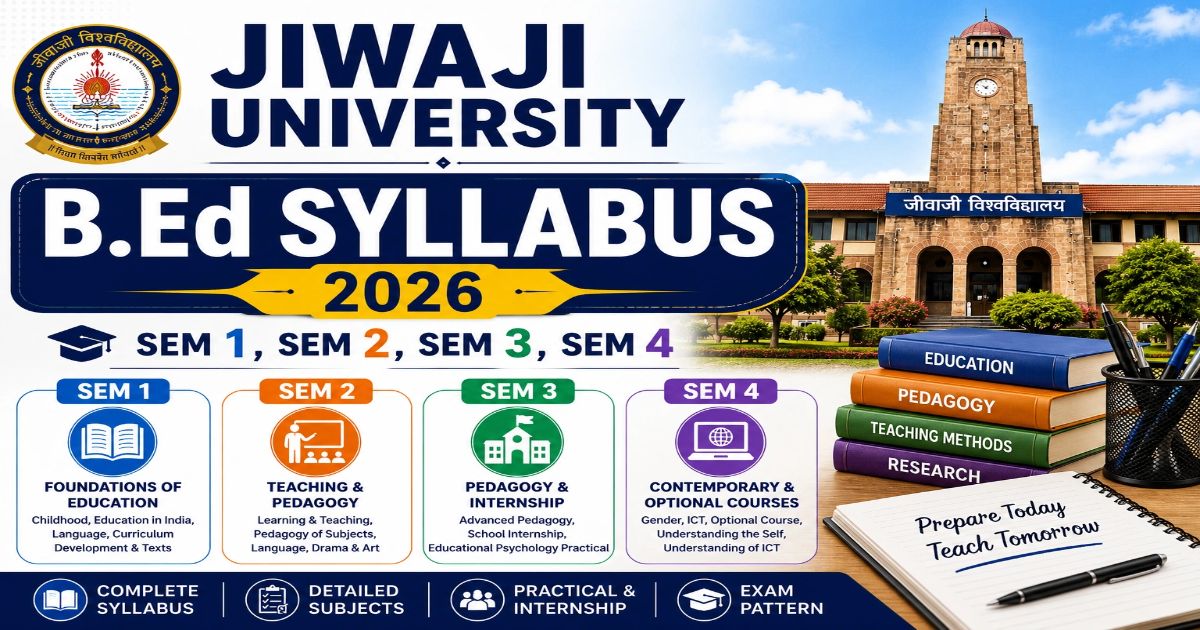
Navigating the Jiwaji University B.Ed Syllabus 2026 is essential for aspiring educators planning their academic journey. Jiwaji University B.Ed programme is divided into 4 semesters across 2 years. Jiwaji University B.Ed results are live on the results portal. Key subjects in the course circle around Childhood, Language, Reading Methods, Educational Psychology, Drama and Art in Education and others. Jiwaji University’s B.Ed programme uses a mix of theoretical and internal assessments. Students begin their internships in Semester 3. This comprehensive guide details the semester-wise subjects, core papers, and practical components you will encounter during the two-year program. Here, you’ll find a complete breakdown of the curriculum structure, exam pattern, and resources to help you prepare effectively for your B.Ed degree.
Jiwaji University B.Ed Syllabus 2026: Semester-Wise Subjects & Structure
This section details the Jiwaji University B.Ed syllabus 2026, outlining the four-semester structure and key subjects. This comprehensive jiwaji university bed syllabus provides an overview of core courses, specializations, and the crucial internship period, helping students understand the complete academic journey.
Semester 1
Semester 1 introduces foundational concepts in education, covering child development, the Indian education system, language, curriculum, and textual analysis.
| Course Code | Course Title |
| 101 | CC 1: Childhood & Growing Up |
| 102 | CC 2: Education in India – Status. Problems and Issues |
| 103 | CC 3: Language Across the Curriculum – Part I |
| 104 | CC 4: Curriculum Development & School |
| 105 | CC 5: Reading and Reflecting on Texts |
People Also Read

Semester 2
Semester 2 focuses on teaching methodologies, including pedagogy for two school subjects, further language studies, and the role of drama and art in education.
| Course Code | Course Title |
| 201 | CC 1: Learning & Teaching |
| 202 | CC 2: PC 1- (Pedagogy of a School Subject- I: Biology/ Mathematics / Hindi / Sanskrit / English / Urdu) |
| 203 | CC 3: PC 2- (Pedagogy of a School Subject- II: Chemistry / Physics / History / Civics / Geography / Economics / Commerce / Social Science) |
| 204 | CC 4: Language Across the Curriculum – Part – l |
| 205 | CC 5: Drama & Art in Education |
Semester 3
Semester 3 combines advanced pedagogy with a significant school internship component, offering practical experience in teaching methods, unit planning, and classroom observation.
| Course Code | Course Title |
| 301 | CC 1: Pedagogy of a School Subject (Part II) |
| 302 | – SI: School Internship – SI 1: Method of Teaching – SI 2: Method of Teaching – II – SI 3: Unit Plan (l & II) – SI 4: Unit Test (l & II) – SI 5: Workbook / Working Model – SI 6: Micro Teaching – SI 7: Observation Lesson |
| 303 | Educational Psychology Practical |
The Semester 3 internship is comprehensively evaluated across various practical teaching skills, including micro teaching, lesson planning, and classroom execution, totaling 350 marks:
- Micro Teaching Under Simulated Conditions (Eight Skills) – 48 Marks
- Lesson Planning (Practice Teaching) – 100 Marks
- Exclusion of Lesson in the Actual Classroom Situation & School Work – 100 Marks
- Unit Plan – 40 Marks
- Unit Test Administration, Evaluation and Interpretation – 40 Marks
- Resource Unit / Instructional Kit / Workbook / Working Models – 12 Marks
- Observation Records – 10 Marks
Semester 4
Semester 4 covers contemporary educational themes like gender, society, and technology, alongside an optional course choice from areas such as value education or environmental studies.
| Course Code | Course Title |
| 401 | CC 1: Gender, School & Society |
| 402 | CC 2: Educational Technology & ICT |
| 403 | CC 3: Optional Course: Any One – Value Education – Futurology in Education – Health and Physical Education – Guidance and Counseling in School – Environmental Education – Action Research |
| 404 | CC 4: Understanding the Sel |
| 405 | CC 5: Understanding of ICT |
Jiwaji University B.Ed First Year Syllabus 2026: Core Subjects & Electives
The Jiwaji University B.Ed syllabus for the 2026 academic year outlines a comprehensive four-semester course structure. This section details the core subjects and other key areas covered, providing insight into the curriculum designed for aspiring educators at Jiwaji University.
| Category | Details |
| Academic Year | 2026 |
| Overall B.Ed Course Structure | Four semesters |
| General Core Subjects Covered | Childhood and Growing Contemporary India Education, Creating an Inclusive School Health, Yoga, and Physical Education |
| Other Areas Covered | Subject Specialisation, Skill-Based Electives, and Thematic Areas |
Jiwaji University B.Ed Second Year Syllabus 2026: Pedagogy & Practical Components
The Jiwaji University B.Ed syllabus for 2026 is structured across four semesters, with the second year specifically covering Semester 3 and Semester 4. This section details the pedagogy and practical components within the second year of the jiwaji university bed syllabus.
| Course Code | Course Title |
| 301 | CC 1: Pedagogy of a School Subject (Part II) |
| 302 | SI: School Internship
– SI 1: Method of Teaching – I – SI 2: Method of Teaching – II – SI 3: Unit Plan (l & II) – SI 4: Unit Test (l & II) – SI 5: Workbook / Working Model – SI 6: Micro Teaching – SI 7: Observation Lesson |
| 303 | Educational Psychology Practical |
This table highlights the core pedagogical and practical components of Semester 3, including a significant School Internship and an Educational Psychology Practical.
Jiwaji University B.Ed Question Papers 2026: Download Previous Year PDFs
Jiwaji University B.Ed previous year question papers are readily available for download in PDF format, serving as essential study material for students. Students can access 80-90 B.Ed previous year question papers, ranging from 2018-2026. These include papers from semesters 1 to 6. Plus, students can also access ‘Open Book Question Papers’ under the ‘Colleges/Examination’ section on the official website.
B.Ed First Semester
This table details the availability of Jiwaji University B.Ed 1st Semester question papers for specific subjects, showing consistent coverage from 2018 through 2025 across core courses.
| Paper Code | Subject | Available Years |
| 101 | Childhood and Growing Up | 2018, 2019, 2021, 2022, 2023, 2024, 2025 |
| 102 | Education in India – Status, Problems and Issues | 2018, 2019, 2021, 2022, 2023, 2024, 2025 |
| 103 | Language Across The Curriculum – Part 1 | 2018, 2019, 2021, 2022, 2023, 2024, 2025 |
| 104 | Curriculum Development and School | 2018, 2019, 2021, 2022, 2023, 2024, 2025 |
Subject-wise Question Papers Availability
The table highlights popular B.Ed courses and their respective number of previous year question papers, with Education Studies having the most among those listed.
| Course/Subject | Number of PYQs |
| Education Studies | 8 |
| Gender Studies | 6 |
| Inclusive Education | 6 |
| Language Education | 6 |
| Education Pedagogy | 6 |
| Education | 3 |
| Guidance and Counselling | 3 |
| History Pedagogy | 3 |
| Philosophy of Education | 3 |
Jiwaji University B.Ed Exam Pattern
The Jiwaji University B.Ed. examination pattern follows a semester-based system with a combination of internal assessment, university examinations, practical work, and teaching internship components.
Exam Structure
| Component | Pattern / Marks Distribution |
| Course Duration | 2 Years (4 Semesters) |
| Examination System | University examination at the end of each semester |
| Theory Paper Marks | 100 marks (25 Internal + 75 External) for most theory papers |
| External Theory Exam Duration | 3 Hours |
| Section A | 5 Objective-type questions × 1 mark = 5 marks (all compulsory) |
| Section B | 10 questions to be answered out of 13 × 5 marks = 50 marks; answers of about 100–150 words |
| Section C | 2 questions to be answered out of 4 × 10 marks = 20 marks; answers of about 400–500 words |
| Total External Marks | 75 Marks |
| Internal Assessment Marks | Attendance (5) + First Test (5) + Second Test (5) + Assignment (10) = 25 marks |
| Minimum Attendance Required | 75% in each subject to appear in semester examinations |
| Passing Marks (Theory & Practicum) | Minimum 40% in each theory paper and practicum separately |
| Passing Marks (Teaching Internship) | Minimum 50% separately in Internship in Teaching |
| Third Semester Internship Marks | 350 marks (150 Internal + 200 External) |
| Internship Components | Micro Teaching (48), Lesson Planning (100), Classroom Teaching & School Work (100), Unit Plan (40), Unit Test Administration & Evaluation (40), Resource Unit/Instructional Kit (12), Observation Records (10) |
| Final Division Criteria | First Division: 60% and above; Second Division: 50%–59.99%; Third Division: 40%–49.99% |
Semester-wise Structure
| Semester | Total Marks | Internal | External |
| Semester I | 400 | 110 | 290 |
| Semester II | 400 | 110 | 290 |
| Semester III | 450 | 175 | 275 |
| Semester IV | 450 | 120 | 330 |
| Grand Total | 1,700 | 515 | 1,185 |
How to Download Jiwaji University B.Ed Syllabus 2026 PDF Online
To download the Jiwaji University B.Ed syllabus online, students should visit the official university website. This section provides a clear, step-by-step guide on how to access and download the Jiwaji University B.Ed syllabus PDF directly from jiwaji.edu for future reference.
- Step 1: Go to the Jiwaji University official website at jiwaji.edu.
- Step 2: Select the ‘Home’ option from the homepage.
- Step 3: Choose ‘School of Studies’ from the list of options.
- Step 4: Click on the course, branch, and semester for an academic year.
- Step 5: The PDF of the course syllabus will appear on the screen.
- Step 6: Download the Jiwaji University B.Ed Syllabus for future reference.
Frequently Asked Questions
1. What is Jiwaji University’s B.Ed syllabus?
The Jiwaji University B.Ed programme is divided into four semesters spread across two academic years. Students study theory papers, pedagogy courses, practicals, and complete a mandatory school internship.
2. Is the school internship compulsory in the Jiwaji University B.Ed syllabus?
Yes, the Semester 3 school internship is compulsory. It carries 350 marks and evaluates teaching skills through lesson planning, micro teaching, classroom execution, unit tests, and observation records.
3. What is the minimum attendance required for Jiwaji University B.Ed examinations?
Students must maintain at least 75% attendance in each subject to become eligible for semester examinations. Attendance also contributes up to 5 marks toward internal assessment scores.
4. How are internal assessment marks awarded in the Jiwaji University B.Ed course?
Internal assessment consists of 25 marks, including attendance (5 marks), first test (5 marks), second test (5 marks), and assignments or academic tasks (10 marks).
5. What are the passing marks for the Jiwaji University B.Ed programme?
Students must secure at least 40% marks separately in each theory paper and practicum. For the teaching internship component, a minimum of 50% marks is required to pass.
Jiwaji University B.Ed Syllabus 2026 – Frequently Asked Questions
How can students access and download the Jiwaji University B.Ed Syllabus 2026?
Students can access and understand the topics and courses planned for them as per the Jiwaji University B.Ed syllabus 2026. The steps to access the syllabus will allow students to download the links more easily during last-minute preparation.
What is the structure and duration of the Jiwaji University B.Ed programme?
The Jiwaji University B.Ed programme is divided into 4 semesters across 2 years. It covers the full syllabus from the 1st semester to the 4th semester, outlining the complete course structure.
What kind of subjects are included in the Jiwaji University B.Ed Syllabus?
The Jiwaji University B.Ed syllabus 2026 outlines the topics and courses planned for students. Specific subjects mentioned include "Language across the curriculum" for both the 1st and 2nd semesters.
Where can students find their Jiwaji University B.Ed results?
Jiwaji University B.Ed results are live and accessible to students. These results can be found on the university's dedicated results portal.
Are previous year question papers available for the Jiwaji University B.Ed program?
Yes, Jiwaji University provides question papers for all courses and all parts. This includes B.Ed papers for students of Jiwaji University, Gwalior MP.
Why is it important for students to navigate the Jiwaji University B.Ed Syllabus 2026?
Navigating the Jiwaji University B.Ed Syllabus 2026 is essential for aspiring educators. It helps them plan their academic journey and understand the topics and courses planned for their program.