

LLM Salary in India 2026: Comprehensive Guide for Law Graduates
Nishit Kumar is a senior EdTech industry leader with over a decade of experience in building and scaling education platforms, shaping their product, content, and growth strategy. At…
Latest update: LLM 2026 admissions & dates updated. Read more ›
For law graduates in India considering advanced studies, understanding the potential LLM salary in India for 2026 is crucial. This comprehensive guide delves into the career prospects, earning potential, and various factors influencing salaries for Master of Laws (LLM) degree holders, helping students and parents make informed decisions about this postgraduate qualification.
Overview of LLM in India (2026)
The Master of Laws (LLM) is a postgraduate academic degree in law, typically pursued after completing an undergraduate law degree (LLB). In India, an LLM enhances a lawyer’s specialization, research skills, and academic standing, often leading to improved career opportunities and higher earning potential. The 2026 landscape for LLM graduates is expected to be competitive yet rewarding, with increasing demand for specialized legal expertise.
What is the average LLM salary in India for 2026?
The average LLM salary in India for 2026 is projected to range from INR 4 LPA to INR 15 LPA for fresh graduates, with significant variations based on specialization, university, location, and type of employer. Experienced professionals with an LLM can command much higher packages, often exceeding INR 25 LPA.
Which LLM specializations offer the highest salaries in India?
Specializations like Corporate Law, Intellectual Property Rights (IPR) Law, Cyber Law, and International Business Law are consistently among the highest-paying LLM fields in India. These areas are driven by the growth of technology, global trade, and complex regulatory environments, creating a strong demand for specialized legal experts.
- Corporate Law: High demand in law firms, in-house legal departments of MNCs, and financial institutions.
- Intellectual Property Rights (IPR) Law: Crucial for tech companies, pharmaceutical firms, and creative industries.
- Cyber Law/Technology Law: Essential for cybersecurity firms, IT companies, and government bodies dealing with digital regulations.
- International Business Law/Trade Law: Valued by multinational corporations, export-import firms, and international organizations.
- Constitutional Law/Human Rights Law: While not always the highest paying in corporate settings, offers rewarding careers in judiciary, NGOs, and public service.
Is an LLM worth it for jobs and salary growth in India?
Yes, an LLM can significantly enhance job prospects and salary growth in India, especially for those aiming for specialized roles, academic careers, or positions in top-tier law firms and multinational corporations. It provides a competitive edge, deeper expertise, and often opens doors to roles that might not be accessible with just an LLB.
An LLM demonstrates a commitment to advanced learning and specialization, which is highly valued by employers seeking niche legal expertise. It can lead to:
- Faster career progression.
- Access to higher-paying specialized roles.
- Opportunities in academia and legal research.
- Enhanced credibility and networking opportunities.
What are the top career paths after LLM in India and their salary ranges?
After an LLM, graduates can pursue diverse career paths in legal practice, academia, corporate sectors, and public service. The salary ranges vary significantly based on the chosen path and employer.
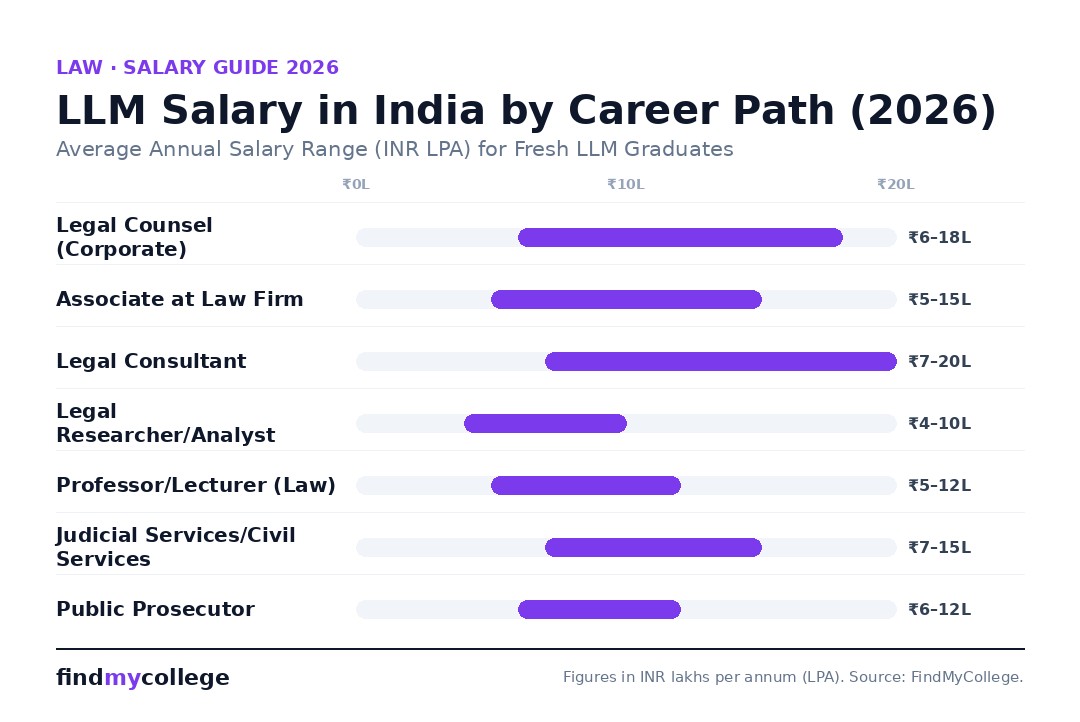
| Career Path | Description | Average Annual Salary Range (INR) – Fresh LLM (2026) |
|---|---|---|
| Legal Counsel (Corporate) | Working in-house for companies, advising on legal matters, contracts, compliance. | 6 LPA – 18 LPA |
| Associate at Law Firm | Practicing in specialized areas (e.g., corporate, IPR, litigation) at private law firms. | 5 LPA – 15 LPA (Tier 1 firms can offer higher) |
| Legal Consultant | Providing expert legal advice to clients on specific issues, often project-based. | 7 LPA – 20 LPA |
| Legal Researcher/Analyst | Conducting legal research for firms, think tanks, or academic institutions. | 4 LPA – 10 LPA |
| Professor/Lecturer (Law) | Teaching law at universities and colleges, engaging in academic research. | 5 LPA – 12 LPA (Entry-level) |
| Judicial Services/Civil Services | Preparing for competitive exams for judicial positions or administrative roles. | Salaries as per government pay scales (e.g., Judicial Magistrate: 7 LPA – 15 LPA) |
| Public Prosecutor | Representing the state in criminal cases. | 6 LPA – 12 LPA |
How does an LLM from a top-tier university impact salary?
An LLM from a top-tier university in India (e.g., NLUs, Symbiosis Law School, Jindal Global Law School) significantly impacts salary prospects due to better placements, stronger alumni networks, and enhanced industry recognition. Graduates from these institutions often secure roles in premier law firms and corporations with higher starting packages.
Top universities often have dedicated placement cells that attract leading recruiters, offering students access to better opportunities. The brand value and academic rigor also contribute to employers’ confidence in their graduates.
What is the eligibility for LLM in India for 2026?
To be eligible for an LLM program in India for 2026, candidates typically need an LLB degree (3-year or 5-year integrated) from a recognized university with a minimum aggregate score, usually between 50-60%. Some universities may also require a valid score in national-level entrance exams like CLAT PG or their own institutional entrance tests.
Key Eligibility Criteria:
- Educational Qualification: LLB (3-year or 5-year integrated) from a UGC-recognized university.
- Minimum Marks: Generally 50-60% aggregate in LLB (relaxation for reserved categories).
- Entrance Exams: CLAT PG (for NLUs), AILET PG (for NLU Delhi), LSAT India, or university-specific tests.
- Other Requirements: Some programs might require work experience, a statement of purpose (SOP), or letters of recommendation (LORs).
How much does an LLM course cost in India (2026)?
The cost of an LLM course in India for 2026 varies widely depending on the type of institution. Government universities and National Law Universities (NLUs) generally have lower fees compared to private universities.
| Institution Type | Average Annual Fee Range (INR) – 2026 | Total Course Fee Range (INR) – 2026 (1-2 years) |
|---|---|---|
| Government Universities/NLUs | 50,000 – 2,00,000 | 1,00,000 – 4,00,000 |
| Private Universities | 1,50,000 – 5,00,000+ | 3,00,000 – 10,00,000+ |
These figures are for tuition fees and do not include living expenses, books, or other miscellaneous costs.
What is the return on investment (ROI) for an LLM in India?
The return on investment (ROI) for an LLM in India can be substantial, especially for graduates from top institutions and those specializing in high-demand fields. While the initial investment in fees and time is significant, the potential for higher salaries, faster career progression, and access to specialized roles often justifies the expenditure within a few years.
For example, an LLM graduate earning INR 8 LPA with a course cost of INR 4 LPA (over two years) could potentially recover their investment within 1-2 years through the salary premium compared to an LLB-only graduate.
LLM Admission Process and Key Dates (2026)
The admission process for LLM programs in India typically involves appearing for an entrance exam, followed by counseling or interviews. Key dates for 2026 will largely follow previous years’ patterns.
Common LLM Entrance Exams (2026)
- CLAT PG (Common Law Admission Test – Postgraduate): For admissions to LLM programs in 22 National Law Universities (NLUs).
- AILET PG (All India Law Entrance Test – Postgraduate): For LLM admission specifically to NLU Delhi.
- LSAT India: Accepted by many private law colleges for their LLM programs.
- University-Specific Entrance Exams: Many private and state universities conduct their own tests.
| Exam Name | Application Period (Tentative 2026) | Exam Date (Tentative 2026) | Result Date (Tentative 2026) |
|---|---|---|---|
| CLAT PG | August – November 2025 | December 2025 | December 2025 |
| AILET PG | August – November 2025 | December 2025 | December 2025 |
| LSAT India | October 2025 – May 2026 | January & May 2026 | February & June 2026 |
Explore more on FindMyCollege
Related pages for LLM aspirants on findmycollege.com:
Frequently Asked Questions
Is an LLM from a foreign university better for salary in India?
An LLM from a reputable foreign university can indeed lead to higher salaries in India, particularly if it’s from a globally recognized institution and in a high-demand specialization. It often provides international exposure, a global network, and a unique perspective that is valued by top-tier law firms and multinational corporations operating in India. However, the significantly higher cost of foreign LLMs must be weighed against the potential salary increment.
Can I pursue an LLM part-time or distance learning in India?
Yes, several universities in India offer part-time or distance learning LLM programs, catering to working professionals. These programs provide flexibility, allowing students to continue their careers while pursuing advanced legal education. However, the recognition and career prospects for distance/part-time LLMs might differ from full-time residential programs, especially for roles requiring extensive practical exposure or immediate placement.
What is the difference in salary between an LLB and an LLM graduate?
Generally, an LLM graduate commands a higher starting salary and has better long-term earning potential compared to an LLB-only graduate. While an LLB is the foundational degree, an LLM provides specialization, making graduates more attractive for niche roles that offer premium compensation. The salary gap can be significant, especially in corporate law, IPR, and other specialized fields, where LLM holders are often preferred for advanced positions.
Do government jobs offer good salaries after LLM in India?
Government jobs after an LLM, such as in the judiciary, public prosecution, or legal departments of PSUs and ministries, offer stable careers with competitive salaries and excellent benefits. While the starting salaries might not always match the highest corporate packages, government roles provide job security, prestige, and regular increments, making them attractive for many LLM graduates. Opportunities also exist in legal research for government bodies and think tanks.
Are there scholarships available for LLM in India?
Yes, numerous scholarships are available for LLM programs in India, offered by universities, government bodies, and private organizations. These scholarships can be merit-based, need-based, or specific to certain specializations or demographic groups. Students should research individual university websites, government scholarship portals, and external funding opportunities well in advance of their application deadlines.
How important is work experience before pursuing an LLM for salary prospects?
Work experience before an LLM can significantly enhance salary prospects, especially for those aiming for mid-to-senior level roles. Many LLM programs, particularly those focused on practical applications like corporate law, highly value candidates with prior legal experience. Such experience allows students to better grasp advanced concepts, network effectively, and leverage their practical skills, making them more marketable to employers upon graduation and often leading to higher starting salaries.