

Master of Architecture Salary in India 2026: A Comprehensive Guide
Nishit Kumar is a senior EdTech industry leader with over a decade of experience in building and scaling education platforms, shaping their product, content, and growth strategy. At…
Latest update: Master of Architecture 2026 admissions & dates updated. Read more ›
For aspiring architects in India, pursuing a Master of Architecture (M.Arch) degree is a significant step towards professional advancement and enhanced earning potential. This comprehensive guide delves into the salary landscape for M.Arch graduates in India for 2026, covering various factors that influence remuneration, career prospects, and the overall value of this postgraduate qualification.
What is the average Master of Architecture (M.Arch) salary in India for 2026?
The average Master of Architecture (M.Arch) salary in India for 2026 typically ranges from INR 4.5 LPA to INR 12 LPA for fresh graduates and mid-level professionals, with experienced architects earning significantly more. This figure can vary widely based on specialization, employer type, location, and individual skill set.
An M.Arch degree equips graduates with advanced design, theoretical, and technical skills, making them highly sought after in specialized roles within the architecture and construction industries. The postgraduate qualification often leads to higher starting salaries and faster career progression compared to a Bachelor of Architecture (B.Arch) alone.
How does M.Arch salary compare to B.Arch salary in India?
M.Arch graduates generally command a significantly higher salary than B.Arch graduates, especially as they gain experience and move into specialized or leadership roles. While a B.Arch provides foundational knowledge, an M.Arch offers advanced expertise, leading to better compensation.
A B.Arch graduate might start with an average salary of INR 3 LPA to INR 6 LPA, whereas an M.Arch graduate often begins in the INR 4.5 LPA to INR 8 LPA range. Over time, the gap widens, with M.Arch holders more likely to reach senior positions with salaries exceeding INR 15-20 LPA.
Which specializations in M.Arch offer the highest salaries?
Specializations in Urban Design, Landscape Architecture, Sustainable Architecture, and Architectural Conservation often lead to higher salaries due to their niche demand and specialized skill requirements. These fields address critical contemporary challenges and require advanced expertise.
- Urban Design: Focuses on the planning and design of cities and public spaces, highly valued in government and large private development projects.
- Landscape Architecture: Deals with the design of outdoor public areas, landmarks, and structures to achieve environmental, social-behavioral, or aesthetic outcomes.
- Sustainable Architecture/Green Building: Specializes in environmentally friendly design and construction, a rapidly growing sector.
- Architectural Conservation: Involves the preservation and restoration of historic buildings and sites, a specialized field with limited but high-paying opportunities.
- Building Information Modeling (BIM): While not a traditional M.Arch specialization, expertise in BIM tools and processes is highly valued across all architectural roles and can significantly boost earning potential.
What factors influence M.Arch salary in India?
Several critical factors influence an M.Arch graduate’s salary in India, including the type of employer, geographical location, years of experience, specific skills, and the reputation of the institution from which the degree was obtained.
- Employer Type: Multinational corporations (MNCs), large private architectural firms, and government agencies (e.g., CPWD, urban development authorities) generally offer higher salaries than smaller private practices or NGOs.
- Geographical Location: Major metropolitan cities like Mumbai, Delhi-NCR, Bangalore, Pune, and Hyderabad typically offer higher salaries due to a greater concentration of projects and higher cost of living.
- Years of Experience: Salary grows significantly with experience. A fresh M.Arch graduate will earn less than someone with 5-10 years of post-M.Arch experience.
- Skills and Portfolio: Proficiency in advanced software (Revit, AutoCAD, SketchUp, Rhino, V-Ray, Grasshopper), strong design skills, project management capabilities, and a compelling portfolio are crucial for higher compensation.
- Institution Reputation: Graduates from top-tier institutions (e.g., IITs, NITs, CEPT University, SPA Delhi) often have an edge in placements and initial salary offers.
- Role and Responsibilities: Leadership roles, project management positions, and specialized consulting roles naturally command higher salaries.
Top Job Roles and Expected Salaries for M.Arch Graduates (2026)
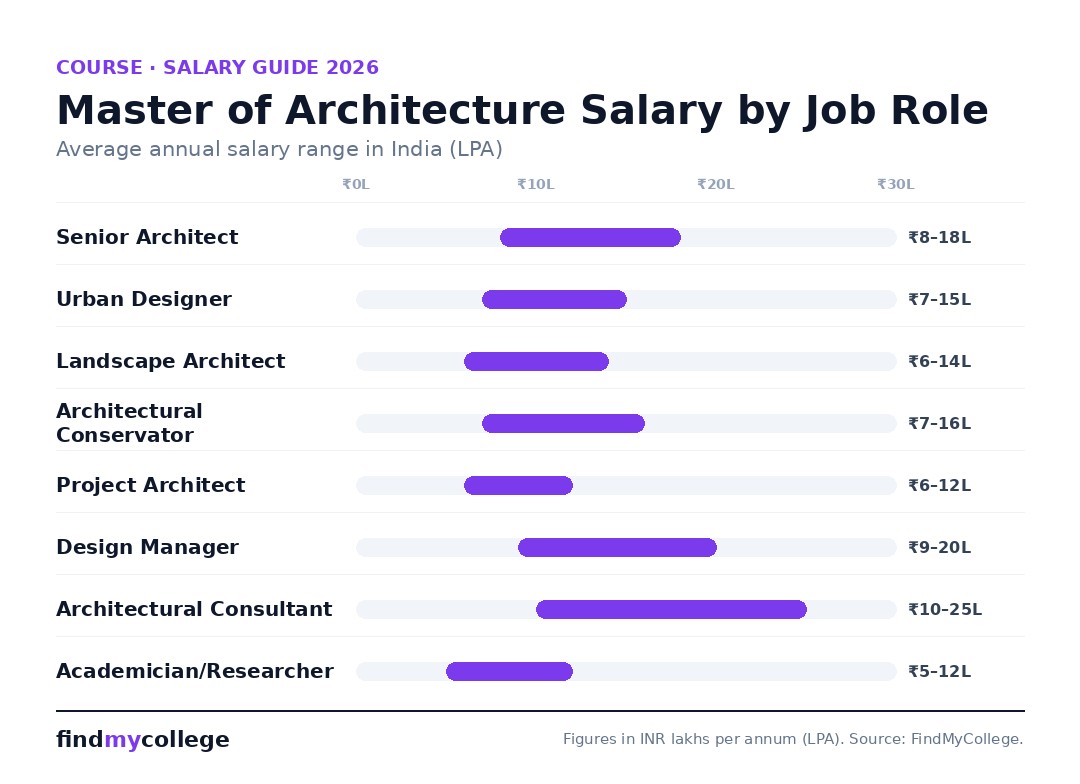
M.Arch graduates can pursue a diverse range of roles within the architecture, construction, and urban planning sectors. Here’s an overview of common job titles and their expected salary ranges for 2026:
| Job Role | Description | Average Annual Salary Range (INR) |
|---|---|---|
| Senior Architect | Leads design projects, manages teams, client interaction. | 8 LPA – 18 LPA |
| Urban Designer | Plans and designs urban spaces, infrastructure, and communities. | 7 LPA – 15 LPA |
| Landscape Architect | Designs outdoor spaces, parks, gardens, and environmental sites. | 6 LPA – 14 LPA |
| Architectural Conservator | Specializes in preserving and restoring historical buildings. | 7 LPA – 16 LPA |
| Project Architect | Manages specific architectural projects from conception to completion. | 6 LPA – 12 LPA |
| Design Manager | Oversees design processes, ensures quality and adherence to brief. | 9 LPA – 20 LPA |
| Architectural Consultant | Provides expert advice on design, planning, and construction. | 10 LPA – 25 LPA+ |
| Academician/Researcher | Teaches architecture, conducts research in universities. | 5 LPA – 12 LPA (varies by institution) |
Is pursuing an M.Arch degree worth it for career and salary growth?
Yes, pursuing an M.Arch degree is generally worth it for significant career and salary growth, especially for those aiming for specialized roles, leadership positions, or academic careers. The advanced knowledge and skills acquired open doors to higher-paying opportunities and greater professional recognition.
While the initial investment in time and money is considerable, the long-term returns in terms of enhanced earning potential, job satisfaction, and the ability to work on more complex and impactful projects often justify the pursuit of an M.Arch. It also provides a competitive edge in a crowded job market.
Eligibility Criteria for Master of Architecture (M.Arch) in India
To be eligible for a Master of Architecture (M.Arch) program in India, candidates typically need a Bachelor of Architecture (B.Arch) degree from a recognized university, often with a minimum aggregate score (e.g., 50-60%). Some institutions may also require a valid score in a national-level entrance exam.
- Educational Qualification: A B.Arch degree (5-year program) or an equivalent qualification recognized by the Council of Architecture (COA).
- Minimum Marks: Generally, a minimum of 50-60% aggregate marks in B.Arch is required, though this can vary by institution and category (e.g., SC/ST candidates may have relaxed criteria).
- Entrance Exams: Many top institutions require scores from exams like GATE (Graduate Aptitude Test in Engineering) in Architecture and Planning (AR paper), or their own university-specific entrance tests.
- Portfolio: A strong portfolio showcasing design skills and previous architectural work is often a crucial component of the application process.
- Work Experience: While not always mandatory, some programs or specializations may prefer or require a certain amount of professional work experience.
How much does Master of Architecture (M.Arch) cost in India?
The cost of a Master of Architecture (M.Arch) program in India varies significantly based on the type of institution (government vs. private) and its reputation. Generally, fees can range from INR 50,000 to INR 3,00,000 per annum.
| Institution Type | Average Annual Fee Range (INR) | Total Course Fee Range (INR, for 2 years) |
|---|---|---|
| Government/Public Universities (e.g., IITs, NITs, SPAs) | 50,000 – 1,50,000 | 1,00,000 – 3,00,000 |
| Private Universities/Colleges | 1,00,000 – 3,00,000 | 2,00,000 – 6,00,000 |
These figures typically cover tuition fees but may not include hostel charges, examination fees, or other miscellaneous expenses. Scholarships and educational loans are available to help students manage these costs.
Explore more on FindMyCollege
Related pages for Master of Architecture aspirants on findmycollege.com:
Frequently Asked Questions
What is the duration of the M.Arch course in India?
The Master of Architecture (M.Arch) course in India is typically a two-year, full-time postgraduate program, divided into four semesters.
Are there any entrance exams for M.Arch in India?
Yes, prominent entrance exams for M.Arch in India include GATE (Graduate Aptitude Test in Engineering), specifically the Architecture and Planning (AR) paper. Many universities also conduct their own entrance tests, followed by an interview and portfolio review.
Can I pursue M.Arch after a B.Tech in Civil Engineering?
Generally, no. The primary eligibility for M.Arch is a Bachelor of Architecture (B.Arch) degree. A B.Tech in Civil Engineering does not provide the foundational architectural design knowledge required for an M.Arch program. However, some specialized programs like M.Plan (Master of Planning) or M.Tech in Construction Management might be accessible.
What are the career prospects after M.Arch in government sector?
After M.Arch, career prospects in the government sector are excellent. Graduates can join organizations like the CPWD (Central Public Works Department), State PWDs, Urban Development Authorities, Housing Boards, Municipal Corporations, and various government planning agencies as architects, urban planners, or conservation specialists. Salaries are competitive with good benefits.
Does an M.Arch degree help in starting my own architectural firm?
Yes, an M.Arch degree significantly helps in starting your own architectural firm. It provides advanced design skills, business acumen (in some programs), and a deeper understanding of complex projects, which are crucial for running a successful practice. The enhanced credibility also helps in attracting clients.
Which cities in India offer the best M.Arch salaries?
Cities offering the best M.Arch salaries in India include Mumbai, Delhi-NCR (Gurgaon, Noida), Bangalore, Pune, and Hyderabad. These metropolitan areas have a high concentration of architectural firms, real estate developers, and government projects, leading to more job opportunities and higher compensation.