

Master of Business Economics (MBE) India 2026 Overview
Nishit Kumar is a senior EdTech industry leader with over a decade of experience in building and scaling education platforms, shaping their product, content, and growth strategy. At…
Latest update: Master of Business Economics 2026 admissions & dates updated. Read more ›
Welcome to the comprehensive Master of Business Economics (MBE) India 2026 Overview page. This guide is designed for prospective students and parents seeking detailed information about this postgraduate program, particularly those from an Arts stream background. The MBE course offers a unique blend of economic theory and business application, preparing graduates for analytical roles in various sectors.
What is the Master of Business Economics (MBE) course?
The Master of Business Economics (MBE) is a two-year, full-time postgraduate program that integrates advanced economic principles with practical business strategies. It is typically offered under the Arts faculty, distinguishing it from purely management or finance degrees by its strong emphasis on economic analysis, quantitative methods, and policy implications for business decision-making.
The curriculum is designed to equip students with a robust understanding of microeconomics, macroeconomics, econometrics, financial economics, and international trade, alongside their applications in corporate strategy, market analysis, and public policy. Graduates are trained to analyze complex economic data, forecast market trends, and provide informed recommendations to businesses and government bodies.
What is the eligibility for Master of Business Economics in India for 2026?
To be eligible for the Master of Business Economics (MBE) program in India for the 2026 academic year, candidates generally need a Bachelor’s degree in any discipline from a recognized university, with a minimum aggregate score, often between 50% and 60%.
While a background in Economics or Mathematics is highly advantageous, many universities accept graduates from other streams, including Arts, Commerce, and Science, provided they meet the minimum percentage criteria. Some institutions may also require a certain level of mathematical or statistical proficiency at the undergraduate level. Reserved category candidates typically receive a relaxation in the minimum percentage requirement as per government norms.
What is the admission process for MBE in 2026?
The admission process for the Master of Business Economics (MBE) in 2026 typically involves appearing for a national or university-specific entrance examination, followed by a Group Discussion (GD) and Personal Interview (PI) round.
Key steps include:
- Application Submission: Candidates must fill out online application forms for their desired universities, usually available from October to January for the upcoming academic year.
- Entrance Exam: Most top colleges require a valid score from entrance exams such as DUET (Delhi University Entrance Test), CUET PG (Common University Entrance Test Postgraduate), or their own institutional tests.
- Shortlisting: Based on entrance exam scores, candidates are shortlisted for the subsequent rounds.
- Group Discussion (GD) & Personal Interview (PI): Shortlisted candidates participate in GDs to assess their communication and analytical skills, followed by PIs to evaluate their motivation, subject knowledge, and overall suitability for the program.
- Final Merit List: A final merit list is prepared based on a composite score, usually weighing entrance exam scores, GD/PI performance, and sometimes academic record.
Key Entrance Exams & Tentative Dates for MBE 2026
Here’s a table outlining common entrance exams and their approximate schedules for the 2026 admission cycle:
| Entrance Exam | Application Period (Tentative) | Exam Date (Tentative) | Participating Universities (Examples) |
|---|---|---|---|
| CUET PG | Dec 2025 – Jan 2026 | March 2026 | Delhi University, JNU, BHU, etc. |
| DUET (for specific courses) | Feb – March 2026 | May – June 2026 | Delhi University (if not under CUET PG) |
| GIPE Entrance Exam | Jan – Feb 2026 | April 2026 | Gokhale Institute of Politics and Economics |
| Symbiosis Entrance Test (SET) | Jan – April 2026 | May 2026 | Symbiosis School of Economics |
How much does Master of Business Economics cost in India?
The cost of pursuing a Master of Business Economics (MBE) in India varies significantly depending on the type of institution, ranging from approximately INR 20,000 to INR 5,00,000 per annum.
Government universities and departments typically offer the program at a much lower fee, often between INR 20,000 to INR 1,00,000 per year. Private institutions and deemed universities, on the other hand, tend to have higher fees, usually in the range of INR 2,00,000 to INR 5,00,000 per year. These figures generally cover tuition fees but may not include hostel charges, examination fees, or other miscellaneous expenses. It’s crucial for students to check the specific fee structure of their target colleges.
What is the syllabus and specialisations offered in MBE?
The Master of Business Economics (MBE) syllabus is designed to provide a strong foundation in economic theory, quantitative methods, and their business applications. While core subjects are common, some institutions may offer specialisations.
A typical MBE curriculum includes:
Core Subjects
- Microeconomic Theory
- Macroeconomic Theory
- Econometrics
- Mathematical Methods for Economics
- Statistical Methods for Economics
- Financial Economics
- International Trade and Finance
- Industrial Economics
- Public Economics
- Business Forecasting
- Managerial Economics
- Research Methodology
Potential Specialisations (depending on the institution)
- Financial Markets: Focuses on derivatives, portfolio management, and financial modeling.
- Data Analytics: Emphasizes big data, machine learning, and statistical software for economic analysis.
- International Business: Covers global trade policies, international finance, and multinational corporate strategies.
- Development Economics: Explores economic growth, poverty, and policy interventions in developing countries.
Is Master of Business Economics worth it for jobs? What are the career prospects and average salaries?
Yes, the Master of Business Economics (MBE) is highly worth it for jobs, offering strong career prospects in analytical and strategic roles across diverse sectors. Graduates are well-prepared for positions requiring economic reasoning, quantitative analysis, and strategic decision-making.
MBE graduates find employment in:
- Financial Services: Investment banking, equity research, risk management, financial analysis.
- Consulting: Economic consulting, management consulting, policy advisory.
- Market Research: Data analysis, consumer insights, market forecasting.
- Analytics: Business intelligence, data science, predictive modeling.
- Government & Public Sector: Economic policy analysis, research roles in ministries and central banks.
- Corporate Sector: Business analyst, strategist, pricing analyst, economic advisor.
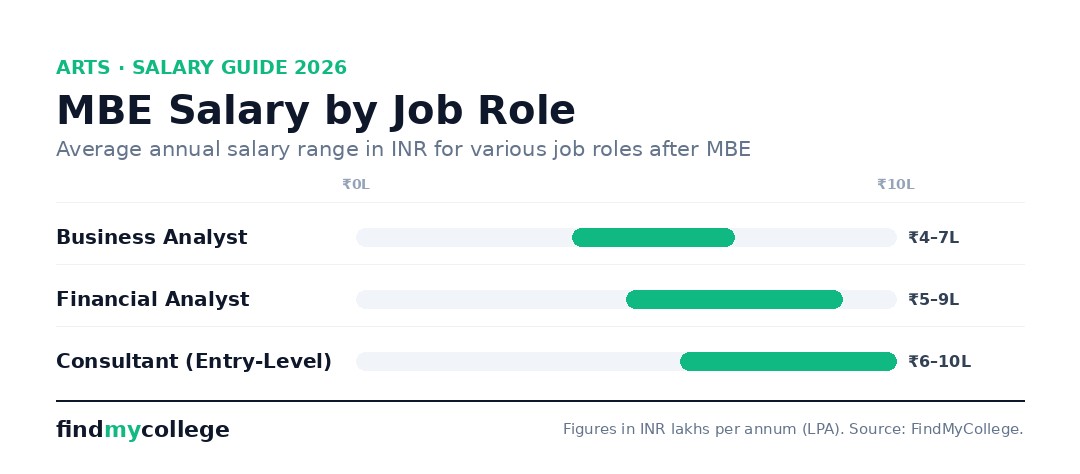
Average Salary Ranges for MBE Graduates (India, Entry to Mid-Level)
The average starting salary for an MBE graduate in India typically ranges from INR 4 LPA to INR 8 LPA, with experienced professionals earning significantly more. Salaries depend on the role, industry, employer, and individual skills.
| Job Role | Average Annual Salary Range (INR) | Key Responsibilities |
|---|---|---|
| Business Analyst | 4,00,000 – 7,00,000 | Analyzing business processes, identifying improvements, data modeling. |
| Economic Analyst | 4,50,000 – 8,00,000 | Forecasting economic trends, policy analysis, market research. |
| Market Research Analyst | 3,50,000 – 6,50,000 | Collecting and interpreting market data, competitor analysis. |
| Financial Analyst | 5,00,000 – 9,00,000 | Evaluating investment opportunities, financial modeling, risk assessment. |
| Data Analyst | 4,00,000 – 7,50,000 | Collecting, cleaning, and interpreting data sets to answer business questions. |
| Consultant (Entry-Level) | 6,00,000 – 10,00,000+ | Solving client problems, conducting research, preparing presentations. |
MBE vs. MBA vs. MA Economics: Which is better for me?
Choosing between MBE, MBA, and MA Economics depends heavily on your career aspirations and academic interests. Each program caters to a distinct professional path.
- Master of Business Economics (MBE): Ideal for those who want to apply economic principles and quantitative methods directly to business problems. It’s a bridge between pure economics and practical business management, focusing on analytical decision-making from an economic perspective. Best for roles like business analyst, economic consultant, or market strategist.
- Master of Business Administration (MBA): Geared towards developing general management and leadership skills. It covers a broader range of business functions (marketing, finance, HR, operations) with less emphasis on deep economic theory. Best for aspiring managers, entrepreneurs, or those seeking leadership roles across various industries.
- MA Economics: A more theoretical and research-oriented program, focusing on advanced economic theory, econometrics, and policy analysis. It’s suitable for those aiming for careers in academia, research, government policy, or pursuing further studies like a PhD in Economics.
If your strength lies in analytical thinking, quantitative analysis, and understanding market dynamics from an economic lens, MBE is likely the best fit. If you’re looking for broad management skills, MBA is better. If you’re passionate about economic theory and research, MA Economics is your path.
Top Colleges Offering Master of Business Economics in India
Several reputable institutions in India offer the Master of Business Economics program, known for their rigorous curriculum and strong placement records.
- University of Delhi (Department of Business Economics): Highly regarded, known for its strong academic foundation and placements.
- Gokhale Institute of Politics and Economics (GIPE), Pune: A premier institution for economics and related fields.
- Symbiosis School of Economics (SSE), Pune: Offers a strong blend of economics and business applications.
- Jawaharlal Nehru University (JNU), New Delhi (School of Social Sciences): While primarily MA Economics, some courses align with business economics.
- University of Hyderabad: Offers a well-structured program.
- Madras School of Economics (MSE), Chennai: Known for its specialized programs in applied economics.
Frequently Asked Questions
Is MBE a good option for Arts stream students?
Yes, MBE is an excellent option for Arts stream students, especially those with a strong aptitude for mathematics, statistics, and analytical thinking. Many universities accept Arts graduates, and the program’s focus on economic reasoning and business application provides a valuable skill set that complements an Arts background.
What is the difference between MBE and M.Com (Business Economics)?
While both involve ‘Business Economics,’ MBE (Master of Business Economics) is generally more focused on applying advanced economic theory and quantitative methods to business problems, often with a stronger analytical and research bent. M.Com (Business Economics) is typically offered under the Commerce faculty and may have a broader curriculum covering accounting, finance, and general business management alongside economic principles, often with a more practical, less theoretical approach.
Are there scholarships available for MBE students?
Yes, various scholarships are available for MBE students. These can include merit-based scholarships offered by the institutions themselves, government scholarships for specific categories (e.g., SC/ST/OBC, economically weaker sections), and private scholarships from foundations or corporate bodies. Students should check with their target universities’ financial aid offices and national scholarship portals.
What quantitative skills are required for MBE?
A strong foundation in quantitative skills is crucial for MBE. This includes proficiency in college-level mathematics (calculus, linear algebra), statistics (probability, hypothesis testing, regression analysis), and a willingness to learn econometrics and statistical software. Many programs have quantitative methods as core subjects to bring students up to speed.
Can I pursue a PhD after MBE?
Yes, an MBE degree can serve as a strong foundation for pursuing a PhD, particularly in Economics, Business Economics, or related fields like Finance or Management. The rigorous training in economic theory, econometrics, and research methodology prepares students well for doctoral-level research.
What is the typical class size for an MBE program?
The typical class size for an MBE program can vary significantly by institution. Top government universities often have larger class sizes, ranging from 50 to 100+ students per batch. Private institutions or specialized departments might have smaller, more intimate class sizes, sometimes between 30 and 60 students, allowing for more individualized attention.