Master in Business Finance Salary in India 2026
Nishit Kumar is a senior EdTech industry leader with over a decade of experience in building and scaling education platforms, shaping their product, content, and growth strategy. At…
Latest update: Master in Business Finance 2026 admissions & dates updated. Read more ›
Welcome to the comprehensive guide on Master in Business Finance (MBF) salary in India for 2026. This page provides an in-depth look at career prospects, earning potential, eligibility, and the overall value proposition of pursuing an MBF degree for commerce graduates.
What is Master in Business Finance (MBF)?
The Master in Business Finance (MBF) is a specialized postgraduate program designed to equip students with advanced knowledge and skills in financial management, investment analysis, corporate finance, and financial markets. It focuses on practical application and strategic decision-making within the business finance domain, making graduates highly sought after in the financial services industry.
What is the average salary for a Master in Business Finance graduate in India (2026)?
The average starting salary for a Master in Business Finance graduate in India in 2026 typically ranges from INR 5 LPA to INR 12 LPA, depending on the institution, specialization, and individual skills. With 3-5 years of experience, this can increase significantly to INR 10 LPA to INR 25 LPA or more.
Several factors influence the salary, including the reputation of the college, the student’s academic performance, internship experience, and the specific industry or company they join. Top-tier institutions and specialized roles often command higher packages.
Which job roles offer the best salaries after Master in Business Finance?
Job roles such as Investment Banker, Financial Analyst, Portfolio Manager, and Risk Manager typically offer the most lucrative salaries for MBF graduates. These roles demand specialized skills and often come with performance-based bonuses, significantly boosting overall compensation.
Top Job Roles and Expected Salary Ranges (2026)
Here’s a breakdown of common job roles and their expected annual salary ranges for MBF graduates in India:
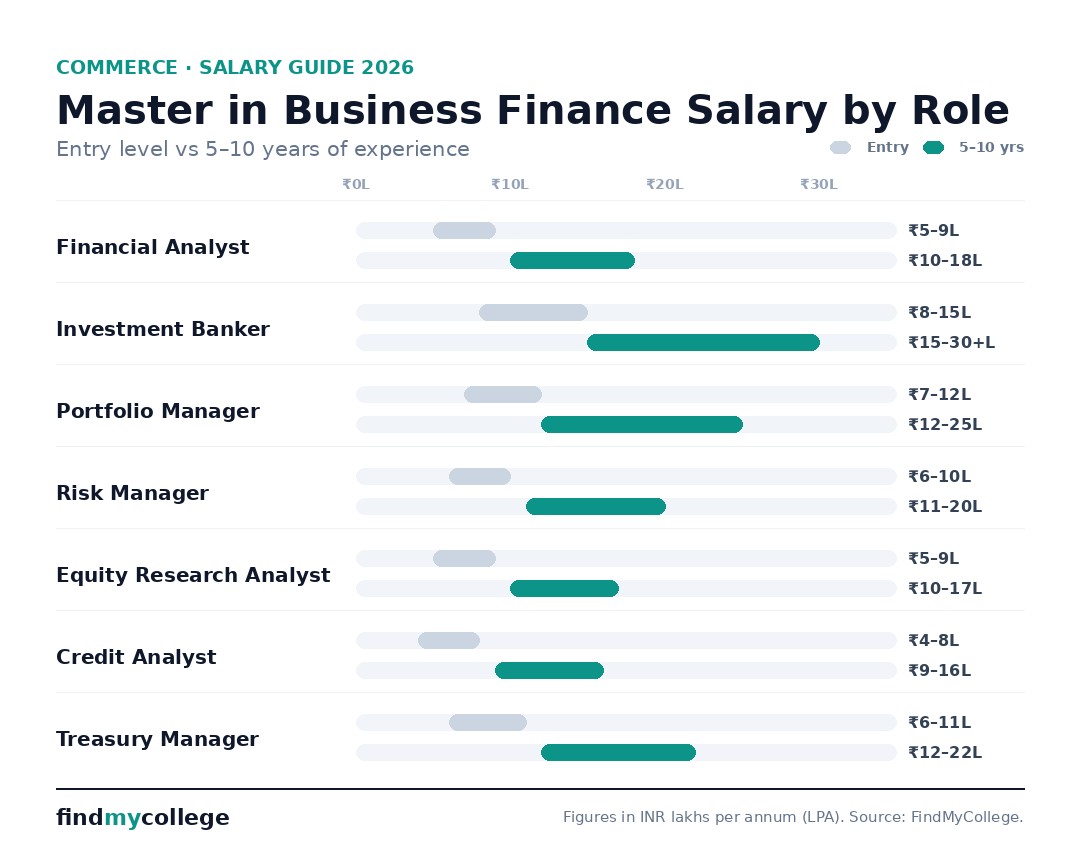
| Job Role | Entry-Level Salary (INR LPA) | Mid-Career Salary (3-5 Yrs Exp) (INR LPA) |
|---|---|---|
| Financial Analyst | 5 – 9 | 10 – 18 |
| Investment Banker | 8 – 15 | 15 – 30+ |
| Portfolio Manager | 7 – 12 | 12 – 25 |
| Risk Manager | 6 – 10 | 11 – 20 |
| Equity Research Analyst | 5 – 9 | 10 – 17 |
| Credit Analyst | 4 – 8 | 9 – 16 |
| Treasury Manager | 6 – 11 | 12 – 22 |
Which industries and companies hire Master in Business Finance graduates?
MBF graduates are primarily sought after in the financial services sector, including investment banks, asset management companies, private equity firms, and corporate finance departments of large organizations. Consulting firms and fintech companies also actively recruit MBF professionals.
Top Recruiting Sectors:
- Investment Banking: Mergers & Acquisitions, Capital Markets, Corporate Advisory
- Asset Management: Mutual Funds, Hedge Funds, Wealth Management
- Private Equity & Venture Capital: Investment Analysis, Deal Sourcing
- Commercial Banking: Corporate Lending, Credit Analysis
- Financial Consulting: Strategy, Risk Advisory, Transaction Services
- Fintech Companies: Financial Product Development, Data Analytics
- Corporate Finance: Treasury, Financial Planning & Analysis (FP&A)
Prominent Recruiters (Examples):
- JP Morgan Chase & Co.
- Goldman Sachs
- Morgan Stanley
- Deloitte, EY, PwC, KPMG (Big Four)
- ICICI Bank, HDFC Bank, Axis Bank
- Reliance Industries, Tata Group (Corporate Finance divisions)
- BlackRock, SBI Mutual Fund
Is Master in Business Finance worth it for jobs and salary in 2026?
Yes, pursuing a Master in Business Finance is generally worth it for jobs and salary in 2026, especially for those aiming for specialized roles in the high-growth financial sector. The program provides a strong return on investment (ROI) through enhanced career opportunities and significantly higher earning potential compared to a bachelor’s degree alone.
The specialized knowledge gained in areas like financial modeling, valuation, and risk management is highly valued by employers, leading to competitive salaries and faster career progression. The networking opportunities and industry exposure from a good MBF program also contribute significantly to its worth.
What is the eligibility for Master in Business Finance?
The primary eligibility for a Master in Business Finance typically requires a bachelor’s degree in Commerce, Business Administration, Economics, or a related field with a minimum aggregate score (often 50-60%). Many top institutions also require valid scores from entrance exams like CAT, XAT, GMAT, or CMAT.
Typical Eligibility Criteria:
- Educational Qualification: Bachelor’s degree (10+2+3/4 format) in Commerce, BBA, BBM, B.Sc. Finance, B.A. Economics, or equivalent from a recognized university.
- Minimum Marks: Usually 50-60% aggregate in the qualifying bachelor’s degree. Some institutes offer relaxation for reserved categories.
- Entrance Exams: Mandatory scores from national-level exams (CAT, XAT, CMAT, MAT, GMAT) or institute-specific entrance tests.
- Work Experience: While not always mandatory for all MBF programs, some premier institutes may prefer or require 1-2 years of relevant work experience.
- English Proficiency: For international students or programs, TOEFL/IELTS scores may be required.
How much does Master in Business Finance cost in India (2026)?
The cost of a Master in Business Finance program in India for 2026 varies widely, ranging from INR 2 LPA to INR 15 LPA, depending on whether it’s a government-funded institution or a private university. Premier private institutions and specialized programs tend to have higher fees.
Fee Structure (2026 Estimates):
| Type of Institution | Average Annual Fees (INR) | Total Program Fees (INR) |
|---|---|---|
| Government/Public Universities | 1,00,000 – 4,00,000 | 2,00,000 – 8,00,000 |
| Private Universities/B-Schools (Tier 2/3) | 4,00,000 – 8,00,000 | 8,00,000 – 16,00,000 |
| Premier Private B-Schools (Tier 1) | 8,00,000 – 15,00,000+ | 16,00,000 – 30,00,000+ |
These figures typically include tuition fees but may not cover hostel, mess, or other miscellaneous expenses. Scholarships and educational loans are available to help manage the costs.
How does Master in Business Finance compare to MBA Finance for salary?
While both Master in Business Finance (MBF) and MBA Finance lead to strong career outcomes, an MBF typically offers a more specialized and in-depth focus on finance, potentially leading to higher starting salaries in niche financial roles like investment banking or quantitative finance. An MBA Finance provides a broader management perspective, which can be advantageous for leadership roles across various industries.
For individuals certain about a career solely within finance, MBF provides a deeper dive. For those seeking flexibility and a broader business understanding with a finance specialization, MBA Finance might be more suitable. Salary differences can often be marginal at entry-level, but an MBF’s specialization can sometimes command a premium in highly technical finance roles.
What are the top colleges for Master in Business Finance in India?
Top colleges for Master in Business Finance in India include institutions like IIMs (for their specialized finance programs), NMIMS, SP Jain, Symbiosis, and Christ University, among others. These institutions are known for their rigorous curriculum, strong industry connections, and excellent placement records.
Key Factors for Top Colleges:
- Accreditation and Rankings
- Faculty Expertise and Industry Experience
- Curriculum Relevance and Specializations Offered
- Placement Statistics (Average Salary, Top Recruiters, % Placed)
- Infrastructure and Resources (e.g., Bloomberg terminals)
- Alumni Network
Frequently Asked Questions
What is the duration of a Master in Business Finance program?
Most Master in Business Finance programs in India are full-time, two-year postgraduate courses, typically divided into four semesters.
Are there any part-time or online MBF programs available?
Yes, some institutions offer part-time or executive MBF programs designed for working professionals, and with the rise of online education, fully online MBF options are also becoming available from various universities.
What skills are essential for a successful career after MBF?
Essential skills include strong analytical and quantitative abilities, financial modeling proficiency, communication skills, problem-solving, attention to detail, and a solid understanding of financial markets and regulations.
Can I pursue CFA or FRM after an MBF?
Absolutely. An MBF degree provides an excellent foundation for pursuing professional certifications like Chartered Financial Analyst (CFA) or Financial Risk Manager (FRM), which further enhance career prospects and earning potential in finance.
What is the career growth trajectory after an MBF?
Graduates can expect rapid career growth, moving from analyst roles to senior analyst, associate, manager, and eventually to leadership positions like Vice President, Director, or Head of Finance within 10-15 years, depending on performance and industry.
Is an MBF suitable for someone without a commerce background?
While a commerce or finance background is advantageous, some MBF programs accept graduates from other disciplines (e.g., engineering, science) provided they demonstrate strong quantitative aptitude and sometimes complete foundational finance courses.