

Master of Finance and Control (MFC) Salary in India 2026
Nishit Kumar is a senior EdTech industry leader with over a decade of experience in building and scaling education platforms, shaping their product, content, and growth strategy. At…
Latest update: Master of Finance and Control 2026 admissions & dates updated. Read more ›
The Master of Finance and Control (MFC) is a postgraduate program designed for commerce graduates seeking advanced knowledge and skills in financial management, investment analysis, and corporate finance. As India’s economy continues its robust growth, the demand for skilled finance professionals is consistently high, making the MFC degree a valuable asset for career progression. This comprehensive guide provides an in-depth look at the salary landscape for MFC graduates in India for the year 2026, addressing key questions about career prospects, earning potential, and return on investment.
What is the average Master of Finance and Control (MFC) salary in India for 2026?
The average starting salary for a Master of Finance and Control (MFC) graduate in India for 2026 typically ranges from INR 4.5 LPA to INR 9.0 LPA, depending on factors such as the institution’s reputation, individual skills, location, and the specific role. With 2-5 years of experience, this can increase significantly, often reaching INR 8.0 LPA to INR 15.0 LPA or more for mid-level positions.
Which job roles offer the best salaries after Master of Finance and Control?
Job roles in investment banking, financial analysis, portfolio management, and corporate finance generally offer the most lucrative salary packages for MFC graduates. These roles demand a high level of analytical skill, strategic thinking, and a deep understanding of financial markets, which are core competencies developed during an MFC program.
Top Job Roles and Expected Salary Ranges (2026)
The following table outlines common job roles for MFC graduates and their expected salary ranges in India for 2026, categorized by experience level:
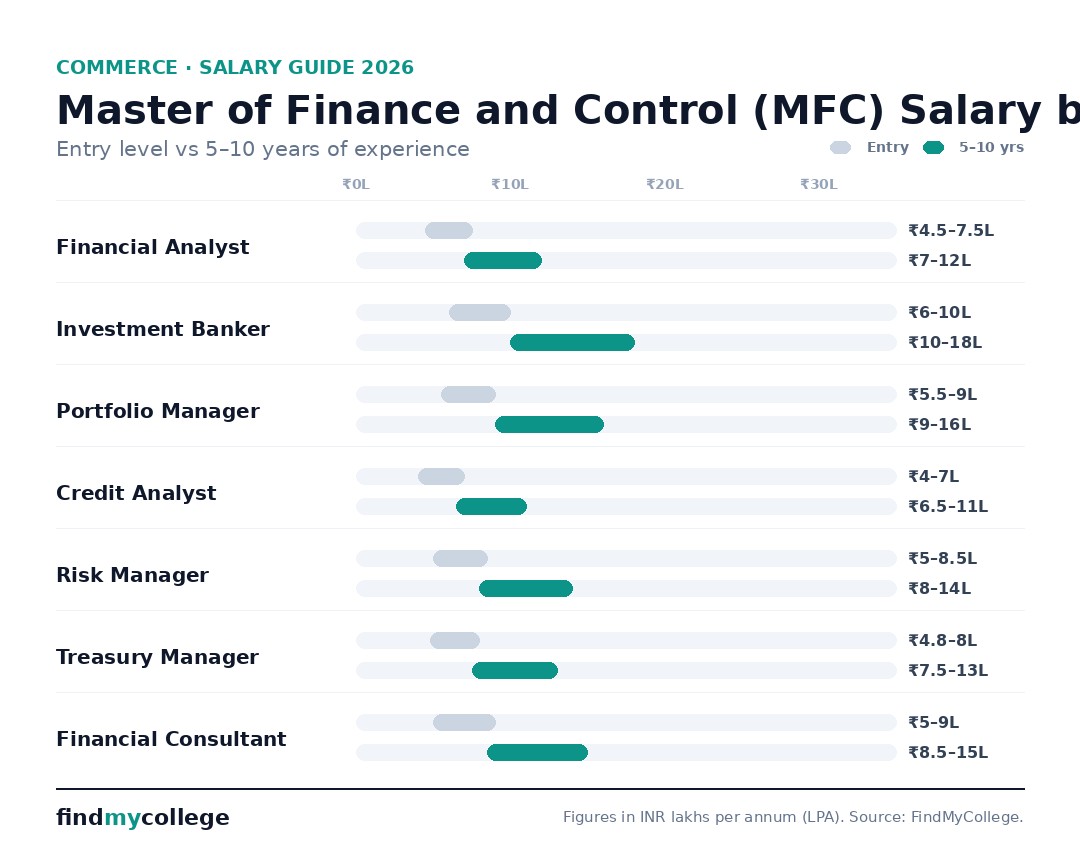
| Job Role | Entry-Level (0-2 Years) | Mid-Level (3-6 Years) | Senior-Level (7+ Years) |
|---|---|---|---|
| Financial Analyst | INR 4.5 – 7.5 LPA | INR 7.0 – 12.0 LPA | INR 12.0 – 20.0+ LPA |
| Investment Banker | INR 6.0 – 10.0 LPA | INR 10.0 – 18.0 LPA | INR 18.0 – 35.0+ LPA |
| Portfolio Manager | INR 5.5 – 9.0 LPA | INR 9.0 – 16.0 LPA | INR 16.0 – 30.0+ LPA |
| Credit Analyst | INR 4.0 – 7.0 LPA | INR 6.5 – 11.0 LPA | INR 10.0 – 18.0+ LPA |
| Risk Manager | INR 5.0 – 8.5 LPA | INR 8.0 – 14.0 LPA | INR 14.0 – 25.0+ LPA |
| Treasury Manager | INR 4.8 – 8.0 LPA | INR 7.5 – 13.0 LPA | INR 13.0 – 22.0+ LPA |
| Financial Consultant | INR 5.0 – 9.0 LPA | INR 8.5 – 15.0 LPA | INR 15.0 – 28.0+ LPA |
Which industries hire Master of Finance and Control graduates?
MFC graduates are highly sought after across a diverse range of industries, primarily within the financial services sector. Key industries include investment banking, commercial banking, asset management, insurance, financial consulting, and fintech companies. Additionally, large corporations with robust finance departments in sectors like manufacturing, IT, and FMCG also recruit MFC professionals for their treasury, corporate finance, and risk management functions.
Top Recruiting Sectors
- Investment Banks: JP Morgan, Goldman Sachs, Morgan Stanley, Axis Capital, ICICI Securities
- Commercial Banks: HDFC Bank, ICICI Bank, SBI, Axis Bank, Kotak Mahindra Bank
- Asset Management Companies (AMCs): SBI Mutual Fund, HDFC Mutual Fund, ICICI Prudential AMC, UTI AMC
- Financial Consulting Firms: Deloitte, EY, PwC, KPMG, Accenture
- Rating Agencies: CRISIL, ICRA, CARE Ratings
- Fintech Companies: Paytm, PhonePe, Zerodha, PolicyBazaar
- Insurance Companies: LIC, HDFC Life, ICICI Prudential Life, Bajaj Allianz
How does the college reputation impact MFC salary?
The reputation and ranking of the institution from which an MFC degree is obtained significantly impact initial salary packages and career trajectory. Graduates from top-tier colleges often secure higher starting salaries, better job roles, and placements in premier companies due to stronger industry connections, rigorous curriculum, and a more competitive peer group. For instance, an MFC from a top IIM or Delhi University’s Department of Financial Studies (DFS) will typically command a premium over a degree from a lesser-known institution.
Is Master of Finance and Control (MFC) worth it for jobs and salary in 2026?
Yes, the Master of Finance and Control (MFC) is generally considered a highly worthwhile degree for jobs and salary prospects in 2026, especially for those with a strong inclination towards finance and commerce backgrounds. The specialized knowledge in financial markets, corporate finance, and investment strategies makes graduates highly relevant to the evolving financial landscape. The strong demand for skilled finance professionals, coupled with competitive salary packages and clear career progression paths, ensures a good return on investment (ROI) for most graduates.
What is the eligibility for Master of Finance and Control (MFC)?
The general eligibility criteria for a Master of Finance and Control (MFC) program typically require a Bachelor’s degree in Commerce, Business Administration, Economics, or any related discipline with a minimum aggregate score, usually 50-60%. Many top institutions also require a valid score in national-level entrance exams such as CAT, XAT, CMAT, or university-specific tests, followed by a Group Discussion (GD) and Personal Interview (PI) round. Some colleges may also consider work experience, though it’s not always mandatory for entry.
How much does Master of Finance and Control (MFC) cost in India?
The cost of a Master of Finance and Control (MFC) program in India varies widely based on the type of institution (government vs. private) and its reputation. Government universities and departments often have lower fees, while private institutions, especially those with strong placement records, charge significantly more.
MFC Fee Ranges (2026)
| Institution Type | Average Annual Fee Range | Total Course Fee Range (2 Years) |
|---|---|---|
| Government/Public Universities | INR 50,000 – 2,00,000 | INR 1,00,000 – 4,00,000 |
| Private Universities/Colleges | INR 2,00,000 – 7,00,000 | INR 4,00,000 – 14,00,000 |
| Top-Tier Private Institutions | INR 6,00,000 – 10,00,000+ | INR 12,00,000 – 20,00,000+ |
What are the key subjects covered in a Master of Finance and Control program?
An MFC program provides a comprehensive curriculum covering various aspects of finance, control, and related business disciplines. Core subjects typically include:
- Financial Management & Policy
- Investment Analysis & Portfolio Management
- Derivatives & Risk Management
- International Financial Management
- Corporate Valuation & Restructuring
- Financial Modeling & Econometrics
- Strategic Financial Management
- Financial Markets & Institutions
- Business Ethics & Corporate Governance
- Advanced Accounting & Financial Reporting
How does MFC compare to MBA in Finance for salary and career?
While both MFC and MBA in Finance lead to careers in finance, the MFC is generally more specialized and technical, focusing deeply on financial concepts, tools, and applications. An MBA in Finance offers a broader management perspective with finance as a specialization, often covering general management subjects alongside finance. For salary, an MBA from a top-tier B-school often commands a higher initial package due to its broader appeal and network, but a specialized MFC from a reputable institution can match or even exceed it for specific finance-intensive roles like investment banking or quantitative analysis. The choice depends on whether a student prefers a deep dive into finance (MFC) or a broader management career with a finance focus (MBA).
Explore more on FindMyCollege
Related pages for Master of Finance and Control aspirants on findmycollege.com:
Frequently Asked Questions
What are the typical entrance exams for MFC in India?
Common entrance exams for MFC programs in India include CAT, XAT, CMAT, MAT, GMAT (for some institutions), and university-specific entrance tests like DU JAT (for some Delhi University programs) or other state-level exams. Performance in these exams is crucial for admission to top colleges.
Can non-commerce graduates pursue MFC?
While MFC is primarily designed for commerce graduates, some institutions may allow non-commerce graduates (e.g., B.Sc. in Mathematics/Statistics, B.Tech with a strong quantitative background) to apply, provided they meet specific academic criteria or clear foundational courses. It’s best to check individual college eligibility requirements.
What is the growth potential for MFC graduates in India?
The growth potential for MFC graduates is significant. With experience, professionals can move into senior management roles such as Chief Financial Officer (CFO), Head of Treasury, Senior Portfolio Manager, or Investment Director. Continuous learning and certifications like CFA or FRM can further accelerate career growth and salary.
Are there international job opportunities after MFC?
While the MFC curriculum is robust, it is primarily tailored to the Indian financial context. For international job opportunities, an MFC degree might need to be supplemented with global certifications (like CFA) or further international education. However, experience gained in India’s dynamic financial sector is highly valued globally.
What skills are essential for a successful MFC career?
Key skills for a successful MFC career include strong analytical and quantitative abilities, financial modeling proficiency, excellent communication and presentation skills, critical thinking, problem-solving, attention to detail, and a solid understanding of financial regulations and market dynamics.
What is the difference between MFC and M.Com in Finance?
An MFC is a professional, application-oriented degree focusing on practical financial management, investment strategies, and corporate finance. An M.Com in Finance is generally more academic and theoretical, often serving as a stepping stone for research or teaching careers, though it also opens doors to finance roles. MFC typically has a stronger industry focus and better placement records for core finance jobs.
Do MFC programs offer specializations?
Some MFC programs offer specializations or electives in areas like Investment Banking, Financial Technology (FinTech), Risk Management, Wealth Management, or International Finance, allowing students to tailor their studies to specific career interests. However, the core curriculum remains broad-based in finance and control.
What is the typical placement rate for MFC programs?
Placement rates for MFC programs, especially from reputable institutions, are generally high, often ranging from 80% to 100%. Top colleges boast strong industry connections and dedicated placement cells that facilitate internships and final job placements with leading financial firms and corporations.