

Master of Fashion Design Salary in India 2026: A Comprehensive Guide
Nishit Kumar is a senior EdTech industry leader with over a decade of experience in building and scaling education platforms, shaping their product, content, and growth strategy. At…
Latest update: Master of Fashion Design 2026 admissions & dates updated. Read more ›
This comprehensive guide provides a detailed overview of the Master of Fashion Design (MFD) salary in India for 2026, addressing key questions for prospective students and their parents. We delve into career prospects, salary expectations across various roles and industries, return on investment, and crucial factors influencing earning potential after completing an MFD degree.
What is the average Master of Fashion Design salary in India for 2026?
The average starting salary for a Master of Fashion Design (MFD) graduate in India for 2026 typically ranges from INR 4.5 LPA to INR 8.5 LPA, depending on factors such as the institution, specialization, individual skills, and the hiring company’s profile. With 3-5 years of experience, this can increase significantly to INR 8 LPA – INR 15 LPA or more.
A Master of Fashion Design degree equips graduates with advanced skills in design thinking, trend forecasting, sustainable fashion, textile innovation, and business acumen, making them highly sought after in the competitive fashion industry. The salary potential is directly linked to the depth of expertise gained and the ability to innovate within the dynamic fashion landscape.
What are the top job roles and their salaries after Master of Fashion Design?
After completing a Master of Fashion Design, graduates can pursue a diverse range of specialized roles within the fashion industry, each offering distinct salary potential. Top roles include Fashion Designer, Merchandiser, Stylist, and Product Developer, with salaries varying based on experience and company size.
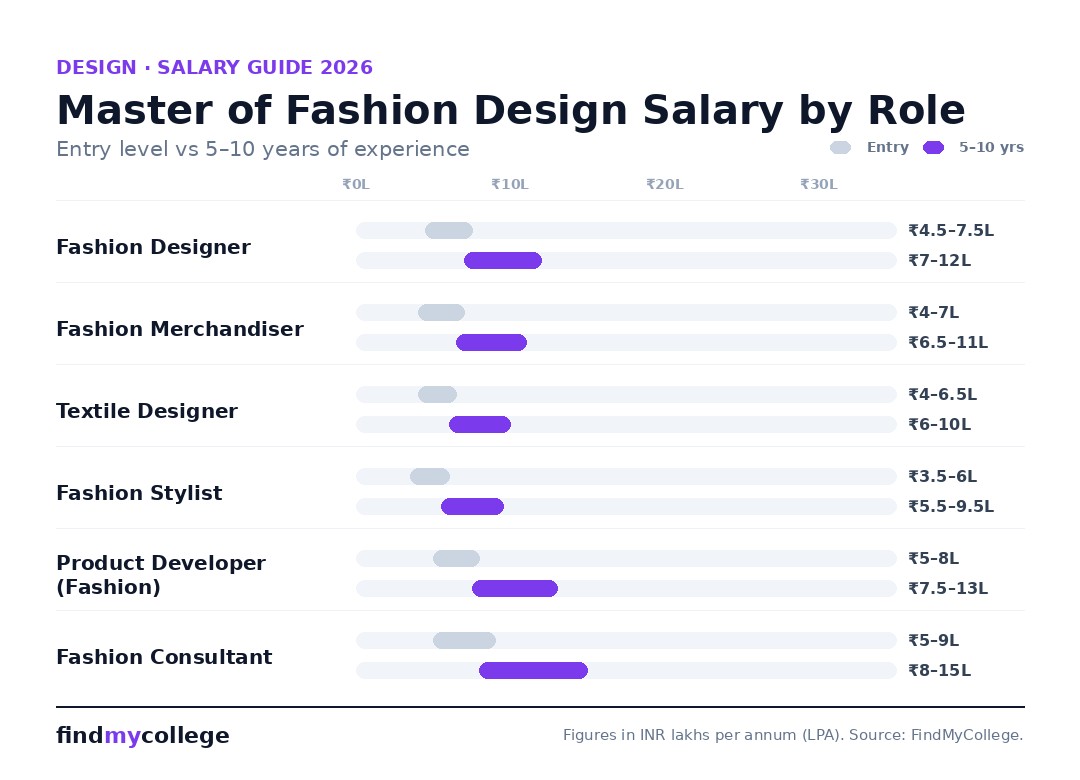
Here’s a breakdown of common job roles and their expected salary ranges in India for 2026:
| Job Role | Entry-Level Salary (0-2 years exp.) | Mid-Level Salary (3-5 years exp.) | Senior-Level Salary (5+ years exp.) |
|---|---|---|---|
| Fashion Designer | INR 4.5 – 7.5 LPA | INR 7.0 – 12.0 LPA | INR 12.0 – 25.0+ LPA |
| Fashion Merchandiser | INR 4.0 – 7.0 LPA | INR 6.5 – 11.0 LPA | INR 10.0 – 20.0+ LPA |
| Textile Designer | INR 4.0 – 6.5 LPA | INR 6.0 – 10.0 LPA | INR 9.0 – 18.0+ LPA |
| Fashion Stylist | INR 3.5 – 6.0 LPA | INR 5.5 – 9.5 LPA | INR 8.5 – 16.0+ LPA |
| Product Developer (Fashion) | INR 5.0 – 8.0 LPA | INR 7.5 – 13.0 LPA | INR 13.0 – 22.0+ LPA |
| Fashion Consultant | INR 5.0 – 9.0 LPA | INR 8.0 – 15.0 LPA | INR 14.0 – 28.0+ LPA |
| Design Manager | N/A (requires experience) | INR 9.0 – 16.0 LPA | INR 15.0 – 30.0+ LPA |
Which specializations in Master of Fashion Design offer higher salaries?
Specializations within Master of Fashion Design that focus on niche, high-demand areas or integrate technology often command higher salaries. These include Sustainable Fashion Design, Fashion Technology & Innovation, Luxury Brand Management, and Fashion Forecasting.
- Sustainable Fashion Design: With increasing global awareness, designers specializing in eco-friendly materials, ethical production, and circular fashion models are highly valued.
- Fashion Technology & Innovation: Expertise in CAD/CAM, 3D printing, wearable technology, and digital fashion design is crucial for brands looking to innovate and streamline processes.
- Luxury Brand Management: Graduates with an understanding of the luxury market, branding, and consumer psychology can secure roles in high-end fashion houses.
- Fashion Forecasting & Trend Analysis: Predicting future trends is vital for brands, and specialists in this area help companies stay ahead, leading to better compensation.
People Also Read




How does the college/university impact Master of Fashion Design salary?
The reputation and placement record of the college or university significantly impact a Master of Fashion Design graduate’s starting salary and career trajectory. Graduates from top-tier institutions often secure better placements with higher packages due to strong industry connections, superior curriculum, and rigorous training.
Institutions like NIFT (National Institute of Fashion Technology), NID (National Institute of Design), and Pearl Academy are renowned for their MFD programs and consistently attract top recruiters. Their alumni networks and industry partnerships provide a distinct advantage in the job market.
What is the Return on Investment (ROI) for a Master of Fashion Design degree?
The Return on Investment (ROI) for a Master of Fashion Design degree can be substantial, especially when considering long-term career growth and increased earning potential. While initial investment in fees can be high, the advanced skills and networking opportunities often lead to accelerated career progression and higher salaries compared to bachelor’s degree holders.
The total cost of an MFD program in India can range from INR 2 Lakhs to INR 10 Lakhs for government institutions and INR 5 Lakhs to INR 20 Lakhs for private universities. Considering an average starting salary of INR 5-8 LPA, the payback period can range from 2-4 years, with significant growth potential thereafter.
What factors influence Master of Fashion Design salary in India?
Several critical factors influence the salary of a Master of Fashion Design graduate in India, including the candidate’s skill set, practical experience, portfolio quality, location, and the type of employer.
- Skills and Portfolio: A strong portfolio showcasing diverse design skills, technical proficiency, and innovative concepts is paramount.
- Internships and Experience: Relevant internships and prior work experience significantly boost earning potential.
- Location: Metropolitan cities like Mumbai, Delhi, Bangalore, and Chennai, which are fashion hubs, generally offer higher salaries due to more opportunities and higher cost of living.
- Company Type: Working for established fashion houses, international brands, or luxury labels typically offers better compensation than smaller boutiques or startups, though startups can offer rapid growth.
- Negotiation Skills: The ability to effectively negotiate salary based on one’s value and market rates is also crucial.
Is Master of Fashion Design worth it for jobs and career growth?
Yes, a Master of Fashion Design is generally worth it for jobs and significant career growth, especially for those aspiring to leadership roles, specialized positions, or entrepreneurship within the fashion industry. The advanced degree provides a competitive edge, deeper industry knowledge, and a stronger professional network.
While a bachelor’s degree can secure entry-level positions, an MFD often opens doors to managerial, directorial, or highly specialized roles faster. It also provides the strategic thinking and business acumen necessary for launching successful fashion ventures.
How does Master of Fashion Design compare to other design master’s degrees in terms of salary?
Master of Fashion Design salaries are competitive with other design master’s degrees, such as Master of Design (M.Des) in Product Design or Communication Design, though specific figures can vary based on industry demand and specialization. Fashion design offers a unique blend of creativity and business acumen.
| Master’s Degree | Average Entry-Level Salary (INR LPA) | Average Mid-Level Salary (INR LPA) | Key Industries |
|---|---|---|---|
| Master of Fashion Design (MFD) | 4.5 – 8.5 | 8.0 – 15.0 | Apparel, Textiles, Luxury, Retail, E-commerce |
| Master of Design (M.Des) – Product Design | 5.0 – 9.0 | 9.0 – 18.0 | Consumer Goods, Electronics, Automotive, UX/UI |
| Master of Design (M.Des) – Communication Design | 4.0 – 7.5 | 7.0 – 13.0 | Advertising, Branding, Digital Media, Publishing |
| Master of Business Administration (MBA) – Luxury Brand Mgmt. | 6.0 – 12.0 | 10.0 – 25.0 | Luxury Goods, Retail, Consulting |
Explore more on FindMyCollege
Related pages for Master of Fashion Design aspirants on findmycollege.com:
Frequently Asked Questions
What is the eligibility for Master of Fashion Design?
Typically, candidates need a Bachelor’s degree in Fashion Design, Textile Design, or a related field from a recognized university, often with a minimum aggregate score (e.g., 50-60%). Some institutions may also consider candidates from other design backgrounds or with relevant industry experience. Entrance exams like NIFT M.Des, NID DAT, or CEED are usually required.
How long does it take to complete a Master of Fashion Design program?
A Master of Fashion Design (MFD) program in India is generally a two-year, full-time postgraduate course, divided into four semesters. Some specialized programs might have slightly different durations.
Can I pursue an MFD after a non-fashion bachelor’s degree?
While most MFD programs prefer a background in fashion or design, some institutions may offer bridge courses or accept candidates from other disciplines with a strong portfolio and relevant work experience. It’s best to check the specific eligibility criteria of your target colleges.
What are the career prospects for MFD graduates abroad?
MFD graduates from India have strong career prospects abroad, especially in fashion hubs like Paris, Milan, New York, and London. The global fashion industry values skilled designers, and an Indian MFD degree can be a stepping stone to international roles, though additional qualifications or work permits may be required.
Are there opportunities for entrepreneurship after MFD?
Absolutely. An MFD degree provides the advanced design skills, business acumen, and industry insights necessary to launch and manage one’s own fashion label, design studio, or fashion consultancy. Many MFD programs include modules on entrepreneurship and business development.
What is the difference between M.Des in Fashion Design and MFD?
Often, M.Des (Master of Design) in Fashion Design and MFD (Master of Fashion Design) are used interchangeably and refer to similar postgraduate programs. However, some institutions might structure their M.Des to be broader, encompassing various design disciplines, while MFD is specifically focused on fashion. Always check the curriculum and course objectives.
Do MFD graduates get placed in luxury brands?
Yes, MFD graduates, especially those from top-tier colleges with strong portfolios and relevant specializations (like Luxury Brand Management), frequently secure placements or internships with leading luxury fashion brands, both Indian and international. Networking and a strong understanding of the luxury market are key.