
Microbiology Courses After 12th: Course Types and Eligibility
Nishit Kumar is a senior EdTech industry leader with over a decade of experience in building and scaling education platforms, shaping their product, content, and growth strategy. At…
After Class 12, students can pursue Microbiology through 3 to 4-year undergraduate degrees (B.Sc, B.Sc Hons, B.Voc), 1 to 2-year Diplomas, or short-term Certificate programs.
Applicants can compare course types, stream requirements, entrance exams, top college options, fee structures, and career opportunities after completing Class 12.
| Parameter | Details |
|---|---|
| UG Course Duration | 3 to 4 Years |
| Diploma Course Duration | 1 to 2 Years |
| Certificate Course Duration | Few hours to 6 Months |
| Eligibility Criteria | Pass 10+2 with Science stream (Biology/PCB preferred) securing 50% to 60% aggregate marks |
| Key Entrance Exams | CUET UG, LPU NEST, IISER IAT, AMUEEE, Assam CEE |
| UG Course Fees | INR 30,000 to INR 5,00,000 |
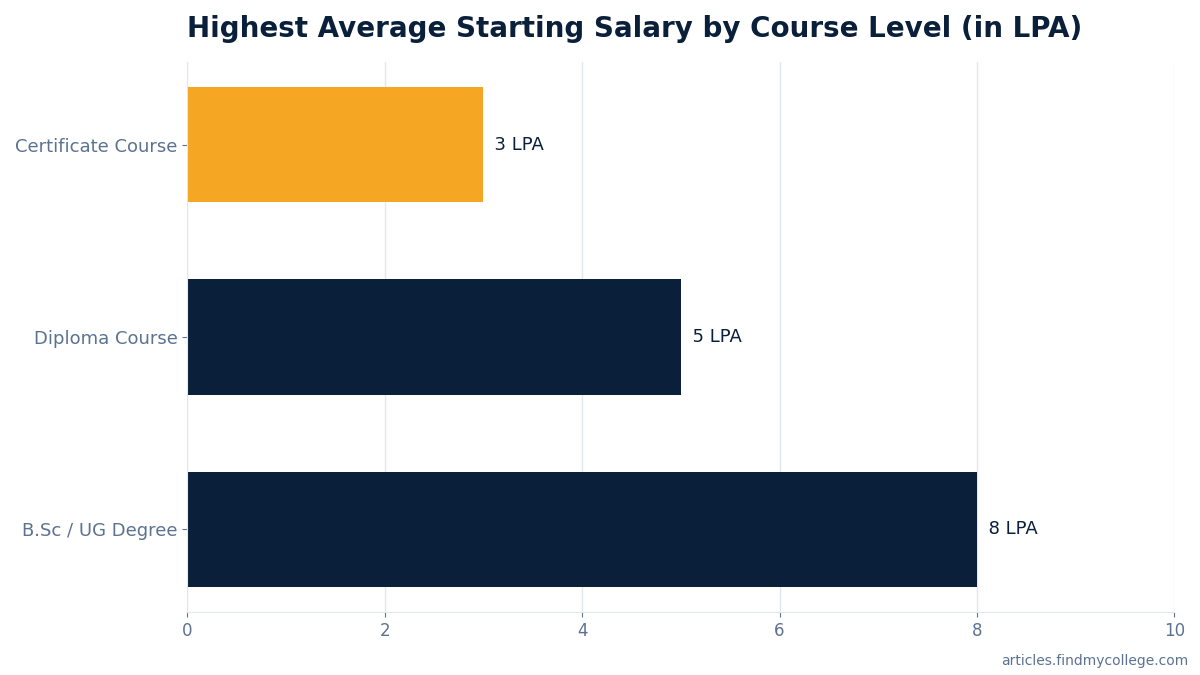
| Starting Salary (UG) | INR 3 to 8 LPA |
Eligibility and Duration
Candidates from the Science stream with Physics, Chemistry, and Biology (PCB) meet standard criteria across all universities. Although Biology (PCB) is preferred for Class 12 admission, some colleges accept PCM students for Microbiology courses.
Undergraduate degree courses (B.Sc, B.Sc Hons) span 3 to 4 years. Diploma courses in Microbiology take 1 to 2 years, whereas short-term online certificates range from self-paced modules to several months of training.
Microbiology Entrance Exams After 12th
Entrance examinations determine entry to several top-tier central, state, and private universities offering Microbiology. While many regional institutions admit students based on 12th marks, national and university-level tests create standardized admission pathways.
National-level entrance exams like CUET UG, ICAR AIEEA, and university-level exams like LPU NEST are accepted for undergraduate admissions. Other recognized entrance tests for Microbiology admission include IISER IAT, AMUEEE, and Assam CEE depending on the target university.
List of B.Sc Microbiology Colleges
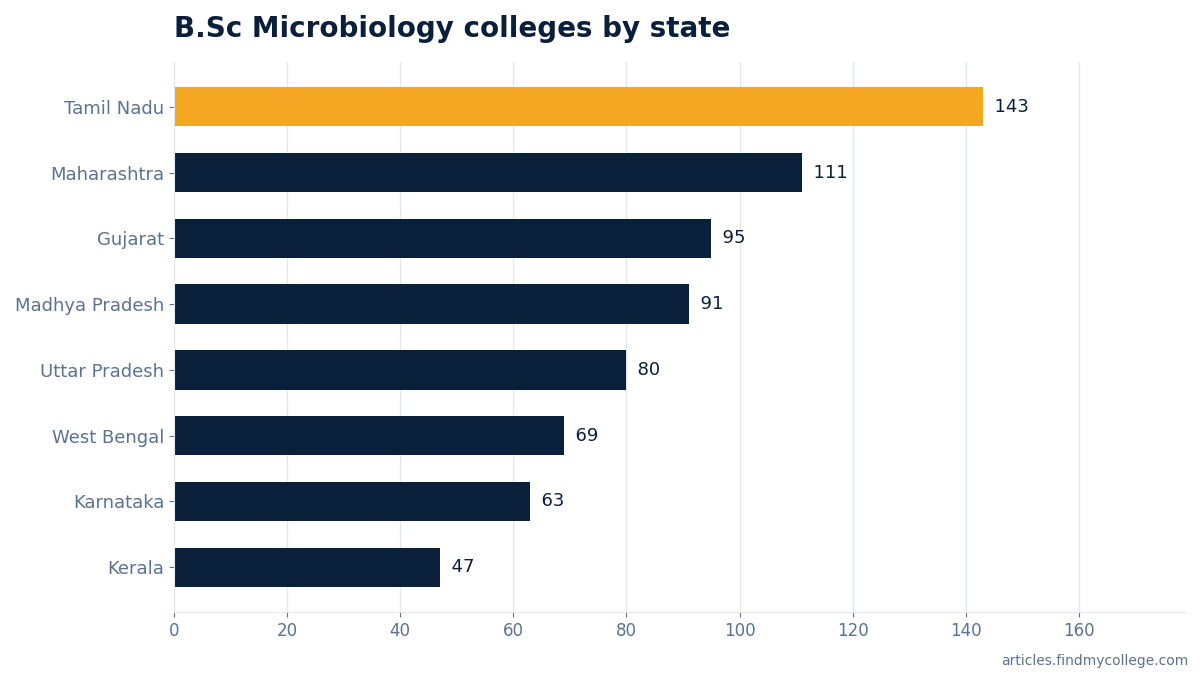
At least 976 colleges offer B.Sc Microbiology, including at least 96 government colleges and 455 private colleges across India. State distribution shows strong concentration, with Tamil Nadu hosting 143 colleges, Maharashtra 111, Gujarat 95, Madhya Pradesh 91, Uttar Pradesh 80, and West Bengal 69.
| College | City | Ownership | Total course fee | NIRF rank |
|---|---|---|---|---|
| Punjab Agricultural University | Ludhiana | — | ₹3.29 lakh | 3 (Overall, 2025) |
| Delhi University | Delhi | Government | — | 5 (Overall, 2025) |
| Ramakrishna Mission Vivekananda Centenary College Rahara | Kolkata | — | ₹51,000 | 6 (Overall, 2025) |
| ShereKashmir University of Agricultural Sciences and Technology of Jammu | Jammu | — | ₹1.15 lakh | 7 (Overall, 2025) |
| St. Xavier’s College Kolkata | Kolkata | Private (aided) | ₹4.82 lakh | 8 (Overall, 2025) |
| PSG College of Arts and Science | Coimbatore | Private (aided) | ₹96,850 | 10 (Overall, 2025) |
| Kerala Agricultural University | Thrissur | — | ₹2.48 lakh | 12 (Overall, 2025) |
| Saveetha Institute of Medical and Technical Sciences | Chennai | — | ₹1.65 lakh | 13 (Overall, 2025) |
| Madras Christian College | Chennai | Private (aided) | ₹1.47 lakh | 16 (Overall, 2025) |
| Orissa University of Agriculture and Technology | Bhubaneswar | — | ₹38,010 | 19 (Overall, 2025) |
| City | Colleges | Fee range | Well-known options |
|---|---|---|---|
| Kolkata | 30 | ₹6,717 – ₹4.96 lakh | West Bengal University of Health Sciences, Asutosh College |
| Bangalore | 28 | ₹26,750 – ₹4.00 lakh | Jain University, Visveswarapura College of Science |
| Chennai | 27 | ₹55,000 – ₹5.00 lakh | Saveetha Institute of Medical and Technical Sciences, Sri Ramachandra Institute of Higher Education and Research |
| Hyderabad | 23 | ₹21,495 – ₹7.60 lakh | Osmania University, Malla Reddy University |
| Bhopal | 23 | ₹24,593 – ₹2.00 lakh | Bhabha University, LNCT University |
| Dehradun | 22 | ₹1.10 lakh – ₹6.08 lakh | University of Petroleum and Energy Studies, Uttaranchal University |
| Pune | 20 | ₹35,080 – ₹3.00 lakh | Fergusson College, Sir Parashurambhau College |
| Mumbai | 18 | ₹7,086 – ₹1.20 lakh | Wilson College, Kishinchand Chellaram College |
Students seeking flexible learning can also evaluate online and distance education choices provided by state and private universities.
| College | City | Total course fee |
|---|---|---|
| Vikram University | Ujjain | ₹1.04 lakh |
| Madurai Kamaraj University, Directorate of Distance Education | Madurai | ₹27,000 |
| St. Peter’s Institute of Distance Education | Chennai | ₹75,000 |
Fees Structure for Microbiology Courses
Academic expenses for Microbiology programs vary according to course level, institutional funding, and specialized facilities. Total course fees range from INR 5,000 to INR 5,00,000 depending on the institute.
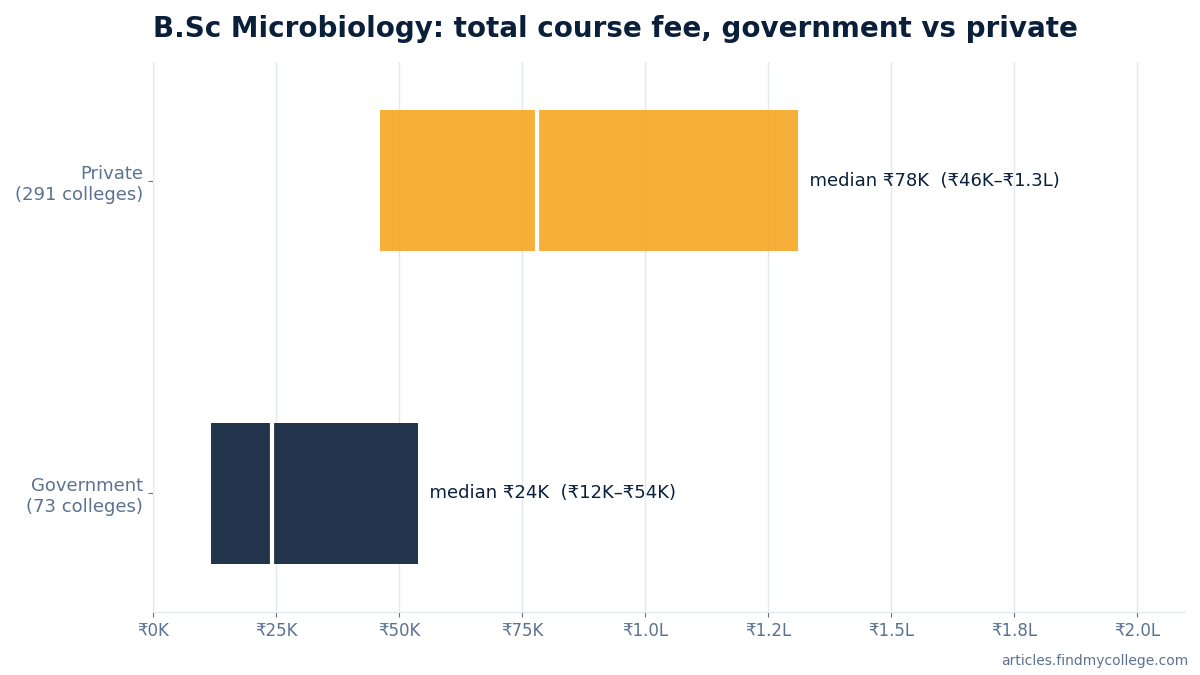
Government colleges have a median total course fee of ₹24,231, with the middle half falling between ₹11,854 and ₹53,885 (based on 73 colleges with fee data). Private colleges reflect higher fee structures, recording a median total course fee of ₹78,000, with the middle half between ₹46,056 and ₹1.31 lakh (based on 291 colleges with fee data).
Diploma courses in Microbiology take 1 to 2 years and have an average fee of INR 5,000 to INR 30,000. Online certificate courses in Microbiology are offered on platforms like Udemy, Coursera, edX, and Swayam, ranging from free self-audit options to INR 50,000 for verified credentials.
| College | City | Ownership | Total course fee |
|---|---|---|---|
| Government Arts College for Women Salem | Salem | Government | ₹6,000 |
| Acharya Prafulla Chandra College | Kolkata | Government | ₹6,717 |
| Elphinstone College | Mumbai | Government | ₹7,086 |
| Indira Gandhi College of Arts and Science | Pondicherry | Government | ₹7,400 |
| Gulbarga University | Gulbarga | Government | ₹8,020 |
| Periyar Arts College | Cuddalore | Government | ₹8,040 |
| Sevadal Mahila Mahavidyala | Nagpur | Government | ₹8,065 |
| L.R.G Government Arts College for Women | Tiruppur | Government | ₹8,550 |
| Maulana Azad College | Kolkata | Government | ₹8,890 |
| Uluberia College | Howrah | Government | ₹9,000 |
Career Options and Salary Scope
Microbiology graduates work in sectors such as healthcare, pharmaceutical industry, food & beverage industry, agriculture, and clinical diagnostic laboratories. Top entry-level job profiles after studying microbiology include Microbiologist, Bacteriologist, Virologist, Biomedical Scientist, and Environmental Microbiologist.
Salary prospects depend heavily on educational qualification and technical laboratory experience. Across 53 colleges tracked for graduate outcomes, the median average placement package stands at 2.93 LPA.
Private sector institutes and aided colleges offer varied recruitment tracks across research laboratories, quality control units, and clinical research facilities.
| College | City | Ownership | Total course fee | Average package |
|---|---|---|---|---|
| Ramnarain Ruia Autonomous College | Mumbai | Private (aided) | ₹33,361 | 5.43 LPA |
| Fergusson College | Pune | Private (aided) | — | 5.02 LPA |
| R. K. Talreja College of Arts, Science and Commerce | Mumbai | Private (aided) | — | 5 LPA |
| K J Somaiya College of Science and Commerce | Mumbai | Private (aided) | ₹49,105 | 4.91 LPA |
| Ramakrishna Mission Vidyamandira | Howrah | Private (aided) | ₹43,200 | 4.7 LPA |
| St. Francis College for Women | Hyderabad | Private (aided) | ₹1.68 lakh | 4.12 LPA |
| Kishinchand Chellaram College | Mumbai | Private (aided) | — | 3.64 LPA |
| St. Philomena’s College | Mysore | Private (aided) | ₹1.03 lakh | 3.62 LPA |
| Ewing Christian College | Allahabad | Private (aided) | ₹79,560 | 3.57 LPA |
| The American College | Madurai | Private (aided) | ₹1.26 lakh | 3.54 LPA |
How to Apply for B.Sc Microbiology Admission in 2026: Step by Step
- Select Course Type: Decide between a full-time UG degree (B.Sc / B.Sc Hons – 3 to 4 years), Diploma (1 to 2 years), or short-term Certificate course.
- Register for Entrance Exams: Apply for relevant entrance tests such as CUET UG, LPU NEST, IISER IAT, AMUEEE, or Assam CEE depending on target universities.
- Submit College Applications: Apply to centralized counselling portals (like CUET Counselling) or individual college application forms for merit-based or entrance-based seats.
- Attend Counselling & Seat Allotment: Participate in seat selection rounds based on merit scores or entrance rank lists published by respective colleges.
- Verify Documents & Pay Fees: Submit required marksheets, photo IDs, and certificates, and pay the required fee to confirm admission.
| What to do | Where | Link |
|---|---|---|
| Compare colleges, fees and cutoffs | B.Sc Microbiology colleges in India | findmycollege.com |
Admissions across Indian colleges are offered through merit or entrance exams like CUET UG, with course fees ranging from INR 30,000 to INR 5 Lakh.
FAQs
How can I become microbiologist after 12th?
Complete 10+2 in Science with Biology (50-60% aggregate), clear entrance exams like CUET UG or LPU NEST if required, and complete a 3-year B.Sc or B.Sc (Hons) in Microbiology.
Which entrance exams are conducted for B.Sc Microbiology?
B.Sc Microbiology admissions are based on Class 12 merit or entrance exams such as CUET UG, IISER IAT, AMUEEE, and LPU NEST.
Can Commerce students take microbiology courses after 12th?
B.Sc and Diploma programs in Microbiology require a Science background with Biology. Commerce students can enroll in online certificate courses, which have no prerequisites.
What is the starting salary after B.Sc Microbiology?
The average starting salary for B.Sc Microbiology graduates ranges between INR 3 LPA to INR 8 LPA depending on the job role, employer, and skills.
Does microbiology require mathematical skills?
Mathematical proficiency is among the key skills required for microbiology, along with analytical, research, problem-solving, and communication skills. The curriculum focuses on cell structure, metabolism, genetics, and laboratory techniques.
Does microbiology have scope in India?
Yes, microbiology graduates can work across sectors such as pharmaceuticals, healthcare, clinical diagnostic laboratories, food and beverage industries, environmental agencies, and agriculture.