M.Sc in Forensic Science India 2026: Course Overview
Nishit Kumar is a senior EdTech industry leader with over a decade of experience in building and scaling education platforms, shaping their product, content, and growth strategy. At…
Latest update: M.Sc in Forensic Science 2026 admissions & dates updated. Read more ›
Welcome to the comprehensive overview of the M.Sc in Forensic Science program in India for the academic year 2026. This page is designed for prospective students and their parents, offering a deep dive into what this postgraduate science degree entails, its career prospects, and the practicalities of pursuing it.
What is M.Sc in Forensic Science?
M.Sc in Forensic Science is a two-year postgraduate program that focuses on the application of scientific principles and methods to criminal and civil investigations. It equips students with advanced knowledge and practical skills in various forensic disciplines to analyze evidence found at crime scenes and present findings in legal proceedings.
The curriculum typically blends theoretical knowledge with extensive practical training, including laboratory work, case studies, and sometimes internships. Graduates play a crucial role in the justice system, working alongside law enforcement agencies, legal professionals, and other experts.
What is the eligibility for M.Sc in Forensic Science in India?
To be eligible for an M.Sc in Forensic Science, candidates generally need a Bachelor’s degree in Science (B.Sc) with a strong foundation in subjects like Chemistry, Physics, Biology, Biotechnology, Biochemistry, or Forensic Science itself. Most universities require a minimum aggregate score, typically ranging from 50% to 60% in the undergraduate degree.
Some institutions may also consider B.Pharm, MBBS, or BDS graduates. Specific subject combinations at the undergraduate level are often preferred; for instance, a B.Sc with Chemistry as a major or one of the core subjects is frequently a prerequisite. Age limits are generally not imposed, but it’s advisable to check individual university criteria.
How much does M.Sc in Forensic Science cost in India?
The cost of pursuing an M.Sc in Forensic Science in India varies significantly based on the type of institution (government vs. private) and its reputation. Government universities typically have lower fees compared to private colleges, which often offer more advanced infrastructure and industry collaborations.
M.Sc Forensic Science Fee Ranges (Annual)
| Institution Type | Annual Fee Range (INR) |
|---|---|
| Government Universities | ₹15,000 – ₹80,000 |
| Private Colleges/Universities | ₹80,000 – ₹3,00,000+ |
These figures are indicative and may not include additional costs like hostel fees, examination fees, and study materials, which can add another ₹50,000 – ₹1,50,000 annually.
What is the admission process for M.Sc in Forensic Science for 2026?
The admission process for M.Sc in Forensic Science for 2026 typically involves either direct admission based on undergraduate merit or through an entrance examination, followed by an interview in some cases. Many prominent universities conduct their own entrance tests.
Typical Admission Steps:
- Application: Fill out the online/offline application form on the university’s official website, usually between March and June.
- Entrance Exam: Appear for the university’s entrance exam (e.g., DUET, BHU PET, PU CET, etc.) or a national-level exam if applicable. These are generally held between June and August.
- Merit List/Interview: Shortlisted candidates based on exam scores or undergraduate merit are called for an interview or counselling session.
- Document Verification & Fee Payment: Final admission is granted after successful document verification and payment of the first installment of fees.
Common Entrance Exams & Tentative 2026 Dates
| Entrance Exam | Conducting Body | Application Period (Tentative) | Exam Date (Tentative) |
|---|---|---|---|
| DUET (Delhi University Entrance Test) | NTA | April – May 2026 | July 2026 |
| BHU PET (Banaras Hindu University PG Entrance Test) | BHU | April – May 2026 | July 2026 |
| PU CET (Panjab University Common Entrance Test) | Panjab University | April – May 2026 | June 2026 |
| NIPER JEE (for some related courses) | NIPER | April – May 2026 | June 2026 |
What are the specializations available in M.Sc Forensic Science?
M.Sc in Forensic Science offers several specializations, allowing students to focus on specific areas of forensic investigation. These specializations equip graduates with expert knowledge in niche fields, enhancing their career prospects.
Key Specializations:
- Forensic Chemistry & Toxicology: Focuses on the analysis of drugs, poisons, explosives, and other chemical substances.
- Forensic Biology & DNA Analysis: Deals with biological evidence like blood, semen, hair, and tissue for DNA profiling and identification.
- Forensic Ballistics: Involves the examination of firearms, ammunition, and bullet trajectories in crime scenes.
- Forensic Document & Fingerprint Examination: Specializes in analyzing handwriting, forged documents, and latent fingerprints.
- Cyber Forensics & Digital Forensics: Focuses on recovering and analyzing data from computers, mobile phones, and networks for criminal investigations.
- Forensic Anthropology & Odontology: Deals with human remains for identification and age estimation, often in mass disaster or decomposed body cases.
Is M.Sc in Forensic Science worth it for jobs in India? What are the career prospects and salary?
Yes, an M.Sc in Forensic Science is increasingly worth it for jobs in India, especially with the growing demand for scientific evidence in legal proceedings and advancements in forensic technology. Graduates can find employment in government forensic science laboratories, police departments, investigative agencies, private detective agencies, and even in the corporate sector for cyber security roles.
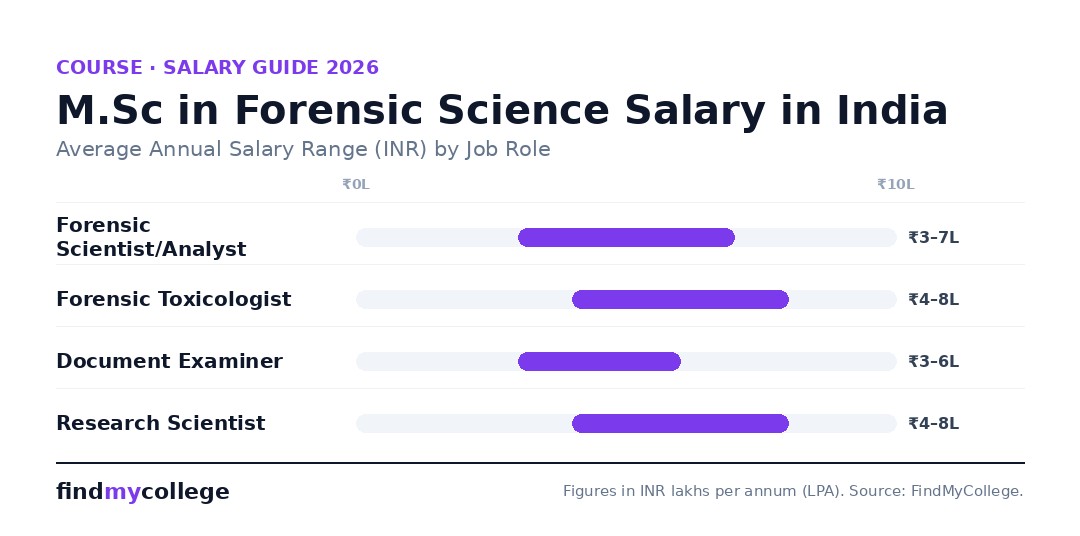
Common Job Roles and Average Annual Salary Ranges (Entry to Mid-Level)
| Job Role | Average Annual Salary Range (INR) | Key Responsibilities |
|---|---|---|
| Forensic Scientist/Analyst | ₹3,00,000 – ₹7,00,000 | Analyzing evidence (DNA, chemicals, fingerprints) in labs. |
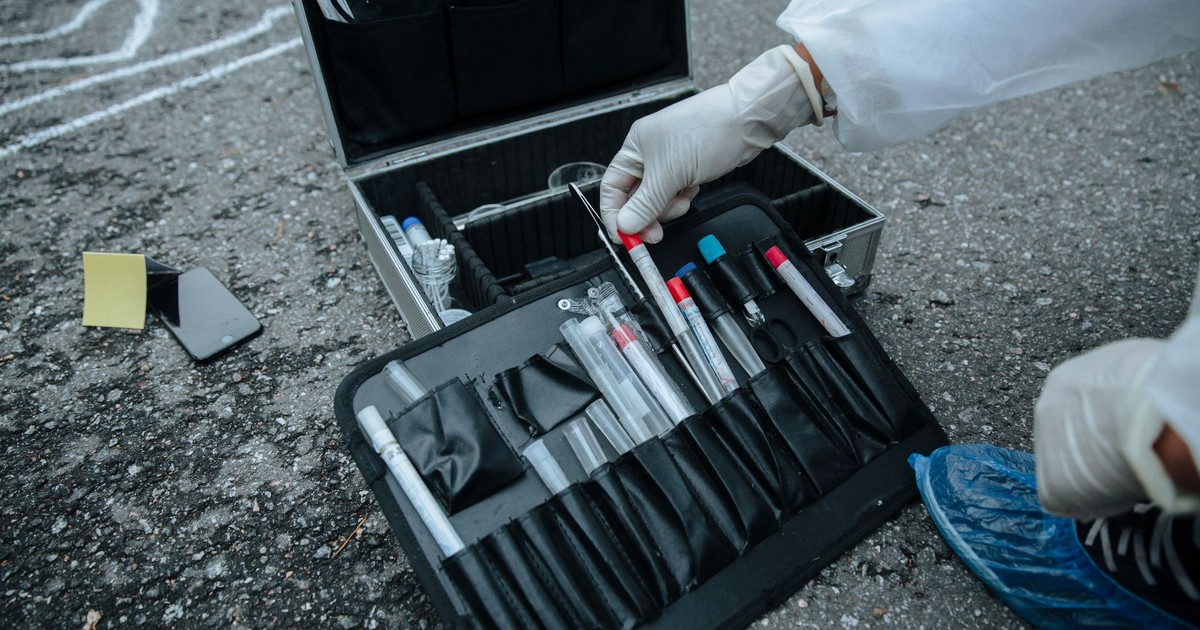
| Crime Scene Investigator (CSI) | ₹3,50,000 – ₹6,50,000 | Collecting and preserving evidence at crime scenes. |
| Forensic Toxicologist | ₹4,00,000 – ₹8,00,000 | Detecting and identifying drugs/poisons in biological samples. |
| Cyber Forensic Expert | ₹4,50,000 – ₹9,00,000 | Recovering and analyzing digital evidence. |
| Document Examiner | ₹3,00,000 – ₹6,00,000 | Authenticating documents and handwriting. |
| Research Scientist | ₹4,00,000 – ₹8,00,000 | Developing new forensic techniques and tools. |
Salaries can vary significantly based on the employer (government vs. private), experience, location, and specific specialization. Government jobs often offer better job security and benefits, while private sector roles, especially in cyber forensics, can offer higher starting salaries.
M.Sc Forensic Science vs. Related Courses: Which is better?
Choosing between M.Sc Forensic Science and related courses depends on your specific career aspirations and interests. While M.Sc Forensic Science provides a broad and specialized understanding of forensic applications, other courses might offer deeper dives into specific scientific disciplines or broader interdisciplinary approaches.
Comparison: M.Sc Forensic Science vs. Related Courses
| Feature | M.Sc Forensic Science | M.Sc Chemistry/Biotechnology | M.Tech Cyber Security |
|---|---|---|---|
| Primary Focus | Application of science to legal investigations. | Deep dive into chemical/biological principles. | Advanced knowledge in protecting digital systems. |
| Career Path | Forensic labs, CSI, law enforcement, private investigation. | R&D, pharmaceuticals, academia, environmental science. | Cybersecurity analyst, ethical hacker, security architect. |
| Prerequisites | B.Sc (Science stream, often specific subjects). | B.Sc (Chemistry/Biotechnology). | B.E/B.Tech (CS/IT) or M.Sc (CS/IT). |
| Skillset | Evidence analysis, crime scene management, legal reporting. | Lab techniques, research, theoretical understanding. | Network security, data encryption, incident response. |
If your goal is directly related to crime investigation and evidence analysis, M.Sc Forensic Science is the most direct and beneficial path. If you prefer a broader scientific career with potential for forensic application later, M.Sc Chemistry or Biotechnology could be a foundation. M.Tech Cyber Security is distinct and focuses purely on digital protection rather than physical evidence.
What are the top colleges for M.Sc in Forensic Science in India?
Several reputable institutions across India offer excellent M.Sc Forensic Science programs, known for their strong faculty, well-equipped laboratories, and industry connections. Choosing a college often depends on factors like location, fee structure, and specific specializations offered.
Leading Institutions (not exhaustive and in no particular order):
- National Forensic Sciences University (NFSU), Gandhinagar
- University of Delhi, Delhi
- Panjab University, Chandigarh
- Banaras Hindu University (BHU), Varanasi
- Amity University, Noida
- Osmania University, Hyderabad
- Dr. Harisingh Gour University, Sagar
- Institute of Forensic Science, Mumbai
- Lovely Professional University (LPU), Phagwara
It is always recommended to visit the official websites of these universities for the most up-to-date information on their M.Sc Forensic Science programs, admission criteria, and facilities.
Frequently Asked Questions
Is a background in mathematics necessary for M.Sc Forensic Science?
While a strong background in mathematics is not typically a primary requirement, basic mathematical and statistical skills are beneficial for data analysis, interpreting scientific results, and understanding certain forensic techniques. Most programs will cover necessary statistical methods.
Can I pursue a Ph.D. after M.Sc in Forensic Science?
Yes, after completing an M.Sc in Forensic Science, you can definitely pursue a Ph.D. in Forensic Science or related scientific disciplines. This path is ideal for those interested in research, academia, or advanced roles in forensic R&D.
Are there any government jobs for M.Sc Forensic Science graduates?
Absolutely. Government jobs are a major career avenue. Graduates can apply for positions in State Forensic Science Laboratories (FSLs), Central Forensic Science Laboratories (CFSLs), Bureau of Police Research and Development (BPR&D), CBI, NIA, and various police departments as Scientific Officers or Assistant Forensic Scientists.
What is the scope of M.Sc Forensic Science abroad?
The scope for M.Sc Forensic Science graduates abroad is also significant, particularly in countries with advanced forensic infrastructure like the USA, UK, Canada, and Australia. However, you may need to meet specific country-wise licensing or certification requirements.
What skills are essential for a successful career in Forensic Science?
Essential skills include keen observation, analytical thinking, attention to detail, strong scientific knowledge, problem-solving abilities, excellent communication (both written and verbal for report writing and court testimony), and ethical conduct.
Is an internship mandatory during M.Sc Forensic Science?
While not always strictly mandatory by all universities, internships are highly recommended and often integrated into the curriculum. They provide invaluable practical experience, exposure to real-world forensic work, and networking opportunities, significantly boosting employability.