
Masters in Textile Design India 2026: Course Overview
Nishit Kumar is a senior EdTech industry leader with over a decade of experience in building and scaling education platforms, shaping their product, content, and growth strategy. At…
Latest update: Masters in Textile Design 2026 admissions & dates updated. Read more ›
Welcome to the comprehensive overview of the Masters in Textile Design (MTex Design) program in India for the academic year 2026. This page is designed to provide prospective students and their parents with a detailed understanding of this postgraduate course, covering everything from its core curriculum to career opportunities and financial considerations.
The MTex Design program is a specialized postgraduate degree focusing on advanced design principles, material innovation, sustainable practices, and market trends within the textile industry. It prepares graduates for leadership roles in design, research, and development.
What is Masters in Textile Design (MTex Design)?
The Masters in Textile Design (MTex Design) is a two-year postgraduate program that delves deep into the artistic, technical, and commercial aspects of textile creation. It aims to cultivate advanced design thinking, material expertise, and an understanding of global textile markets, preparing students for innovative roles in the industry.
This program goes beyond foundational design, emphasizing research methodologies, sustainable textile practices, smart textiles, and the integration of technology in textile production and aesthetics. Students often specialize in areas like woven design, printed textiles, surface ornamentation, textile technology, or fashion textiles.
What are the Eligibility Criteria for Masters in Textile Design in 2026?
To be eligible for a Masters in Textile Design in 2026, candidates typically need a Bachelor’s degree in Textile Design, Fashion Design, Fine Arts, or a related discipline from a recognized university, often with a minimum aggregate score of 50-60%.
Specific eligibility can vary between institutions, but common requirements include:
- Educational Qualification: A Bachelor’s degree (B.Des, B.FTech, B.Sc. in Textiles/Fashion, B.A. in Fine Arts, or equivalent) from a recognized university.
- Minimum Marks: Generally, an aggregate of 50-60% in the undergraduate degree is required. Some top institutions may have higher cut-offs.
- Entrance Exams: Most premier institutes require candidates to clear national-level (e.g., CEED, NID DAT) or institute-specific entrance examinations, which often include a design aptitude test, general ability test, and a studio test/portfolio review.
- Portfolio: A strong portfolio showcasing previous design work, creative skills, and technical abilities is often a mandatory component of the application process.
- Work Experience: While not always mandatory, relevant work experience in the textile or fashion industry can be an advantage for some programs.
How Much Does Masters in Textile Design Cost in India (2026 Fee Ranges)?
The cost of a Masters in Textile Design in India for 2026 can vary significantly, ranging from approximately INR 1,00,000 to INR 6,00,000 per annum, depending on whether the institution is government-funded or private.
Government institutions generally have lower fees due to subsidies, while private colleges, especially those with state-of-the-art facilities and international collaborations, tend to have higher fee structures. Additional costs may include hostel fees, material costs, and examination fees.
| Institution Type | Annual Fee Range (INR) | Key Factors Influencing Cost |
|---|---|---|
| Government/Public Institutes (e.g., NID, NIFT) | ₹1,00,000 – ₹3,00,000 | Subsidies, infrastructure, faculty, reputation |
| Private Universities/Colleges | ₹2,50,000 – ₹6,00,000+ | Facilities, international collaborations, industry ties, brand value |
What is the Admission Process for MTex Design in 2026?
The admission process for MTex Design in 2026 typically involves an entrance examination, a portfolio review, and a personal interview, followed by counseling and seat allocation.
Here’s a general step-by-step guide:
- Application: Fill out the online application form for your chosen colleges, usually available from October to January for the 2026 intake.
- Entrance Exam: Appear for national-level exams like CEED (Common Entrance Examination for Design) or NID DAT (Design Aptitude Test), or institute-specific tests. These usually occur between January and March.
- Portfolio Submission/Review: Shortlisted candidates are often required to submit a digital or physical portfolio showcasing their design skills and creativity.
- Studio Test/Group Discussion: Some institutes conduct a studio test to assess practical design abilities or a group discussion to evaluate communication and analytical skills.
- Personal Interview: Candidates who clear the previous stages are invited for a personal interview to assess their motivation, communication skills, and understanding of the textile industry.
- Merit List & Counseling: Based on the combined scores of all stages, a merit list is prepared, and successful candidates are called for counseling and seat allocation.
Key Entrance Exams & Tentative 2026 Dates
| Exam Name | Conducting Body | Application Period (Tentative) | Exam Date (Tentative) | Focus Areas |
|---|---|---|---|---|
| CEED | IIT Bombay | Oct – Nov 2025 | Jan 2026 | Design Aptitude, Visualisation, Creativity, Analytical Reasoning |
| NID DAT | NID | Oct – Dec 2025 | Jan 2026 (Prelims), Apr – May 2026 (Mains) | Design Aptitude, General Knowledge, Creativity, Studio Test |
| NIFT PG Entrance | NIFT | Nov – Jan 2026 | Feb 2026 | General Ability Test (GAT), Creative Ability Test (CAT) |
What Specializations are Available in Masters in Textile Design?
Masters in Textile Design offers various specializations, allowing students to focus on specific areas of interest within the vast textile industry, such as woven design, printed textiles, surface ornamentation, or sustainable textiles.
Common specializations include:
- Woven Design: Focuses on loom-based textile creation, understanding weaves, yarns, and fabric structures.
- Printed Textiles: Explores various printing techniques, digital textile printing, color theory, and pattern development.
- Surface Ornamentation: Deals with embroidery, embellishments, dyeing, and other techniques to add value and aesthetics to fabrics.
- Sustainable Textiles: Emphasizes eco-friendly materials, processes, and circular design principles in textile production.
- Textile Technology & Innovation: Focuses on advanced materials, smart textiles, and technological advancements in manufacturing.
- Fashion Textiles: Concentrates on textile development specifically for apparel and fashion applications.
- Home Textiles: Specializes in textiles for interior design, furnishings, and decor.
Is Masters in Textile Design Worth It for Jobs? Career Prospects & Salary Outcomes
Yes, a Masters in Textile Design is highly worth it for jobs, offering enhanced career prospects, leadership roles, and higher earning potential in a diverse and evolving industry compared to a bachelor’s degree alone.
Graduates are equipped for roles requiring advanced design thinking, research, and innovation. The textile industry, including fashion, home furnishings, technical textiles, and sustainable practices, continuously seeks skilled professionals.
Common Career Roles & Average Salary Ranges (Post-MTex Design)
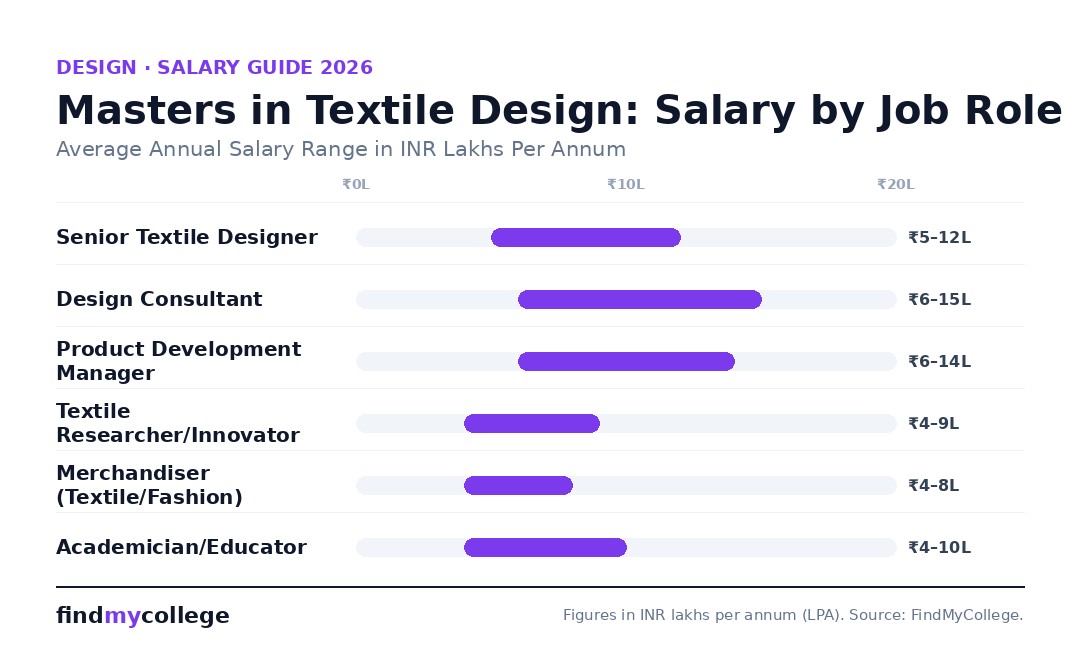
Salaries can vary based on experience, company, location, and specific skills. These are indicative annual ranges in INR.
| Job Role | Description | Average Annual Salary Range (INR) |
|---|---|---|
| Senior Textile Designer | Leads design projects, develops collections, manages design teams. | ₹5,00,000 – ₹12,00,000+ |
| Textile Technologist | Focuses on material science, process innovation, quality control. | ₹4,50,000 – ₹10,00,000 |
| Design Consultant | Provides expert design advice to businesses, often freelance or agency-based. | ₹6,00,000 – ₹15,00,000+ (project-based) |
| Product Development Manager | Oversees the development of new textile products from concept to market. | ₹6,00,000 – ₹14,00,000 |
| Textile Researcher/Innovator | Engages in R&D for new materials, sustainable practices, smart textiles. | ₹4,00,000 – ₹9,00,000 |
| Merchandiser (Textile/Fashion) | Manages product lines, sourcing, and market analysis. | ₹4,00,000 – ₹8,00,000 |
| Academician/Educator | Teaches textile design at colleges and universities. | ₹4,00,000 – ₹10,00,000+ |
Masters in Textile Design vs. Other Design Masters: Which is Right for You?
Choosing between a Masters in Textile Design and other design masters (like Fashion Design, Product Design, or Communication Design) depends entirely on your specific career aspirations and passion for materials, patterns, and fabric innovation versus other design disciplines.
- Masters in Textile Design: Ideal if you are passionate about fabrics, yarns, surface embellishments, sustainable textiles, and the technical aspects of textile production. It leads to roles in textile mills, home furnishings, technical textiles, and fashion textile development.
- Masters in Fashion Design: Focuses on apparel creation, garment construction, fashion forecasting, and styling. Best for those aspiring to be fashion designers, stylists, or merchandisers in the apparel industry.
- Masters in Product Design: Deals with the design and development of physical products (non-textile). Suitable for those interested in industrial design, user experience, and manufacturing processes for consumer goods.
- Masters in Communication Design: Concentrates on visual communication through graphics, branding, digital media, and advertising. For those interested in graphic design, UI/UX, and marketing communication.
Consider your undergraduate background, your strongest skills, and where you envision yourself working in the long term. Textile Design offers a unique blend of art, science, and industry, crucial for a sector that underpins many other creative industries.
Top Colleges Offering Masters in Textile Design in India
Several prestigious institutions in India offer excellent Masters in Textile Design programs, known for their strong industry connections, faculty, and infrastructure.
- National Institute of Design (NID): Ahmedabad, Gandhinagar, Bengaluru (M.Des in Textile Design)
- National Institute of Fashion Technology (NIFT): Various campuses (M.Des in Textile Design, M.F.Tech in Textile Production)
- Indian Institutes of Technology (IITs): Especially IIT Delhi (M.Des in Textile Design via CEED)
- Pearl Academy: Delhi, Mumbai, Bengaluru (M.A. in Textile Design)
- Symbiosis Institute of Design (SID): Pune (M.Des in Textile Design)
- CEPT University: Ahmedabad (M.Des in Textile Design)
- Srishti Manipal Institute of Art, Design and Technology: Bengaluru (M.A. in Textile Design)
Frequently Asked Questions
Is a portfolio mandatory for MTex Design admissions?
Yes, a strong portfolio showcasing your design skills, creativity, and understanding of textiles is almost always a mandatory component for MTex Design admissions at top institutions. It helps evaluators understand your practical abilities and design philosophy.
Can I pursue MTex Design if my bachelor’s degree is not in textiles?
While a bachelor’s in textile or fashion design is preferred, some institutions may accept candidates with degrees in Fine Arts, Applied Arts, or even Architecture, provided they demonstrate a strong aptitude for textile design through their portfolio and entrance exams.
What is the duration of the Masters in Textile Design program?
The Masters in Textile Design program is typically a two-year, full-time postgraduate course, divided into four semesters.
Are there any scholarships available for MTex Design students?
Yes, many government and private institutions offer scholarships based on merit, financial need, or specific categories. You should check with individual colleges and national scholarship portals for available opportunities.
What is the difference between M.Des and M.A. in Textile Design?
Both M.Des (Master of Design) and M.A. (Master of Arts) in Textile Design are postgraduate degrees. M.Des often has a stronger emphasis on practical design, innovation, and industry application, while M.A. might lean more towards theoretical, historical, or critical studies in textiles, though the curriculum can overlap significantly depending on the institution.
What are the job prospects for sustainable textile designers?
Job prospects for sustainable textile designers are growing rapidly. The industry is increasingly focused on eco-friendly practices, creating demand for professionals who can design with sustainable materials, processes, and circular economy principles. Roles include sustainable textile developer, ethical sourcing manager, and eco-fashion consultant.