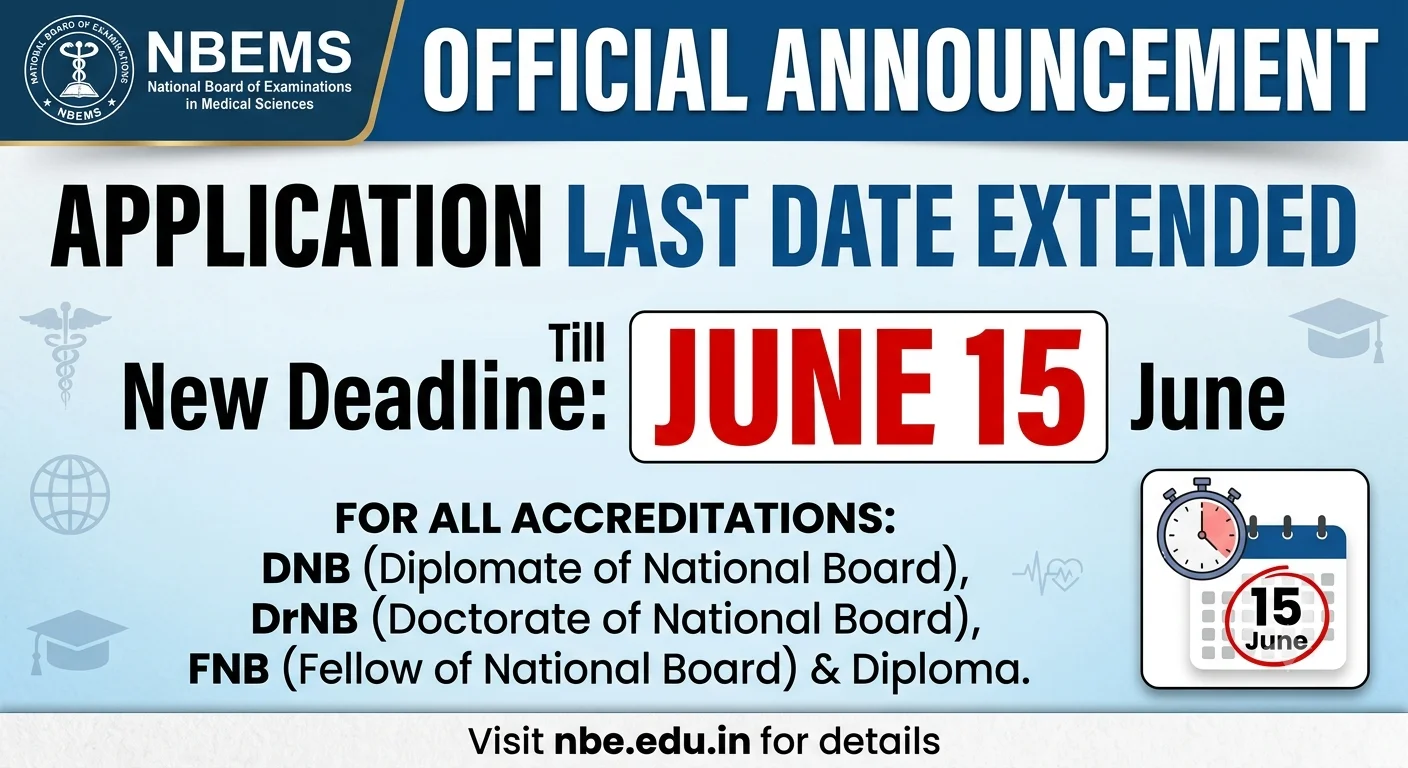
NBEMS Extends DNB, DrNB, FNB & Diploma Accreditation Application Last Date Till June 15; Check Revised Schedule
The National Board of Examinations in Medical Sciences (NBEMS) has extended the last date for submitting applications for accreditation of DNB, DrNB, FNB, and Diploma courses. Medical institutions and hospitals seeking accreditation can now apply until June 15, giving applicants additional time to complete the process.
The decision has been welcomed by many healthcare institutions across the country as it provides extra time to prepare documents, verify eligibility requirements, and submit applications without facing last-minute difficulties. The extension is expected to benefit both new institutions applying for accreditation and existing accredited centers seeking renewal or expansion of seats.
NBEMS is one of the leading medical education bodies in India and is responsible for conducting postgraduate and super-specialty medical education programs through accredited hospitals and healthcare institutions. Accreditation by NBEMS allows eligible institutions to train medical graduates in various specialty and super-specialty disciplines.
Why the Extension Was Announced
According to the latest notification, NBEMS has revised the accreditation schedule and extended the deadline for online submission of applications. The board regularly receives requests from institutions that require additional time to gather necessary approvals, infrastructure details, faculty records, and supporting documents.
Many hospitals and healthcare centers across India are in the process of expanding their academic and clinical facilities. The extension provides such institutions an opportunity to complete their applications properly and avoid errors that may occur due to time constraints.
The revised deadline also ensures wider participation from institutions interested in offering postgraduate medical training under the NBEMS framework.
What is NBEMS Accreditation?
NBEMS accreditation is a formal recognition granted to hospitals and healthcare institutions that meet prescribed standards for medical training. Once accredited, these institutions become eligible to conduct training programs under various NBEMS courses.
The accreditation process focuses on several important factors, including:
- Availability of qualified faculty
- Adequate patient load
- Clinical infrastructure
- Teaching facilities
- Diagnostic and treatment services
- Academic environment
- Research opportunities
Institutions that satisfy all requirements are granted accreditation for specific specialties and courses.
Courses Covered Under the Accreditation Process
The current application cycle includes accreditation for four major categories of NBEMS programs:
DNB Programs
Diplomate of National Board (DNB) courses are postgraduate medical programs offered in various specialties. These courses are considered equivalent to MD and MS qualifications in many circumstances and are highly respected in the medical community.
DrNB Programs
Doctorate of National Board (DrNB) programs are super-specialty courses pursued after postgraduate medical education. These courses provide advanced training in specialized branches of medicine and surgery.
FNB Programs
Fellowship of National Board (FNB) courses offer advanced fellowship training in focused areas of medical practice. They help doctors gain expertise in specialized fields and emerging medical disciplines.
Diploma Courses
NBEMS diploma programs are designed to provide structured postgraduate medical education in selected specialties. These courses help strengthen the healthcare workforce and improve access to trained specialists.
Revised Schedule Released by NBEMS
As per the revised schedule, institutions now have additional time to complete and submit their accreditation applications.
Important Dates
| Event | Revised Date |
|---|---|
| Last date for submission of accreditation applications | June 15 |
| Document scrutiny and verification | As per NBEMS schedule |
| Assessment and inspection process | To be announced by NBEMS |
| Final accreditation decision | After completion of evaluation |
Applicants are advised to complete submissions well before the deadline to avoid technical issues during the final days of registration.
Who Can Apply?
Various healthcare institutions are eligible to apply for accreditation under NBEMS guidelines.
Eligible institutions generally include:
- Government hospitals
- Private hospitals
- Medical colleges
- Multi-specialty healthcare centers
- Super-specialty hospitals
- Trust hospitals
- Corporate healthcare institutions
However, eligibility depends on compliance with NBEMS norms for infrastructure, faculty, patient care services, and academic facilities.
Institutions must carefully review the accreditation handbook and specialty-specific requirements before submitting applications.
Documents Required for Accreditation
Hospitals applying for accreditation are generally required to provide detailed information regarding their facilities and services.
Common documents include:
- Hospital registration certificates
- Faculty details
- Bed strength information
- Patient statistics
- Operation theatre details
- Laboratory facilities information
- Radiology and imaging services data
- ICU facilities details
- Academic infrastructure records
- Compliance certificates
Applicants must ensure that all uploaded documents are accurate and updated.
Importance of Accreditation for Hospitals
NBEMS accreditation offers several advantages to healthcare institutions.
Academic Recognition
Accredited institutions become recognized centers for postgraduate and super-specialty medical education.
Improved Healthcare Services
The accreditation process encourages hospitals to strengthen infrastructure, teaching facilities, and patient care services.
Attraction of Skilled Doctors
Accredited centers attract talented medical graduates who wish to pursue advanced training programs.
Better Academic Environment
The presence of trainees, faculty members, and research activities contributes to a strong academic culture within hospitals.
Contribution to Medical Education
Accredited institutions play an important role in producing trained specialists who serve communities across India.
Impact on Medical Education in India
India continues to witness growing demand for specialist and super-specialist doctors. NBEMS accreditation helps expand training opportunities by involving hospitals beyond traditional medical colleges.
Many hospitals possess excellent clinical facilities but may not be affiliated with universities. Through NBEMS accreditation, such institutions can contribute to postgraduate medical education and help address shortages of trained specialists.
The expansion of accredited seats also supports the government’s broader objective of strengthening healthcare services and increasing the availability of qualified doctors across urban and rural regions.
Application Process
Institutions seeking accreditation must submit applications through the designated online platform.
The general process involves:
- Registration of the institution.
- Selection of specialty or course.
- Uploading required documents.
- Submission of infrastructure and faculty details.
- Payment of applicable fees.
- Verification by NBEMS.
- Assessment and inspection.
- Accreditation decision.
Hospitals should carefully follow all instructions and ensure that information provided in the application matches supporting documents.
Advisory for Applicants
NBEMS has advised institutions not to wait until the final day to submit applications. Heavy traffic near the deadline can sometimes lead to delays in uploading documents or completing the registration process.
Applicants should:
- Verify all details before submission.
- Upload clear and valid documents.
- Check specialty-specific eligibility conditions.
- Maintain copies of submitted records.
- Monitor official notifications for updates.
Any discrepancy identified during scrutiny or assessment may affect the accreditation process.
Growing Role of NBEMS in Healthcare Training
Over the years, NBEMS has emerged as one of India’s most important institutions for postgraduate medical education. Its programs have helped expand specialist training capacity significantly.
Thousands of doctors across the country pursue DNB, DrNB, FNB, and Diploma courses every year. Accredited hospitals play a vital role in delivering quality training while simultaneously providing healthcare services to patients.
The latest extension is expected to encourage more institutions to participate in the accreditation process and contribute to the country’s growing healthcare education ecosystem.
Conclusion
The extension of the accreditation application deadline until June 15 provides a valuable opportunity for hospitals and healthcare institutions seeking recognition under DNB, DrNB, FNB, and Diploma programs. The additional time will help applicants complete documentation, review eligibility requirements, and submit error-free applications.
Institutions interested in becoming accredited training centers should utilize this extended window effectively and ensure timely submission of applications. As India continues to strengthen its medical education system, NBEMS accreditation remains a crucial step toward expanding quality postgraduate and super-specialty medical training across the nation.

📰 More Education News
- SNUSAT Result 2026 Phase 1 to Be Declared Today at ugapplications.snu.edu.in; Know How to Download ResultMay 29, 2026 • Simran
- NEET UG, PG Counselling 2026-27: MCC Issues Guidelines for Nationality Conversion to NRIMay 29, 2026 • Simran
- IIT Madras SWAYAM Plus Launches 3 New AI Courses Under AI for All InitiativeMay 29, 2026 • Simran
- Mumbai University 2026 Second Merit List Out Tomorrow! Get Live Updates for College-Wise AdmissionsMay 29, 2026 • Simran