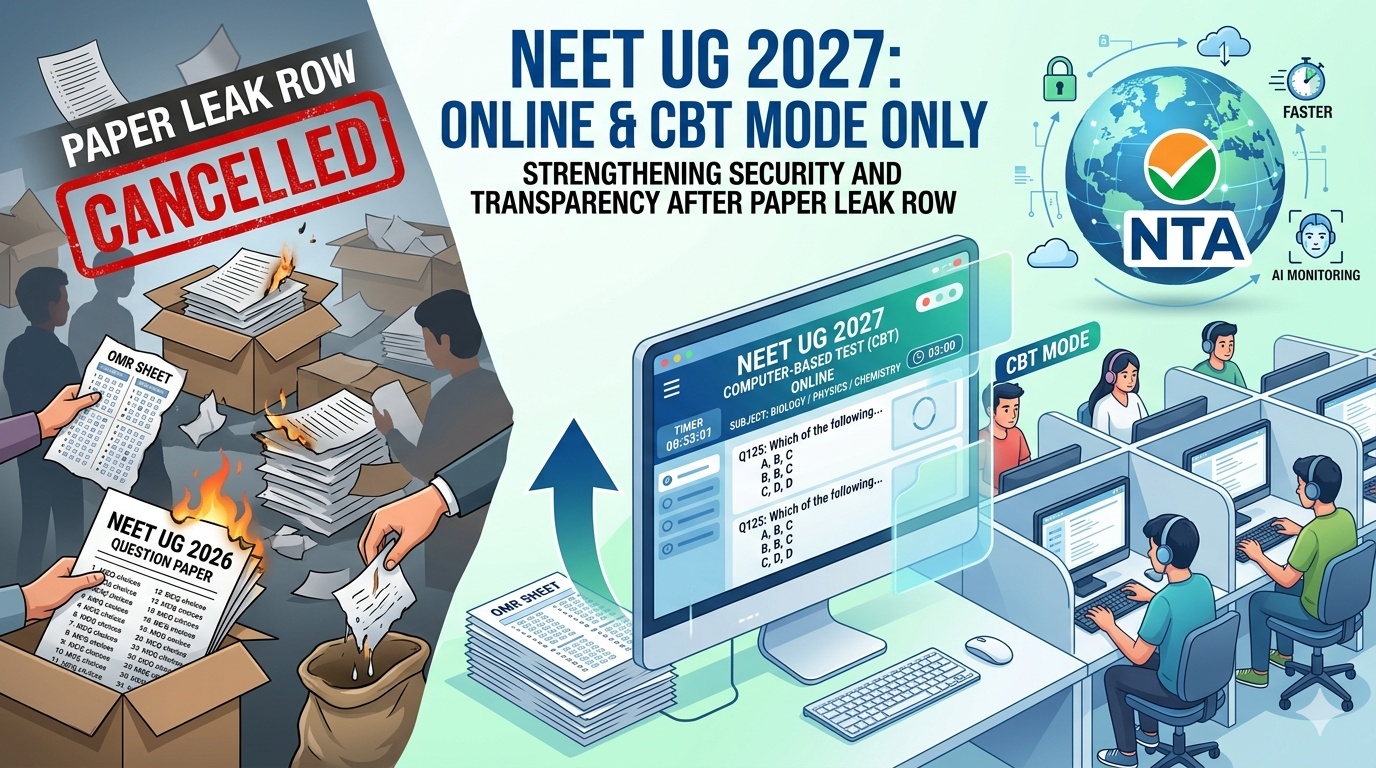
NEET UG 2027 to Be Conducted Online in CBT Mode After Paper Leak Row; Education Minister Signals Major Exam Reform
The National Eligibility cum Entrance Test Undergraduate (NEET UG), India’s largest medical entrance examination, is likely to witness one of the biggest changes in its history from 2027 onwards. Amid the controversy surrounding the NEET paper leak issue and concerns over exam security, the Education Minister has indicated that NEET UG 2027 may be conducted completely online in Computer-Based Test (CBT) mode.
The announcement has sparked a nationwide discussion among students, parents, coaching institutes, and education experts. If implemented, this move would mark a major shift from the traditional pen-and-paper format that has been followed for years. The decision is being viewed as a step toward improving transparency, reducing the chances of paper leaks, and modernizing the examination system.
The proposed transition to CBT mode comes after repeated concerns over question paper security, allegations of malpractice, and demands for stricter exam monitoring mechanisms. Students preparing for medical entrance examinations are now eager to understand how the new pattern may work and what changes they should expect in the coming years.
Government Considering Major Changes in NEET UG
According to statements made by the Education Minister during recent discussions on examination reforms, the government is seriously considering conducting NEET UG in online mode from 2027. The ministry believes that technology-driven examinations can help prevent incidents like paper leaks and ensure greater fairness in the admission process.
The NEET UG examination is conducted for admission into MBBS, BDS, AYUSH, and several allied medical courses across India. Every year, more than 20 lakh candidates appear for the examination, making it one of the largest entrance tests in the country.
Currently, the exam is held in offline mode using OMR answer sheets. Students are required to mark answers manually using pens. However, officials believe that managing such a large-scale examination in offline format increases logistical challenges and security risks.
The proposed CBT model may allow authorities to conduct the examination through secured computer systems at designated test centers, similar to exams such as JEE Main and CUET.
Paper Leak Controversy Triggered Reform Discussions
The discussion around conducting NEET UG online intensified after allegations of question paper leaks and irregularities in recent examinations. Reports of leaked papers, unfair practices, and organized cheating networks raised serious concerns regarding the credibility of the examination system.
Students and parents across the country demanded stricter action and reforms to ensure merit-based admissions. Several petitions and protests also highlighted the need for a more secure examination process.
The controversy created pressure on authorities to reassess the current system. Education experts argued that digital examinations could reduce the possibility of paper transportation leaks and unauthorized access to question papers.
Following the incidents, government agencies and examination authorities reportedly began studying the feasibility of introducing CBT mode for NEET UG.
Why CBT Mode Is Being Considered
The Computer-Based Test format offers several advantages over traditional offline examinations. Officials believe that shifting NEET UG online could strengthen exam security and simplify administration.
Better Security Measures
In CBT exams, question papers are encrypted digitally and delivered directly to examination systems shortly before the test begins. This significantly reduces the risk of physical paper leaks during printing, storage, or transportation.
Randomized Questions
Online examinations can use randomized question sequences for different candidates. This minimizes chances of copying and organized cheating inside exam halls.
Faster Evaluation
Computer-based systems can process responses quickly, reducing evaluation time and enabling faster declaration of results.
Improved Monitoring
CBT centers often include advanced surveillance systems, biometric verification, and live monitoring tools that help authorities track suspicious activities.
Reduced Human Error
OMR-based exams sometimes face issues related to incorrect filling, damaged sheets, or scanning errors. CBT systems can reduce such technical mistakes.
Challenges in Conducting NEET UG Online
While the proposal has several advantages, conducting NEET UG in CBT mode will also present major challenges due to the scale of the examination.
Large Number of Candidates
NEET UG is attempted by lakhs of students from urban as well as rural areas. Ensuring adequate computer infrastructure for all candidates will be a huge task.
Digital Accessibility
Many students, especially from remote regions, may not have sufficient exposure to computer-based exams. Authorities may need to provide mock tests and practice platforms to help students adapt.
Internet and Technical Issues
A stable technical infrastructure will be essential. Any server failure, system crash, or connectivity problem during the examination could affect candidates.
Multiple Exam Shifts
Due to the high number of applicants, the exam may need to be conducted in multiple shifts. This raises concerns regarding normalization and fairness between different question papers.
Training and Preparation
Students accustomed to offline exams may initially find CBT mode challenging. Schools and coaching institutes may also need to modify preparation methods.
Experts Divided Over the Proposal
The proposed shift to CBT mode has received mixed reactions from education experts and student communities.
Some experts have welcomed the move, saying it could modernize India’s examination system and strengthen transparency. They believe technology-driven exams are the future and that NEET UG should align with global testing standards.
Others, however, have raised concerns about digital inequality. They argue that students from rural backgrounds may face disadvantages due to limited access to computers and internet-based learning resources.
Several educators have suggested that authorities should conduct extensive trial runs and provide free practice sessions before implementing the new system fully.
Possible Exam Pattern Changes
Although official details have not yet been announced, experts believe NEET UG 2027 in CBT mode may include several structural changes.
Possible modifications may include:
- On-screen question display
- Digital answer selection
- Timer-based section management
- Auto-submission after exam completion
- Multiple exam shifts
- AI-based monitoring systems
- Biometric attendance verification
Authorities may also introduce mock examinations to familiarize students with the online interface.
NTA Likely to Play Key Role
The National Testing Agency (NTA), which currently conducts NEET UG, is expected to play a central role in implementing the new system.
NTA already conducts several major entrance examinations in CBT mode, including JEE Main, CUET, and UGC NET. This experience may help the agency manage the transition for NEET UG.
However, experts believe that NEET UG presents a much bigger challenge due to its scale and the high emotional pressure associated with medical admissions.
The agency may need to increase the number of test centers, improve technical infrastructure, and collaborate with state authorities for smooth execution.
Students Asked Not to Panic
Education officials and experts have advised students not to panic about the proposed changes. Since the new format is expected from 2027 onwards, current aspirants still have sufficient time to prepare.
Experts recommend that students gradually become comfortable with digital test interfaces by practicing online mock tests and computer-based question solving.
Many coaching institutes have already started introducing CBT practice sessions to help students adapt to the changing examination environment.
Demand for Transparent Examination System
The debate around NEET UG reforms reflects a broader national conversation about examination integrity in India. Over the past few years, several competitive exams have faced allegations of irregularities, leading to growing demands for stronger security systems.
Students and parents are increasingly expecting transparent, technology-driven, and accountable examination processes. The proposed move toward CBT mode is being seen as part of this larger reform effort.
Education policy analysts believe that if implemented successfully, NEET UG’s transition to online mode could influence other major examinations as well.
Official Notification Yet to Be Released
As of now, no official notification confirming the final implementation of CBT mode for NEET UG 2027 has been released. Authorities are expected to conduct consultations, technical studies, and stakeholder discussions before announcing a final decision.
Students are advised to rely only on official announcements from the Education Ministry and NTA regarding examination pattern changes.
Further details regarding syllabus, exam duration, number of shifts, and mock test facilities are expected to be announced in the coming months if the proposal moves forward.
Future of Medical Entrance Exams in India
The proposed shift to online examinations represents a major transformation in India’s competitive exam landscape. With increasing use of digital technology in education, authorities are looking for systems that are secure, scalable, and efficient.
If NEET UG 2027 is officially conducted in CBT mode, it will become one of the largest computer-based examinations in the world.
For millions of medical aspirants, the coming years may bring a completely new examination experience. While the transition may require adjustment, the government believes that stronger technology integration could help restore confidence in the examination system after the recent controversies.
The final roadmap is still awaited, but one thing is clear — the future of NEET UG may soon become fully digital.