
India’s Higher Education Enrolment Hits 4.5 Crore: Women and Marginalised Groups Lead the Way
The Union Ministry of Education has released the latest All India Survey on Higher Education (AISHE) report. The data brings fantastic news for India’s academic landscape. For the first time, total student enrolment in higher education has crossed a massive milestone, hitting 4.5 crore (45 million) students.
This growth shows a 31.5% increase in college and university admissions over the last decade, up from 3.42 crore in 2014-15. Even more exciting is who is driving this growth. Women and students from marginalised communities are leading this educational wave across the country.
Key Highlights from the AISHE Report
If you are preparing for competitive exams or tracking educational trends, here are the most important numbers you need to know:
-
Total Enrolment: 4,50,01,123 students are now pursuing higher education in India.
-
Gross Enrolment Ratio (GER): The percentage of youth aged 18–23 attending college rose to 30%, up from 23.7% a decade ago.
-
Private College Domination: Private unaided colleges continue to be the primary drivers of access, educating over 71.4% of all college students.
Women Outpacing Men in Higher Education
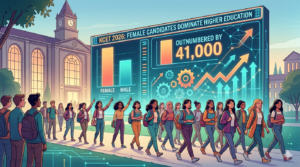
One of the most remarkable findings of the report is the steady rise of female students. Women are no longer just catching up; they are leading the way.
The Gender Parity Index (GPI)
The Gender Parity Index (GPI) stands at 1.08. A GPI score above 1.0 means that more women are enrolling in higher education than men. This marks the seventh consecutive year that India has maintained a female-majority trend in college entries.
Growing Presence in STEM
Science, Technology, Engineering, and Mathematics (STEM) fields have traditionally seen lower female participation. However, the new data shows that female enrolment in STEM has climbed to 44%, up from 38.4% a decade ago. Total STEM enrolment across India has crossed 1.02 crore students for the first time.
Postgraduate Dominance
Women are also staying in academia longer than men. They now make up 56.2% of all postgraduate enrolments nationwide, compared to 49.5% at the undergraduate level. In major states like Bihar, West Bengal, Kerala, Telangana, and Punjab, female enrolment has officially surpassed male enrolment.
Massive Inclusivity Wins for SC, ST, and OBC Communities
The AISHE report highlights a major shift toward social justice, with historical increases in the representation of marginalised groups over the past ten years.
What are Students Choosing to Study?
Undergraduate (UG) degrees remain the backbone of the Indian higher education system, accounting for 76.8% of all enroled students (nearly 3.5 crore).
Among undergraduate courses, the Bachelor of Arts (BA) remains the most popular stream, commanding 1.3 crore students. This is followed closely by:
-
Bachelor of Science (BSc): 53.4 lakh students
-
Bachelor of Technology/Engineering (BTech/BE): 43.2 lakh students
-
Bachelor of Commerce (BCom): 40.8 lakh students
Where is Enrolment Highest?
Six states account for more than half of India’s total student enrolment. Uttar Pradesh leads the nation with 72.7 lakh students, followed by Maharashtra (46.5 lakh) and Tamil Nadu (35.8 lakh). Madhya Pradesh, Karnataka, and Bihar round out the top six.
To support this massive student network, the number of teachers in India has also grown to 17.32 lakh, with women comprising 44.9% of the total academic workforce.





Further reading
📰 More Education News
- CSEET October 2026 question paper PDFs to be released by ICSI soonOct 8, 2026 • Nishit Kumar
- CUET UG 2027 to see ‘one student, one day’ exam model, shorter durationOct 8, 2026 • Nishit Kumar
- CUET UG 2027 exam may be shorter, ‘one student, one day’ pattern proposedOct 8, 2026 • Nishit Kumar
- Acharya Narendra Deo: Apply for M.Sc Zoology 2026 admission now, 41 seatsOct 8, 2026 • Nishit Kumar