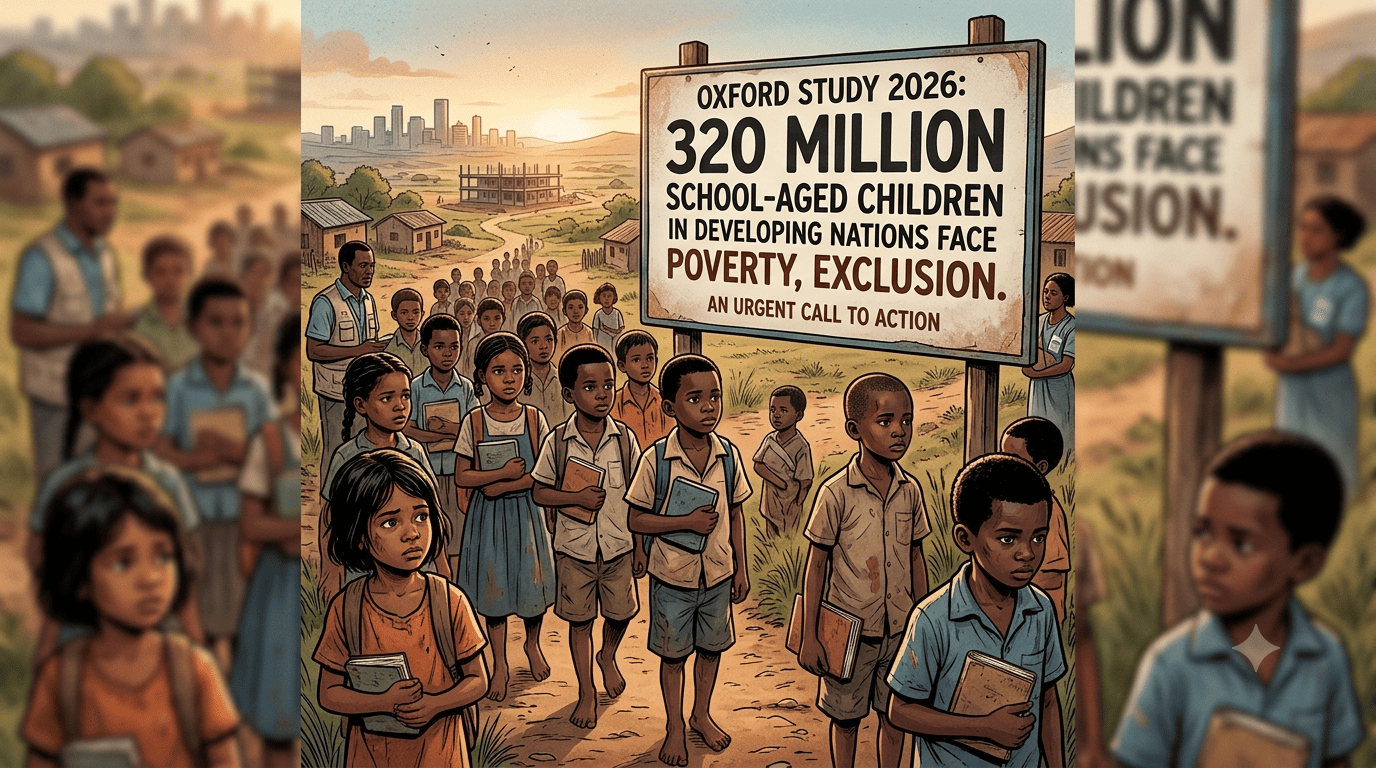
Oxford Study 2026: 320 Million School-Aged Children in Developing Nations Face Poverty, Exclusion
The University of Oxford, in collaboration with the Oxford Poverty and Human Development Initiative (OPHI), today, September 15, 2026, released a new global study highlighting a critical educational and poverty crisis across 108 developing countries. The full analysis found that approximately 31% of school-aged children, totaling around 320 million, are either out of school, experiencing multidimensional poverty, or both.
This significant report underscores the urgent need for targeted interventions, revealing that the intersection of poverty and educational exclusion affects a staggering number of young lives. The findings provide crucial context for policymakers and development organisations, including the United Nations Development Programme (UNDP), to address the deep-seated deprivations faced by these vulnerable populations.
Global Education and Poverty Crisis 2026: Key Findings
The Oxford study, which analysed approximately 1.04 billion school-aged children across 108 developing nations, paints a stark picture of educational inequality and deprivation. It found that 135.8 million children are currently out of school. A more concerning statistic reveals that 110.2 million of these out-of-school children are also living in multidimensionally poor households, indicating that more than four in five children who are not attending school are simultaneously experiencing poverty.
These 110.2 million children, who are both poor and out of school, face an average of five additional deprivations beyond their lack of education and income. These deprivations are measured across the other nine Global Multidimensional Poverty Index (MPI) indicators, highlighting a complex web of challenges that include poor health, lack of access to clean water, and inadequate sanitation.
Educational Disadvantage and Household Deprivations
The study further details the profound impact of household educational attainment on children’s schooling and poverty status. A significant 82.1% of children who are both poor and out of school reside in households where no woman has completed six years of schooling. Similarly, 62.3% of these children live in households where no man has completed six years of schooling.
Alarmingly, 46.8% of poor and out-of-school children live in households where no adult has completed even one year of schooling. This intergenerational cycle of educational deprivation is also evident in intrahousehold inequalities, with over one-third of poor school-aged children living in households where some children attend school while others do not.
Poverty and Malnutrition Among Young Children
Beyond school-aged children, the Oxford study also investigated the plight of younger children. Across 97 countries, covering 518.5 million children under five, 252.3 million children are individually undernourished, multidimensionally poor, or both. A critical finding is that more than 95.6 million children under five are both undernourished and multidimensionally poor.
These 95.6 million children, who suffer from both poverty and undernutrition, experience an average of four to five additional deprivations. This highlights the severe and layered challenges faced by the youngest and most vulnerable populations in developing countries, impacting their health, development, and future prospects.
The Rise of ‘Pioneer Children’ and South Asia’S Role
The study identified 71.3 million children aged 10–17 as “pioneer children” across the 108 countries analysed. These are children who are the first in their household to complete six years of schooling, representing a crucial step towards breaking the cycle of intergenerational educational poverty. South Asia accounts for a substantial portion of these pioneer children, with 35 million.
India leads this group within South Asia, contributing 28 million pioneer children. Other nations in the region also show significant numbers, with Bangladesh having over 3 million, Pakistan 2 million, Nepal 837,000, and Afghanistan 508,500 pioneer children. These figures underscore the progress being made in some areas, even amidst the broader challenges of poverty and educational exclusion.

📰 More Education News
- WB JELET 2026 Round 2 Seat Allotment Result Out at wbjeeb.nic.in; Reporting Deadline Sep 17Sep 15, 2026 • Simran
- DU PhD Admission 2026 Registration Deadline Extended Till September 16 at admission.uod.ac.inSep 15, 2026 • Simran
- CPGET 2026 Provisional Seat Allotment on September 17: Check DetailsSep 15, 2026 • Simran
- Bihar PGDAC 2026 Round 2 Choice Filling Extended; Deadline Today at bceceboard.bihar.gov.inSep 15, 2026 • Simran