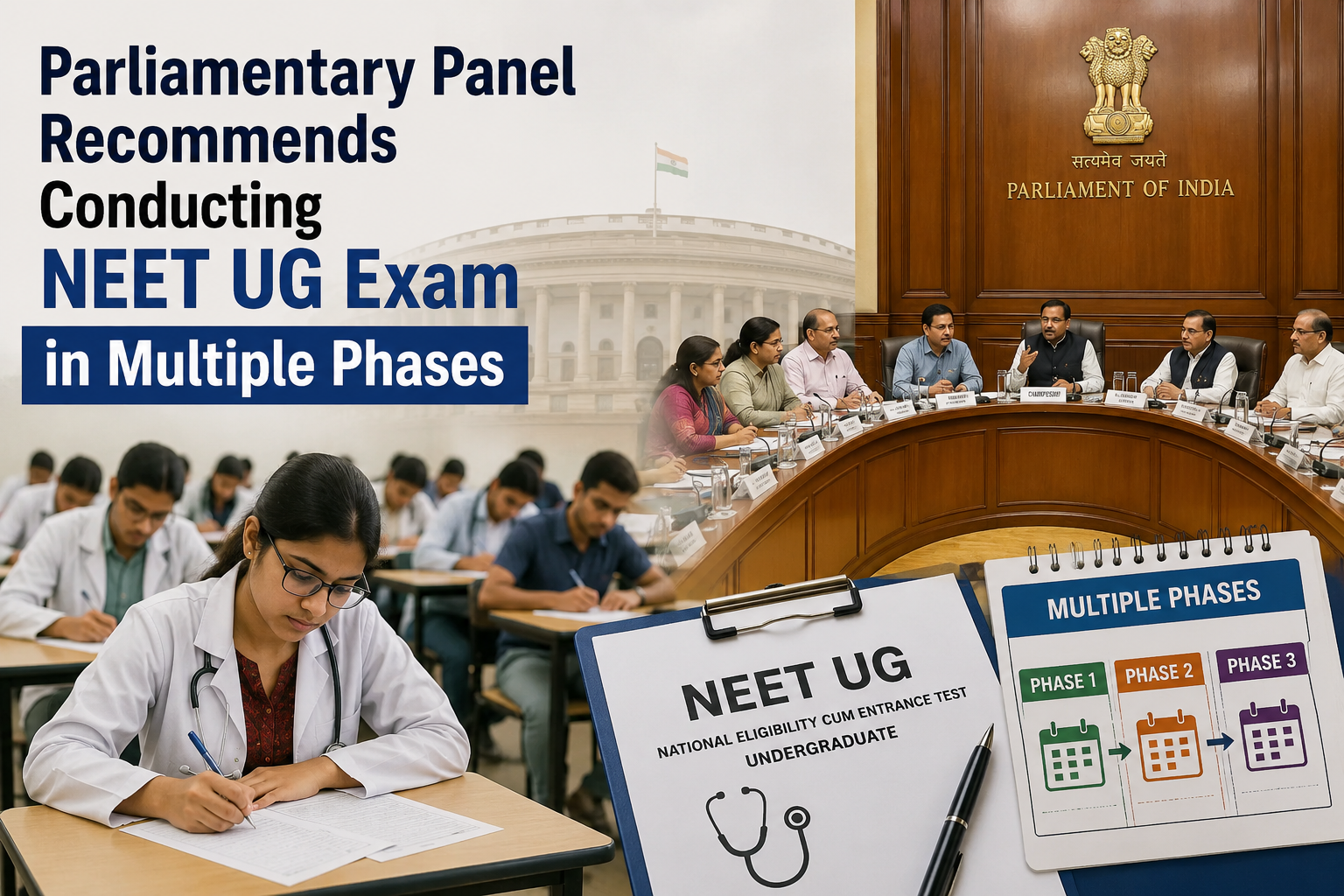
Parliamentary Panel Recommends Conducting NEET UG Exam in Multiple Phases; Major Changes Suggested for NTA
The National Eligibility cum Entrance Test Undergraduate (NEET UG) may witness significant changes in the coming years after a parliamentary panel recommended conducting the NEET UG exam in multiple phases instead of a single-day examination. The panel has also proposed several reforms for the National Testing Agency (NTA) to improve transparency, security, and fairness in the country’s largest medical entrance exam.
The recommendations come after concerns were raised over the conduct of recent NEET UG examinations. Issues related to exam security, allegations of paper leaks, and operational challenges have led policymakers to examine the current examination system and suggest reforms aimed at restoring confidence among students and parents.
If implemented, these recommendations could bring one of the biggest changes in the history of the NEET UG exam.
Parliamentary Panel Suggests Major Reforms
A parliamentary panel reviewing the functioning of the National Testing Agency has recommended that the NEET UG exam should be held in multiple phases rather than on a single day across the country.
According to the panel, conducting the examination in different phases could help reduce administrative pressure while improving security arrangements. The committee believes that a phased examination system would allow authorities to better monitor the conduct of the exam and quickly address any issues that arise during the process.
Apart from recommending multiple phases, the panel has also called for stronger institutional reforms within the NTA to improve its overall functioning.
Why Was This Recommendation Made?
The recommendation follows widespread discussions regarding the conduct of recent medical entrance examinations. NEET UG attracts more than 20 lakh candidates every year, making it one of the largest entrance examinations in India.
Managing such a large examination on a single day involves thousands of examination centres, lakhs of invigilators, transportation of confidential question papers, and extensive coordination among various agencies.
The parliamentary panel observed that such a massive exercise creates significant logistical challenges and increases the risks associated with exam management.
It believes that conducting the examination in multiple phases may reduce these risks while improving the overall examination process.
How Could Multiple Phases Work?
Although the panel has not suggested a detailed implementation plan, experts believe that the exam could be conducted over different dates, similar to several national-level entrance examinations already held in multiple sessions.
If the proposal is accepted, candidates would appear for the NEET UG exam on different days or in separate examination sessions. To maintain fairness, the NTA would need to prepare different question papers with similar difficulty levels.
A normalization process could also be introduced to ensure that students appearing in different phases are evaluated fairly.
However, no final decision has been announced regarding the examination format.
People Also Read



Proposed Changes for the National Testing Agency
The parliamentary panel has also suggested broader reforms for the National Testing Agency.
Some of the major recommendations include:
- Strengthening the institutional capacity of the NTA.
- Improving security protocols during examinations.
- Increasing transparency in examination management.
- Enhancing accountability at different administrative levels.
- Adopting advanced technology to monitor examinations.
- Conducting regular audits of examination systems.
- Building stronger mechanisms to prevent malpractice.
The panel believes that these measures will help improve public confidence in the examination system and reduce the possibility of irregularities.
Importance of the NEET UG Exam
The NEET UG exam serves as the single entrance examination for admission to undergraduate medical courses across India.
Students seeking admission to MBBS, BDS, AYUSH, veterinary, nursing, and several other health science programmes appear for this examination every year.
Since admissions to government and private medical colleges largely depend on NEET UG scores, the examination plays a crucial role in determining the future of lakhs of aspiring doctors.
Any change in the examination process therefore has a direct impact on students, educational institutions, and admission authorities.
Possible Benefits of Conducting NEET UG in Multiple Phases
Education experts believe the recommendation could offer several advantages if implemented carefully.
Better Exam Management
Dividing candidates into multiple phases may reduce the burden on examination authorities. Smaller batches would make it easier to monitor centres and ensure smooth conduct.
Improved Security
Conducting the examination in phases could allow authorities to focus more closely on security arrangements, reducing opportunities for malpractice.
Better Resource Utilisation
Schools, colleges, and examination centres may find it easier to manage infrastructure and staff when candidates are spread across multiple examination dates.
Reduced Administrative Pressure
The NTA would have more flexibility in handling unexpected situations such as technical issues, weather-related disruptions, or local administrative challenges.
Enhanced Monitoring
Authorities could deploy more effective surveillance systems, making it easier to detect and prevent irregularities.
Challenges That May Arise
While the proposal offers several potential benefits, experts have also pointed out certain challenges.
Ensuring Fairness
One of the biggest concerns is maintaining equal difficulty levels across different examination phases. Even small differences in question paper difficulty could affect rankings.
Normalization of Scores
If multiple question papers are used, an appropriate normalization system may become necessary. This process would need to be transparent and scientifically designed to maintain student confidence.
Risk of Information Sharing
Students appearing in earlier phases may attempt to share information about the examination with candidates scheduled for later sessions. Strong security measures would therefore be essential.
Higher Operational Costs
Conducting multiple examinations may require additional manpower, security arrangements, technology support, and administrative expenses.
Longer Admission Timeline
Multiple examination phases, evaluation, normalization, and result preparation could extend the overall admission schedule unless carefully planned.
Reactions from Students and Education Experts
The parliamentary panel’s recommendation has generated mixed reactions among stakeholders.
Many students have welcomed the idea, believing that stronger security measures could help improve the credibility of the examination. Several parents have also expressed hope that reforms will reduce controversies surrounding future examinations.
Some education experts support the proposal, stating that conducting large-scale examinations in multiple phases has become common internationally and can improve operational efficiency.
However, other experts believe that implementing multiple phases for a highly competitive examination like NEET UG would require extremely careful planning. They stress that maintaining fairness across all sessions would be the biggest challenge for the NTA.
Coaching institutes have also noted that any major change in the examination pattern should be announced well in advance so that students have sufficient time to prepare accordingly.
What Happens Next?
At present, the parliamentary panel’s recommendations are advisory in nature.
The final decision regarding the conduct of the NEET UG exam rests with the concerned authorities and the Government of India. Before any changes are implemented, the recommendations may undergo further review, discussions, and administrative evaluation.
If approved, the NTA would also need to develop detailed guidelines regarding examination scheduling, question paper preparation, score normalization, security arrangements, and counselling timelines.
Students preparing for upcoming NEET UG examinations should continue following the existing examination pattern until any official announcement is made.
News Important Links
Final Words
The parliamentary panel’s recommendation to conduct the NEET UG exam in multiple phases marks an important step in discussions about improving India’s largest medical entrance exam. Along with proposed reforms for the NTA, the suggestions aim to strengthen transparency, security, and administrative efficiency while restoring confidence in the examination system.
Although the proposal presents several potential benefits, it also raises important questions about fairness, normalization, and implementation. Until the government takes a final decision, the recommendations remain proposals, but they have already sparked an important conversation about the future of medical entrance examinations in India.

Simran is currently working as a Senior Content Writer at Findmycollege , where she creates engaging and research-driven learning resources for students. She has completed her Graduation in Journalism from Delhi University. With 4 years of experience in the EdTech industry, she has previously contributed to leading platforms like Leverage Edu and Aakash. Her expertise lies in simplifying Engineering and Medical entrance exam content to guide aspirants in their preparation journey. Beyond writing, Simran enjoys sketching, watching movies, and finding creative inspiration in everyday life.
View all posts →Related Articles

NEET UG 2026 Re-Exam: Paper Setters in Lockdown Till June 21; NTA Tightens Security
Jun 08, 2026
NEET 2026 Re-Exam Date Out; NTA to Conduct Re-NEET UG 2026 on This Date
May 15, 2026
NEET 2026 Paper Leak Row Deepens; NTA Director Admits ‘Gaps In System’ Amid Nationwide Anger
May 27, 2026
NEET UG 2026 Paper Leak Case: Supreme Court to Hear Major Pleas Seeking NTA Overhaul
May 29, 2026
NEET UG is world's fifth largest exam; online transition from 2027 discussed
Oct 01, 2026
ABVP Submits NEET UG 2027 Reform Plan to Nilekani Panel, Proposes Two-Stage Exam, Twice a Year
Sep 15, 2026Further reading
- NEET UG 2026: Uttarakhand opens Round 3 NRI quota MBBS registration until 5 October
- Kerala NEET third phase option registration for MBBS, BDS courses closes October 10
- National Eligibility cum Entrance Test (UG) application form: eligibility, dates and how to apply Next step
- Ladakh Central Pool MBBS/BDS: Apply by Sep 10 for 2026-27 single merit list Applications open
- Common University Entrance Test application form: eligibility, dates and how to apply
- National Eligibility cum Entrance Test (UG): complete exam guide
📰 More Education News
- MHM: Apply for 2026-27 Himachal Pradesh admissions nowOct 2, 2026 • Nishit Kumar
- TNOU admission 2026-27 deadline extended: apply by 13 OctoberOct 2, 2026 • Nishit Kumar
- SSC JE, Delhi Police SI, CHSL 2026 exam dates announced: tests from November to DecemberOct 2, 2026 • Nishit Kumar
- UCEED 2027 registration opens for B.Des admissions; apply by October 31Oct 2, 2026 • Nishit Kumar