Public Examinations (Prevention of Unfair Means) Amendment Bill, 2026 Tabled in Parliament: Key Provisions, Penalties, and Debates
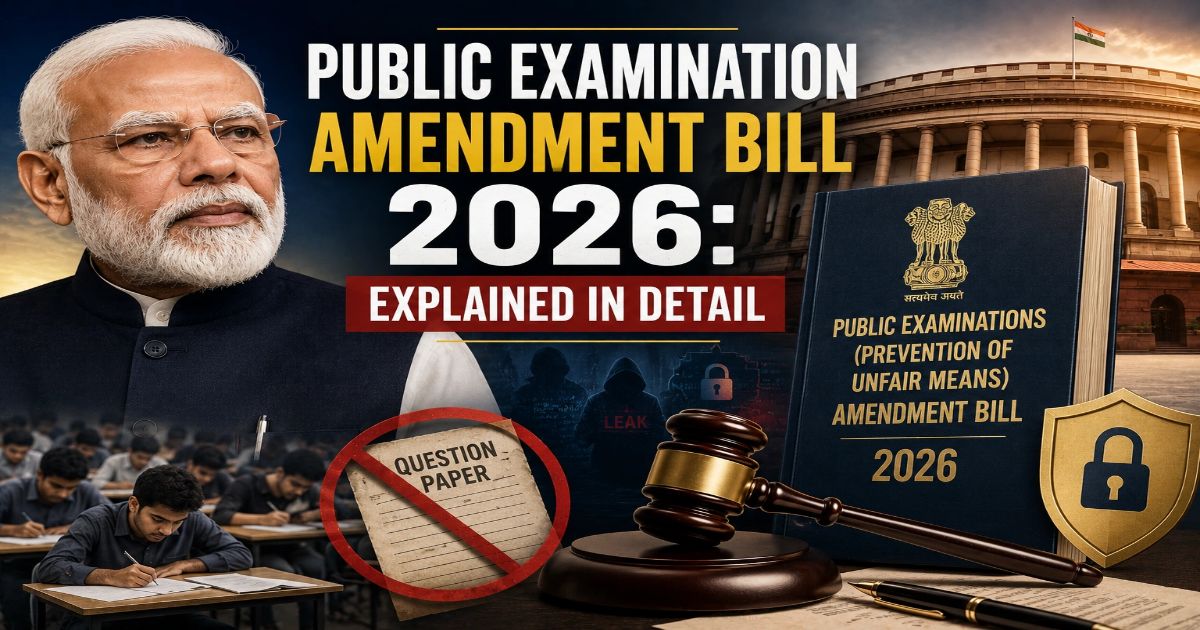
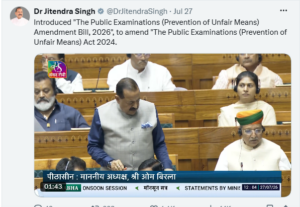
On July 27, 2026, Union Minister of State Dr. Jitendra Singh introduced the Public Examinations (Prevention of Unfair Means) Amendment Bill, 2026 in the Lok Sabha. The tabled bill represents a decisive legislative response to recurring paper leaks and examination scandals that have eroded public trust and sparked widespread student agitation.
The Public Examinations (Prevention of Unfair Means) Amendment Bill, 2026 seeks to amend the Public Examinations (Prevention of Unfair Means) Act, 2024, which was originally enacted to curb organized cheating, paper leaks, impersonation, and corrupt practices during central recruitment and entrance tests. The 2026 Amendment Bill significantly strengthens the original Act by expanding definitions of offences, introducing steeper financial and custodial penalties, mandating strict timelines for police investigations, and establishing designated Special Fast Track Courts across states.
Why Was the Amendment Bill Introduced?
The Public Examinations (Prevention of Unfair Means) Amendment Bill, 2026 was introduced in response to the NEET 2026 paper leak and the widespread student protests that followed it. Some prominent reasons include:
-
Persistence of Paper Leaks: High-stakes national examinations—most notably the National Eligibility cum Entrance Test (NEET-UG)—continued to face allegations of question paper leaks, compromised testing centers, and organized syndicate involvement.
-
Public Demand for Accountability: Escalating student protests across the country demanding structural overhaul and administrative accountability prompted the government to enforce harsher deterrents.
-
Delays in Judicial Adjudication: Existing legal frameworks lacked strict timeframes for completing investigations and trials, allowing perpetrators and organized paper-leak syndicates to exploit procedural delays.
-
Strengthening Deterrence: The Union Government emphasized the necessity of closing legal loopholes, increasing financial liability for private service providers, and forming dedicated investigative mechanisms.
What Changes Does the Amendment Bill Propose?
The Amendment Bill proposes the following key changes:
1. Special Task Force (STF): Empowers the Central Government to set up an STF to investigate cross-border and multi-state examination offences, alongside agencies such as the CBI. One such task force – led by Nandan Nilekani – has already been constituted.
2. Special Fast Track Courts: Requires States and Union Territories to designate Courts of Session as Special Fast Track Courts, in consultation with the respective High Court Chief Justice, for day-to-day hearings.
3. Time-Bound Investigations: Mandates completion of investigations and filing of the chargesheet within two months of the FIR being registered.
4. Time-Bound Trials and Appeals: Requires trials to conclude within three months of chargesheet filing. Appeals must be filed within 30 days and, as far as possible, decided by a two-judge High Court bench within three months.
5. Longer Debarment for Service Providers: Extends the debarment period for private testing service providers found involved in unfair practices or paper leaks.
What Are the Penalties for Paper Leaks and Other Offences?
Under the proposed Public Examinations (Prevention of Unfair Means) Amendment Bill, 2026, offences continue to remain cognizable, non-bailable, and non-compoundable. Compared to the 2024 Act, the Bill proposes stricter punishments, higher fines, longer debarment periods, and faster investigation and trial timelines.
| Offence / Provision | Proposed Amendment Bill, 2026 | Public Examinations Act, 2024 |
|---|---|---|
| Individual Offenders | 5–10 years’ imprisonment and a fine of up to ₹50 lakh | 3–5 years’ imprisonment and a fine of up to ₹10 lakh |
| Service Providers | Fine of up to ₹5 crore and debarment for 8 years | Fine of up to ₹1 crore and debarment for 4 years |
| Management/Directors of Service Providers | 5–10 years’ imprisonment and a fine of up to ₹5 crore | 3–10 years’ imprisonment and a fine of ₹1 crore |
| Organised Paper Leak Syndicates | 7–10 years’ imprisonment, a fine of up to ₹10 crore, and attachment of property | 5–10 years’ imprisonment and a fine of at least ₹1 crore |
| Investigation | Mandatory completion within 2 months and provision for a Central Special Task Force (STF) | Standard police investigation (DySP/ACP level) or referral to central agencies |
| Trial & Appeals | Special Fast Track Courts with day-to-day trials, completion within 3 months (as far as possible), and appeals to be filed within 30 days | Regular court proceedings with no statutory timeline |
Note: The proposed Amendment Bill also empowers authorities to attach and seize properties linked to organised paper leak syndicates, strengthening action against organised examination fraud.
Which Exams Will Be Covered?
The Amendment Bill governs public examinations conducted by central authorities, test agencies, and specified government bodies.
-
Union Public Service Commission (UPSC): Civil Services, NDA, CDS, Combined Medical Services, and engineering service exams.
-
Staff Selection Commission (SSC): Combined Graduate Level (CGL), Combined Higher Secondary Level (CHSL), and Multi-Tasking Staff (MTS) recruitment.
-
Railway Recruitment Boards (RRBs): Non-Technical Popular Categories (NTPC), Loco Pilot, and Group D recruitment examinations.
-
National Testing Agency (NTA): High-stakes competitive national entrance examinations including NEET-UG, JEE Main, CUET-UG, CUET-PG, and UGC-NET.
-
Institute of Banking Personnel Selection (IBPS): Probationary Officer (PO), Clerk, and Specialist Officer bank recruitment tests.
-
Central Government Departments: Any entrance or recruitment examination notified by Ministries or Central Departments.
Major Criticism Against the Public Examinations (Prevention of Unfair Means) Amendment Bill, 2026
Despite the government’s claim that the Amendment Bill will strengthen the fight against paper leaks, it has faced criticism on several fronts:
- Focuses more on punishment than prevention: Critics argue that the Bill increases penalties but does not sufficiently address the systemic issues that lead to paper leaks, such as weak exam security, poor oversight, and administrative failures.
- Limited accountability for authorities: Opposition leaders have questioned why the Bill prescribes stringent punishment for offenders and service providers but does not clearly fix responsibility on officials or examination bodies whose lapses enable such incidents.
- Concerns over implementation: The Bill mandates time-bound investigations and fast-track trials. Critics say many states may lack the judicial infrastructure and investigative capacity to consistently meet these deadlines.
- No specific relief for affected students: Student groups have argued that while the Bill penalises those responsible for paper leaks, it does not provide a framework to compensate or support candidates whose examinations are cancelled or delayed due to such incidents.
Reactions from Top Political Leaders
The Public Examinations (Prevention of Unfair Means) Amendment Bill, 2026 received mixed reactions during the parliamentary debate, with the government defending it as a stronger anti-paper leak law and the Opposition calling for broader examination reforms.
| Leader | Party / Position | Key Statement |
|---|---|---|
| Jitendra Singh | BJP | “The Bill seeks faster justice and stronger deterrence against examination malpractices.” |
| Kiren Rijiju | BJP | “We want all parties to take part in the discussion on the Bill.” |
| Shashi Tharoor | Congress | “The entire examination system needs to be reviewed and overhauled.” |
| Akhilesh Yadav | Samajwadi Party | “The government should not challenge public awareness.” |
What Happens Next?
Following its formal introduction in the Lok Sabha on July 27, 2026, the Bill moves into Parliamentary debate and review.
-
Parliamentary Debate & Voting: The Bill must be debated and passed by both the Lok Sabha and Rajya Sabha.
-
Presidential Assent: Upon passing both Houses, the Bill will be forwarded to the President of India for assent to become law.
-
Notification & Rule Formulation: Once enacted, the Ministry of Personnel, Public Grievances and Pensions will issue statutory guidelines to establish Special Fast Track Courts and formulate working rules for the Special Task Force in coordination with state governments.

📰 More Education News
- IIT Bombay BTech 2026-27 fees released: first semester academic fees set at ₹1,34,150Oct 27, 2026 • Nishit Kumar
- CUET PG 2027 exam dates revised by NTA: March 2 start, buffer dates removedOct 27, 2026 • Nishit Kumar
- DSSSB admit card 2026 released: download hall ticket for October 27 to December 5 examsOct 27, 2026 • Nishit Kumar
- NEET PG 2026 counselling: NBEMS clarifies fee rules, joining process for AIQ seatsOct 27, 2026 • Nishit Kumar