Reservation Hatao Andolan: BJP Grapples with Anti-Quota Protests Amidst Demands for Reform
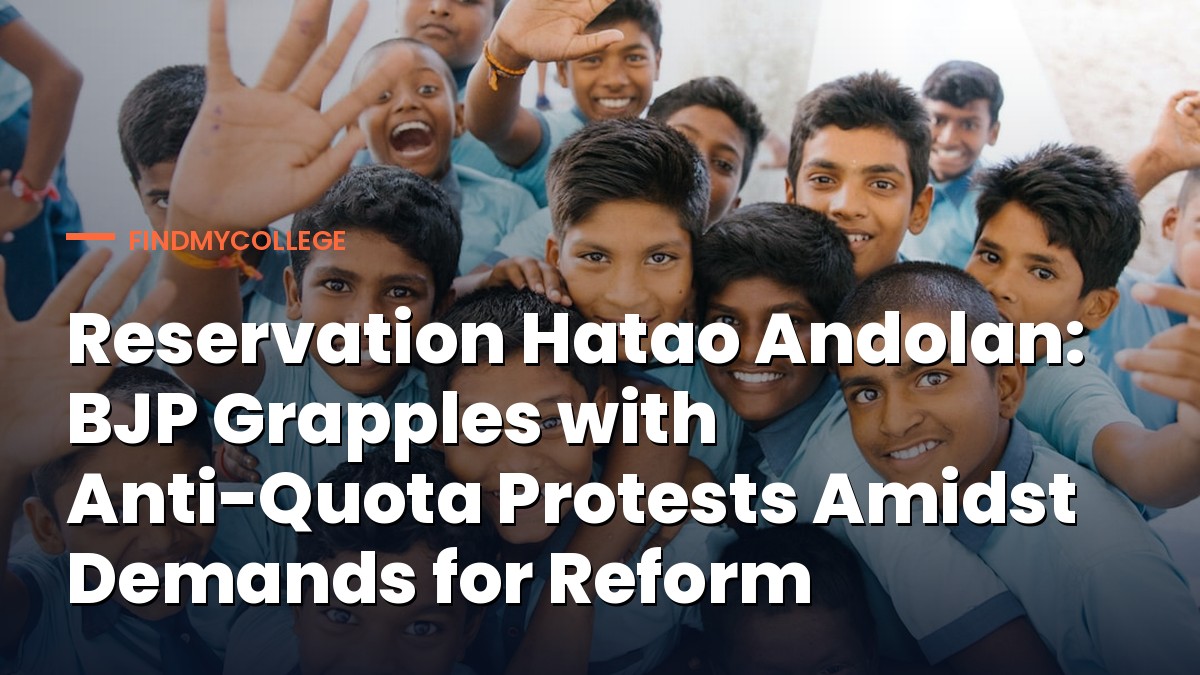
The Reservation Hatao Andolan (RHA) has escalated its protests across North and Central India on September 7, 2026, demanding significant reforms to the country’s caste-based reservation system. These demonstrations, which follow earlier gatherings in Delhi, highlight growing discontent among sections of society who argue that the current quota system affects opportunities for students and professionals.
The movement, spearheaded by Harsh Dubey, a NEET aspirant, gained rapid traction online, accumulating 5.6 million followers on its Instagram page by July 28, 2026, just weeks after its launch in July 2026. The RHA’s core demands include capping reservations to one generation, implementing income-based criteria for affirmative action, and a full review of the SC/ST (Prevention of Atrocities) Act.
| Event | Reservation Hatao Andolan protests |
|---|---|
| Date | 21 August 2026 |
| Status | Ongoing |
Reservation Hatao Andolan: Key Protests and Political Engagement
The RHA’s public presence began with an unauthorized protest at Jantar Mantar, New Delhi, on August 21, 2026, which Delhi Police did not sanction. This was followed by significant political engagement, with Harsh Dubey meeting Uttar Pradesh Deputy Chief Minister Brajesh Pathak on August 23, 2026. Union Health Minister J.P. Nadda also met with Dubey, along with Ran Bahadur Singh Chauhan and Mrityunjay Pathak, on August 27, 2026, describing it as “an important step towards fostering conversation around the issue.”
The movement’s reach expanded significantly on September 7, 2026, with protests reported across multiple cities including Haridwar, Varanasi, Noida, Ashoknagar in Madhya Pradesh, Agra, and Palwal in Haryana. Protesters at these events voiced strong sentiments, with some chanting “Jab jab Modi darta hai, police ko aage karta hai,” and others making derogatory remarks about marginalized communities, stating, “We have not even let them sit close to us” and “These are the people who polish our shoes.”
Rha’S Evolving Demands and Ideological Stance
Initially, the RHA advocated for the complete removal of reservations, but it later shifted its slogan to “reservation reform.” This change reflects a strategic move to broaden its appeal while still pushing for substantial alterations to the existing system. Swami Anand Swaroop, a vocal supporter, commented on the movement’s potential impact, stating, “Surprisingly, the upper-caste society has awakened—who it will uproot, we can’t say, but reforms in reservations, the abolition of SC/ST quotas, and the rollback of UGC are definitely going to happen.”
The movement’s proponents argue that the current system hinders merit. Abhishek Agnihotri, a supporter, highlighted this concern, stating, “Most of the doctors and professionals in developed countries are Indian expats. People migrate because their merit does not get an opportunity here. They are using the knowledge from the Vedas and Shastras there while we are promoting people who score less than them.” However, the Akhil Bharatiya Vidyarthi Parishad (ABVP) has distanced itself from these protests. Shravan B. Raj of ABVP stated, “Reservation has been a great tool envisaged in the Constitution for upward mobility of socio-economically marginalised groups. Such demands are heard from people who have only observed limited metropolitan parts of the country.”
Legal and Constitutional Context of Reservations
India’s reservation policy has a complex legal history. The 103rd Constitutional Amendment in 2019 introduced a 10% reservation for Economically Weaker Sections (EWS), which notably breached the 50% cap on total reservations established by the Indra Sawhney v. Union of India ruling in 1992. The constitutional validity of the EWS quota was after that upheld by the Supreme Court in Janhit Abhiyan v. Union of India in 2022.
The SC/ST (Prevention of Atrocities) Act, a key target for reform by the RHA, has also been a point of contention. The movement’s demands for its review come amidst instances like Ajeet Bharti being charged under the Act. Political figures like Chirag Paswan and Jitan Ram Manjhi have yet to issue detailed statements regarding the ongoing protests and their implications for the reservation system.
Key Reservation Milestones
| Year | Event/Ruling |
|---|---|
| 1950 | Constitution adopted Articles 15(4), 16(4), 46 permit reservation for backward classes |
| 1979 | Mandal Commission formed, recommended 27% OBC reservation |
| 1990 | V.P. Singh govt. implements Mandal report |
| 1992 | Indra Sawhney v. Union of India upheld 27% OBC quota, capped total reservation at 50%, introduced creamy layer exclusion |
| 2006 | 93rd Amendment / OBC quota in higher education extended OBC reservation to central higher-ed institutions |
| 2006 | M. Nagaraj v. Union of India upheld reservation in promotions for SC/ST with conditions |
| 2019 | 103rd Constitutional Amendment introduced 10% EWS reservation, breaching the 50% cap |
| 2022 | Janhit Abhiyan v. Union of India upheld the EWS quota’s constitutional validity |
| 2018–2024 | Jarnail Singh and related rulings extended creamy-layer logic to SC/ST promotions; allowed sub-categorization within reserved groups |

📰 More Education News
- MCC NEET PG counselling 2026: private deemed universities hike fees up to 1,471%Oct 25, 2026 • Nishit Kumar
- Apply for BCA AI/ML programs in Haryana/Delhi NCR for 2026-27 admissionsOct 25, 2026 • Nishit Kumar
- NEET UG 2026 stray vacancy round: 335 medical seats unfilled in Karnataka, report by October 25Oct 25, 2026 • Nishit Kumar
- IRMA Anand MBA admissions 2027-29 open: apply by 24 DecemberOct 25, 2026 • Nishit Kumar