Online vs Regular MBA India 2026: Honest Salary & Career Comparison Guide
Deciding between an Online MBA vs Regular MBA in India for 2026 often boils down to an honest salary and career comparison, and the landscape is evolving rapidly. While traditional programs have long been the gold standard, the rise of accredited online alternatives offers flexibility without necessarily sacrificing earning potential or professional growth. This guide cuts through the noise, providing a clear comparison of average packages, job roles, top colleges, fees, and admission processes for both formats in 2026.
Online vs Regular MBA India 2026: Key Differences & Pros/Cons
| Parameters | Online MBA | Traditional MBA |
|---|---|---|
| Ideal for | Freshers and Working Professionals | Students, Non-Working Individuals (as there are strict class timings) |
| Duration | 1 to 2 years (flexible pace) Duration may depend on the program you choose. | 1 to 2 years of full-time regular classes. |
| Eligibility | Bachelor’s degree with 45-50% score | Bachelor’s degree with 45-50% score |
| Work Experience | May or may not be required, depends on the institution | Some colleges may ask for it |
| Entrance Exams | Rarely, some institutions may require it | CAT, XAT, GMAT, etc are crucial |
| Flexibility | High | Low |
| Mode of Learning | Online | Offline/ On Campus |
| Curriculum | Industry Focused Curriculum and practical application | Curriculum with direct industry exposure |
| Course Fees | Affordable (1 to 14 lakhs) | Expensive (INR 3 lakh to more than 25 lakhs) |
| Other Expenses (travel/relocation/hostel) | Does not include | Includes extra expenses |
| Salary and Placement | Good salary packages and placements similar to an offline MBA (Fresher: ₹4.8 LPA, Mid-Level: ₹10.15 LPA, Senior: ₹18.30+ LPA) | Placement chances are high, and good salary potential (INR 6 lakhs to more than 25 lakhs) |
| Working professionals | Yes. Flexible schedule, opportunity to earn, real-time skill application | No. Requires full-time commitment, have to career break |
| Career switcher | Yes. Flexible schedule, opportunity to earn, real-time skill application | No. Requires full-time commitment, have to career break |
When considering an Online MBA vs Regular MBA in India 2026: Honest Salary and Career Comparison, it’s clear that while traditional MBAs offer structured placements and direct industry exposure, online MBAs present a more budget-friendly option with strong long-term salary growth (30-50% within 1-2 years), often recovering investment within 6-12 months, making them highly attractive for working professionals and career switchers.
2026 MBA Salary Comparison: Online vs Regular MBA Average Packages
| College Tier | Institutions (Examples) | Average Package Range (LPA) |
|---|---|---|
| Tier-1 (Top IIMs) | IIM Ahmedabad, Bangalore, Calcutta | ₹28 – ₹36 lakh |
| Tier-1 (Other Top) | IIM Lucknow, Kozhikode, Indore, FMS Delhi, XLRI Jamshedpur, SPJIMR, MDI | ₹16 – ₹28 lakh |
| Tier-2 | NMIMS, IMT Ghaziabad, TAPMI, GIM Goa | ₹10 – ₹16 lakh |
| Tier-3 | Majority of AICTE-approved colleges | ₹4 – ₹8 lakh |
The landscape for MBA salaries in 2026 shows a significant range, with top-tier regular MBAs commanding packages up to ₹36 lakh. However, for those considering an Online MBA vs Regular MBA in India 2026: Honest Salary and Career Comparison, it’s crucial to note that the total cost for a Regular MBA can be substantial, exemplified by a ₹26 lakh scenario (₹10L tuition + ₹16L lost salary over 2 years).
| Your Experience | Typical Pre-MBA Salary | Post-MBA Salary Range | Expected Growth |
|---|---|---|---|
| 0-2 years (fresher) | ₹2.5 – ₹4 LPA | ₹4 – ₹7 LPA | 50-80% |
| 3-5 years | ₹5 – ₹8 LPA | ₹8 – ₹13 LPA | 40-60% |
| 6-10 years | ₹10 – ₹18 LPA | ₹15 – ₹25 LPA | 30-50% |
| 10+ years | ₹18 – ₹30 LPA | ₹25 – ₹45 LPA | 25-40% |
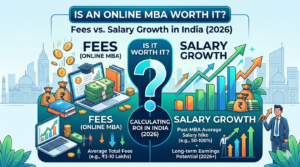
While regular MBA median salaries can be ₹4 lakh to ₹8 lakh lower than the average for Tier-1 institutions, Online MBAs offer a compelling alternative with an average salary range of ₹4.5 lakh to ₹12 lakh per year and typical salary growth of 30-70% within one or two years. The investment recovery period for an Online MBA is remarkably short, often 6-12 months, with an example scenario showing an investment of ₹1.8L leading to 35% salary growth (from ₹8 LPA to ₹10.8 LPA) and a payback period of approximately 8 months.
| Specialization | Entry-Level Roles | Salary Range |
|---|---|---|
| Finance | Financial Analyst, Risk Analyst | ₹5 – ₹15 LPA |
| Marketing | Brand Manager, Digital Marketing Manager | ₹5 – ₹16 LPA |
| HR Management | HR Manager, Talent Acquisition Lead | ₹5 – ₹14 LPA |
| Business Analytics | Business Analyst, Data Analyst | ₹7 – ₹18 LPA |
| Operations | Operations Manager, Supply Chain Lead | ₹6 – ₹16 LPA |
| IT Management | IT Project Manager, Tech Lead | ₹8 – ₹22 LPA |
| Healthcare Management | Hospital Admin, Healthcare Consultant | ₹5 – ₹15 LPA |
For those evaluating the Online MBA vs Regular MBA in India 2026: Honest Salary and Career Comparison, specific online programs show promising outcomes: Amrita Online MBA alumni experience an average salary growth of 33.94%, Symbiosis Online MBA alumni packages range from ₹6.2 lakh – ₹14.4 lakh LPA, and Amity Online MBA has a highest reported package of ₹18 lakh LPA. Even IIMs offering online MBAs (Kozhikode/Indore) see salary outcomes closer to the Tier-2 range for employed professionals, while private providers typically offer incremental salary movement of ₹1 lakh to ₹3 lakh annually.
| Role | Salary Range (LPA) |
|---|---|
| Business Analyst | ₹5.5 – ₹10 LPA |
| Finance Analyst / Finance Manager | ₹6 – ₹13 LPA |
| HR Manager / HRBP | ₹5 – ₹9.5 LPA |
| Marketing or Brand Manager | ₹6 – ₹12 LPA |
| Product Manager | ₹8 – ₹18 LPA |
| Digital Marketing Manager | ₹5 – ₹10 LPA |
| Operations / Supply Chain Manager | ₹5.5 – ₹11 LPA |
| Business Development Manager | ₹4 – ₹9 LPA |
| Strategy & Planning Manager | ₹7 – ₹15 LPA |
| Consultant (HR/Marketing/Finance) | ₹6 – ₹20 LPA |
Furthermore, Chandigarh University Online MBA packages demonstrate strong potential, with freshers earning ₹5-20 LPA and experienced professionals achieving up to ₹30 LPA.
Online vs Regular MBA Career Growth 2026: Job Roles & Progression
| Your Experience | Typical Pre-MBA Salary | Post-MBA Salary Range | Expected Growth |
|---|---|---|---|
| 0-2 years (fresher) | ₹2.5 – ₹4 LPA | ₹4 – ₹7 LPA | 50-80% |
| 3-5 years | ₹5 – ₹8 LPA | ₹8 – ₹13 LPA | 40-60% |
| 6-10 years | ₹10 – ₹18 LPA | ₹15 – ₹25 LPA | 30-50% |
| 10+ years | ₹18 – ₹30 LPA | ₹25 – ₹45 LPA | 25-40% |
Most working professionals who complete an online MBA see a 30% to 70% hike within one or two years, qualifying them for better roles, bigger responsibilities, and leadership tracks. Graduates with over 3-6 years of work experience pursuing an online MBA can expect the most dramatic salary increases, with those moving into leadership, finance, consulting, or tech management roles potentially seeing up to a 100% hike, and over 60%-120% in consulting and strategy, offering a compelling Online MBA vs Regular MBA in India 2026: Honest Salary and Career Comparison.
| Specialization | Entry-Level Roles | Salary Range |
|---|---|---|
| Finance | Financial Analyst, Risk Analyst | ₹5 – ₹15 LPA |
| Marketing | Brand Manager, Digital Marketing Manager | ₹5 – ₹16 LPA |
| HR Management | HR Manager, Talent Acquisition Lead | ₹5 – ₹14 LPA |
| Business Analytics | Business Analyst, Data Analyst | ₹7 – ₹18 LPA |
| Operations | Operations Manager, Supply Chain Lead | ₹6 – ₹16 LPA |
| IT Management | IT Project Manager, Tech Lead | ₹8 – ₹22 LPA |
| Healthcare Management | Hospital Admin, Healthcare Consultant | ₹5 – ₹15 LPA |
There is no difference between full-time and online MBA in terms of career opportunities, with job roles being similar irrespective of the degree format. By 2026, most employers will equate online MBAs from leading institutions with traditional MBAs, especially when candidates demonstrate strong work experience and industry knowledge, further narrowing the salary gap.
| Job Role | Salary Range |
|---|---|
| Business Analyst | ₹5.5 – ₹10 LPA |
| Finance Analyst / Finance Manager | ₹6 – ₹13 LPA |
| HR Manager / HRBP | ₹5 – ₹9.5 LPA |
| Marketing or Brand Manager | ₹6 – ₹12 LPA |
| Product Manager | ₹8 – ₹18 LPA |
| Digital Marketing Manager | ₹5 – ₹10 LPA |
| Operations / Supply Chain Manager | ₹5.5 – ₹11 LPA |
| Business Development Manager | ₹4 – ₹9 LPA |
| Strategy & Planning Manager | ₹7 – ₹15 LPA |
| Consultant (HR/Marketing/Finance) | ₹6 – ₹20 LPA |
Online MBA students benefit from not having a career gap, as they continue working, graduating with both experience and a new qualification. Employers highly value the skills naturally built by online MBA students, such as digital learning, virtual communication, and multitasking, making them relevant for promotions and evaluations. An online MBA helps open doors to managerial roles, industry transitions, and long-term professional stability, with a potential 45%-80% salary increase for those changing industries or job roles. The future of online MBA programs in India by 2026 looks incredibly strong due to rising demand for flexibility, with programs becoming more interactive, better recognized, and fully accepted across industries, strengthening the case for an Online MBA vs Regular MBA in India 2026: Honest Salary and Career Comparison.
People Also Read




Top 10 Online & Regular MBA Colleges India 2026 Rankings
| S No | College | Fee |
|---|---|---|
| 1 | NMIMS Online | INR 2,20,000 |
| 2 | Amity Online | INR 1,99,000 |
| 3 | D.Y. Patil Online | INR 1,70,000 |
| 4 | Symbiosis Online | INR 3,00,000 |
| 5 | Manipal Online | INR 175000 |
| 6 | Amrita Online | INR 170000 |
| 7 | Chandigarh Online | INR 2,00,000 |
| 8 | IGNOU IOP | INR 64,000 |
| 9 | LIBA Online | INR 3,50,000 |
| 10 | We School Online | INR 2,57,000 |
The fees for Online MBA programs in India for 2026 show a significant range, from INR 66,000 to INR 3,50,000, with NMIMS Online ranked #1 among the best Online MBA programs in India for 2026. Amity University Online is recognized as the #1 online university in India in the management category for 2026.
| Online Colleges | Total Fees |
|---|---|
| Amity Online | INR 1,99,000 |
| DY Patil Online | 1,89,000 |
| Manipal University Online | INR 1,75,000 |
| Jain University Online | INR 1,60,000 – 2,50,000 |
| GLA University Online | INR 96,000 |
| Uttaranchal Online | INR 1,40,000 |
| Kurukshetra Online | INR 98,000 |
| Chandigarh University Online | INR 1,50,000 |
| LPU Online | INR 1,37,000 |
| UPES Online | INR 1,50,000 |
For those evaluating an Online MBA vs Regular MBA in India 2026: Honest Salary and Career Comparison, these fee structures provide a clear financial overview for various online programs. Manipal University Online secured 3rd place in the Top 10 Online MBA Colleges in India list for 2026, and its NIRF ranking for 2025 places it among the top 60 universities.
| College Names | NIRF 2024 |
|---|---|
| XLRI-Xavier School of Management | 9 |
| MDI Gurgaon | 11 |
| IIFT Delhi | 15 |
| BIMTECH | 64 |
When considering the overall landscape of MBA education, the IIRF ranking 2026 evaluates programs based on placement performance, faculty quality, industry interface, research, and infrastructure. IIM Ahmedabad was recognized as the top government MBA college in the IIRF MBA Ranking 2025, while SPJIMR Mumbai was the No.1 private business school.
| Private Colleges | Total Fee |
|---|---|
| XLRI Xavier School of Management | INR 4 lakh – INR 13.9 lakh |
| Amity University | INR 1.99 Lakh |
| Manipal University | INR 1.79 Lakh |
| Management Development Institute | INR 8.95 lakh |
| S P Jain Institute of Management and Research Mumbai | INR 10 lakh |
| GLA University | INR 97,000 |
| Chandigarh University | INR 1.5 – 1.8 lakh |
For those seeking the most prestigious institutions, IIM Ahmedabad, FMS Delhi, IIM Calcutta, IIM Bangalore, IIM Lucknow, IIM Indore, and JBIMS held strong positions in the IIRF Ranking 2025. These rankings are vital for an Online MBA vs Regular MBA in India 2026: Honest Salary and Career Comparison, helping aspirants weigh the benefits of different program types.
Online vs Regular MBA Fees 2026: ROI & Scholarship Options
| MBA Type/Category | Fees/Investment | Typical Payback/Break-even Period | Key ROI/Cost Factor |
|---|---|---|---|
| Online MBA (General) | ₹60,000 – ₹2 lakh (annual) | 6-12 months (Typical Recovery) | Strong ROI for working professionals; no career break |
| Online MBA (Chandigarh University example) | ₹1.8L | Approximately 8 months | Specific investment example |
| Regular/Offline MBA (General) | ₹2 lakh – ₹10 lakh+ (annual) | – | Higher starting salaries, faster progression; large upfront investment |
| Regular MBA (Example Scenario) | ₹26L (₹10L fees + 2 years lost salary of ₹16L) | – | Total cost including lost salary |
| FMS Delhi | Roughly ₹20,000 | – | Notably low fees |
| Top IIM MBA (average) | ₹24–27 lakh | Under 1–2 years | – |
| Newer IIMs (CAP IIMs) | ₹20–25 lakh | 2–3 years | – |
| Tier-3 B-school (example) | ₹15–20 lakh | – | – |
When considering an Online MBA vs Regular MBA in India 2026: Honest Salary and Career Comparison, the data clearly shows a significant difference in upfront investment and payback periods. While a Regular MBA, especially from top institutions, demands a substantial financial commitment often exceeding ₹20 lakh, an Online MBA offers a much lower investment, with typical recovery within 6-12 months, making it a strong ROI option for working professionals.
How to Apply for Online/Regular MBA 2026: Admission Process Steps
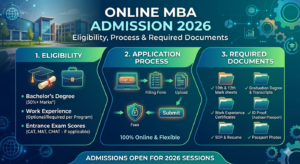
Online MBA Admission 2026 offers flexible, career-focused management education with simple eligibility criteria and a streamlined digital application process. This makes it an attractive option when comparing **Online MBA vs Regular MBA in India 2026: Honest Salary and Career Comparison**.
- Online MBA Eligibility – Basic Requirement: A bachelor’s degree from a recognised institution.
- Online MBA Eligibility – Minimum Marks: Minimum aggregate marks (typically around 50%).
- Online MBA Eligibility – Academic Stream: Open to graduates from any stream.
- Online MBA Eligibility – Work Experience: Some programs may prefer work experience (not always mandatory).
- Online MBA Application Process Design: Designed to be simple and fully digital.
- Online MBA Admission Steps Variation: The MBA admission steps may vary by university.
- Required Document – Academic Proof: Graduation mark sheets and certificates.
- Required Document – Identity Proof: Valid ID proof.
- Required Document – Photograph: Passport-size photographs.
- Required Document – Work Experience: Work experience documents (if applicable).
| Step | Description |
|---|---|
| 1. Register Online | Visit the official admission portal of the institution of choice and create an account. |
| 2. Fill Application Form | Enter personal, academic, and professional details. |
| 3. Upload Documents | Submit required documents such as mark sheets and ID proof. |
| 4. Application Review | The application is evaluated by the admissions team. |
| 5. Fee Payment | Pay the program fee to confirm admission. |
| 6. Enrollment Confirmation | Receive admission confirmation and access to learning resources. |
MBA Eligibility Criteria 2026: Online vs Regular Program Requirements
For 2026 admissions, understanding the distinct eligibility criteria for Online MBA vs Regular MBA in India is crucial, particularly when considering factors beyond just academic qualifications, which can significantly impact your career trajectory.
- Online MBA Eligibility (General): A recognised bachelor’s degree in any discipline from a UGC-approved university/institution is fundamental. Graduates of recognised professional programs like CA/ICWA are also eligible.
- Online MBA Minimum Aggregate Marks (2026): A minimum of 50% aggregate marks is required (45% for SC/ST/OBC candidates).
- Online MBA Graduation Structure: Most universities follow a 10+2+3 graduation structure for admission into their online MBA programs.
- Online MBA Entrance Exams (2026): Unlike most full-time MBA programs, most online MBA programs in 2026 will not require taking an entrance exam (like CAT, MAT, CMAT, XAT, UGA). Several institutions allow direct admission without exams, though some top UGC-DEB accredited institutions (e.g., NMIMS Online, Amity Online) may require them.
- Online MBA Work Experience: Work experience is desirable but not required for a general online MBA program. Online MBA programs are intended for both new graduates and experienced professionals.
- Online MBA Provisional Admission: Some institutions allow final-year students to apply on a provisional basis.
- Online MBA Eligibility Variations: Eligibility can vary; for example, Amity University requires 40% of total passing marks, while highly selective programs may require 60% and/or specific prior coursework.
- Regular MBA Eligibility (2026): Candidates must hold a bachelor’s degree (3 or 4 years) with at least 50% aggregate marks (45% for reserved categories in some cases).
- Regular MBA Admission Process (2026): Admission in 2026 is based on entrance exam scores followed by Group Discussion (GD) and Personal Interview (PI) rounds.
- Regular MBA Entrance Exams: Popular entrance exams include CAT, XAT, MAT, CMAT, Indira CET (PG), ATMA, MAH MBA CET, and CUET PG. Different colleges accept different exams.
Frequently Asked Questions
What is the difference between an online MBA and a regular MBA? …
An Online MBA utilizes digital tools, video lectures, and virtual classrooms, offering flexibility to study from any location and enabling a better work-life-study balance, making it ideal for working professionals. These programs are often more affordable than a traditional Regular MBA due to reduced campus-related expenses. While both formats aim for career advancement and professional growth, the provided information does not offer specific salary or career outcome comparisons between an Online MBA and a Regular MBA. For detailed salary and career prospects, it is recommended to consult official program sources.
What is the average salary after completing an online MBA in India, …
Fresh MBA graduates in India can expect starting salaries ranging from ₹4.5 lakh to ₹6 lakh per annum, depending on the sector and organization. While a specific average salary exclusively for online MBAs is not provided, the overall MBA salary in 2026 is heavily influenced by factors such as the institution’s tier and reputation, specialization, and candidate experience. Degrees from reputed universities are noted to have significant value, impacting career prospects and potential earnings.
What are the typical job roles and career progression paths after an Online MBA in India in 2026, and how do they compare to a Regular MBA?
After an MBA in India, typical job roles span industries such as finance, marketing (e.g., Marketing Manager, Marketing Director), HR, IT, and consulting, with roles like SEO Analyst also emerging. Both Online and Regular MBAs are generally understood to boost earnings and career growth across these sectors. However, the provided research does not offer specific comparative data on typical job roles, distinct career progression paths, or salary differences between Online and Regular MBAs in India for 2026. For detailed comparisons, it is advisable to consult official program career reports and alumni networks.
Are there any scholarship options mentioned for Online or Regular MBAs in India for 2026?
Yes, scholarship options are available for MBA programs in India for 2026, including various government and private scholarships that can offer financial support up to ₹1,00,000. However, some renowned MBA scholarships explicitly state eligibility requires pursuing a regular degree course, excluding correspondence, distance learning, or diploma programs. For specific details on scholarships for online MBAs, it is recommended to check directly with the respective online program providers or official scholarship portals.