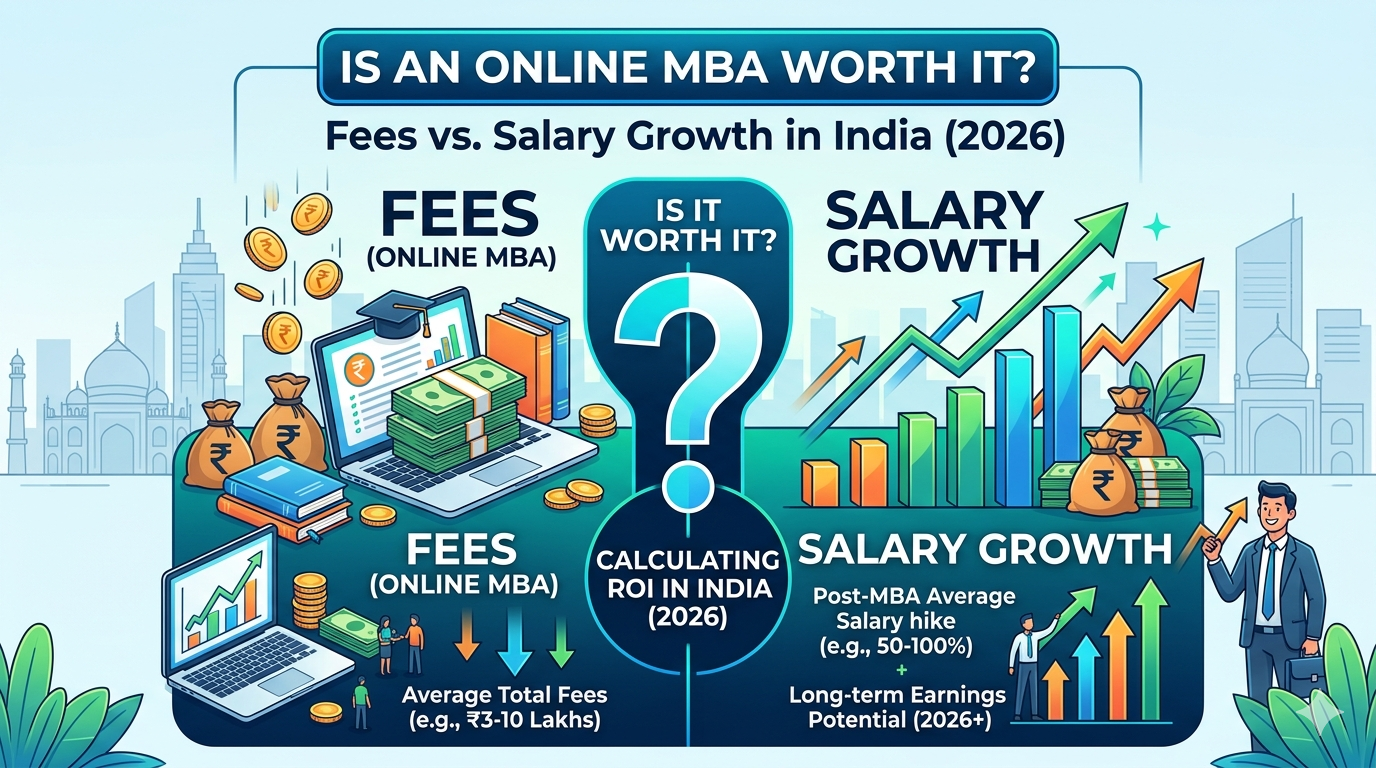
Is an Online MBA Worth It? Fees vs. Salary Growth in India (2026)
In 2026, the Indian professional landscape has shifted: a career break is no longer the only way to climb the corporate ladder. As the demand for agile leadership grows, the “Online MBA” has transitioned from a backup plan to a strategic power move. But with fees ranging from ₹50,000 to over ₹3,00,000, the burning question remains: Is the Return on Investment (ROI) actually there?
While traditional on-campus programs often demand a massive financial and professional sacrifice, the Online MBA offers a unique value proposition: the ability to earn while you learn.
This blog dives deep into the 2026 data, comparing the latest fee structures of top-tier Indian universities against projected salary hikes of 30% to 70%. We will analyze whether a digital degree can truly compete with its offline counterpart and how to identify the programs that offer the fastest “break-even” point for your career.
Online MBA ROI India 2026: Average Salary Hike & Payback Period
| Year | Average Salary (₹ LPA) |
|---|---|
| Before MBA | 5 LPA |
| Year 1 After MBA | 7 LPA |
| Year 3 After MBA | 10 LPA |
| Year 5 After MBA | 14–18 LPA |
Online MBA Fees in India: Comparing Top Tier vs. Budget Programs
In 2026, the fee structure for an Online MBA in India is highly stratified, offering options for every budget. The primary differentiator isn’t just the brand name, but the level of LMS (Learning Management System) sophistication and placement support provided.
Top-Tier Programs (₹1.5 Lakh – ₹4 Lakh)
These programs are typically offered by private universities with high NAAC ratings (A+ or A++) and global recognition.
-
Examples: Amity University Online, NMIMS Global, and Manipal University Jaipur.
-
What you pay for: Live interactive sessions with industry experts, robust career coaching, extensive alumni networks, and dedicated placement cells that host virtual job fairs. These programs are designed for those seeking a significant brand boost on their LinkedIn profile.
People Also Read




Budget & Government Programs (₹50,000 – ₹1.2 Lakh)
These are ideal for professionals who need the degree for internal promotions or government job eligibility without breaking the bank.
-
Examples: IGNOU, Sikkim Manipal (Distance/Online), and various State Open Universities.
-
What you pay for: Primarily the “UGC-DEB Approved” credential and self-paced study materials. While they offer great flexibility, placement support is often minimal, and the onus of finding a new job lies entirely on the student.
Average Salary Hike 2026: Expected Growth for Working Professionals
The narrative that “Online MBAs don’t lead to raises” is officially dead in 2026. Data from recent graduates shows a clear upward trend in compensation, provided the candidate has at least 2–3 years of prior work experience.
-
Standard Salary Hike: On average, working professionals completing an Online MBA from a reputable Indian institute report a salary increase of 30% to 50% within 12 months of graduation.
-
The “Career Switcher” Bonus: For those successfully transitioning from technical roles (like Software Testing) to management roles (like Product Management), the hike can soar between 70% and 100%.
-
Average Salary Packages:
-
Entry-level (0-2 years exp): ₹4 LPA – ₹7 LPA
-
Mid-level (5-8 years exp): ₹12 LPA – ₹18 LPA
-
Senior-level (10+ years exp): ₹22 LPA+ (often involves moving into AVP or Director roles).
-
Top 5 High-Paying Specializations for Online MBA Graduates
Choosing the right specialization is the single biggest factor in determining your 2026 ROI. While “General Management” is safe, specialized roles are currently commanding the highest premiums.
-
Business Analytics & Data Science: With AI integration becoming standard, managers who can interpret “Big Data” are in high demand. Graduates in this field often see the fastest ROI, with average starting packages for managers hovering around ₹15–20 LPA.
-
IT & FinTech Management: As India’s digital payment ecosystem matures, the intersection of Finance and Tech is a goldmine. This specialization is perfect for those eyeing roles in Neo-banks, UPI-led startups, or Cybersecurity firms.
-
Digital Marketing & E-commerce: No longer just about “social media,” this role now focuses on growth hacking and consumer behavior analytics. It offers high flexibility and is a favorite for those looking at remote-first global roles.
-
Operations & Supply Chain Management: Post-pandemic logistics and the “Make in India” push have made supply chain experts indispensable. This field offers high stability and competitive pay in the manufacturing and e-commerce sectors (Amazon, Flipkart, etc.).
-
Human Resource Analytics: Modern HR is data-driven. Specializing in HR Analytics allows professionals to move beyond administrative tasks into “People Strategy,” a role that has seen a 25% increase in demand since last year.
Salary Comparison: Online MBA vs Full-Time MBA
When evaluating an MBA program, salary growth is one of the most critical factors. In India’s evolving job market, both online and full-time MBA graduates are witnessing strong salary trajectories, but the patterns differ based on experience and career stage.
| University | Online MBA Fee | Avg Salary (LPA) | ROI Multiple | Full-time Fee | Full-time Avg |
|---|---|---|---|---|---|
| LPU | ₹1.46L | 7-12L | 5-8x | ₹10L | 15-25L |
| Amity | ₹1.99-2.99L | 6-15L | 3-7x | ₹13L | 10-20L |
| UPES | ₹1.75L | 8-16L | 5-9x | ₹15L | 12-22L |
| Chandigarh | ₹1.58L | 7-18L | 4-11x | ₹5.12 to 7.94L | 10-28L |
Online MBA vs Traditional MBA: Key Differences
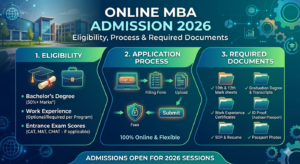
Understanding the structural differences between online and traditional MBA programs is crucial before making a decision. Each format is designed for a different type of learner and career path.
| Parameters | Online MBA | Traditional MBA |
|---|---|---|
| Ideal for | Freshers and Working Professionals | Students, Non-Working Individuals (as there are strict class timings) |
| Duration | 1 to 2 years (flexible pace) Duration may depend on the program you choose. | 1 to 2 years of full-time regular classes. |
| Eligibility | Bachelor’s degree with 45-50% score | Bachelor’s degree with 45-50% score |
| Work Experience | May or may not be required, depends on the institution | Some colleges may ask for it |
| Entrance Exams | Rarely, some institutions may require it | CAT, XAT, GMAT, etc are crucial |
| Flexibility | High | Low |
| Mode of Learning | Online | Offline/ On Campus |
| Curriculum | Industry Focused Curriculum and practical application | Curriculum with direct industry exposure |
| Cost | Usually lower, as it involves no relocation or living costs, only course fees. | Varies depending on the program and the institution you apply to. Usually higher as it includes tuition fee, relocation, living expenses, etc. |
Online MBAs are built for flexibility and accessibility. Students can attend classes from anywhere, learn at their own pace, and often balance work alongside studies. This makes it an ideal choice for professionals who cannot afford a career break.
Traditional MBAs, however, offer immersive learning environments. Students benefit from peer interaction, case discussions, internships, and campus placements. These experiences play a major role in shaping leadership skills and industry readiness.
Top 10 Online MBA Colleges India 2026: IIMs, Symbiosis & More
India’s online MBA ecosystem has matured significantly by 2026, with many reputed institutions offering high-quality programs that rival traditional degrees in terms of curriculum and industry relevance.
| S No | College | Fee |
|---|---|---|
| 1 | NMIMS Online | INR 2,20,000 |
| 2 | Amity Online | INR 1,99,000 |
| 3 | D.Y. Patil Online | INR 1,70,000 |
| 4 | Symbiosis Online | INR 3,00,000 |
| 5 | Manipal Online | INR 175000 |
| 6 | Amrita Online | INR 170000 |
| 7 | Chandigarh Online | INR 2,00,000 |
| 8 | IGNOU IOP | INR 64,000 |
| 9 | LIBA Online | INR 3,50,000 |
| 10 | We School Online | INR 2,57,000 |
These institutions are known for offering flexible learning platforms, updated curriculum, and industry-aligned specializations such as marketing analytics, finance, HR, and business analytics.
Many of these programs also include live sessions, recorded lectures, capstone projects, and industry mentorship. Some even provide placement assistance, which has significantly improved the credibility of online MBAs.
IGNOU remains the most affordable option, while institutions like Symbiosis and LIBA provide premium offerings with enhanced networking opportunities and brand value.
Online MBA Fees India 2026: ₹2 Lakh to ₹15 Lakh Program Costs
The cost of an online MBA in India varies widely depending on the institution, brand value, and program features. However, compared to full-time MBAs, online programs are significantly more affordable.
| University/College | Location | Approx. Total Fees (2 Years) |
|---|---|---|
| Amity University Online | Noida | ₹1,75,000 – ₹1,99,000 |
| NMIMS Global Access School | Mumbai | ₹2,10,000 – ₹2,20,000 |
| Manipal University Jaipur Online | Jaipur | ₹1,60,000 – ₹1,75,000 |
| Uttaranchal University | None | ₹94,000 |
| Shoolini University | None | ₹90,000 |
| Sharda University | None | ₹1,00,000 |
| Hindustan Online (CODE) | None | ₹1,20,000 |
| Jain Online | None | ₹1,50,000 |
| Chandigarh University | None | ₹1,50,000 |
| UPES | None | ₹1,50,000 |
| Lovely Professional University | None | ₹1,56,000 |
| DY Patil | None | ₹1,70,000 |
| Online Manipal University | None | ₹1,75,000 |
| ICFAI Hyderabad Online | None | ₹2,00,000 |
The lower fee structure is one of the biggest advantages of online MBAs. Students save not only on tuition but also on accommodation, travel, and other living expenses.
Premium online MBA programs may cost up to ₹3–5 lakh, but they often include advanced features like global faculty, international exposure, and career services.
In contrast, full-time MBA programs in top institutions can cost between ₹15 lakh to ₹25 lakh, making financial planning a crucial factor for many students.
How to Choose the Best Online MBA Program in India by 2026?
Selecting the right online MBA program requires careful evaluation of multiple factors beyond just fees. With hundreds of options available, students must focus on quality, credibility, and long-term career impact.
First, accreditation and recognition should be your top priority. Ensure that the university is approved by UGC and AICTE (if applicable). Accreditation ensures that your degree will be recognized by employers and other institutions.
Second, evaluate the curriculum and specialization options. Choose a program that aligns with your career goals, whether it is finance, marketing, HR, operations, or data analytics. Industry-relevant curriculum and practical projects add significant value.
Third, consider faculty quality and industry exposure. Programs that involve experienced faculty, guest lectures, and real-world case studies provide better learning outcomes.
Fourth, check for placement assistance and career support. While not all online MBAs offer placements, many reputed institutions now provide career guidance, resume building, and interview preparation.
Fifth, assess the learning platform and flexibility. A good online MBA should offer a user-friendly platform, recorded lectures, live sessions, and mobile accessibility.
Lastly, consider ROI rather than just cost. A slightly expensive program with better career outcomes may be a smarter investment than a cheaper one with limited opportunities.
In 2026, the best online MBA is not just about affordability—it is about choosing a program that delivers skills, credibility, and career growth in a competitive job market.
Online MBA Specializations ROI 2026: Finance, Marketing, HR Salary Growth
Choosing the right specialization in an Online MBA is one of the most important decisions for maximizing return on investment (ROI) in 2026. With evolving industry demands, employers are prioritizing role-specific expertise over general management degrees. Finance, Marketing, and HR remain the most popular specializations, but each offers different salary trajectories, growth potential, and career outcomes.
Finance MBA: High ROI with Strong Long-Term Earnings
An Online MBA in Finance continues to offer one of the highest returns in India, especially for candidates targeting roles in banking, consulting, fintech, and corporate finance.
Key Roles After Online MBA Finance
- Financial Analyst
- Investment Analyst
- Risk Manager
- Corporate Finance Manager
- Equity Research Analyst
Salary Growth (India 2026)
| Experience Level | Average Salary |
|---|---|
| Entry Level | ₹9–13 LPA |
| 2–3 Years | ₹14–20 LPA |
| 5+ Years | ₹22–35+ LPA |
Finance professionals typically experience steady and compounding salary growth, particularly in performance-driven roles.
Why ROI is High
- Strong demand across BFSI, fintech, and consulting sectors
- High variable pay and bonuses
- Global career opportunities
Considerations
- Requires strong quantitative and analytical skills
- Competitive job market
- Additional certifications like CFA or FRM can significantly increase earning potential
Conclusion: Finance is the best option for candidates targeting high-paying, analytical, and long-term growth careers.
Marketing MBA: Fast Growth and High Demand in Digital Roles
Marketing has transformed significantly with the rise of digital platforms. In 2026, roles in digital marketing, performance marketing, and product marketing are in high demand.
Key Roles
- Digital Marketing Manager
- Brand Manager
- Growth Manager
- Product Marketing Manager
- Performance Marketing Specialist
Salary Growth (India 2026)
| Experience Level | Average Salary |
|---|---|
| Entry Level | ₹7–11 LPA |
| 2–3 Years | ₹12–18 LPA |
| 5+ Years | ₹20–30 LPA |
Marketing roles offer faster career progression, especially in startups, e-commerce, and tech companies.
Why ROI is Strong
- High demand for digital and data-driven marketing skills
- Opportunities for freelance and consulting income
- Faster promotions in growth-focused organizations
Considerations
- Performance-driven roles with targets and KPIs
- Salary variation based on skills and company type
- Requires a mix of creativity and analytical ability
Conclusion: Marketing is ideal for candidates seeking rapid career growth and diverse opportunities.
HR MBA: Stable Growth with Leadership Opportunities
Human Resources has evolved into a strategic function in organizations. In 2026, HR roles increasingly involve analytics, workforce planning, and business strategy.
Key Roles
- HR Manager
- Talent Acquisition Specialist
- HR Business Partner
- Learning and Development Manager
- Compensation and Benefits Analyst
Salary Growth (India 2026)
| Experience Level | Average Salary |
|---|---|
| Entry Level | ₹6–9 LPA |
| 2–3 Years | ₹9–14 LPA |
| 5+ Years | ₹16–26 LPA |
HR offers consistent and stable salary growth, with strong progression into leadership roles over time.
Why ROI is Moderate to High
- Essential function across all industries
- Growing demand for strategic HR roles
- Leadership positions offer strong long-term salaries
Considerations
- Slower initial salary growth compared to Finance and Marketing
- Limited variable pay compared to sales or finance roles
- Requires strong communication and people management skills
Conclusion: HR is best suited for candidates looking for stability and long-term leadership roles.
Frequently Asked Questions