

Ph.D in Econometrics Salary in India 2026: A Comprehensive Guide
Nishit Kumar is a senior EdTech industry leader with over a decade of experience in building and scaling education platforms, shaping their product, content, and growth strategy. At…
Latest update: Ph.D in Econometrics 2026 admissions & dates updated. Read more ›
Embarking on a Ph.D in Econometrics is a significant academic and career decision. This comprehensive guide provides detailed insights into the Ph.D in Econometrics salary in India for 2026, covering potential earnings, career paths, eligibility, and the overall return on investment (ROI) for this specialized Science stream doctorate.
What is a Ph.D in Econometrics?
A Ph.D in Econometrics is an advanced doctoral program focusing on the application of statistical methods to economic data. It equips students with the theoretical and practical skills to analyze economic phenomena, test economic theories, and forecast economic trends using quantitative techniques.
This rigorous program typically involves advanced coursework in econometrics, statistics, mathematics, and economic theory, followed by extensive original research culminating in a dissertation. Graduates are highly sought after in academia, research institutions, government agencies, and the private sector for their analytical prowess and data-driven decision-making capabilities.
What is the average Ph.D in Econometrics salary in India for 2026?
The average Ph.D in Econometrics salary in India for 2026 typically ranges from INR 10 LPA to INR 25 LPA for entry to mid-level positions, with experienced professionals and those in specialized roles earning significantly more. This range is influenced by factors such as the institution of graduation, specific job role, industry, and geographical location.
Graduates with a Ph.D in Econometrics possess highly specialized skills in statistical modeling, time series analysis, causal inference, and big data analytics, making them valuable assets across various sectors. Initial salaries might be lower in academic or government research roles compared to the private sector, but these often come with greater job security and research freedom.
What are the top job roles and their salaries after a Ph.D in Econometrics?
After a Ph.D in Econometrics, graduates can pursue a variety of high-demand roles, primarily in research, data science, and quantitative analysis. The salaries for these roles vary based on the sector and experience.
Some of the top job roles and their expected salary ranges in India for 2026 are:
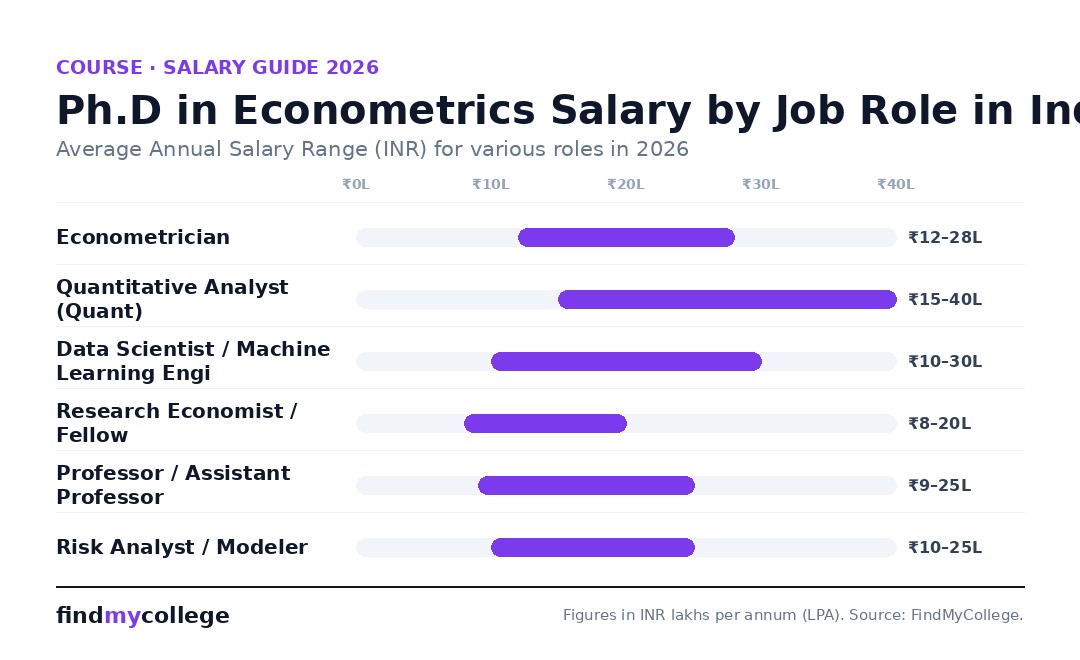
| Job Role | Average Annual Salary Range (INR) | Key Responsibilities |
|---|---|---|
| Econometrician | 12 LPA – 28 LPA | Develop and apply statistical models to economic data, forecast economic trends, conduct policy analysis. |
| Quantitative Analyst (Quant) | 15 LPA – 40 LPA+ | Develop and implement complex mathematical models for financial markets, risk management, and trading strategies. |
| Data Scientist / Machine Learning Engineer | 10 LPA – 30 LPA | Analyze large datasets, build predictive models, develop algorithms for business insights. |
| Research Economist / Fellow | 8 LPA – 20 LPA | Conduct original economic research, publish papers, contribute to policy formulation in academic or research institutions. |
| Professor / Assistant Professor | 9 LPA – 25 LPA | Teach econometrics and economics courses, supervise Ph.D students, conduct research, publish scholarly articles. |
| Risk Analyst / Modeler | 10 LPA – 25 LPA | Assess and quantify financial risks using statistical and econometric models, develop risk mitigation strategies. |
Which industries offer the best salaries for Ph.D in Econometrics graduates?
The financial services sector, particularly investment banking, hedge funds, and fintech companies, generally offers the highest salaries for Ph.D in Econometrics graduates. Consulting firms and large technology companies also provide competitive compensation.
- Financial Services: Banks, investment firms, hedge funds, and fintech companies heavily rely on econometricians and quants for risk management, algorithmic trading, portfolio optimization, and financial modeling.
- Consulting: Economic consulting firms and management consulting firms hire Ph.D graduates for their analytical skills to solve complex business and economic problems for clients.
- Technology: Tech giants and data analytics companies employ econometricians for predictive modeling, user behavior analysis, and developing AI/ML applications.
- Government & Public Sector: Reserve Bank of India (RBI), NITI Aayog, various ministries, and public sector banks recruit for research and policy analysis roles. While salaries might be lower than the private sector, they offer stability and impact.
- Academia & Research: Universities and dedicated research institutions offer roles as professors, researchers, and post-doctoral fellows, focusing on theoretical and applied econometrics.
What is the eligibility for Ph.D in Econometrics in India?
To be eligible for a Ph.D in Econometrics in India, candidates typically need a strong Master’s degree in Economics, Econometrics, Statistics, Mathematics, or a related quantitative field, often with a minimum aggregate score of 55-60%.
Specific eligibility criteria include:
- Master’s Degree: An M.A./M.Sc. in Economics, Econometrics, Statistics, Mathematics, or a closely related discipline from a recognized university. Some institutions may accept M.Tech/MBA with a strong quantitative background.
- Minimum Marks: Usually 55% (or equivalent grade) for General category candidates, with relaxations for SC/ST/OBC (NCL)/PwD candidates as per government norms.
- Entrance Exams: Most universities require candidates to clear a national-level entrance exam (e.g., UGC NET, CSIR NET, GATE) or a university-specific entrance test. Some top institutions might also consider GRE scores.
- Research Proposal: A well-articulated research proposal outlining the intended area of study is often a mandatory component of the application process.
- Interview: Shortlisted candidates are typically required to appear for an interview with the departmental research committee.
How much does a Ph.D in Econometrics cost in India?
The cost of a Ph.D in Econometrics in India varies significantly, ranging from INR 50,000 to INR 5,00,000 per annum, depending on whether the institution is public (government-funded) or private.
- Government Universities/Institutes (e.g., IITs, IIMs, Central Universities): Fees are generally lower, ranging from INR 10,000 to INR 1,00,000 per annum. Many Ph.D scholars in these institutions also receive fellowships or stipends (e.g., UGC NET JRF, institutional fellowships) which can cover tuition and provide a living allowance.
- Private Universities/Institutes: Fees are considerably higher, typically ranging from INR 1,00,000 to INR 5,00,000 per annum. Scholarships and teaching assistantships might be available but are less common or comprehensive than in public institutions.
Additional costs include examination fees, library fees, research expenses, and living expenses, which can add substantially to the overall expenditure.
Is a Ph.D in Econometrics worth it for jobs and salary in India?
Yes, a Ph.D in Econometrics is generally considered highly worth it for jobs and salary in India, especially for those aspiring to careers in advanced research, academia, quantitative finance, and data science. The specialized skills acquired lead to high-paying, intellectually stimulating roles.
While the program requires a significant time commitment (typically 4-6 years), the long-term career prospects and earning potential are substantial. Graduates are equipped with unique analytical and problem-solving abilities that are in high demand across various sectors. The ROI is particularly strong for those who secure roles in the private financial sector or top-tier academic institutions.
What are the career prospects after Ph.D in Econometrics?
Career prospects after a Ph.D in Econometrics are excellent and diverse, spanning academia, government, and the private sector. Graduates are highly valued for their ability to conduct rigorous quantitative analysis and derive data-driven insights.
- Academic & Research Institutions: Professor, Assistant Professor, Post-doctoral Fellow, Research Associate in Economics, Econometrics, or Statistics departments.
- Financial Sector: Quantitative Analyst (Quant), Risk Modeler, Portfolio Manager, Financial Economist, Data Scientist in banks, hedge funds, investment firms, and fintech companies.
- Consulting Firms: Economic Consultant, Strategy Consultant, Data Analytics Consultant.
- Government & Public Policy: Economist, Statistician, Policy Analyst in central banks (e.g., RBI), NITI Aayog, various ministries, and international organizations.
- Technology Companies: Data Scientist, Machine Learning Engineer, Research Scientist focusing on predictive analytics and algorithmic development.
How does a Ph.D in Econometrics compare to an MBA for salary and career?
A Ph.D in Econometrics and an MBA cater to fundamentally different career aspirations and offer distinct salary and career trajectories. While an MBA focuses on general management and leadership, a Ph.D in Econometrics specializes in advanced quantitative research and analysis.
| Feature | Ph.D in Econometrics | MBA |
|---|---|---|
| Primary Focus | Deep theoretical and empirical research, quantitative analysis, model building. | Business administration, management, leadership, strategy. |
| Typical Duration | 4-6 years (full-time) | 1-2 years (full-time) |
| Entry-Level Roles | Research Economist, Quant, Data Scientist, Assistant Professor. | Management Consultant, Product Manager, Marketing Manager, Financial Analyst. |
| Average Starting Salary (INR) | 10 LPA – 25 LPA (highly specialized) | 8 LPA – 20 LPA (general management) |
| Long-Term Career Path | Research leadership, senior academic roles, chief economist, head of quant research. | Senior management, C-suite executive, entrepreneurship. |
| Skillset Developed | Advanced statistics, econometrics, programming (R, Python), research methodology, critical thinking. | Leadership, communication, strategic planning, finance, marketing, operations. |
| Best Suited For | Individuals passionate about research, quantitative analysis, and academic/specialized roles. | Individuals aiming for management, leadership, and business roles. |
While an MBA might offer a quicker entry into management roles, a Ph.D in Econometrics provides a deeper specialization that can lead to higher salaries in niche, high-skill areas, particularly in quantitative finance and advanced data science, over the long term.
Frequently Asked Questions
What is the highest salary for a Ph.D in Econometrics in India?
The highest salaries for Ph.D in Econometrics in India can exceed INR 40-50 LPA, particularly for experienced quantitative analysts in top-tier investment banks, hedge funds, or senior data scientists in leading tech companies. Senior academic positions or chief economist roles can also command high packages.
Are there scholarships or stipends available for Ph.D in Econometrics students?
Yes, many government institutions and some private universities offer scholarships, fellowships, or stipends (e.g., UGC NET JRF, institutional research scholarships, teaching assistantships) to Ph.D students, which can cover tuition fees and provide a monthly living allowance.
What skills are essential for a successful career after a Ph.D in Econometrics?
Essential skills include advanced statistical and econometric modeling, proficiency in statistical software (R, Python, Stata, SAS), strong mathematical foundations, data manipulation and visualization, critical thinking, problem-solving, and excellent communication skills for presenting complex findings.
Can I pursue a Ph.D in Econometrics part-time in India?
Yes, some universities offer part-time Ph.D programs in Econometrics, often catering to working professionals. The duration is typically longer than full-time programs, and eligibility criteria might include relevant work experience.
Which are the top universities for Ph.D in Econometrics in India?
Top universities for Ph.D in Econometrics in India include the Indian Institutes of Technology (IITs), Indian Institutes of Management (IIMs) (for their FPM/Ph.D in Economics/Decision Sciences), Delhi School of Economics, Jawaharlal Nehru University (JNU), Indira Gandhi Institute of Development Research (IGIDR), and various central universities.
Is a Ph.D in Econometrics difficult?
Yes, a Ph.D in Econometrics is considered highly challenging due to its rigorous coursework, demanding research requirements, and the need for strong analytical and quantitative skills. It requires significant dedication, perseverance, and intellectual curiosity.