Ph.D in Hindi (Arts) India 2026: Comprehensive Overview
Nishit Kumar is a senior EdTech industry leader with over a decade of experience in building and scaling education platforms, shaping their product, content, and growth strategy. At…
Latest update: Ph.D in Hindi 2026 admissions & dates updated. Read more ›
Welcome to the comprehensive overview of the Ph.D in Hindi program in India for the academic year 2026. This page is designed for prospective students and parents seeking detailed information about pursuing doctoral studies in Hindi under the Arts stream. A Ph.D in Hindi offers an advanced academic pathway for deep research into Hindi language, literature, linguistics, and culture, preparing scholars for careers in academia, research, and specialized fields.
What is a Ph.D in Hindi?
A Ph.D in Hindi is a doctoral-level research program focused on advanced study and original research in various aspects of the Hindi language, its literature, linguistics, cultural studies, and comparative philology. It culminates in the submission of a thesis that makes a significant contribution to the existing body of knowledge in the field.
The program typically spans 3 to 6 years, depending on the university and the nature of the research. It involves coursework, comprehensive examinations, and extensive independent research under the guidance of a supervisor. Graduates are equipped with critical analytical skills, research methodologies, and a profound understanding of Hindi’s historical, social, and literary contexts.
What is the eligibility for Ph.D in Hindi in 2026?
To be eligible for a Ph.D in Hindi in 2026, candidates typically need a Master’s degree in Hindi or an allied subject from a recognized university, with a minimum aggregate score, often 55% (or equivalent grade), with a 5% relaxation for SC/ST/OBC (non-creamy layer)/PwD candidates as per UGC norms. Many universities also require qualification in a national-level entrance exam like UGC NET/JRF or a university-specific Ph.D entrance test.
Detailed Eligibility Criteria:
- Educational Qualification: Master’s degree (M.A.) in Hindi or an equivalent degree from a recognized Indian or foreign university.
- Minimum Marks: Generally, a minimum of 55% aggregate marks (or an equivalent grade in a point scale wherever grading system is followed) in the Master’s degree.
- Relaxation: A relaxation of 5% of marks (from 55% to 50%) is allowed for candidates belonging to SC/ST/OBC (non-creamy layer)/Differently-abled categories.
- Entrance Exam: Most universities require candidates to qualify for a Ph.D entrance examination conducted by the university itself or a national-level test like UGC NET/JRF. Candidates who have qualified UGC NET/JRF are often exempted from the university’s entrance test but may still need to appear for an interview.
- Research Proposal: A well-defined research proposal is often required at the interview stage.
How do I get admission to Ph.D in Hindi in 2026?
Admission to a Ph.D in Hindi program in 2026 typically involves applying to universities, appearing for an entrance examination (if not exempted), and then attending an interview where candidates present their research interests. The final selection is based on a combination of entrance exam scores, academic record, and interview performance.
Ph.D in Hindi Admission Process 2026:
- Application: Fill out the online/offline application form for your chosen universities, usually available between September and November 2025 for the 2026 academic year.
- Entrance Exam: Appear for the university’s Ph.D entrance test or ensure you have a valid UGC NET/JRF score. These exams typically cover research methodology and subject-specific knowledge.
- Interview/Viva Voce: Shortlisted candidates are called for an interview. During this, you will discuss your research interests, proposed topic, and demonstrate your aptitude for research.
- Merit List & Admission: Universities release a merit list based on the combined scores. Selected candidates complete the admission formalities, including fee payment and document verification.
Key Dates (Tentative for 2026 Admissions):
| Event | Tentative Dates (2025-2026) | Details |
|---|---|---|
| Application Period | Sept – Nov 2025 | Online application forms available |
| Entrance Exam | Dec 2025 – Jan 2026 | University-specific or national exams |
| Result Declaration | Jan – Feb 2026 | Announcement of entrance exam results |
| Interview/Viva Voce | Feb – March 2026 | Interaction with research committee |
| Final Merit List | March – April 2026 | Publication of selected candidates |
| Admission & Enrollment | April – May 2026 | Fee payment and document submission |
How much does Ph.D in Hindi cost in India?
The cost of a Ph.D in Hindi in India varies significantly based on the type of institution (government vs. private) and its reputation, ranging from INR 10,000 to INR 1,50,000 per annum. Government universities generally have lower fees, often with opportunities for scholarships and fellowships.
Ph.D in Hindi Fee Structure (Annual, Tentative 2026):
| Institution Type | Annual Fee Range (INR) | Additional Costs |
|---|---|---|
| Government Universities/Central Universities | 10,000 – 50,000 | Exam fees, library fees, hostel (if applicable) |
| State Universities | 15,000 – 75,000 | Research material, conference travel |
| Private Universities/Deemed Universities | 50,000 – 1,50,000+ | Publication charges, lab access (if any) |
Many Ph.D scholars receive financial assistance through UGC JRF (Junior Research Fellowship), university fellowships, or project-based stipends, which can significantly offset the costs.
What are the specializations available in Ph.D in Hindi?
A Ph.D in Hindi offers diverse specialization areas, allowing scholars to focus on specific aspects of the language and its cultural context. Common specializations include Hindi Literature (ancient, medieval, modern), Hindi Linguistics, Comparative Literature, Folk Literature, Translation Studies, and Cultural Studies related to Hindi.
Common Specialization Areas:
- Hindi Sahitya (Literature): Deep dive into various periods (Adikaal, Bhaktikaal, Ritikaal, Adhunik Kaal), genres (poetry, prose, drama), and prominent authors.
- Hindi Bhasha Vigyan (Linguistics): Study of phonetics, phonology, morphology, syntax, semantics, historical linguistics, and sociolinguistics of Hindi.
- Tulnatmak Sahitya (Comparative Literature): Comparing Hindi literature with other Indian or global literatures.
- Lok Sahitya (Folk Literature): Research into oral traditions, folk tales, songs, and regional variations.
- Anuvad Vigyan (Translation Studies): Theory and practice of translation, particularly between Hindi and other languages.
- Hindi Patrakarita Evam Jansanchar (Journalism & Mass Communication): Focus on the role of Hindi in media and communication.
- Dalit Sahitya & Nari Vimarsh: Critical studies on marginalized voices and feminist perspectives in Hindi literature.
Is Ph.D in Hindi worth it for jobs? What are the career prospects?
Yes, a Ph.D in Hindi is highly valuable for specific career paths, primarily in academia, research, and specialized roles requiring advanced linguistic and literary expertise. Graduates typically find employment as Professors, Researchers, Content Writers, Editors, Translators, and Lexicographers.
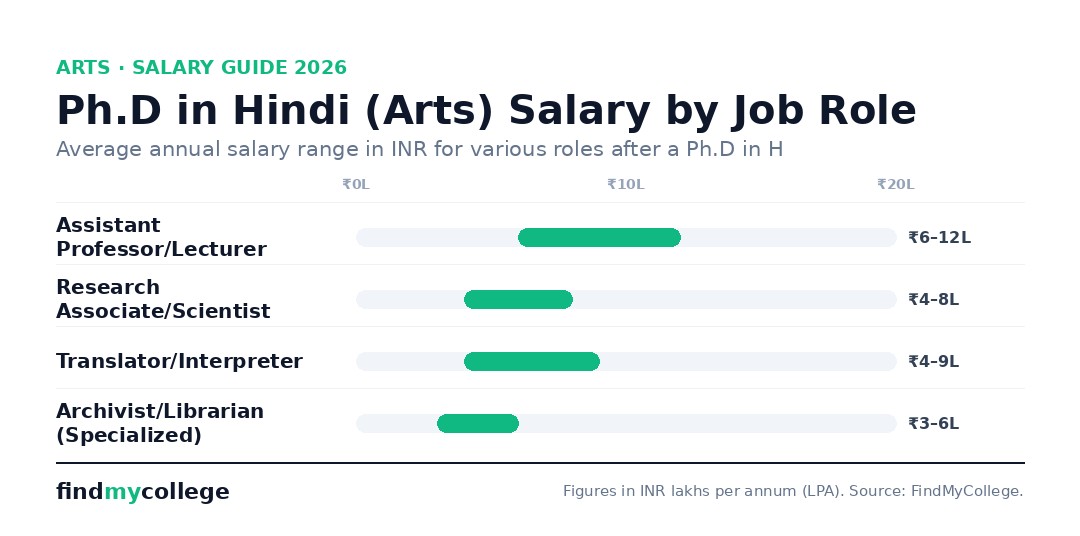
Career Prospects and Salary Outcomes (Post-Ph.D in Hindi):
| Job Role | Description | Average Annual Salary Range (INR) |
|---|---|---|
| Assistant Professor/Lecturer | Teaching and research in universities/colleges. | 6,00,000 – 12,00,000+ |
| Research Associate/Scientist | Conducting research in academic or government institutions. | 4,00,000 – 8,00,000 |
| Content Writer/Editor (Hindi) | Creating/editing content for publishing houses, media, digital platforms. | 3,50,000 – 7,00,000 |
| Translator/Interpreter | Translating documents or interpreting for government, international organizations. | 4,00,000 – 9,00,000 |
| Lexicographer/Terminologist | Developing dictionaries, glossaries, and technical terminology. | 4,50,000 – 8,50,000 |
| Archivist/Librarian (Specialized) | Managing and preserving Hindi literary and linguistic resources. | 3,00,000 – 6,00,000 |
Salaries can vary significantly based on experience, institution, and location. Government jobs, especially in central universities, often offer better pay scales and benefits.
What is the difference between M.Phil and Ph.D in Hindi?
The M.Phil (Master of Philosophy) in Hindi is a pre-doctoral research program, typically 1-2 years, focused on foundational research skills and a shorter dissertation, while the Ph.D in Hindi is a full-fledged doctoral program, 3-6 years, requiring extensive original research and a substantial thesis that contributes new knowledge to the field.
M.Phil vs. Ph.D in Hindi:
- Duration: M.Phil (1-2 years), Ph.D (3-6 years).
- Depth of Research: M.Phil involves preliminary research and a shorter dissertation; Ph.D requires extensive original research and a comprehensive thesis.
- Objective: M.Phil often serves as a stepping stone to Ph.D or for those seeking advanced research skills without full doctoral commitment. Ph.D aims to produce independent scholars and researchers.
- Entry Requirements: M.Phil usually requires a Master’s degree; Ph.D typically requires a Master’s degree and often an M.Phil or equivalent research experience.
- Career Outcomes: M.Phil can lead to teaching positions at the college level or research assistant roles; Ph.D is essential for university professorships and advanced research positions.
What are the top universities for Ph.D in Hindi in India?
Several prestigious universities across India offer excellent Ph.D programs in Hindi, known for their strong faculty, research facilities, and academic environment. Some of the top institutions include Delhi University, Jawaharlal Nehru University (JNU), Banaras Hindu University (BHU), University of Hyderabad, and Aligarh Muslim University (AMU).
Leading Institutions for Ph.D in Hindi:
- University of Delhi (DU): Renowned for its extensive Hindi department and diverse research areas.
- Jawaharlal Nehru University (JNU), New Delhi: Known for its interdisciplinary approach and strong focus on linguistics and comparative literature.
- Banaras Hindu University (BHU), Varanasi: A historic institution with a rich legacy in Hindi studies.
- University of Hyderabad: Offers a robust program with emphasis on modern Hindi literature and critical theory.
- Aligarh Muslim University (AMU): Strong focus on classical and modern Hindi literature, with a rich cultural context.
- Mahatma Gandhi Antarrashtriya Hindi Vishwavidyalaya, Wardha: A university dedicated solely to Hindi language and literature.
- Panjab University, Chandigarh: Offers strong research opportunities in various Hindi specializations.
- University of Allahabad: One of the oldest universities with a significant contribution to Hindi literary studies.
Frequently Asked Questions
Can I pursue Ph.D in Hindi through distance education?
No, generally, a Ph.D program, especially in a humanities subject like Hindi, cannot be pursued entirely through distance education as it requires extensive in-person research guidance, library access, and participation in seminars. While some universities might offer part-time options, they still involve regular interaction with the supervisor and campus resources.
Are there any scholarships for Ph.D in Hindi students?
Yes, numerous scholarships and fellowships are available. The most prominent is the UGC Junior Research Fellowship (JRF) for NET-qualified candidates. Universities also offer their own non-NET fellowships or research assistantships. Additionally, state governments and private foundations may provide grants for doctoral research.
What is the typical duration of a Ph.D in Hindi?
The typical duration for a Ph.D in Hindi in India is 3 to 6 years. This includes coursework, comprehensive exams, research, and thesis submission. The minimum duration is usually 3 years, and the maximum is often 6 years, extendable under special circumstances.
Do I need to know Sanskrit to pursue Ph.D in Hindi?
While not strictly mandatory for all specializations, a basic understanding or knowledge of Sanskrit is highly beneficial, especially for research in ancient and medieval Hindi literature, linguistics, and the historical development of the Hindi language, as Hindi has strong roots in Sanskrit.
What is the research proposal for Ph.D in Hindi?
A research proposal for a Ph.D in Hindi is a detailed document outlining your intended research topic, its objectives, methodology, literature review, expected outcomes, and a tentative timeline. It demonstrates your understanding of the field and your ability to conduct independent research, and it is crucial for the interview stage of admissions.
Can I switch my research topic during my Ph.D in Hindi?
It is possible to switch or significantly modify your research topic during your Ph.D, but it usually requires formal approval from your supervisor and the departmental research committee. This process can be time-consuming and may impact your overall program duration.
What are the key skills developed during a Ph.D in Hindi?
A Ph.D in Hindi develops critical skills such as advanced research methodology, analytical and critical thinking, academic writing, presentation skills, in-depth subject matter expertise, linguistic analysis, and the ability to contribute original scholarly work to the field.
What is the scope of Ph.D in Hindi abroad?
The scope of a Ph.D in Hindi abroad is primarily in academic institutions with South Asian Studies or Linguistics departments, where graduates can pursue teaching and research roles. Opportunities also exist in international organizations, cultural centers, and translation services requiring expertise in Hindi and Indian culture.