

Ph.D. in Philosophy (Arts) India 2026: Comprehensive Overview
Nishit Kumar is a senior EdTech industry leader with over a decade of experience in building and scaling education platforms, shaping their product, content, and growth strategy. At…
Latest update: Ph.D in Philosophy 2026 admissions & dates updated. Read more ›
Welcome to the comprehensive overview of the Ph.D. in Philosophy program in India for the academic year 2026, specifically tailored for students from the Arts stream. This page provides an in-depth look at what the program entails, who it’s for, and what you can expect in terms of academic rigor, career outcomes, and financial investment. A Ph.D. in Philosophy is a terminal degree that signifies advanced scholarship and original research in various philosophical domains, preparing candidates for careers in academia, research, and specialized intellectual roles.
What is a Ph.D. in Philosophy and why pursue it in India?
A Ph.D. in Philosophy is an advanced doctoral program focused on original research and significant contribution to the field of philosophy. Pursuing this degree in India offers access to a rich intellectual tradition, diverse philosophical schools of thought, and a growing academic landscape with reputable institutions.
The program typically involves intensive coursework, comprehensive examinations, and the completion of a substantial dissertation that presents original research. It is designed for individuals who possess a deep passion for philosophical inquiry, critical thinking, and a desire to contribute new knowledge to the discipline. India, with its ancient philosophical heritage and modern academic institutions, provides a unique environment for exploring both Eastern and Western philosophical traditions.
What is the eligibility for Ph.D. in Philosophy in India for 2026?
To be eligible for a Ph.D. in Philosophy in India for 2026, candidates generally need a Master’s degree in Philosophy or a closely related discipline from a recognized university, with a minimum aggregate score, often 55% (50% for reserved categories).
Specific eligibility criteria can vary by institution, but common requirements include:
- Master’s Degree: An M.A. in Philosophy is usually preferred. Some universities may accept M.Phil. degrees or Master’s degrees in allied Arts/Humanities subjects (e.g., Political Science, Sociology, Literature) if the candidate demonstrates sufficient philosophical background.
- Minimum Marks: A minimum of 55% aggregate marks (or equivalent grade) at the Master’s level is standard for general category candidates. This is often relaxed to 50% or 5% marks for candidates belonging to SC/ST/OBC (non-creamy layer)/PwD categories, as per UGC guidelines.
- Entrance Examination: Most universities require candidates to clear a university-specific Ph.D. entrance examination.
- NET/JRF Qualification: Candidates who have qualified for the UGC-NET (National Eligibility Test) or UGC-JRF (Junior Research Fellowship) are often exempted from the university’s entrance exam and may be directly called for an interview. This is a significant advantage.
- Interview/Viva Voce: All shortlisted candidates, whether through entrance exam or NET/JRF exemption, must undergo an interview where they present their research proposal and discuss their academic background.
How long does a Ph.D. in Philosophy typically take in India?
A Ph.D. in Philosophy in India typically takes a minimum of three years and can extend up to six years, depending on the university’s regulations, the nature of the research, and the candidate’s progress.
The duration is often divided into:
- Coursework (6-12 months): Initial period dedicated to foundational courses, research methodology, and literature review.
- Comprehensive/Qualifying Exams: Usually conducted after coursework to assess readiness for dissertation research.
- Research and Dissertation Writing (2-5 years): The core period for conducting original research, data collection (if applicable), analysis, and writing the doctoral thesis.
- Viva Voce: Final defense of the dissertation.
What are the key specializations available in Ph.D. in Philosophy?
Ph.D. in Philosophy programs offer a wide array of specializations, allowing students to delve deep into specific areas of philosophical inquiry, ranging from ancient traditions to contemporary analytical approaches.
Common specializations include:
- Ethics and Moral Philosophy: Normative ethics, meta-ethics, applied ethics (bioethics, environmental ethics).
- Metaphysics and Epistemology: Nature of reality, knowledge, truth, justification.
- Logic and Philosophy of Language: Formal logic, philosophical logic, meaning, reference.
- Political Philosophy: Justice, rights, democracy, political theory.
- Aesthetics: Philosophy of art, beauty, aesthetic experience.
- Philosophy of Mind: Consciousness, mental states, mind-body problem.
- Philosophy of Science: Scientific method, theories, explanation.
- History of Philosophy: Ancient Greek, Medieval, Early Modern, Continental, Indian, Chinese Philosophy.
- Indian Philosophy: Vedanta, Nyaya, Buddhism, Jainism, Yoga, Mimamsa, Samkhya.
- Continental Philosophy: Phenomenology, Existentialism, Post-structuralism, Critical Theory.
How much does a Ph.D. in Philosophy cost in India (2026)?
The cost of a Ph.D. in Philosophy in India varies significantly between government-funded universities and private institutions, with government universities generally being much more affordable.
Here’s an estimated fee range for 2026:
| Institution Type | Annual Tuition Fees (INR) | Other Charges (Exam, Lab, Library, etc.) (INR) | Total Annual Cost (Approx.) (INR) |
|---|---|---|---|
| Government Universities (e.g., Central/State Universities) | ₹5,000 – ₹30,000 | ₹2,000 – ₹15,000 | ₹7,000 – ₹45,000 |
| Private Universities/Deemed Universities | ₹50,000 – ₹2,50,000+ | ₹10,000 – ₹50,000+ | ₹60,000 – ₹3,00,000+ |
Additional costs include hostel fees (₹30,000-₹80,000 per year), research expenses, books, and personal living expenses. Many Ph.D. scholars receive financial assistance through UGC-JRF, institutional fellowships, or project-based stipends, which can significantly offset these costs.
What is the admission process for Ph.D. in Philosophy for 2026?
The admission process for a Ph.D. in Philosophy in India for 2026 typically involves an application, an entrance examination, and an interview, with specific dates varying by university.
A general timeline and steps are as follows:
- Application Form: Universities release application forms online, usually between September and November for the academic year commencing July/August of the following year. Some universities have a second admission cycle.
- Entrance Examination: Candidates appear for a written entrance test, which typically assesses research aptitude, logical reasoning, and subject-specific knowledge in Philosophy.
- Result Declaration: Shortlisted candidates based on entrance exam scores (or NET/JRF exemption) are announced.
- Interview/Viva Voce: Shortlisted candidates are called for an interview. This is a crucial stage where candidates discuss their proposed research topic, methodology, and academic background with a panel of experts. A well-prepared research proposal is essential.
- Final Selection: Based on the combined performance in the entrance exam (if applicable) and interview, candidates are offered admission.
- Enrollment: Selected candidates complete admission formalities and begin their coursework.
Key Dates & Exam Pattern (Illustrative for 2026)
While specific dates vary, here’s a general idea for major entrance exams and university admissions:
| Event | Tentative Period (2026) | Details |
|---|---|---|
| UGC-NET Application | March-April & Sept-Oct | For JRF/Lectureship eligibility, often exempts from university entrance. |
| University Ph.D. Application | Sept-Nov (Cycle 1), March-May (Cycle 2) | Check individual university websites for exact deadlines. |
| University Ph.D. Entrance Exam | Dec-Jan (Cycle 1), June-July (Cycle 2) | Typically 2-3 hours, MCQ + descriptive, covering research methodology & Philosophy. |
| Interview/Viva Voce | Feb-March (Cycle 1), July-Aug (Cycle 2) | Presentation of research proposal, discussion with faculty. |
| Admission & Enrollment | July-Aug | Commencement of coursework. |
Is a Ph.D. in Philosophy worth it for jobs and career prospects in India?
A Ph.D. in Philosophy is highly valuable for careers in academia and research, but its utility extends to various sectors requiring advanced critical thinking, analytical skills, and ethical reasoning, making it a worthwhile pursuit for those passionate about the field.
While the primary career path is often in academia, teaching, and research, the skills acquired during a Ph.D. are highly transferable:
- Academia: Professor, Assistant Professor, Lecturer in universities and colleges. This is the most direct career path, requiring strong research and teaching abilities.
- Research Fellow/Scientist: Working in think tanks, research institutions, or government policy bodies.
- Content Writer/Editor: For academic publishers, educational technology firms, or media houses, leveraging strong writing and analytical skills.
- Ethics Consultant: In corporate settings, healthcare, or technology companies, advising on ethical implications of business practices, AI, or data privacy.
- Policy Analyst: In government or NGOs, contributing to policy formulation and analysis, especially in areas requiring philosophical grounding.
- Journalism/Public Relations: Roles that demand critical analysis, persuasive communication, and understanding of complex issues.
- Civil Services: The analytical and critical reasoning skills are highly beneficial for competitive exams like UPSC.
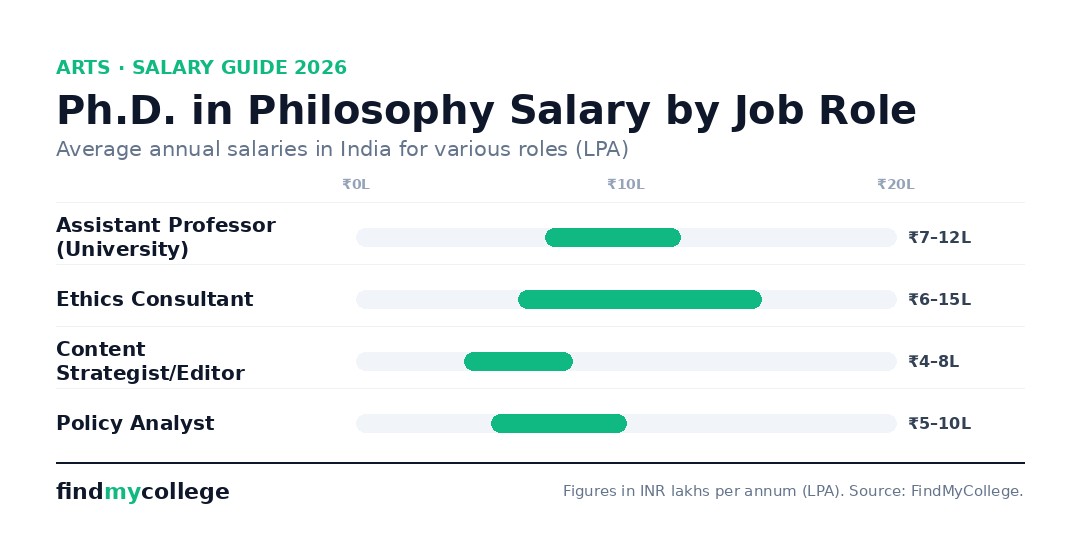
Average Salary by Role (Illustrative, Post-Ph.D.)
| Job Role | Average Annual Salary (INR) | Key Skills Utilized |
|---|---|---|
| Assistant Professor (University) | ₹7,00,000 – ₹12,00,000+ | Teaching, Research, Curriculum Development, Mentoring |
| Research Fellow/Associate | ₹4,50,000 – ₹9,00,000 | Research Design, Data Analysis, Report Writing, Critical Thinking |
| Ethics Consultant | ₹6,00,000 – ₹15,00,000+ | Ethical Reasoning, Policy Development, Stakeholder Communication |
| Content Strategist/Editor (Academic) | ₹4,00,000 – ₹8,00,000 | Writing, Editing, Research Synthesis, Communication |
| Policy Analyst | ₹5,00,000 – ₹10,00,000 | Critical Analysis, Policy Research, Advocacy, Problem-Solving |
Salaries can vary significantly based on the institution, experience, location, and specific industry. A strong publication record and networking are crucial for career advancement.
Ph.D. in Philosophy vs. M.Phil. in Philosophy: What’s the difference?
The M.Phil. (Master of Philosophy) is a pre-doctoral research degree, typically one to two years, focused on advanced coursework and a shorter dissertation, while the Ph.D. is a terminal doctoral degree requiring original, extensive research over three to six years.
Here’s a comparison:
| Feature | M.Phil. in Philosophy | Ph.D. in Philosophy |
|---|---|---|
| Duration | 1-2 years | 3-6 years (minimum 3 years) |
| Focus | Advanced coursework, research methodology, short thesis/dissertation. | Original, extensive research leading to a substantial dissertation. |
| Degree Level | Pre-doctoral, often a stepping stone to Ph.D. | Terminal doctoral degree. |
| Eligibility | Master’s degree in Philosophy. | Master’s degree in Philosophy (M.Phil. often preferred). |
| Career Impact | Enhances research skills, better for some teaching roles, prepares for Ph.D. | Essential for university professorships, high-level research, and specialized roles. |
Many universities have phased out the M.Phil. program, integrating its research components into the initial years of the Ph.D. program.
Frequently Asked Questions
Which are the top universities for Ph.D. in Philosophy in India?
Some of the top universities for Ph.D. in Philosophy in India include Jawaharlal Nehru University (JNU), University of Delhi, Banaras Hindu University (BHU), University of Hyderabad, Jadavpur University, and various IITs (for Philosophy of Science/Technology related research). Reputable state universities also offer strong programs.
Can I pursue a Ph.D. in Philosophy part-time?
Yes, many universities in India offer part-time Ph.D. programs in Philosophy. These programs are designed for working professionals and typically have a longer duration (e.g., 4-8 years) to accommodate professional commitments. Eligibility criteria and admission processes are similar but may have additional requirements for employer NOC.
Is a research proposal mandatory for Ph.D. admission?
Yes, a well-structured research proposal is almost always mandatory for Ph.D. admission in Philosophy. It is a critical component of the interview stage, demonstrating your research interest, understanding of the field, and proposed methodology. It helps the faculty assess your potential as a researcher.
What is the role of UGC-NET/JRF in Ph.D. admissions?
Qualifying UGC-NET makes you eligible for Assistant Professorship and often exempts you from the university’s Ph.D. entrance examination. Qualifying UGC-JRF (Junior Research Fellowship) additionally provides a substantial monthly stipend for the duration of your Ph.D., making it a highly sought-after qualification for financial support.
Are there scholarships available for Ph.D. in Philosophy students?
Yes, several scholarships and fellowships are available. The most prominent is the UGC-JRF. Other options include institutional fellowships, Prime Minister’s Research Fellowship (PMRF), various state-specific scholarships, and project-based research assistantships under faculty. It’s crucial to actively seek and apply for these opportunities.
What kind of research topics are popular in Philosophy Ph.D. programs?
Popular research topics are diverse and often interdisciplinary. They include contemporary issues in ethics (e.g., AI ethics, environmental ethics), philosophy of mind (consciousness, free will), political philosophy (justice, democracy in a globalized world), re-interpretations of classical texts, comparative philosophy (East-West dialogues), and philosophy of technology or science. The key is to identify a gap in existing literature and propose original research.