Ph.D in Sanskrit Salary in India 2026: Comprehensive Guide
Nishit Kumar is a senior EdTech industry leader with over a decade of experience in building and scaling education platforms, shaping their product, content, and growth strategy. At…
Latest update: Ph.D in Sanskrit 2026 admissions & dates updated. Read more ›
Welcome to our comprehensive guide on the Ph.D in Sanskrit Salary in India for 2026. This page is designed for prospective students and parents seeking detailed information about the career prospects, earning potential, and overall value of pursuing a Doctorate in Sanskrit from an Indian institution. We delve into various job roles, salary ranges, and the factors influencing income for Ph.D holders in this esteemed discipline.
What is the average salary for a Ph.D in Sanskrit in India?
The average salary for a Ph.D in Sanskrit in India typically ranges from INR 4,00,000 to INR 12,00,000 per annum, depending on the specific role, institution (academic vs. research), experience, and location. Entry-level positions might start lower, while experienced professionals in senior academic or research roles can command significantly higher packages.
A Ph.D in Sanskrit opens doors to diverse career paths, primarily in academia, research, cultural institutions, and government sectors. The demand for Sanskrit scholars remains consistent, particularly with renewed focus on preserving ancient Indian knowledge and promoting linguistic studies.
What are the top job roles and their salaries after a Ph.D in Sanskrit?
After completing a Ph.D in Sanskrit, graduates can pursue several rewarding career paths, each with varying salary structures. The most common and lucrative roles are in academia and research, but opportunities also exist in publishing, content creation, and cultural heritage management.
Professor/Assistant Professor
This is the most common career path. A Ph.D is often a mandatory qualification for teaching positions at universities and colleges. Salaries are governed by UGC (University Grants Commission) norms for government institutions and vary for private colleges.
- Assistant Professor: INR 6,00,000 – INR 10,00,000 per annum
- Associate Professor: INR 9,00,000 – INR 15,00,000 per annum
- Professor: INR 12,00,000 – INR 25,00,000+ per annum
Research Scientist/Fellow
Ph.D holders can work as researchers in various institutions dedicated to Indology, linguistic studies, or ancient texts. This often involves project-based work, archival research, and publishing scholarly articles.
- Junior Research Fellow (JRF): INR 3,72,000 – INR 4,46,400 per annum (stipend-based, often during Ph.D or immediate post-doc)
- Senior Research Fellow (SRF): INR 4,46,400 – INR 5,35,680 per annum
- Research Scientist/Associate: INR 5,00,000 – INR 12,00,000 per annum
Indologist/Curator
Working with museums, archives, and cultural heritage organizations, Indologists and Curators are responsible for preserving, interpreting, and presenting ancient artifacts and texts. This role often involves deep knowledge of Sanskrit and ancient Indian culture.
- Entry-Level: INR 4,00,000 – INR 7,00,000 per annum
- Experienced: INR 7,00,000 – INR 15,00,000 per annum
Content Writer/Editor (Sanskrit/Indology)
With the rise of digital platforms and educational content, there’s a demand for writers and editors specializing in Sanskrit texts, translations, and cultural topics. This can be in publishing houses, educational tech companies, or media organizations.
- Entry-Level: INR 3,50,000 – INR 6,00,000 per annum
- Experienced: INR 6,00,000 – INR 10,00,000 per annum
Translator/Interpreter
Expertise in Sanskrit is valuable for translating ancient texts, manuscripts, and inscriptions for academic, legal, or cultural purposes. This can be freelance or with specialized agencies.
- Per Project/Freelance: Varies widely, often INR 1-5 per word or INR 500-2000 per hour.
- Full-time: INR 4,00,000 – INR 9,00,000 per annum
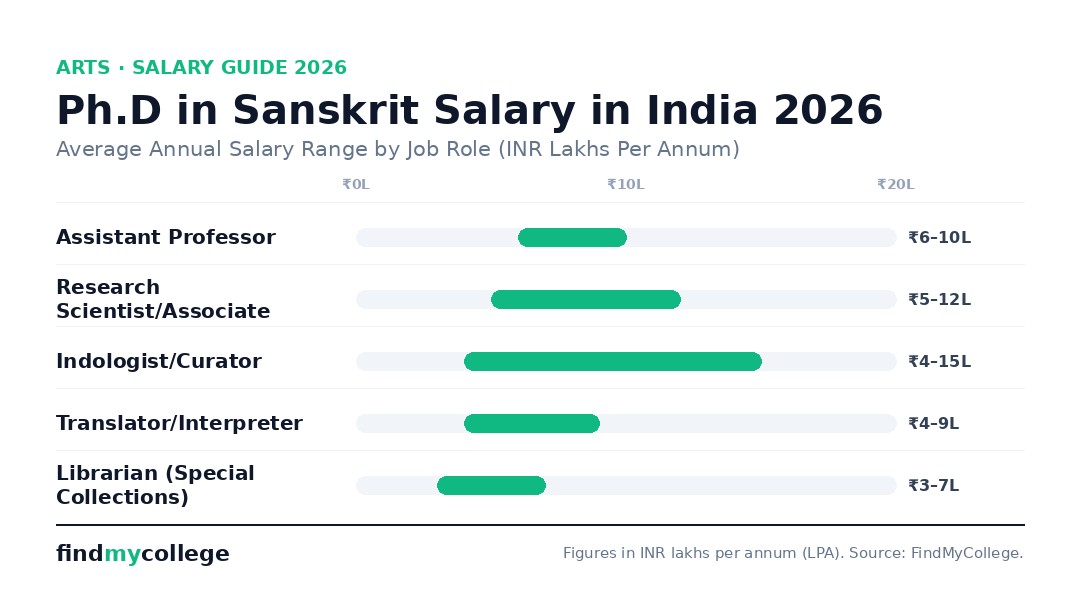
Here’s a summary of potential salary ranges for various roles:
| Job Role | Average Annual Salary Range (INR) | Key Responsibilities |
|---|---|---|
| Assistant Professor (University/College) | 6,00,000 – 10,00,000 | Teaching, Research, Curriculum Development |
| Research Scientist/Associate | 5,00,000 – 12,00,000 | Conducting Research, Publishing Papers, Project Management |
| Indologist/Curator | 4,00,000 – 15,00,000 | Text Preservation, Interpretation, Exhibition Design |
| Content Writer/Editor | 3,50,000 – 10,00,000 | Creating Educational/Cultural Content, Editing Texts |
| Translator/Interpreter | 4,00,000 – 9,00,000 (or project-based) | Translating Ancient Texts, Manuscripts, Documents |
| Librarian (Special Collections) | 3,00,000 – 7,00,000 | Managing Sanskrit Manuscripts/Rare Books |
What factors influence Ph.D in Sanskrit salaries?
Several factors significantly impact the salary potential for Ph.D in Sanskrit graduates in India:
- Institution Type: Salaries in central universities and government-funded research institutions (e.g., Rashtriya Sanskrit Sansthan, various IITs/IIMs with humanities departments) are generally higher and more structured than in private colleges or smaller organizations.
- Experience: As with any field, experience plays a crucial role. Entry-level positions will have lower salaries compared to those with 5-10+ years of post-Ph.D experience.
- Publications & Research Output: A strong publication record in reputed journals, participation in national/international conferences, and successful research projects can significantly boost career progression and salary, especially in academia.
- Specialization: Expertise in niche areas like Vedic studies, Sanskrit linguistics, Manuscriptology, or specific philosophical schools can command higher demand and better remuneration.
- Location: Metropolitan cities like Delhi, Mumbai, Bangalore, and Pune often offer higher salaries due to a greater concentration of universities, research centers, and cultural organizations.
- Grants & Fellowships: Securing prestigious research grants or fellowships can provide additional income and enhance a scholar’s profile, leading to better long-term prospects.
- Teaching vs. Research vs. Industry: Academic teaching roles often have structured pay scales. Pure research roles might be project-based initially. Industry roles (e.g., content, translation) can be more market-driven.
Is a Ph.D in Sanskrit worth it for jobs and salary?
Yes, a Ph.D in Sanskrit can be highly worth it for individuals passionate about the subject and dedicated to a career in academia, research, or cultural preservation. While it may not offer the same immediate high-paying corporate jobs as some STEM fields, it provides a stable and respected career path with significant intellectual rewards and a decent salary progression.
The value proposition of a Ph.D in Sanskrit lies in:
- Specialized Expertise: You become an expert in a rare and profound field, making you highly sought after in specific niches.
- Academic Career Stability: Once established, academic positions offer good job security, benefits, and a clear career ladder.
- Contribution to Knowledge: The opportunity to contribute to the understanding and preservation of ancient Indian wisdom is a significant intrinsic reward.
- Growing Demand: With initiatives like the National Education Policy (NEP) 2020 emphasizing Indian knowledge systems, the demand for qualified Sanskrit scholars is expected to remain robust.
What is the eligibility for Ph.D in Sanskrit?
To be eligible for a Ph.D in Sanskrit, candidates typically need a Master’s degree (M.A.) in Sanskrit or an allied subject with a minimum of 55% aggregate marks (50% for SC/ST/OBC/PwD candidates) from a recognized university. Many universities also require candidates to qualify for a national-level entrance examination or the university’s own entrance test.
Key Eligibility Criteria:
- Master’s Degree: M.A. in Sanskrit, Acharya, or an equivalent post-graduate degree in a related field (e.g., Indology, Philosophy with Sanskrit as a core component).
- Minimum Marks: Generally 55% aggregate at the Master’s level (50% for reserved categories as per UGC norms).
- Entrance Examination:
- UGC NET/JRF: Qualifying for the UGC NET (National Eligibility Test) for Assistant Professorship or JRF (Junior Research Fellowship) often exempts candidates from the university’s entrance test and provides a fellowship.
- University Entrance Test: Most universities conduct their own entrance exams, followed by an interview.
- Interview/Viva Voce: Shortlisted candidates are usually required to appear for an interview where they discuss their research proposal.
Ph.D in Sanskrit Admission Process (General Steps):
- Check Eligibility: Ensure you meet the minimum academic qualifications.
- Prepare for Entrance Exams: Study for UGC NET/JRF or the specific university’s entrance test.
- Identify Research Area & Supervisor: Develop a preliminary research proposal and identify potential supervisors whose work aligns with your interests.
- Apply to Universities: Fill out application forms, submit required documents (transcripts, certificates, research proposal).
- Appear for Entrance Test & Interview: Qualify the written exam and perform well in the interview.
- Enrollment: Upon selection, complete admission formalities and begin your doctoral journey.
How much does a Ph.D in Sanskrit cost in India?
The cost of pursuing a Ph.D in Sanskrit in India varies significantly between government and private institutions. Generally, it is more affordable compared to professional degrees, especially with the availability of fellowships.
Fee Ranges for Ph.D in Sanskrit (Annual):
- Government Universities (e.g., Central Universities, State Universities): INR 5,000 – INR 50,000 per annum. These institutions are heavily subsidized.
- Private Universities/Deemed Universities: INR 30,000 – INR 1,50,000 per annum. Fees are generally higher, but they might offer better infrastructure or specific research facilities.
Additional Costs to Consider:
- Examination Fees: For entrance tests and semester exams.
- Thesis Submission Fees: One-time fee at the end of the program.
- Research Expenses: Books, travel for conferences, fieldwork, software, etc. (often covered by fellowships or research grants).
- Living Expenses: Accommodation, food, transport, especially if relocating.
Fellowships and Scholarships:
Many Ph.D students in Sanskrit receive financial assistance, significantly reducing the burden of costs:
- UGC JRF (Junior Research Fellowship): Provides a monthly stipend (approx. INR 31,000 for JRF, INR 35,000 for SRF) plus HRA and a contingency grant.
- Non-NET Fellowship: Provided by UGC to Ph.D scholars who haven’t qualified NET but are admitted to central universities (approx. INR 8,000 per month).
- Institutional Fellowships: Many universities offer their own scholarships or teaching assistantships.
- ICHR/ICPR Fellowships: For specific research in history or philosophy.
What are the career prospects for a Ph.D in Sanskrit beyond academia?
While academia is the primary career path, a Ph.D in Sanskrit offers several valuable career prospects beyond traditional teaching and research roles. The critical thinking, analytical skills, and deep cultural understanding gained are highly transferable.
- Government Sector: Opportunities in organizations like the Ministry of Culture, Archaeological Survey of India (ASI), National Archives, and various state cultural departments. Roles can include research officers, cultural officers, or archivists.
- Publishing Houses: Working as editors, proofreaders, or content developers for academic publishers specializing in Indology, philosophy, or religious studies.
- NGOs and Cultural Foundations: Many non-governmental organizations focus on cultural preservation, promotion of Indian languages, and traditional arts. A Ph.D in Sanskrit can lead to roles in project management, research, or outreach.
- Digital Humanities: With the increasing digitization of ancient manuscripts, scholars are needed for cataloging, transcribing, and developing digital resources. This combines traditional scholarship with modern technology.
- Journalism/Media: Specializing in cultural journalism, documentary filmmaking, or content creation for platforms focusing on Indian heritage and philosophy.
- Tourism: As cultural guides or consultants for specialized heritage tours, leveraging deep knowledge of historical sites and their Sanskrit connections.
Explore more on FindMyCollege
Related pages for Ph.D in Sanskrit aspirants on findmycollege.com:
Frequently Asked Questions
What is the duration of a Ph.D in Sanskrit program?
A Ph.D in Sanskrit typically takes a minimum of 3 years and can extend up to 6 years, depending on the university regulations, the nature of the research, and the student’s progress. Some universities allow extensions under special circumstances.
Are there part-time Ph.D options for Sanskrit?
Yes, many universities offer part-time Ph.D options in Sanskrit, especially for working professionals. The duration for part-time programs is usually longer, often ranging from 4 to 8 years. Eligibility criteria might be similar, but the research commitment is spread over a longer period.
Which are the top universities for Ph.D in Sanskrit in India?
Some of the top universities for Ph.D in Sanskrit in India include Banaras Hindu University (BHU), University of Delhi, Jawaharlal Nehru University (JNU), University of Pune, University of Madras, Rashtriya Sanskrit Sansthan (now Central Sanskrit University), and various state universities with strong Sanskrit departments.
Can I pursue a Ph.D in Sanskrit after an M.A. in a different Arts subject?
It depends on the university. Some universities may allow candidates with an M.A. in a closely related Arts subject (e.g., Philosophy, Ancient Indian History, Linguistics) to pursue a Ph.D in Sanskrit, provided they demonstrate sufficient proficiency in Sanskrit language and literature, often through an entrance exam or a qualifying course.
What kind of research topics are common in Ph.D in Sanskrit?
Research topics in Ph.D in Sanskrit are vast and diverse, including Vedic studies, classical Sanskrit literature (poetry, drama, prose), Sanskrit grammar and linguistics, Indian philosophy (Nyaya, Vedanta, Mimamsa), Dharmaśāstra, Manuscriptology, Epigraphy, Puranic studies, and comparative studies with other Indian or Western languages/philosophies.
Are there international opportunities after a Ph.D in Sanskrit?
Yes, a Ph.D in Sanskrit can open doors to international academic and research opportunities. Many universities in the USA, UK, Germany, France, and other European countries have strong Indology or South Asian Studies departments that recruit scholars. Post-doctoral fellowships and visiting professorships are common avenues.
What is the difference between a Ph.D in Sanskrit and an Acharya degree?
An Acharya degree is a traditional post-graduate degree in Sanskrit, often equivalent to an M.A., focusing on specific branches of Sanskrit learning (e.g., Vyakarana Acharya, Sahitya Acharya). A Ph.D in Sanskrit is a doctoral research degree that requires original research and a thesis, building upon the foundational knowledge gained from an M.A. or Acharya degree.
How important is a research proposal for Ph.D admission?
A strong research proposal is extremely important for Ph.D admission. It demonstrates your understanding of the chosen research area, your ability to formulate a research question, outline methodology, and identify relevant literature. It’s a key component in assessing your potential as a doctoral researcher and often a major part of the interview process.