
Pune Film Institute Courses 2026: FTII Fees, Duration and Seats
Nishit Kumar is a senior EdTech industry leader with over a decade of experience in building and scaling education platforms, shaping their product, content, and growth strategy. At…
FTII Pune offers 11 full-time courses across film and television disciplines, including 3-year PG Diplomas in Cinematography, Direction, Editing, Sound Recording, Art Direction, and Screen Acting at a total fee of Rs 2.3 Lakhs, alongside a 2-year PG Diploma in Feature Film Screenplay Writing at Rs 1.6 Lakhs. Admission is conducted through the national-level Joint Entrance Test (JET) followed by orientation and interview rounds.
Below is a complete guide covering course options, fee structures, category-wise seat distribution, government and private film making colleges across India, and the step-by-step admission process.
| Parameter | Details |
|---|---|
| Total Full-Time Courses | 11 courses |
| 3-Year PG Diploma Fee | Rs 2.3 Lakhs |
| 2-Year Screenplay Writing Fee | Rs 1.6 Lakhs |
| Admission Exam | Joint Entrance Test (JET) |
| General Seat Quota | About 50% of total seats |
| OBC Reservation Quota | 30% of total seats |
Top Film Making Colleges
Top institutions offering film making degrees and diplomas in India include NIRF-ranked universities alongside specialized media institutes. Candidates evaluating higher education options can compare top-ranked institutions by NIRF standing, total fee requirements, and university ownership.
| College | City | Ownership | Total course fee | NIRF rank |
|---|---|---|---|---|
| Chandigarh University | Chandigarh | Private | ₹6.84 lakh | 19 (Overall, 2025) |
| Calicut University | Calicut | Government | ₹7,970 | 38 (Overall, 2025) |
| Mumbai University | Mumbai | Government | ₹1.46 lakh | 54 (Overall, 2025) |
Government Film Making Colleges
| College | City | Ownership | Total course fee |
|---|---|---|---|
| Calicut University | Calicut | Government | ₹7,970 |
| CSJM Kanpur University | Kanpur | Government | ₹1.00 lakh |
| Mumbai University | Mumbai | Government | ₹1.46 lakh |
| Film and Television Institute of India | Pune | Government | ₹1.6 lakh – ₹2.3 lakh |
| Maulana Abul Kalam Azad University of Technology | Kolkata | Government | ₹2.64 lakh |
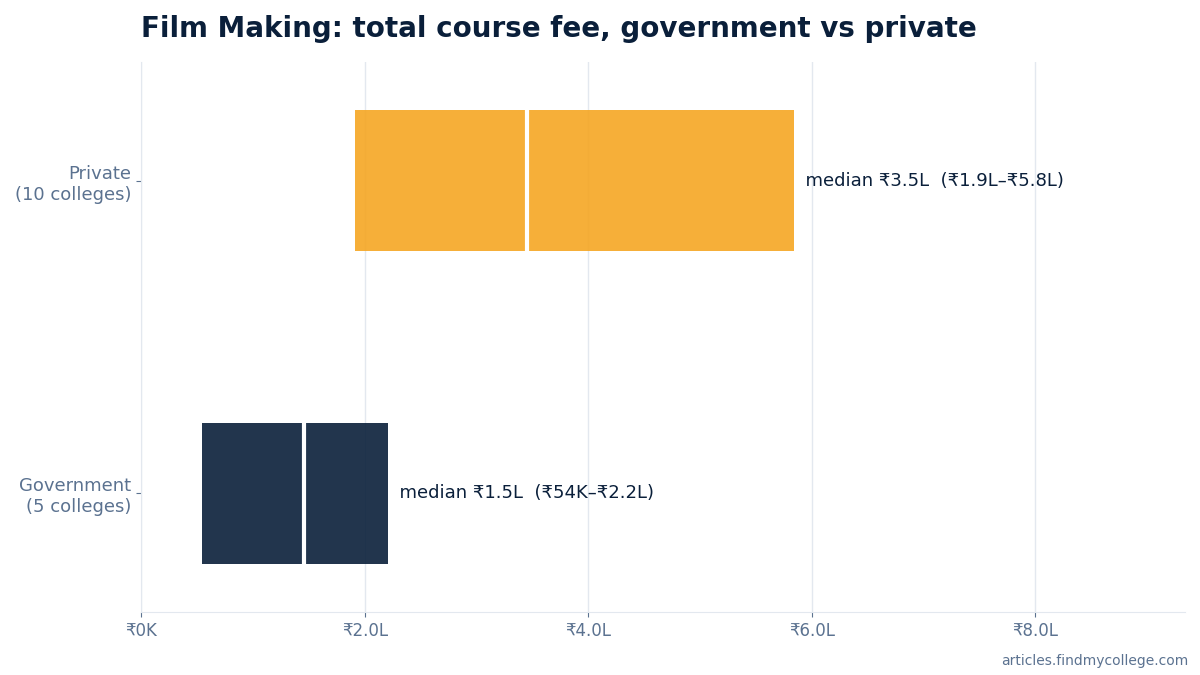
At least 6 government colleges offer Film Making programs in India. For government institutions, the median total course fee is ₹1.46 lakh, with the middle half between ₹54,185 and ₹2.21 lakh.
Private Film Making Colleges
At least 23 private colleges offer Film Making degrees and professional diplomas across India. The median total course fee among private colleges stands at ₹3.46 lakh, with the middle half ranging between ₹1.91 lakh and ₹5.84 lakh (based on 10 colleges with fee data). Private colleges often feature practical infrastructure, specialized studio setups, and industry exposure.
| College | City | Ownership | Total course fee |
|---|---|---|---|
| Chandigarh University | Chandigarh | Private | ₹6.84 lakh |
| Doon Business School | Dehradun | Private | ₹5.50 lakh |
| Karnavati University | Gandhi Nagar | Private | ₹9.00 lakh |
| St. Claret College | Bangalore | Private | ₹2.78 lakh |
| George College | Kolkata | Private | ₹3.16 lakh |
| LISAA School of Design Bangalore | Bangalore | Private | ₹1.65 lakh |
| Institute of Management Study | Kolkata | Private | ₹3.85 lakh |
| CREO Valley School of Film and Television | Bangalore | Private | ₹2.00 lakh |
| Jawaharlal Nehru Institute of Arts and Science | Idukki | Private | ₹1.05 lakh |
| IIFA Lancaster Degree College | Bangalore | Private | ₹3.75 lakh |
People Also Read
Film Making Fees
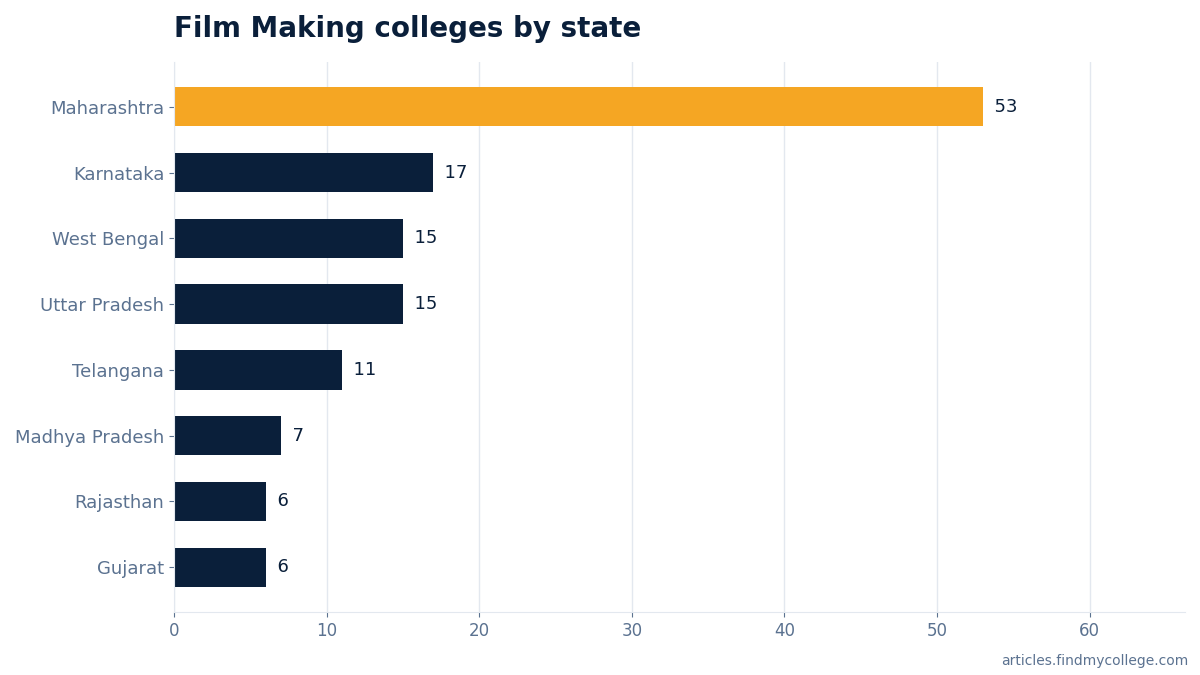
Across India, at least 166 colleges offer Film Making options. Geographic distribution of colleges shows Maharashtra leading with 53 colleges, followed by Karnataka with 17, West Bengal with 15, Uttar Pradesh with 15, Telangana with 11, and Madhya Pradesh with 7. Fee structures vary considerably across major educational hubs.
| City | Colleges | Fee range | Well-known options |
|---|---|---|---|
| Mumbai | 18 | ₹1.46 lakh – ₹13.84 lakh | Mumbai University, Amity University Mumbai |
| Pune | 17 | ₹60,000 – ₹14.19 lakh | MIT World Peace University, DES Pune University |
| Bangalore | 16 | ₹1.20 lakh – ₹6.00 lakh | REVA University, RV University |
| Kolkata | 15 | ₹74,000 – ₹4.80 lakh | Maulana Abul Kalam Azad University of Technology, George College |
| Hyderabad | 9 | ₹75,000 – ₹2.55 lakh | Dhruva Degree College, Roots Collegium |
| Noida | 5 | ₹80,000 – ₹6.69 lakh | Amity University Noida, Sharda University |
| Delhi | 5 | ₹1.61 lakh – ₹4.00 lakh | Jamia Hamdard University, Arena Animation GTB Nagar |
| Navi Mumbai | 5 | ₹2.22 lakh – ₹2.23 lakh | Chhatrapati Shivaji Maharaj University, School of Design and Arts, Chhatrapati Shivaji Maharaj University |
FTII Film Wing Courses: Duration, Seat Intake, and Total Fees
| Course Name | Duration (Years) | Total Fees (Rs in Lakhs) | Seats |
|---|---|---|---|
| PGD in Feature Film Screenplay Writing | 2 | 1.6 | 12 |
| PGD in Cinematography | 3 | 2.3 | 10 |
| PGD in Sound Recording and Sound Design | 3 | 2.3 | 10 |
| PGD in Art Direction and Production Design | 3 | 2.3 | 10 |
| PGD in Direction and Screenplay Writing | 3 | 2.3 | 10 |
| PGD in Editing | 3 | 2.3 | 10 |
| PGD in Screen Acting | 3 | 2.3 | 10 |
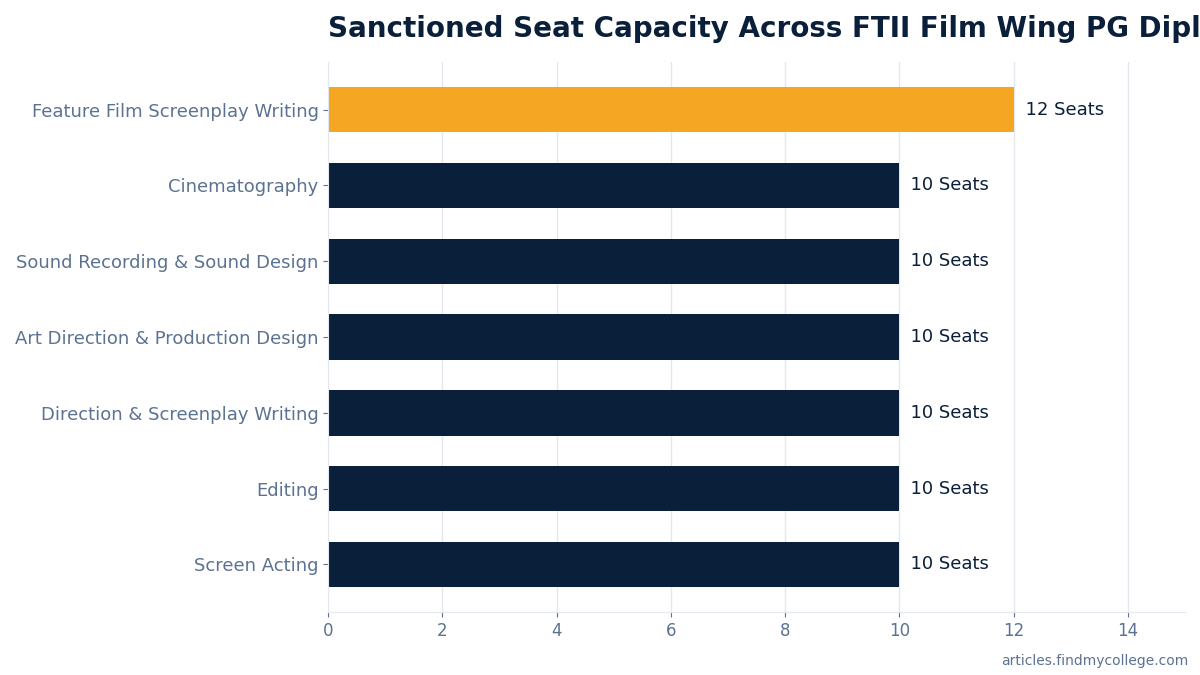
FTII Pune offers 2-year and 3-year Post Graduate Diploma programs across key film disciplines. Total course fees range from Rs 1.6 Lakhs to Rs 2.3 Lakhs, with sanctioned intakes of 10 to 12 seats per course.
How to Apply for Film Making Admission in 2026: Step by Step
- Register for Joint Entrance Test (JET): Apply online for the nationally administered Joint Entrance Test (JET), which serves as the written exam for admission to FTII.
- Appear for JET Written Exam: Take the nationwide written entrance test evaluating candidates on media, film, and television aptitude.
- Shortlisting for Subsequent Rounds: Qualify JET cutoff marks to be shortlisted for second-stage selection rounds.
- Attend Orientation and Interview: Participate in hands-on orientation sessions and personal interviews conducted directly by FTII Pune.
- Category Verification and Final Seat Allocation: Seats are allocated adhering to GoI reservation rules (~50% General, 30% OBC, remaining SC/ST) upon document verification.
- Pay Prescribed Course Fees: Confirm final admission by paying course fees (Rs 1.6 Lakhs for 2-year PGD, Rs 2.3 Lakhs for 3-year PGD specializations).
| What to do | Where | Link |
|---|---|---|
| Compare colleges, fees and cutoffs | Film Making colleges in India | findmycollege.com |
FAQs
What does FTII stand for?
FTII stands for the Film and Television Institute of India. It was established in 1960 under the Ministry of Information and Broadcasting of the Government of India and is located in Pune.
What are the fees of FTII Pune?
The total fee for 3-year PG Diploma courses in Cinematography, Direction, Editing, Acting, Sound Recording, and Art Direction is Rs 2.3 Lakhs. The 2-year PGD in Feature Film Screenplay Writing costs Rs 1.6 Lakhs.
Is it difficult to get into FTII?
Admission is competitive as seat intake across specializations is strictly limited. Selection requires clearing the national Joint Entrance Test (JET) followed by rigorous orientation and interview rounds.
Which course is best for cinematography at FTII?
FTII offers a dedicated 3-year Post Graduate Diploma in Cinematography with a total fee structure of Rs 2.3 Lakhs.
Are there scholarships available at FTII Pune?
Yes, FTII offers central and state government scholarships to deserving students, along with memorial awards from trusts and scholarships sponsored by individuals or production houses.
What is the seat reservation policy at FTII Pune?
FTII follows Government of India reservation norms, distributing roughly 50% of seats for General admission, 30% for OBC, and the remaining seats for SC and ST candidates.