Rad Tech Course: Eligibility, Syllabus, Fees and Career Scope
Radiology technology (Rad Tech) courses in India include 3- to 4-year undergraduate degrees like B.Sc. Radiology & Imaging Technology (B.Sc RIT) and 2-year diploma programs in Radiography or X-Ray technology.
Below, you will find information regarding eligibility requirements, diploma and degree options, year-wise syllabus breakdown, fee structures across government and private institutions, top colleges by state, and career opportunities with expected salaries.
| Parameter | Details |
|---|---|
| Course Duration | 3 Years (B.Sc RIT) / 4 Years (B.Sc RIT Honours with Research) / 2 Years (Diploma) |
| Minimum Eligibility | 10+2 with Physics, Chemistry, Biology/Mathematics and English with 50% – 60% aggregate marks |
| Fresher Monthly Salary | ₹15,000 – ₹25,000 per month (Average ₹3 – 5 LPA) |
| Admission Criteria | Merit-based on 10+2 marks, Personal Interview, or State/NEET-UG Counselling |
What is B.Sc Radiography & Imaging Technology
B.Sc Radio-Imaging Technology (BSc RIT) spans 3 years divided into 6 semesters, while BSc RIT Honours with Research spans 4 years divided into 8 semesters. Key modalities in radiology technology include X-ray Radiography, Computed Tomography (CT Scan), Magnetic Resonance Imaging (MRI), Ultrasound (Sonography), and Nuclear Medicine.
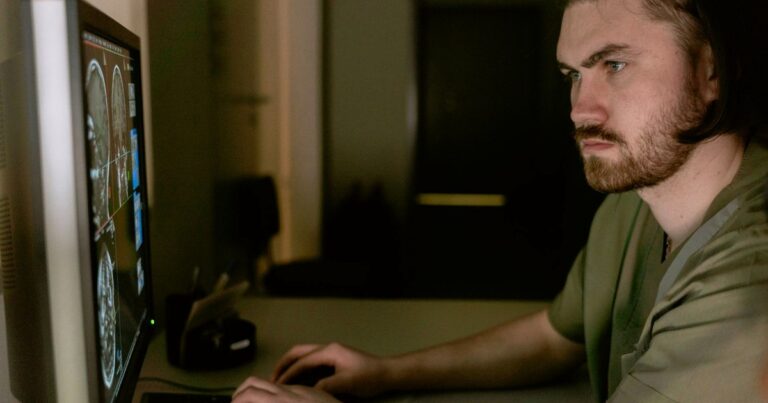
The course trains students to handle diagnostic imaging machinery, assist radiologists during complex procedures, manage radiation exposure risks, and produce accurate medical scans essential for patient treatment planning.
Types and Specialisations of Radiology Tech Courses
Candidates can select from undergraduate degree programs or shorter diploma courses depending on their career goals. A Diploma in X-Ray Technician is a 2-year, 4-semester program focusing on radiographic exposure, positioning, and radiation safety protocols. Similarly, a Diploma in Radiography covers basic diagnostics, ultrasonography, MRI basics, and tumour radiation care.
B.Sc Radiography & Imaging Technology Eligibility
To qualify for admission into a B.Sc Radiography & Imaging Technology program, candidates must pass 10+2 with minimum 50% to 60% aggregate marks in Physics, Chemistry, Biology or Mathematics, and English from a recognized board. NEET is generally not mandatory for undergraduate B.Sc Radiology or diploma programs in most institutes, as admissions depend on Class 12 merit or institutional screening.
B.Sc Radiography & Imaging Technology Syllabus and Subjects
Year 1 B.Sc Radiology syllabus covers Human Anatomy, Human Physiology, General Microbiology and Pathology, and Radiation Physics & Fundamentals of Medical Imaging. Year 2 B.Sc Radiology syllabus covers General Radiography Positioning, Ultrasound & Doppler including 4D, Advanced Digital Imaging & CT Physics, Nuclear Medicine, PET Scan, and MRI Basic Principles.
Year 3 B.Sc Radiology syllabus includes Hospital Management & Medical Ethics, MRI Clinical Applications, Research Methodology & Biostatistics, and Interventional Diagnostic Radiology. The 4th year of B.Sc Radiology Honours focuses on a dedicated research project and dissertation on a chosen topic.
| Year | Core Subjects & Modules Covered |
|---|---|
| Year 1 | Human Anatomy, Human Physiology, General Microbiology & Pathology, Radiation Physics & Medical Imaging Fundamentals |
| Year 2 | General Radiography Positioning, Ultrasound & Doppler (4D), Digital Imaging & CT Physics, Nuclear Medicine & PET Scan, MRI Principles |
| Year 3 | Hospital Management & Medical Ethics, MRI Clinical Applications, Research Methodology & Biostatistics, Interventional Radiology |
| Year 4 (Honours) | Specialised Clinical Research Project & Dissertation |
B.Sc Radiography & Imaging Technology Fees
| College | City | Ownership | Total course fee |
|---|---|---|---|
| Madras Medical College | Chennai | Government | ₹9,000 |
| Thanjavur Medical College | Thanjavur | Government | ₹9,000 |
| Governmernt Vellore Medical College | Vellore | Government | ₹9,000 |
| Government Thoothukudi Medical College | Thoothukudi | Government | ₹9,000 |
| Kanyakumari Government Medical College | Nagapattinam | Government | ₹9,000 |
| Government Villupuram Medical College and Hospital | Villupuram | Government | ₹9,000 |
| Government Sivagangai Medical College and Hospital | Sivaganga | Government | ₹12,350 |
| Kidwai Memorial Institute of Oncology | Bangalore | Government | ₹22,800 |
| Govt. Medical College Karur | Karur | Government | ₹34,500 |
| College | City | Ownership | Total course fee |
|---|---|---|---|
| Uttaranchal University | Dehradun | Private | ₹3.79 lakh |
| Guru Nanak College of Engineering & Management | Dehradun | Private | ₹1.72 lakh |
| Christian Medical College Ludhiana | Ludhiana | Private | ₹1.30 lakh |
| Manipal University, School of Allied Health Sciences | Manipal | Private | ₹7.12 lakh |
| KMCH Institute of Allied Health Sciences | Coimbatore | Private | ₹3.15 lakh |
| DP Institute of Professional Studies | Moradabad | Private | ₹54,000 |
| Dhanalakshmi Srinivasan Medical College and Hospital | Perambalur | Private | ₹1.35 lakh |
| Dolphin PG College of Science and Agriculture | Fatehgarh Sahib | Private | ₹2.10 lakh |
| Lovely Professional University | Jalandhar | Private | ₹6.30 lakh |
| SNS College of Allied Health Sciences | Coimbatore | Private | ₹3.12 lakh |
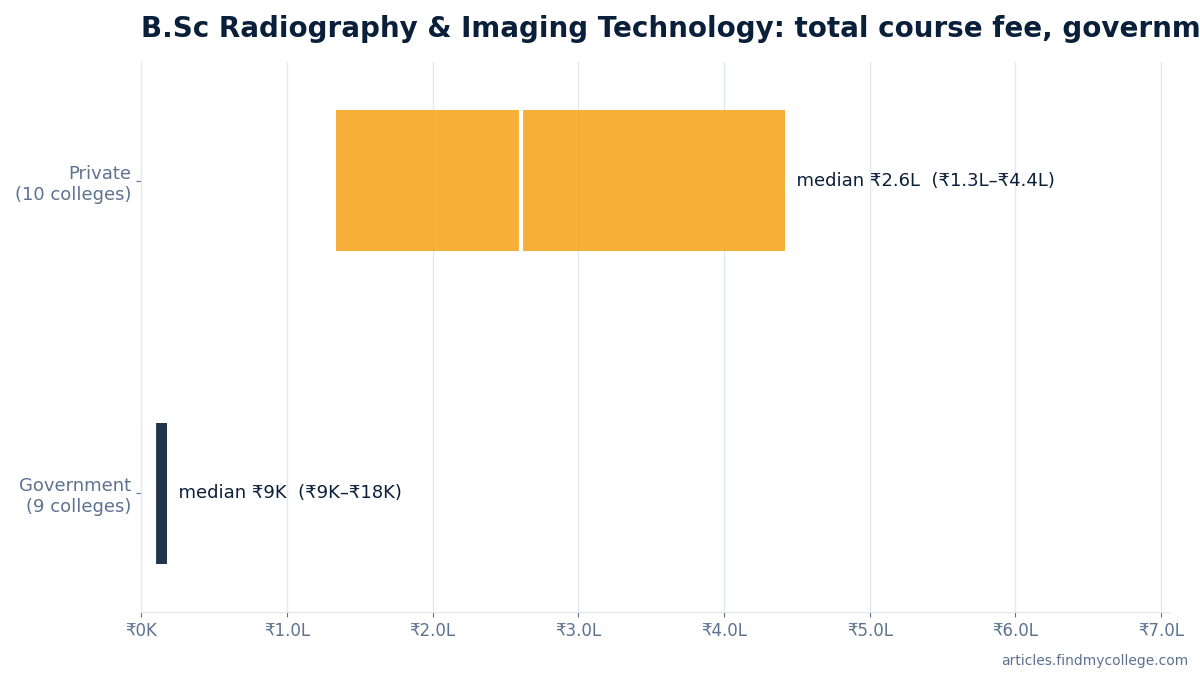
Government colleges present an affordable fee structure with a median total course fee of ₹9,000, compared to ₹2.61 lakh for private colleges. Annual tuition fees for B.Sc Radiology are ₹1.7 Lakhs at SGT University, ₹2 Lakhs at KGMU Lucknow, and ₹2.5 Lakhs at BMCRI Bangalore.
Top B.Sc Radiography & Imaging Technology Colleges
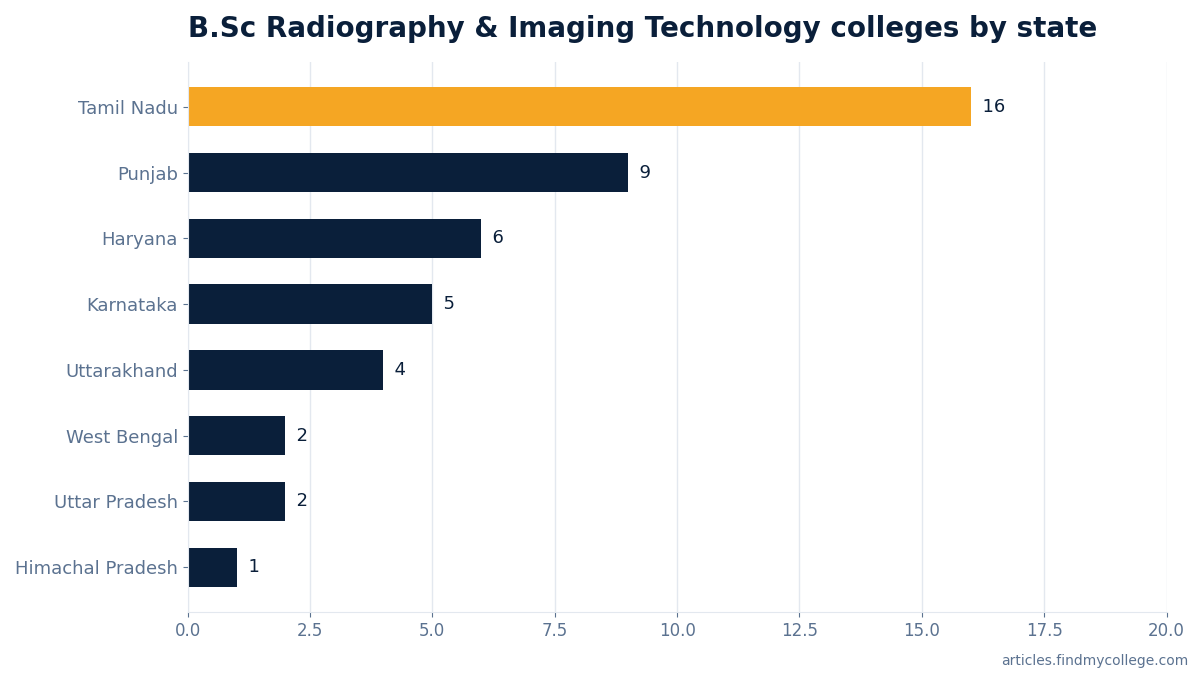
Students can explore radiology programs across various states: Tamil Nadu has at least 16 colleges, Punjab has 9, Haryana has 6, Karnataka has 5, Uttarakhand has 4, and West Bengal has 2. Top institutes for radiology courses in Bangalore include Vydehi Institute of Medical Sciences, MS Ramaiah University, Acharya Institute, and St. John’s Medical College. Top government radiology institutes in Kerala include Government Medical College Thiruvananthapuram, GMC Kottayam, and GMC Kozhikode.
| College | City | Ownership | Total course fee | NIRF rank |
|---|---|---|---|---|
| Lovely Professional University | Jalandhar | Private | ₹6.30 lakh | 31 (Overall, 2025) |
| Maharishi Markandeshwar Ambala | Ambala | — | ₹1.69 lakh | 85 (Overall, 2025) |
| Guru Jambheshwar University of Science and Technology | Hisar | — | ₹1.45 lakh | 101 (Overall, 2023) |
| DY Patil Education Society | Kolhapur | — | ₹2.10 lakh | 101 (Overall, 2023) |
| Sri Venkateswara Institute of Medical Sciences | Tirupati | — | ₹72,900 | 151 (Overall, 2023) |
| City | Colleges | Fee range | Well-known options |
|---|---|---|---|
| Dehradun | 4 | ₹1.72 lakh – ₹3.79 lakh | Uttaranchal University, Guru Nanak College of Engineering & Management |
| Bangalore | 3 | ₹22,800 – ₹7.20 lakh | Presidency University Bangalore, Kidwai Memorial Institute of Oncology |
| Coimbatore | 3 | ₹3.12 lakh – ₹3.15 lakh | Karunya Institute of Technology and Sciences, KMCH Institute of Allied Health Sciences |
| Tiruchirappalli | 2 | ₹6.20 lakh – ₹6.20 lakh | Dhanalakshmi Srinivasan University, KAP Viswanatham Government Medical College |
| Kolkata | 2 | ₹2.93 lakh – ₹4.79 lakh | Sister Nivedita University, The Neotia University |
| Villupuram | 2 | ₹9,000 – ₹2.25 lakh | Takshashila University, Government Villupuram Medical College and Hospital |
| Bathinda | 2 | ₹2.95 lakh – ₹2.95 lakh | Maharaja Ranjit Singh Punjab Technical University, All India Institute of Medical Sciences Bathinda |
| Manipal | 2 | ₹7.12 lakh – ₹7.12 lakh | Manipal University Manipal, Manipal University, School of Allied Health Sciences |
B.Sc Radiography & Imaging Technology Career Scope and Salary
Graduates can work across diagnostic centers, multi-specialty hospitals, research centers, and medical device manufacturing firms. Radiology technician job roles include MRI Technician, CT Technologist, Ultrasound Sonographer, Radiography Technologist, Application Specialist, PACS Administrator, and Clinical Instructor.
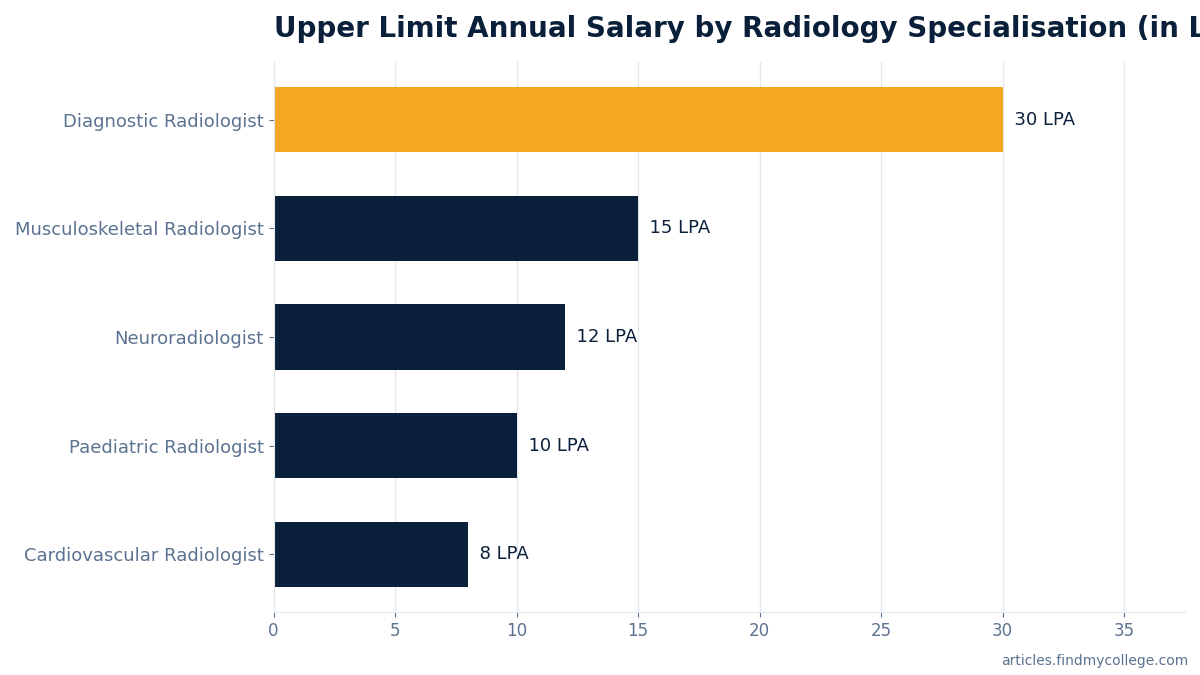
Fresh B.Sc Radiology graduates earn ₹15,000–₹25,000 per month, professionals with 2–5 years experience earn ₹30,000–₹50,000 per month, and experienced staff earn above ₹60,000 per month. Salary for specialized diagnostic radiology roles ranges from ₹5-30 LPA for Diagnostic Radiologists, ₹5-15 LPA for Musculoskeletal Radiologists, ₹4-12 LPA for Neuroradiologists, ₹5-10 LPA for Paediatric Radiologists, and ₹4-8 LPA for Cardiovascular Radiologists.
| Job Role | Key Focus Area | Salary Range (INR per annum) |
|---|---|---|
| Diagnostic Radiologist | General Diagnostic Scans (X-Ray, CT, MRI) | ₹5 – 30 LPA |
| Musculoskeletal Radiologist | Bone & Joint Diagnostics | ₹5 – 15 LPA |
| Neuroradiologist | Brain & Spinal Cord Imaging | ₹4 – 12 LPA |
| Paediatric Radiologist | Child & Infant Imaging | ₹5 – 10 LPA |
| Cardiovascular Radiologist | Heart & Blood Vessel Imaging | ₹4 – 8 LPA |
| Radiography Technician / Technologist | Operating Scanners & Equipment Handling | ₹3 – 5 LPA |
How to Apply for B.Sc Radiography & Imaging Technology Admission in 2026: Step by Step
- Check Eligibility Criteria: Pass 10+2 with minimum 50% to 60% aggregate marks in Physics, Chemistry, Biology/Mathematics, and English from a recognized board.
- Select Course Program: Choose between a 3 to 4-year B.Sc in Radio-Imaging Technology (B.Sc RIT) or a 2-year Diploma in X-Ray / Radiography Technician.
- Submit Online Application Form: Register and submit the application form on the official website of chosen universities or state paramedical admission portals.
- Attend Assessment or Interview: Participate in merit evaluation, personal interaction/interview, or state-level counselling based on class 12 marks or NEET-UG scores if required.
- Submit Documents and Pay Fees: Present Class 10/12 marksheets and migration certificates, then pay annual tuition fees (ranging from ₹20,000 to ₹2.5 Lakhs) to secure admission.
| What to do | Where | Link |
|---|---|---|
| Compare colleges, fees and cutoffs | B.Sc Radiography & Imaging Technology colleges in India | findmycollege.com |
Candidates holding a 2-year diploma in Radiology after 12th standard are also eligible for lateral entry into B.Sc Radiology programs. Admissions across most institutes rely on 10+2 merit scores or university interviews.