BMRIT Course Details: Eligibility, Syllabus & Career Scope
Nishit Kumar is a senior EdTech industry leader with over a decade of experience in building and scaling education platforms, shaping their product, content, and growth strategy. At…
BMRIT (Bachelor of Medical Radiology and Imaging Technology) is a 3 to 4-year undergraduate allied healthcare degree program, including a mandatory 6-month to 1-year clinical internship. Fees range from ₹20,000 per year in government institutes to ₹2,00,000 per year in private universities, with starting salaries between ₹2 LPA and ₹4 LPA.
At least 68 colleges offer BMRIT, with private institute tuition showing a median total course fee of ₹2.40 lakh. Detailed breakdown below covers entrance eligibility, semester syllabus, private and government college fees, job roles, starting salaries, and top institutions.
| Parameter | Details |
|---|---|
| Course Level | Undergraduate Degree |
| Course Duration | 3 Years + 6 Months Internship OR 4 Years (3 Years Academic + 1 Year Clinical Internship) |
| Basic Eligibility | 10+2 with Physics, Chemistry, and Biology (PCB) or Mathematics (PCM) with minimum 45%-50% aggregate |
| Minimum Age Limit | 17 years as on or before 31st December of the admission year (Maximum age: 30 years in select universities) |
| Average Course Fees | Govt: ₹20,000 – ₹1,00,000/year | Private: ₹80,000 – ₹2,00,000/year |
| Entrance Exams | University Entrance Exams, NEET, MH-CET (or Merit-based selection depending on institution) |
What is BMRIT
Bachelor of Medical Radiology and Imaging Technology (BMRIT) is a specialized paramedical degree that trains healthcare professionals to operate diagnostic equipment and handle medical imaging procedures. Students acquire practical proficiency in diagnostic imaging techniques including X-ray, Ultrasound (USG), Computed Tomography (CT), Magnetic Resonance Imaging (MRI), Fluoroscopy, and Mammography.
Course duration varies slightly by institution. For example, Motherhood University offers a 3-year academic program followed by a compulsory 6-month clinical internship. G H Raisoni Skill Tech University delivers BMRIT as a 4-year degree structured into 8 semesters, which includes a full 1-year clinical internship in affiliated hospital diagnostic departments.
| Imaging Modality | Core Focus & Technology Taught | Clinical Application |
|---|---|---|
| X-Ray (Conventional Radiography) | Radiation physics, digital detectors, tube alignment, exposure control | Bone fractures, chest/lung examinations, joint dislocations |
| Computed Tomography (CT Scan) | Multi-slice CT principles, helical scanning, cross-sectional anatomy, contrast media | Trauma, internal organ lesions, vascular imaging, head injuries |
| Magnetic Resonance Imaging (MRI) | Magnetic fields, pulse sequences, T1/T2 relaxation, gradient coils, safety | Soft tissue injuries, brain and spinal cord scans, ligament tears |
| Ultrasonography (USG) | Piezoelectric effect, sound wave propagation, acoustic impedance, transducers | Abdominal scans, fetal monitoring, soft tissue evaluation |
| Fluoroscopy & Interventional | Real-time X-ray imaging, contrast media studies, catheter tracking | Angiographies, gastrointestinal contrast procedures |
| Mammography & Special Views | Low-dose specialized X-ray protocols, compression technique, PACS systems | Breast tissue diagnostics, early lesion detection |
BMRIT Eligibility
Candidates applying for BMRIT must have passed Class 12 (10+2) or equivalent examination from a recognized central or state board with Physics, Chemistry, and Biology or Mathematics (PCB/PCM) as core subjects.
Academic performance requirements depend on university norms and candidate category. Motherhood University specifies a minimum of 50% aggregate marks in 10+2 for General and OBC candidates, with a relaxed threshold of 45% aggregate for SC and ST applicants.
Age restrictions require candidates to be at least 17 years old on or before 31st December of the admission year. Upper age limits vary by university; institutions such as RIMT University and Era University cap the maximum entry age at 30 years.
BMRIT Admission Process
- Application & Entrance Exam: Candidates apply online and appear for university entrance tests (covering Physics, Chemistry, and Mathematics/Biology) or submit NEET/MH-CET scores.
- Application Processing Fee: Applicants register on the university portal and pay required processing fees, such as the ₹1,000 application fee at RIMT University.
- Shortlisting & Document Verification: Universities publish merit lists and verify Std 10th/12th mark sheets, caste or migration certificates, and physical fitness certificates where required.
- Seat Confirmation: Candidates confirm admission by paying registration and semester fees. Provisional admission requires submitting final Class 12 mark sheets within the specified deadline.
Admission to BMRIT is generally based on Class 12 PCB/PCM merit or entrance test scores. Shortlisted candidates must complete document verification and fee payment to finalize enrollment.
BMRIT Syllabus and Subjects
| Semester / Year | Core Academic & Clinical Subjects |
|---|---|
| Semester I | Anatomy (Histology, Musculo-Skeletal), Physiology (Cardiovascular & Respiratory), Fundamentals of Medical Imaging-I, Basic Radiation Physics, English, Computers |
| Semester II | Anatomy (Head & Neck, CNS, PNS), Physiology (Digestive, Endocrine, Renal), Fundamentals of Medical Imaging-II, Radiation Physics (Atom, Electricity, Magnetism), Hospital Management System |
| Semester III | Advanced Radiographic Technique-I, Radiation Physics & Protection, Special Radiographic Techniques & Procedures-I, Contrast Media, Clinical Studentship |
| Semester IV / Year 2 Core | Computed Tomography (CT) Principles & Procedures, Digital Radiography & PACS, Radiation Biology, Patient Care in Radiology |
| Semester V / VI | Magnetic Resonance Imaging (MRI) Technology, Modern Radiological Equipment Physics, Interventional Radiology, Intro to Nuclear Medicine, Biostatistics & Quality Assurance |
| Final Year (12 Months) | Compulsory Hospital Clinical Internship across X-ray, CT, MRI, and USG departments |
BMRIT Fees
Tuition costs for BMRIT vary depending on institutional ownership. Annual fees start at ₹20,000 per year in public institutes and reach up to ₹2,00,000 per year in premium private healthcare universities.
Among 25 private colleges with published fee structures, the median total course fee is ₹2.40 lakh, with the middle 50% of colleges charging between ₹1.80 lakh and ₹3.07 lakh.
For example, Era University charges a tuition fee of ₹1,10,000 per year, exclusive of the clinical internship fee. RIMT University structures its fee schedule with a ₹1,000 application fee, ₹15,000 one-time registration fee, ₹8,000 refundable security deposit, and ₹65,000 semester fee. RIMT also provides 10+2 merit scholarships ranging from 20% to 30% reduction in semester tuition for students obtaining between 60% and 100% marks.
| College | City | Ownership | Total course fee | NIRF rank |
|---|---|---|---|---|
| Indian Institute of Technology Roorkee | Roorkee | — | ₹1.35 lakh | 6 (Overall, 2025) |
| Graphic Era University | Dehradun | — | ₹4.01 lakh | 48 (Overall, 2025) |
| Chitkara University | Patiala | Private | ₹3.64 lakh | 78 (Overall, 2025) |
| College | City | Ownership | Total course fee |
|---|---|---|---|
| Chitkara University | Patiala | Private | ₹3.64 lakh |
| Guru Nanak College of Engineering & Management | Dehradun | Private | ₹3.28 lakh |
| Dev Bhoomi Uttarakhand University | Dehradun | Private | ₹4.99 lakh |
| Roorkee Institute of Technology | Roorkee | Private | ₹1.73 lakh |
| Kasturba Medical College Mangalore | Mangalore | Private | ₹11.78 lakh |
| Kailash Institute of Nursing and Paramedical Sciences | Greater Noida | Private | ₹1.65 lakh |
| Patna Institute of Nursing and Paramedical Science | Patna | Private | ₹2.00 lakh |
| GRD Institute of Management and Technology | Dehradun | Private | ₹4.00 lakh |
| College of Engineering Roorkee | Roorkee | Private | ₹3.41 lakh |
| Mahaveer Institute of Engineering & Technology | Meerut | Private | ₹2.50 lakh |
| City | Colleges | Fee range | Well-known options |
|---|---|---|---|
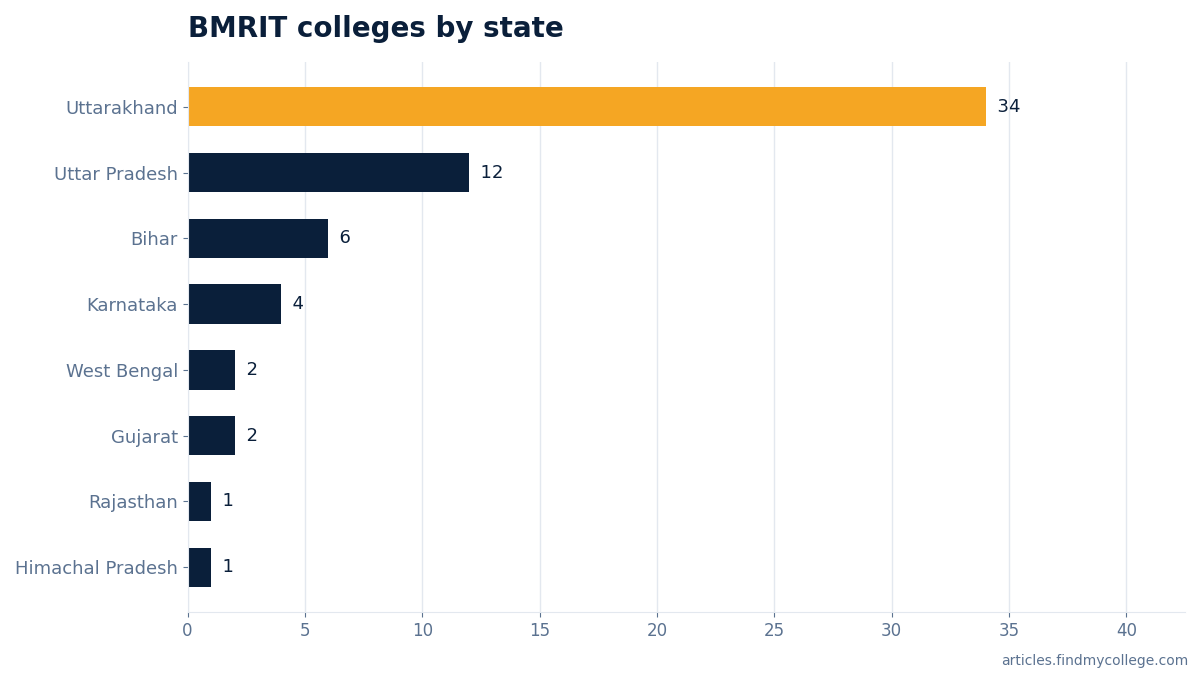
| Dehradun | 16 | ₹1.50 lakh – ₹4.99 lakh | Graphic Era University, Guru Nanak College of Engineering & Management |
| Roorkee | 11 | ₹1.35 lakh – ₹3.41 lakh | Indian Institute of Technology Roorkee, Quantum University |
| Patna | 6 | ₹1.53 lakh – ₹2.47 lakh | Patna Institute of Nursing and Paramedical Science, National Institute of Health Education & Research |
| Lucknow | 5 | ₹2.00 lakh – ₹10.85 lakh | Atal Bihari Vajpayee Medical University, Babu Banarasi Das University |
| Bangalore | 3 | ₹2.20 lakh – ₹6.40 lakh | CMR University, Aditya Group of Institutions |
| Rudra pur | 2 | ₹1.65 lakh – ₹2.45 lakh | Six Sigma Institute of Technology and Science, RIT Group of Institutions |
| Meerut | 2 | ₹2.40 lakh – ₹2.50 lakh | Mahaveer Institute of Engineering & Technology, College of Applied Education and Health Sciences |
| Greater Noida | 2 | ₹1.65 lakh – ₹2.59 lakh | Government Institute of Medical Sciences, Kailash Institute of Nursing and Paramedical Sciences |
BMRIT Career Scope and Salary
- CT Scan Technicians: ₹3 LPA to ₹4 LPA average starting remuneration.
- MRI Scan Technicians: ₹3.5 LPA to ₹5.9 LPA average starting remuneration.
- Mid-Level Professionals (3 to 5 Years Experience): ₹3 LPA to ₹6.5 LPA.
- Senior Technologists (8+ Years Experience): Up to ₹10 LPA to ₹12 LPA.
BMRIT graduates enter diagnostic healthcare as Radiologic Technologists or Radiographers with starting monthly salaries between ₹15,000 and ₹30,000. Higher study options include M.Sc. in Medical Radiology & Imaging Technology, M.Sc. Medical Physics, MBA in Hospital Administration, and Ph.D.
BMRIT vs B.Sc Nursing vs BPT: Which Allied Health Course to Choose?
Choosing between allied healthcare disciplines depends on personal interest in technology, patient care intensity, and program length. BMRIT focuses heavily on complex equipment operation and image processing, with lower direct bedside care than nursing or physiotherapy.
| Parameter | BMRIT | B.Sc Nursing | BPT (Physiotherapy) |
|---|---|---|---|
| Primary Focus | Diagnostic imaging & machine operation | Holistic patient care & bedside nursing | Physical rehabilitation & exercise therapy |
| Technology Dependence | Very High (CT, MRI, X-ray) | Moderate | Moderate |
| Course Duration | 3.5 to 4 Years | 4 Years | 4.5 Years |
| Bedside Patient Care | Moderate (Positioning & scanning) | Very High | Very High |
| Medication Duty | No (Only contrast media assistance) | Yes (Core responsibility) | No |
| Main Career Role | Medical Imaging Technologist | Staff Nurse / Nursing Officer | Physiotherapist |
Key Factors to Choose the Right BMRIT College
- Clinical Internships: Verify that the program provides practical training in affiliated clinical institutions and mandatory internships across X-ray, CT, MRI, and USG departments.
- Course Duration & Structure: Confirm if the curriculum is structured as 3 years plus a 6-month internship or a 4-year degree with 8 semesters including a 1-year clinical internship.
- Radiation Safety Training: Ensure the curriculum teaches radiation protection adhering to ALARA principles using protective gear such as lead aprons, TLD badges, and dosimeters.
- Fee Structure & Scholarships: Review tuition fee breakdowns, refundable security deposits, and merit-based scholarship options available for qualifying 10+2 scores.
Evaluating clinical exposure, safety protocols, and course structure ensures students select an ideal institute for BMRIT. Transparent fee details and scholarship eligibility further aid in choosing the right college.
How to Apply for BMRIT Admission in 2026: Step by Step
- Check Eligibility: Ensure completion of Class 12 (10+2) with Physics, Chemistry, and Biology/Maths with at least 45%-50% aggregate and minimum age of 17 years by 31st December.
- Appear for Entrance Exam / Merit Evaluation: Apply through university entrance tests, state CETs (e.g., MH-CET), or NEET score card if required by the target university.
- Submit Application Form: Fill out the university application portal online, paying the application fee (e.g., ₹1,000 at RIMT University).
- Shortlisting and Provisional Allotment: Check publication of shortlisted candidate list / merit list / CAP allotment letter on the university website.
- Document Verification: Provide Std 10th & 12th Board Certificates, Entrance Exam Scorecard, Caste/Non-Creamy Layer certs, Migration cert, and Physical Fitness certificate.
- Fee Payment & Enrollment: Pay the admission fee, registration charges, and first-semester/annual tuition fees to secure university enrollment number.
| What to do | Where | Link |
|---|---|---|
| Compare colleges, fees and cutoffs | BMRIT colleges in India | findmycollege.com |
FAQs
What is the full form of BMRIT?
BMRIT stands for Bachelor of Medical Radiology and Imaging Technology. It is a 3 to 4-year undergraduate paramedical/allied health degree focused on diagnostic imaging technologies like X-ray, CT scan, and MRI.
Is a BMRIT radiographer a doctor?
No. A BMRIT graduate is a Radiologic Technologist who operates imaging equipment and captures diagnostic scans. A Radiologist is a medical doctor (MBBS + MD/DNB) who diagnoses diseases by interpreting those scans.
Is NEET compulsory for BMRIT admission?
No, NEET is not mandatory for all universities. Most colleges admit BMRIT students based on Class 12 PCB/PCM marks or university-level entrance tests, though some states/institutes accept NEET/MH-CET scores.
BMRIT course details in Hindi: Yeh kaunsa course hai aur iske baad kya job milti hai?
BMRIT ek 3 se 4 saal ka undergraduate degree course hai jisme X-ray, CT scan, MRI aur Ultrasound equipment chalana sikhaya jata hai. Iske baad aap Radiographer, CT/MRI Technician ya Clinical Application Specialist ban sakte hain.
What qualifications do I need to be an MRI technician?
To become an MRI technician, you need a BMRIT degree or B.Sc in Medical Imaging Technology (or Diploma in Radiography) covering MRI physics and pulse sequences, followed by practical clinical internship training.
Which M.Sc is best after BMRIT / B.Sc Radiology?
After BMRIT, popular postgraduate options include M.Sc. in Medical Radiology and Imaging Technology (MMRIT), M.Sc. in Medical Physics, or an MBA in Hospital Administration for management roles.