Recording Engineer Salary in India 2026: Monthly Pay
Nishit Kumar is a senior EdTech industry leader with over a decade of experience in building and scaling education platforms, shaping their product, content, and growth strategy. At…
- 3 Oct 2026AP POLYCET Mock Test Released for Sound Engineering Aspirants
Candidates preparing for polytechnic sound engineering diploma courses can download question PDFs and attempt the AP POLYCET mock test online.
In India, a Sound Recording Engineer earns an average salary of INR 3,94,070 per annum, which equates to roughly INR 30,000 per month. Entry-level professionals with 0 to 4 years of experience earn an average of INR 3,11,000 per year, while seasoned industry experts with over 20 years of experience command INR 10,00,000 and more per annum.
Below, you will find complete breakdown details covering sound engineering pay scales across experience levels, specific job roles, top recruiters in public and private sectors, course fees at major institutes, key software skills, and a step-by-step admission path.
| Parameter | Details |
|---|---|
| Average Annual Salary | INR 3,94,070 per annum |
| Average Monthly Pay | INR 30,000 per month |
| Highest Reported Base Pay | INR 8,00,000 to INR 10,00,000+ per annum |
| Eligibility | 10+2 with Physics, Chemistry, and Mathematics (min 50% aggregate) |
| Course Fee Range | INR 20,000 to INR 8,00,000 |
Sound Engineering Salary in India
| Job Profile | Average Annual Salary (INR) |
|---|---|
| Sound Designer | INR 4,24,000 |
| Audio Engineer | INR 3,16,000 |
| Sound Technician | INR 2,77,000 |
| Audio-Visual Technician | INR 2,70,000 |
| Broadcast Engineer | INR 2,62,000 |
A sound engineer in India earns an average annual salary of around INR 3,94,070, which equates to roughly INR 30,000 per month. Compensation varies across job profiles, ranging from INR 2,62,000 for Broadcast Engineers to INR 4,24,000 for Sound Designers.
Sound Engineering Salary by Experience
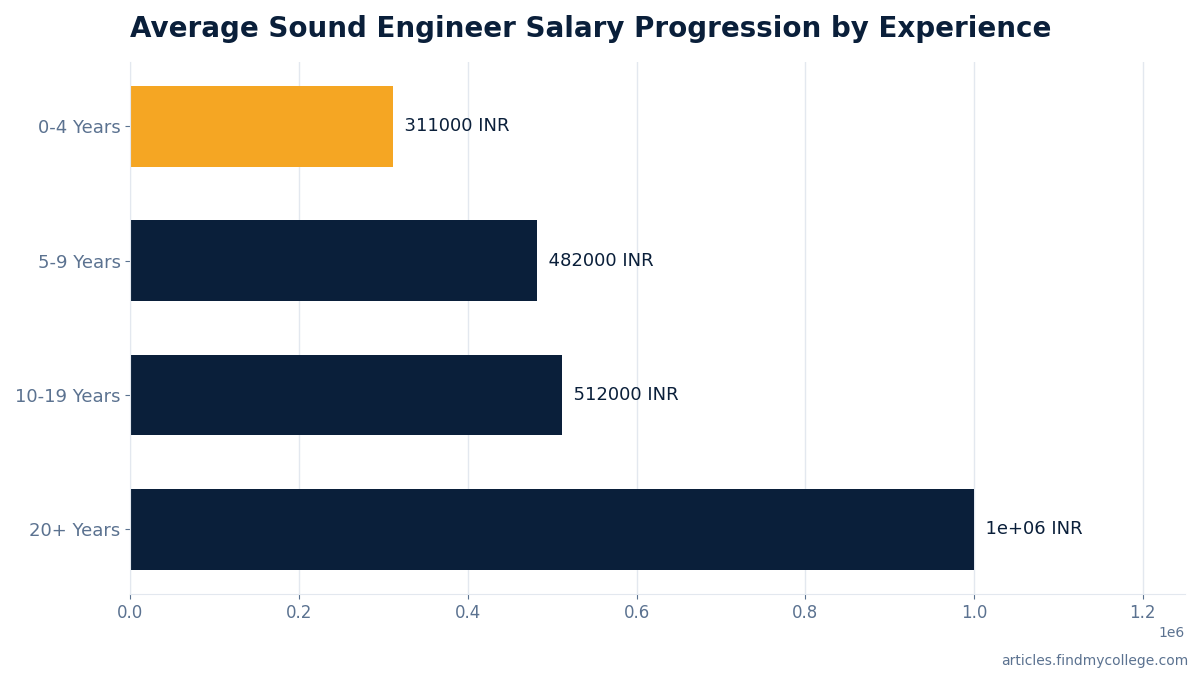
Practical studio experience and project credits play a major role in determining the pay scale of a sound recording engineer in India. Early-career sound engineers with 0 to 4 years of experience earn an average annual salary of INR 3,11,000. During these initial years, engineers focus on microphone placement, track setup, signal flow, and basic session recording.
As professionals transition into mid-level roles with 5 to 9 years of experience, their average salary rises to INR 4,82,000 per year. Senior engineers with 10 to 19 years in the field draw an average annual pay of INR 5,12,000. Master engineers and audio supervisors commanding over 20 years of experience regularly earn INR 10,00,000 and more per year, taking charge of complex mixing sessions, acoustic design, and technical direction.
| Experience Level | Average Annual Salary (INR) |
|---|---|
| 0–4 Years | INR 3,11,000 |
| 5–9 Years | INR 4,82,000 |
| 10–19 Years | INR 5,12,000 |
| 20+ Years | INR 10,00,000+ |
Sound Engineering Salary by Job Role
Sound and audio engineering encompasses several distinct job profiles across music studios, film post-production, broadcast television, and live events. Sound Designers command the highest average annual salary among technical profiles at INR 4,24,000, reflecting the creative and technical demands of crafting audio effects, Foley, and sonic environments for media projects.
Audio Engineers earn an average annual salary of INR 3,16,000, responsible for live multi-track tracking, microphone alignment, and digital editing. Operational roles like Sound Technicians average INR 2,77,000 per year, while Audio-Visual Technicians earn INR 2,70,000 per annum managing event production setups. Broadcast Engineers overseeing live audio feeds for television and radio networks earn an average salary of INR 2,62,000 per year.
People Also Read




Sound Engineering Salary in Government vs Private Sector
| Sector / Recruiter Category | Key Employers | Average Annual Salary / Details |
|---|---|---|
| Public Sector | All India Radio, Prasar Bharati | Paid according to qualifications |
| Private Media & Entertainment | Zee Entertainment, Sun TV Network, Saregama India, Red FM | INR 1,80,000 – INR 7,68,000 |
| IT Services | Wipro | INR 3,48,000 – INR 3,94,000 |
| Film Post-Production & Event Firms | Red Chillies Entertainment, Wizcraft International, Percept | Varies by recruiter and experience |
Government employers like All India Radio and Prasar Bharati hire sound engineers with pay based on qualifications. In the private sector, compensation ranges from INR 1,80,000 at Red FM to INR 7,68,000 at Zee Entertainment, alongside roles at film post-production and event firms.
Top Recruiters
A diverse set of entertainment conglomerates, broadcasting networks, music labels, and IT services firms recruit sound and recording engineers in India. Among private media employers, Zee Entertainment offers top compensation packages spanning from INR 7,08,000 to INR 7,68,000 per annum.
Regional broadcasting giant Sun TV Network pays sound engineering professionals between INR 2,88,000 and INR 4,20,000 per year. Technology firm Wipro offers sound engineering roles with annual salaries ranging from INR 3,48,000 to INR 3,94,000. Music label Saregama India provides pay packages between INR 3,12,000 and INR 3,36,000 annually, while private FM station Red FM pays sound technical staff between INR 1,80,000 and INR 1,92,000 per year.
| Recruiting Company | Average Annual Salary Range (INR) |
|---|---|
| Zee Entertainment | INR 7,08,000 – INR 7,68,000 |
| Sun TV Network | INR 2,88,000 – INR 4,20,000 |
| Wipro | INR 3,48,000 – INR 3,94,000 |
| Saregama India | INR 3,12,000 – INR 3,36,000 |
| Red FM | INR 1,80,000 – INR 1,92,000 |
Sound Engineering Course Fees and Institutes in India
Formal education in sound engineering ranges from government film institutes and national universities to private media academies. Tuition fees vary widely depending on campus equipment, studio facilities, and degree type. The Film and Television Institute of India (FTII) offers course options with fees ranging from INR 34,000 to INR 6,78,000. Premier technical institutes such as IIT Kharagpur offer sound engineering programs with course fees between INR 45,000 and INR 2,30,000.
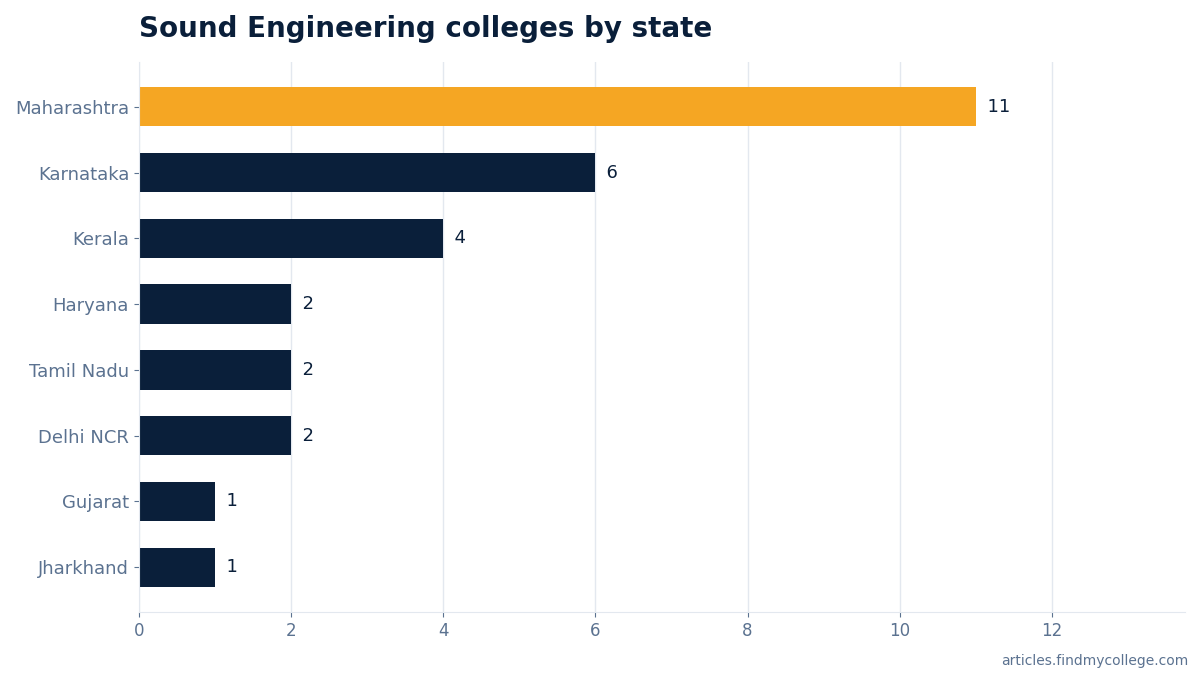
At least 35 colleges offer Sound Engineering across India, including at least 3 government and 3 private institutions. State-wise distribution highlights Maharashtra with 11 colleges, Karnataka with 6, Kerala with 4, Haryana with 2, Tamil Nadu with 2, and Delhi NCR with 2 colleges offering specialized programs in sound engineering and music production.
| College / University Name | Average Course Fees (INR) |
|---|---|
| Film and Television Institute of India (FTII) | INR 34,000 – INR 6,78,000 |
| IIT Kharagpur | INR 45,000 – INR 2,30,000 |
| Crypto Cipher Academy | INR 45,000 – INR 5,60,000 |
| TGC Animation and Multimedia | INR 46,000 – INR 3,80,000 |
| Deviprasad Goenka Management College | INR 47,000 – INR 4,67,780 |
| Atharva Institute of Film and Television (AIFT) | INR 75,000 – INR 7,70,900 |
| National Institute of Film and Fine Arts (NIFFA) | INR 77,000 – INR 5,56,000 |
| Mumbai Music Institute | INR 78,000 – INR 5,99,000 |
| Zee Institute of Media Arts (ZIMA) | INR 85,000 – INR 4,60,000 |
| City | Colleges | Fee range | Well-known options |
|---|---|---|---|
| Bangalore | 6 | ₹1.50 lakh – ₹7.50 lakh | CREO Valley School of Film and Television, IIFA Lancaster Degree College |
| Mumbai | 5 | ₹2.24 lakh – ₹4.25 lakh | Mumbai Music Institute, AAT College |
| Kochi | 3 | ₹1.26 lakh – ₹1.97 lakh | Rajagiri College of Management and Applied Sciences Kakkanad, Goodness Institute of Film and Television |
| Pune | 3 | ₹1.56 lakh – ₹9.00 lakh | Ajeenkya DY Patil University, Seamedu School of ProExpressionism Pune |
| Karjat | 2 | ₹17.62 lakh – ₹18.00 lakh | Universal AI University, Vijaybhoomi University |
| Gurgaon | 2 | ₹6.00 lakh – ₹6.49 lakh | The Northcap University, Seamedu School of ProExpressionism Gurgaon |
| Chennai | 2 | — | Access Atlantech Media College, Bridge Academy for Media Studies |
| Delhi | 2 | — | Delhi Film Institute, NRAI School of Mass Communication |
How to Increase Sound Engineering Salary
To secure higher pay packages in the sound engineering field, professionals must master industry-standard Digital Audio Workstations (DAWs) and audio hardware tools. Employers actively look for engineers proficient in Avid Pro Tools, Steinberg Nuendo/Cubase, iZotope RX for audio restoration and spectral cleaning, and Logic Pro. Hands-on experience operating digital mixing consoles from manufacturers like Yamaha or Allen & Heath further enhances earning potential during live and studio sessions.
Career growth follows a structured progression path that directly influences salary growth over time:
- Studio Assistant / Trainee
- Assistant Sound Engineer
- Sound Engineer / Recordist
- Mixing Engineer
- Senior Re-recording Mixer / Sound Designer
- Studio Head
How to Start Your Sound Engineering Journey: Step by Step
- Check Eligibility Criteria: Ensure completion of Class 10+2 with Physics, Chemistry, and Mathematics from a recognized board with at least 50% aggregate marks.
- Appear for Entrance Examination: Qualify relevant national, state, or university entrance exams such as JEE Main, JEE Advanced, MET, BITSAT, VITEEE, DUET, SRMEEE, or IPU CET.
- Apply to Institutes: Submit applications for B.Tech, B.Sc, B.A, or Diploma/PG Diploma programs in Sound Engineering or Sound Recording & Engineering at target colleges like FTII, SRFTI, IIT Kharagpur, or ZIMA.
- Complete Practical Studio Training: Undergo practical training covering microphone placement, signal flow, digital audio workstations (DAWs like Pro Tools, Nuendo), dialogue editing, and acoustic treatment.
- Secure Internships and Studio Assisting Roles: Join recording studios or post-production facilities as a Trainee or Assistant Engineer to gain real-world credits on music, OTT, or film projects.
| What to do | Where | Link |
|---|---|---|
| Compare colleges, fees and cutoffs | Sound Engineering colleges in India | findmycollege.com |
A structured education combined with hands-on studio practice builds essential audio production skills. Gaining real-world experience as a studio assistant provides an ideal entry point into professional sound engineering.
FAQs
What is the average monthly salary of a Sound Engineer in India?
The average salary of a Sound Engineer in India is around INR 3,94,070 per year, which translates to approximately INR 30,000 per month. Pay increases significantly as you gain industry experience.
How much does an entry-level Audio or Recording Engineer earn?
Entry-level sound engineers with 0 to 4 years of experience earn an average of INR 3,11,000 per year in India. Studio assistants and trainees usually start at this tier before taking on full session recordist duties.
Which companies pay the highest salaries for sound engineers in India?
Zee Entertainment offers top packages ranging between INR 7,08,000 and INR 7,68,000 per year, followed by Sun TV Network (up to INR 4,20,000) and Wipro (up to INR 3,94,000).
What is the career progression path for a Recording Engineer?
The typical progression is Studio Assistant / Trainee → Assistant Sound Engineer → Sound Engineer / Recordist → Mixing Engineer → Senior Re-recording Mixer / Sound Designer → Studio Head.
Which key software tools raise a sound engineer’s salary potential?
Mastering industry-standard DAWs like Avid Pro Tools, Steinberg Nuendo/Cubase, iZotope RX for noise reduction, and Logic Pro, along with certifications like Avid Certified User or Dolby Atmos mixing training, directly increases hiring value.