
Science Courses After 12th: Degree Options, Eligibility and Scope
Nishit Kumar is a senior EdTech industry leader with over a decade of experience in building and scaling education platforms, shaping their product, content, and growth strategy. At…
Science courses after 12th encompass various undergraduate programs across physical, biological, mathematical, and applied science disciplines for students completing 10+2 education. At least 5,638 colleges offer Science Courses in India, including 779 government colleges and 2,620 private colleges.
Students can explore degree specialisations across PCM, PCB, and PCMB streams alongside eligibility criteria, fee structures, top institution rankings, and career placement packages. Below is a complete breakdown of academic paths, course fees, top colleges, and admission steps.
What is Science Courses
Science courses after 12th represent undergraduate academic programs focused on theoretical, experimental, and practical learning across physical, chemical, biological, and mathematical disciplines. At least 5,638 colleges offer Science Courses across India, giving students opportunities to pursue core basic sciences, applied technology, agricultural studies, and healthcare domains.
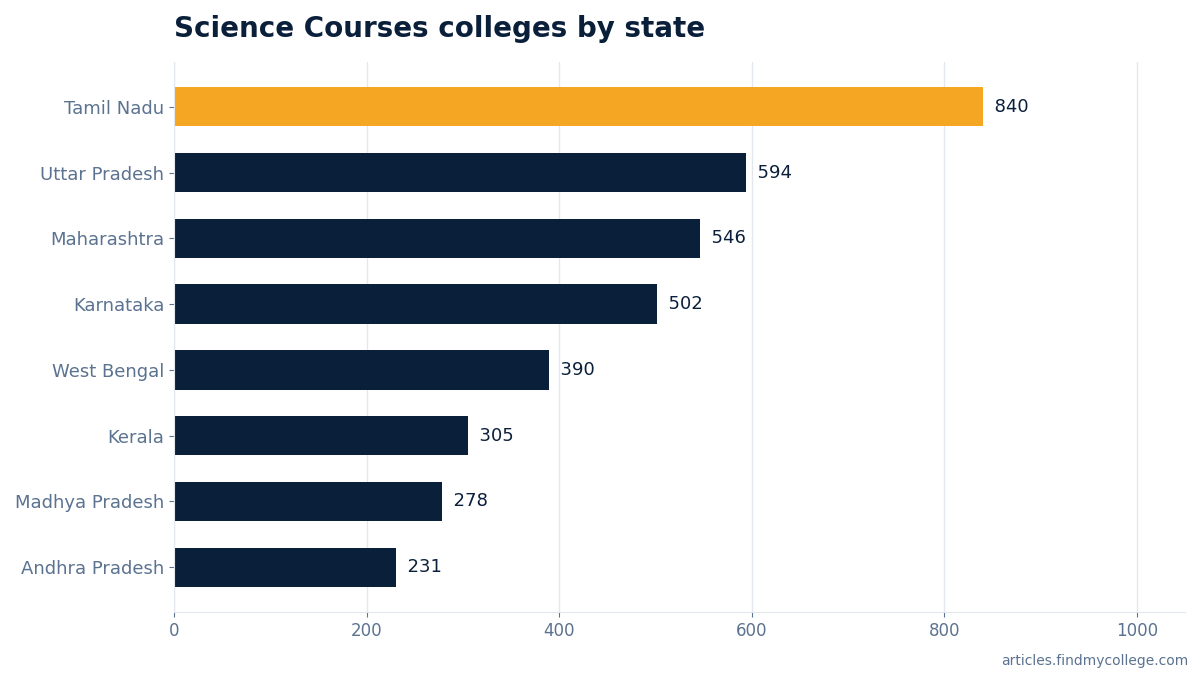
Degree programs range from traditional Bachelor of Science (BSc) degrees to specialized professional tracks. States such as Tamil Nadu with 840 colleges, Uttar Pradesh with 594 colleges, Maharashtra with 546 colleges, Karnataka with 502 colleges, West Bengal with 390 colleges, and Kerala with 305 colleges house extensive networks of science education institutions.
Types and Specialisations of Science Courses After 12th
Science specialisations are structured around secondary school subject combinations, namely Physics, Chemistry, Mathematics (PCM), Physics, Chemistry, Biology (PCB), and Physics, Chemistry, Mathematics, Biology (PCMB). PCM candidates generally select physical, mathematical, computational, and engineering sciences, while PCB graduates pursue biological, life science, agricultural, and medical fields.
Flexible open and distance learning programs provide additional pathways for students seeking remote degree completion options.
Science Courses Eligibility
Eligibility for science degree programs requires candidates to complete 10+2 higher secondary education from a recognized national or state education board. Applicants must pass qualifying examinations with mandatory subject combinations in Physics, Chemistry, and Mathematics or Biology, depending on the target degree stream.
Minimum aggregate score requirements vary between institutions, with competitive merit cut-offs established by central and state universities. Professional science and technology courses may additionally mandate qualifying scores in entrance tests conducted at national, state, or university levels.
| College | City | Total course fee |
|---|---|---|
| Institute of Sports Science and Technology | Pune | ₹68,100 |
| Vignan’s Foundation for Science, Technology and Research Online | Guntur | ₹99,000 |
| Sambalpur University Distance Education | Sambalpur | ₹22,800 |
| Institute of Good Manufacturing Practices India | Noida | ₹65,000 |
| University of Mumbai, Institute of Distance & Open Learning | Mumbai | ₹17,755 |
| Directorate of Distance Education, University of Jammu | Jammu | ₹21,380 |
| St. Peter’s Institute of Distance Education | Chennai | ₹27,000 |
Science Courses Fees
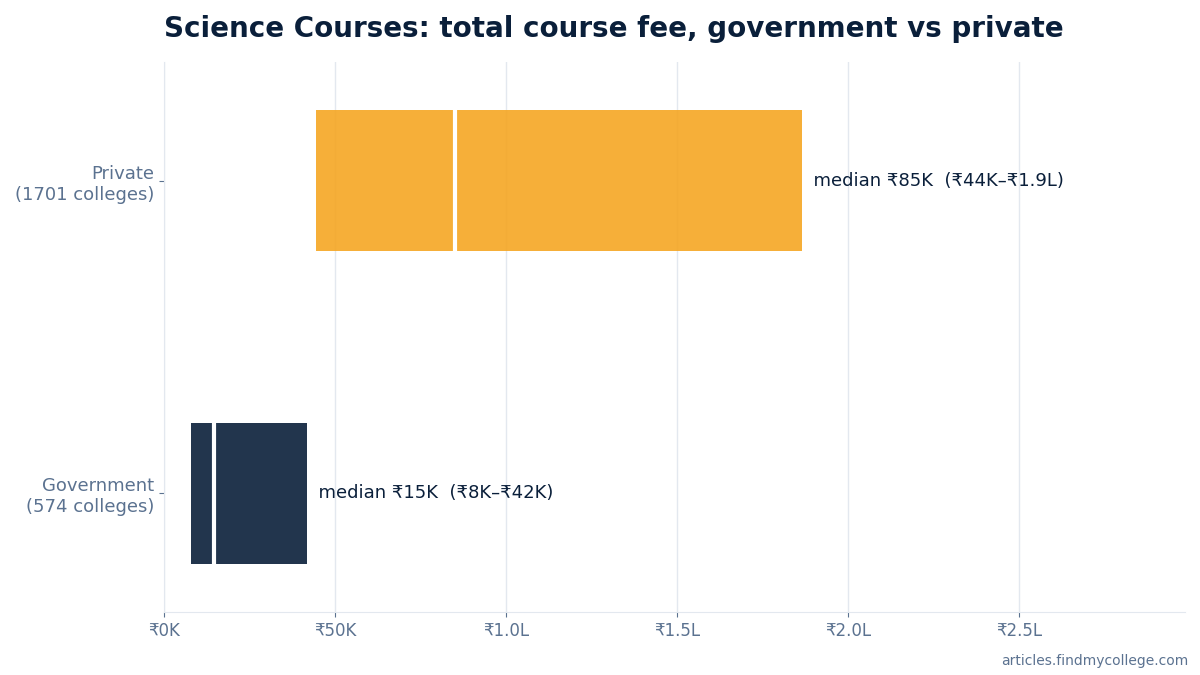
Tuition costs for science programs differ substantially across government and private institutions. Government colleges maintain highly affordable fee structures, with a median total course fee of ₹14,670 and the middle half of fees ranging between ₹7,800 and ₹41,647 based on data from 574 reporting government colleges.
Private science colleges record a median total course fee of ₹85,000, with the middle half spanning ₹44,409 to ₹1.87 lakh across 1,701 reporting private colleges.
| College | City | Ownership | Total course fee |
|---|---|---|---|
| Baosi Banikanta Kakati College | Barpeta | Government | ₹5,000 |
| Queen Mary’s College | Chennai | Government | ₹5,001 |
| Dhakuakhana College | Lakhimpur | Government | ₹5,040 |
| Government College for Women (Autonomous) | Kumbakonam | Government | ₹5,040 |
| University of Calcutta | Kolkata | Government | ₹5,050 |
| Government Degree College Pulwama | Pulwama | Government | ₹5,070 |
| Government Model Science College | Gwalior | Government | ₹5,082 |
| Periyar EVR College, Khajamalai | Tiruchirappalli | Government | ₹5,120 |
| Panihati Mahavidyalaya | Kolkata | Government | ₹5,125 |
| Vijaya Raje Government Girls PG College | Gwalior | Government | ₹5,180 |
| College | City | Ownership | Total course fee | NIRF rank |
|---|---|---|---|---|
| Indian Institute of Science | Bangalore | — | ₹44,600 | 1 (Overall, 2025) |
| Indian Institute of Technology Madras | Chennai | Government | ₹30,850 | 1 (Overall, 2025) |
| Hindu College New Delhi | Delhi | University | ₹55,510 | 1 (Overall, 2025) |
| Miranda House | Delhi | Government | ₹48,180 | 2 (Overall, 2025) |
| Jawaharlal Nehru University | Delhi | Government | — | 2 (Overall, 2025) |
| Indian Institute of Technology Bombay | Mumbai | Government | ₹51,500 | 3 (Overall, 2024) |
| Manipal University Manipal | Manipal | — | ₹4.00 lakh | 3 (Overall, 2025) |
| Punjab Agricultural University | Ludhiana | — | ₹1.34 lakh | 3 (Overall, 2025) |
| Hans Raj College | Delhi | Government | ₹96,845 | 3 (Overall, 2025) |
| City | Colleges | Fee range | Well-known options |
|---|---|---|---|
| Bangalore | 216 | ₹17,606 – ₹63.95 lakh | Alliance University, Christ University |
| Chennai | 181 | ₹5,001 – ₹13.23 lakh | Indian Institute of Technology Madras, Saveetha Institute of Medical and Technical Sciences |
| Kolkata | 144 | ₹5,050 – ₹7.65 lakh | Jadavpur University, The West Bengal National University of Juridical Sciences |
| Delhi | 120 | ₹7,000 – ₹8.10 lakh | Jamia Millia Islamia University, Delhi University |
| Hyderabad | 119 | ₹14,520 – ₹20.20 lakh | University of Hyderabad, Indian Institute of Technology Hyderabad |
| Coimbatore | 114 | ₹6,165 – ₹7.21 lakh | Amrita Vishwa Vidyapeetham, P.S.G College of Technology |
| Mumbai | 109 | ₹17,163 – ₹13.50 lakh | Indian Institute of Technology Bombay, Government Law College Mumbai |
| Pune | 102 | ₹16,940 – ₹15.60 lakh | Dr. DY Patil Vidyapeeth, Fergusson College |
| College | City | Ownership | Total course fee | Average package |
|---|---|---|---|---|
| Thiruthangal Nadar College | Chennai | Private | ₹62,500 | 6.82 LPA |
| BMS Institute of Technology and Management | Bangalore | Private | ₹11.24 lakh | 6.07 LPA |
| Prestige Institute of Management and Research | Indore | Private (aided) | ₹4.05 lakh | 6 LPA |
| Galgotias College of Engineering and Technology | Greater Noida | Private | ₹3.47 lakh | 5.76 LPA |
| RV Institute of Technology and Management | Bangalore | Private | ₹3.00 lakh | 5.49 LPA |
| Delhi Technical Campus Greater Noida | Greater Noida | Private | ₹4.68 lakh | 5.45 LPA |
| Mepco Schlenk Engineering College | Sivakasi | Private | ₹1.20 lakh | 5.44 LPA |
| Dayananda Sagar College of Engineering | Bangalore | Private | ₹3.35 lakh | 5.27 LPA |
| Thiagarajar College of Engineering | Madurai | Private (aided) | ₹1.54 lakh | 5.1 LPA |
| R. K. Talreja College of Arts, Science and Commerce | Mumbai | Private (aided) | ₹92,263 | 5 LPA |
How to Choose the Right Science Course and College
Selecting an appropriate science program involves evaluating stream alignment, institutional rankings, laboratory infrastructure, total course expenses, and past placement records.
- Assess Subject Preference: Match secondary subject strengths in PCM or PCB with suitable degree specialisations in physical, biological, or computational sciences.
- Check Accreditation and Rankings: Review NIRF rankings and university affiliations to ensure academic standards and degree recognition.
- Evaluate Fee and Budget: Compare total course fees between government colleges and private universities to fit financial budgets.
- Inspect Infrastructure: Verify laboratory facilities, research equipment, and library resources needed for practical science education.
- Review Career Outcomes: Analyze placement statistics, average salary packages, and higher study progression trends of graduating batches.
How to Apply for Science Courses Admission: Step by Step
- Verify Eligibility Criteria: Confirm completion of 10+2 higher secondary examination with required subjects in PCM, PCB, or PCMB.
- Register for Entrance Exams: Complete online registration on national or university entrance examination portals for competitive course entry.
- Submit College Applications: Fill out application forms on official university or institute portals with personal details and academic marks.
- Upload Required Documents: Submit scanned copies of 10th and 12th mark sheets, identity proof, reservation certificates, and photographs.
- Participate in Counselling: Attend central or institute-level merit counselling rounds to select course preferences and confirm seat allotment.
- Pay Admission Fees: Complete course fee payment at the allotted college to confirm admission and complete verification.
| What to do | Where | Link |
|---|---|---|
| Compare colleges, fees and cutoffs | Science Courses colleges in India | findmycollege.com |
FAQs
What are the primary science course streams after 12th?
Science degree options are available across physical, biological, mathematical, agricultural, computational, and applied science disciplines. Students can select courses based on 10+2 subject combinations in PCM, PCB, or PCMB.
What is the average fee for science courses in government colleges?
Government science colleges have a median total course fee of ₹14,670, with the middle half of fees ranging between ₹7,800 and ₹41,647 across reporting institutes.
Which states have the highest number of science colleges in India?
Tamil Nadu leads with 840 science colleges, followed by Uttar Pradesh with 594, Maharashtra with 546, Karnataka with 502, West Bengal with 390, and Kerala with 305 colleges.
What is the median average salary package for science graduates?
The median average placement package across 299 reporting colleges for science courses is 3.0 LPA, with private colleges reporting higher packages depending on specialisation.
Which top institutes offer NIRF-ranked science programs?
Leading NIRF-ranked institutions include Indian Institute of Science Bangalore, Indian Institute of Technology Madras, Hindu College New Delhi, Miranda House, and Indian Institute of Technology Bombay.