Sericulture Courses in India: Eligibility, Duration and Career Scope
Sericulture courses in India are offered at UG (3 to 4 years), PG (2 years), Diploma/Certificate (6 months to 1 year), and Doctorate levels (3 to 6 years), with course fees ranging from INR 4,000 to INR 6 Lakh.
Prospective students can explore complete details regarding academic eligibility criteria, entrance examinations, course duration, semester subjects, fee structures, top institutions, and career prospects in the silk sector.
| Parameter | Details |
|---|---|
| Course Levels Offered | UG, PG, Doctorate, Diploma, Certification |
| Course Duration | UG: 3-4 Years, PG: 2 Years, PhD: 3-6 Years, Diploma/Cert: 6 Months to 1 Year |
| UG Eligibility Criteria | Class 12 in Science stream with PCB/PCM subjects and min 55% aggregate score |
| PG Eligibility Criteria | Bachelor’s degree in BSc Sericulture, Agriculture, Horticulture, or Forestry with min 50-55% aggregate |
| Course Fee Range | INR 4,000 to INR 6,000,00 (Government & Private) |
| Average Salary Package | INR 2.3 LPA – INR 9.5 LPA (Public sector starting ~INR 15,000/month) |
| Key Entrance Exams | ICAR AIEEA (UG/PG), CUET UG, CUET PG, KCET, AP PGCET |
| Top Recruiting Bodies | Central Silk Board, CSRTI, NABARD, Krishi Vigyan Kendra, ISEPC, FAO |
What is Sericulture
- Meaning: Derived from the Greek word ‘Serico’ (silk) and English ‘Culture’ (rearing), sericulture literally translates to silk farming.
- Key Species: Bombyx mori is the most researched and extensively used silkworm species globally for silk production.
- Global Market: India holds the second position in global silk production and is the largest silk consumer in the world; together, India and China produce more than 60% of total annual world silk output.
- Process: It involves cultivating host plants like mulberry, feeding silkworms through larval stages, and harvesting cocoons to extract raw silk fibers.
Sericulture involves cultivating host plants and rearing silkworms to harvest silk cocoons. India ranks second in global silk production and is the largest silk consumer in the world.
Sericulture Eligibility
| Course Level | Eligibility Criteria | Duration |
|---|---|---|
| Undergraduate (UG) | Class 12 with PCB/PCM (55% aggregate score) | 3 to 4 Years |
| Doctorate (PhD) | Master’s degree in Sericulture or a relevant discipline | 3 to 6 Years |
| Diploma & Certificate | Class 12 with PCB subjects | 6 Months to 1 Year |
Admissions are granted based on merit or entrance exams including ICAR AIEEA, CUET, KCET, and AP PGCET. In most Indian states, the maximum age limit for undergraduate sericulture admissions is 21 years.
Sericulture Admission Process
Admissions to Sericulture courses across Indian colleges are granted based on merit in qualifying 10+2 or graduation marks, as well as ranks obtained in national or state-level entrance exams. National Testing Agency (NTA), Indian Council of Agricultural Research (ICAR), and state examination boards conduct dedicated tests for seat allocations.
Sericulture Syllabus and Subjects
- Core Topics: Sericulture courses cover the cultivation of mulberry plants, silk harvesting, and processing.
- Subject Combinations: Academic programs may offer Sericulture alongside subjects such as Botany and Zoology.
- Key Species Focus: Training centers on Bombyx mori, the most researched and extensively used silkworm species globally for silk production.
- Practical Skill Development: Programs emphasize building manual and finger dexterity, hand steadiness, keen attention to detail, good eyesight, and physical stamina.
Sericulture translates to silk farming, combining the Greek word ‘Serico’ (silk) and English ‘Culture’ (rearing). The curriculum equips students with essential practical skills to manage silk production successfully.
Top Sericulture Colleges
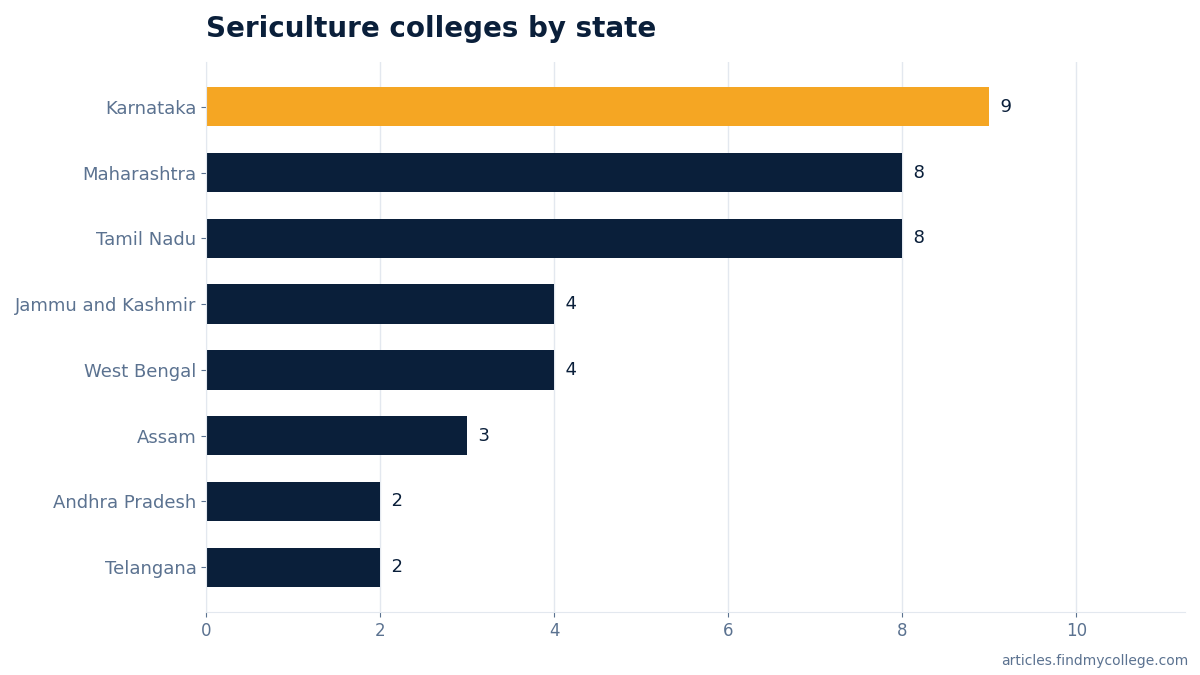
At least 46 colleges offer Sericulture courses in India, including government and private institutions. State-level presence shows Karnataka with 9 colleges, Maharashtra with 8, Tamil Nadu with 8, Jammu and Kashmir with 4, West Bengal with 4, and Assam with 3.
| College | City | Ownership | Total course fee | NIRF rank |
|---|---|---|---|---|
| ShereKashmir University of Agricultural Sciences and Technology of Jammu | Jammu | — | ₹55,700 | 7 (Overall, 2025) |
| University of Agricultural Sciences Bangalore | Bangalore | — | ₹50,550 | 11 (Overall, 2025) |
| Assam Agricultural University | Jorhat | — | ₹34,550 | 18 (Agriculture, 2025) |
| Bangalore University | Bangalore | — | ₹1.09 lakh | 65 (Overall, 2025) |
| University of Mysore | Mysore | — | ₹26,781 | 71 (Overall, 2025) |
| Tamil Nadu Agricultural University | Coimbatore | Government | ₹1.17 lakh | 73 (Overall, 2025) |
| Sadakathullah Appa College | Palayamkottai | Private (aided) | — | 98 (Overall, 2024) |
| Sri Padmavati Mahila Visvavidyalayam | Tirupati | — | ₹16,650 | 151 (Overall, 2023) |
| Shivaji University | Kolhapur | — | ₹12,500 | 151 (Overall, 2023) |
Private institutions and university teaching departments also provide specialized education in silk rearing and mulberry crop management across different regions.
| College | City | Ownership | Total course fee |
|---|---|---|---|
| Dinabandhu Andrews College | Baishnabnagar | Private (aided) | ₹14,725 |
| Bharathi College | Mandya | Private (aided) | ₹1.82 lakh |
| Sri Siddartha First Grade College | Tumkur | Private (aided) | ₹1.82 lakh |
| City | Colleges | Fee range | Well-known options |
|---|---|---|---|
| Bangalore | 3 | ₹50,550 – ₹1.09 lakh | Bangalore University, University of Agricultural Sciences Bangalore |
| Aurangabad | 3 | ₹18,500 – ₹18,500 | Mahatma Gandhi Mission University, MGM Institute of Biosciences and Technology |
| Coimbatore | 3 | ₹83,535 – ₹1.72 lakh | Tamil Nadu Agricultural University, Tamil Nadu Agricultural University, School of Post Graduate Studies |
| Mysore | 3 | ₹26,781 – ₹38,900 | University of Mysore, Maharani’s Science College for Women |
| Jammu | 2 | ₹55,700 – ₹55,700 | University of Jammu, ShereKashmir University of Agricultural Sciences and Technology of Jammu |
| Berhampore | 2 | ₹12,300 – ₹13,800 | Murshidabad University, Krishnath College |
| Anantnag | 1 | ₹11,760 – ₹11,760 | Government Degree College for Women Anantnag |
| Srinagar | 1 | ₹91,100 – ₹91,100 | ShereKashmir University of Agricultural Sciences and Technology of Kashmir |
Sericulture Career Scope and Salary
| Job Profile | Key Responsibilities | Min. Qualification | Top Recruiters |
|---|---|---|---|
| Sericulture Specialist / Researcher | Collaborate with institutes to conduct research and development for the sericulture industry | PhD in Sericulture or equivalent | Central Silk Board, CSRTI, FAO |
| Sericulture Assistant | Ensure all sericulture-related work processes run smoothly | BSc Sericulture | Central Silk Board, CSRTI |
| Sericulture Professor | Teach sericulture courses at higher education institutes | Master’s degree in Sericulture or equivalent | Higher Education Institutes |
The average annual salary package for Sericulture professionals ranges between INR 2.3 LPA and INR 9.5 LPA, with entry-level government roles starting around INR 15,000 per month. State governments frequently recruit Sericulturists through state-level Group 2 competitive examinations.
How to Apply for Sericulture Admission in 2026: Step by Step
- Verify Academic Eligibility Requirements: Confirm that you have passed Class 12 with Physics, Chemistry, and Biology/Mathematics securing at least 55% aggregate for UG, or hold a bachelor’s degree in Sericulture, Agriculture, Horticulture, or Forestry with 50% to 55% aggregate for PG.
- Register and Appear for National or State Entrance Exams: Apply and sit for accepted entrance tests such as ICAR AIEEA (UG/PG), CUET UG, CUET PG, KCET, or AP PGCET based on your target institution.
- Submit University Application Forms: Complete individual university or college registration forms online based on 10+2 or graduation merit marks or entrance test scores.
- Participate in Merit Shortlisting and Counseling Sessions: Track shortlisted candidates on official exam body websites, attend counseling rounds, and submit college choice preference forms.
- Complete Document Verification and Fee Payment: Present original certificates for verification at the allotted institute and pay total tuition fees (INR 4,000 to INR 6 Lakh) to confirm admission.
| What to do | Where | Link |
|---|---|---|
| exam registration | NTA CUET Official Registration Portal | cuet.nta.nic.in |
| Compare colleges, fees and cutoffs | Sericulture colleges in India | findmycollege.com |
Admissions are granted based on 10+2 or graduation merit marks or scores in entrance exams like ICAR AIEEA, CUET, KCET, and AP PGCET. Candidates must complete document verification and fee payment to confirm their seat.
FAQs
What is BSC sericulture?
BSc Sericulture is a 3 to 4-year undergraduate degree course focusing on silkworm rearing, mulberry cultivation, silk extraction, and commercial silk production. Candidates must have completed Class 12 with PCB/PCM subjects.
What is a basic starting salary in sericulture?
The starting salary for sericulture graduates ranges between INR 2.3 LPA and INR 9.5 LPA overall, with entry-level government or public sector roles starting at approximately INR 15,000 per month.
How profitable is sericulture?
Sericulture is highly commercial and profitable. India is the second-largest silk producer globally and the largest consumer. Together, India and China supply over 60% of total annual world silk output.
What is sericulture for class 6?
Sericulture refers to the science and practice of silkworm rearing to produce raw silk fibers. It involves cultivating host plants like mulberry, feeding silkworms through larval stages, and harvesting silk cocoons.
What is the life cycle of silkworms and silk rearing process?
Silkworm rearing involves caring for species like Bombyx mori from egg to larval stage by feeding mulberry leaves, until silkworms spin protective cocoons from which continuous raw silk threads are reeled.
What are the key recruiting organizations for Sericulturists?