Special Education Courses in India: Types, Duration and Eligibility
Special education courses in India range from short-term certificate programs lasting 3 to 4 months and 1 to 2-year diplomas to 2-year degree programs like B.Ed. Special Education recognized by the Rehabilitation Council of India (RCI). and PG Diploma options.
Students can explore key details below, including specialization tracks, duration, eligibility criteria, fee structures across government and private institutions, career options, salary expectations, top colleges, and step-by-step admission procedures.
| Parameter | Details |
|---|---|
| Course Types | Certificate, Diploma (D.Ed. Spl. Ed.), Bachelor’s (B.Ed. Spl. Ed.), Post Graduate Diploma |
| Duration | 3 months to 2 academic years |
| Eligibility | 10+2 with 50-60% marks for Diplomas; Bachelor’s degree with 50% marks for B.Ed. Spl. Ed. |
| Recognizing Body | Rehabilitation Council of India (RCI) |
| Course Fee Range | ₹11,000 to ₹3,00,000 |
List of Special Education
Programs in special education range from short-term certificate courses for caregivers and teachers to formal diploma and post-graduate degree offerings. Selection depends on academic background, duration preferences, and professional registration goals.
- Certificate Courses: Short programs lasting 3 months (60 hours) to 4 months, such as the Certificate Course in Special Needs Education offered by IITT or specialized caregiver programs.
- Diploma in Special Education: A 1 to 2-year program requiring 10+2 in any stream (Arts, Science, Commerce) with a 50-60% aggregate score.
- PG Diploma in Special Education: 12-month post-graduate diploma programs designed for graduates seeking targeted specialization.
- B.Ed. Special Education (Multiple Disabilities): A 2-year semester-pattern degree recognized by the Rehabilitation Council of India (RCI).
| Specialization Domain | Commonly Focused Disability / Area | Key Focus Areas |
|---|---|---|
| Learning Disabilities (LD) | Dyslexia, Dysgraphia, Dyscalculia, Dyspraxia | Assessment, IEP development, remedial strategies |
| Autism Spectrum Disorder (ASD) | Autism, Asperger’s Syndrome, High Functioning Autism | Social skills, sensory issues, play skills, language reciprocity |
| ADHD & Behavioural Needs | Attention Deficit Hyperactivity Disorder | Classroom management, activity level regulation, behavioral intervention |
| Multiple Disabilities (MD) | Physical, Neurological & Combined Impairments | High support needs management, multi-sensory tools, therapeutic support |
| Visual / Hearing Impairment | Blindness, Low Vision, Hearing Loss | Resource room setting, tactile/auditory tools, braille/sign communication |
Eligibility and Duration
Academic eligibility and program duration vary according to the level of study. Certificate courses such as the Certificate Course for Caregivers of Children with Developmental Disabilities offered by AIISH Mysore require a Class 10 (SSLC) pass. Diploma programs require a Class 12 (10+2) qualification in any stream with a minimum of 50% to 60% aggregate marks.
For B.Ed. Special Education programs, candidates must hold a Bachelor’s degree in any school subject with at least 50% aggregate marks. Candidates with a B.E. or B.Tech degree specializing in Science and Mathematics need a minimum of 50% marks (40% for SC/ST candidates) to meet eligibility requirements at institutions like NIEPMD. Admission weightage at NIEPMD includes qualifying exam marks (50), higher qualification (10), experience of minimum 2 years (5), parent/sibling/ward of PwD status (10), rural status (5), and interview (20).
Fees
The total cost of special education programs depends on institution ownership, course duration, and delivery mode. Online short-term certificate courses start at ₹11,000 (such as the 3-month program by IITT), while certificates and diplomas from private institutions like the Asian College of Teachers (ACT) range from ₹18,000 for a 4-month certificate to ₹35,000 for an 8-month diploma and ₹37,000–₹47,000 for a 12-month PG Diploma.
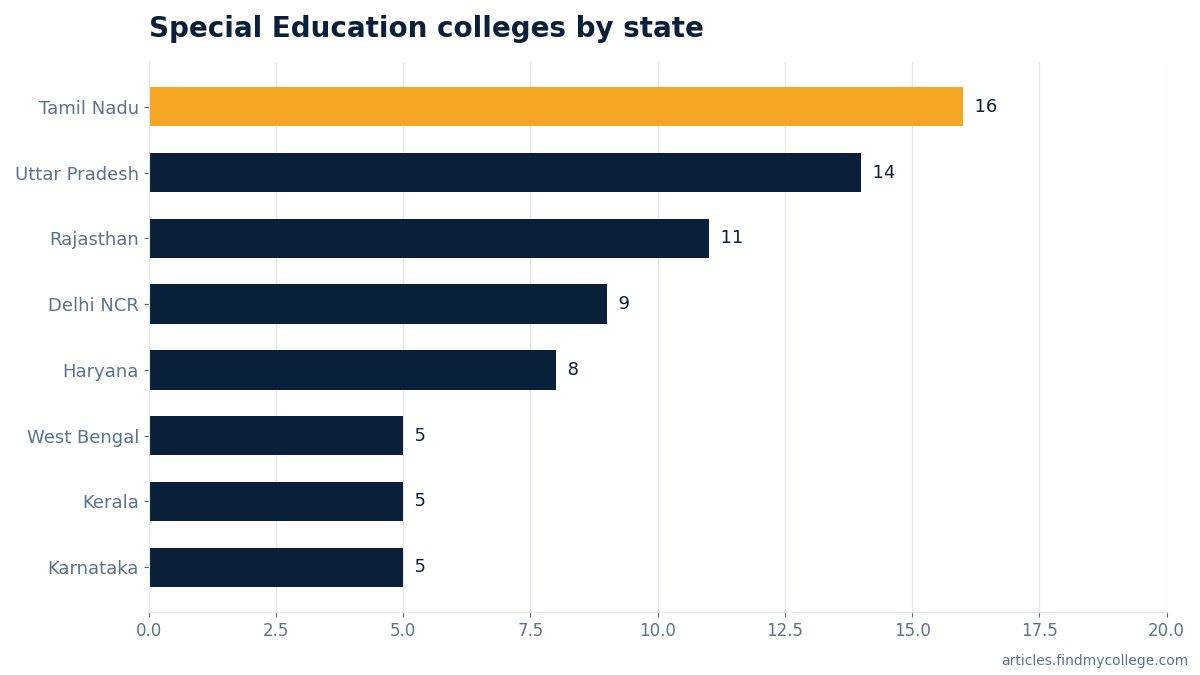
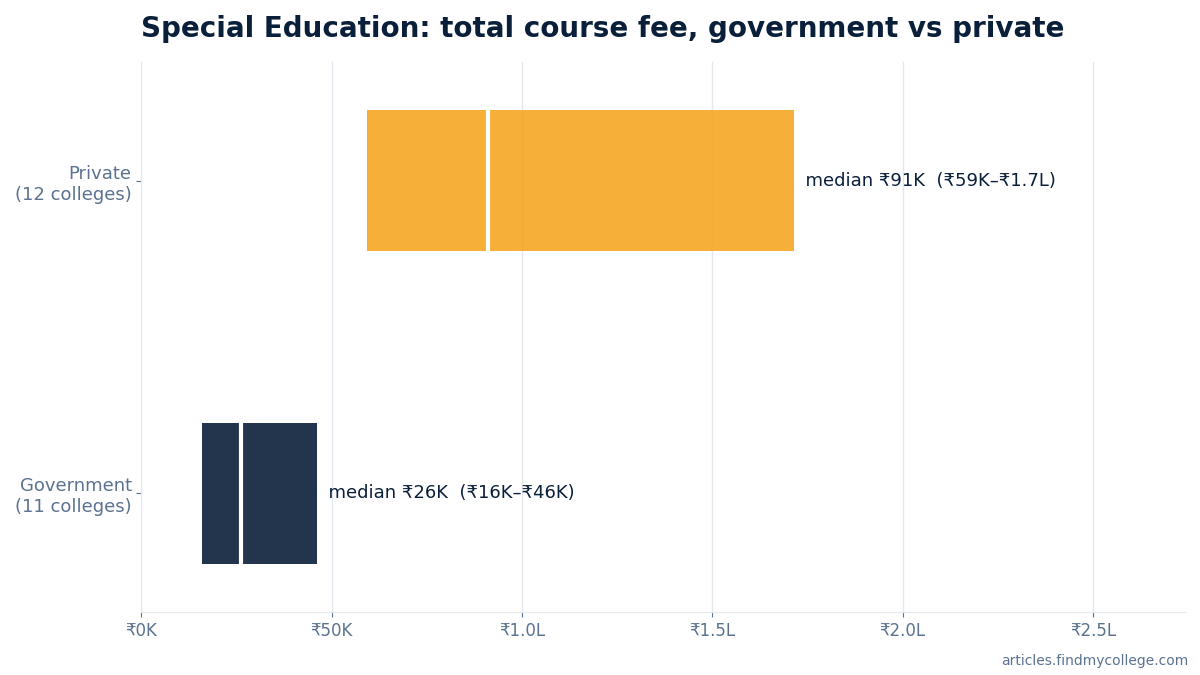
Full-time diploma and degree programs across India generally range between ₹35,000 and ₹3,00,000. Government colleges maintain a median total course fee of ₹26,050, with the middle half falling between ₹15,868 and ₹46,200. Private colleges report a median total course fee of ₹91,000, with the middle half spanning ₹59,291 to ₹1.71 lakh. Geographically, state-wise representation includes Tamil Nadu with 16 colleges, Uttar Pradesh with 14, Rajasthan with 11, Delhi NCR with 9, Haryana with 8, and West Bengal with 5.
| College | City | Ownership | Total course fee |
|---|---|---|---|
| Banaras Hindu University | Varanasi | Government | ₹8,000 |
| All India Institute of Speech and Hearing | Mysore | Government | ₹10,615 |
| Delhi University | Delhi | Government | ₹15,868 |
| National Institute for the Visually Handicapped Regional Centre | Chennai | Government | ₹18,455 |
| Ali Yavar Jung National Institute for the Hearing Handicapped | Mumbai | Government | ₹24,000 |
| Jamia Millia Islamia University | Delhi | Government | ₹26,050 |
| Secondary Training College | Mumbai | Government | ₹30,340 |
| Panjab University | Chandigarh | Government | ₹35,210 |
| National Institute for Empowerment of Persons with Multiple Disabilities | Chennai | Government | ₹46,200 |
| Tamil Nadu Teachers Education University | Chennai | Government | ₹62,000 |
| College | City | Ownership | Total course fee |
|---|---|---|---|
| Delhi Institute of Rural Development Poona | Delhi | Private | ₹1.72 lakh |
| Delhi Institute of Rural Development New Delhi | Delhi | Private | ₹1.70 lakh |
| Indian Institute of Health Education and Research | Patna | Private | ₹2.00 lakh |
| Ashtavakra Institute of Rehabilitation Sciences and Research | Delhi | Private | ₹82,000 |
| Army Institute of Education | Greater Noida | Private | ₹1.23 lakh |
| MIER College of Education | Jammu | Private | ₹1.88 lakh |
| A.W.H College of Education | Calicut | Private | ₹58,055 |
| Immaculate College of Education for Women | Pondicherry | Private | ₹66,000 |
| AMS College of Teacher Education | Hyderabad | Private (aided) | ₹63,000 |
| Action for Autism National Centre for Autism | Delhi | Private | ₹1.00 lakh |
Online and Distance Special Education Options
Flexible distance learning and online options allow working professionals and caregivers to build foundational skills in special needs education. IGNOU offers a Certificate in Early Childhood Special Education enabling inclusion in Mental Retardation lasting from 6 months to 2 years.
Private platforms provide self-paced certificate options, such as IITT’s 3-month (60 hours) online Certificate Course in Special Needs Education priced at ₹11,000, and ACT’s online certificate and diploma pathways ranging from ₹18,000 to ₹47,000. State open universities also offer distance special education degree and diploma programs.
| College | City | Total course fee |
|---|---|---|
| Uttar Pradesh Rajarshi Tandon Open University | Allahabad | ₹37,600 |
| Avinashilingam Institute for Home Science and Higher Education for Women | Coimbatore | ₹52,945 |
| Karnataka State Open University | Mysore | ₹77,770 |
| Shyam University | Dausa | ₹1.44 lakh |
| Dr. B.R. Ambedkar Open University | Hyderabad | ₹40,000 |
| Alagappa University, Directorate of Distance Education | Karaikudi | ₹29,700 |
| Madhya Pradesh Bhoj (Open) University | Bhopal | ₹72,000 |
Career Options and Salary
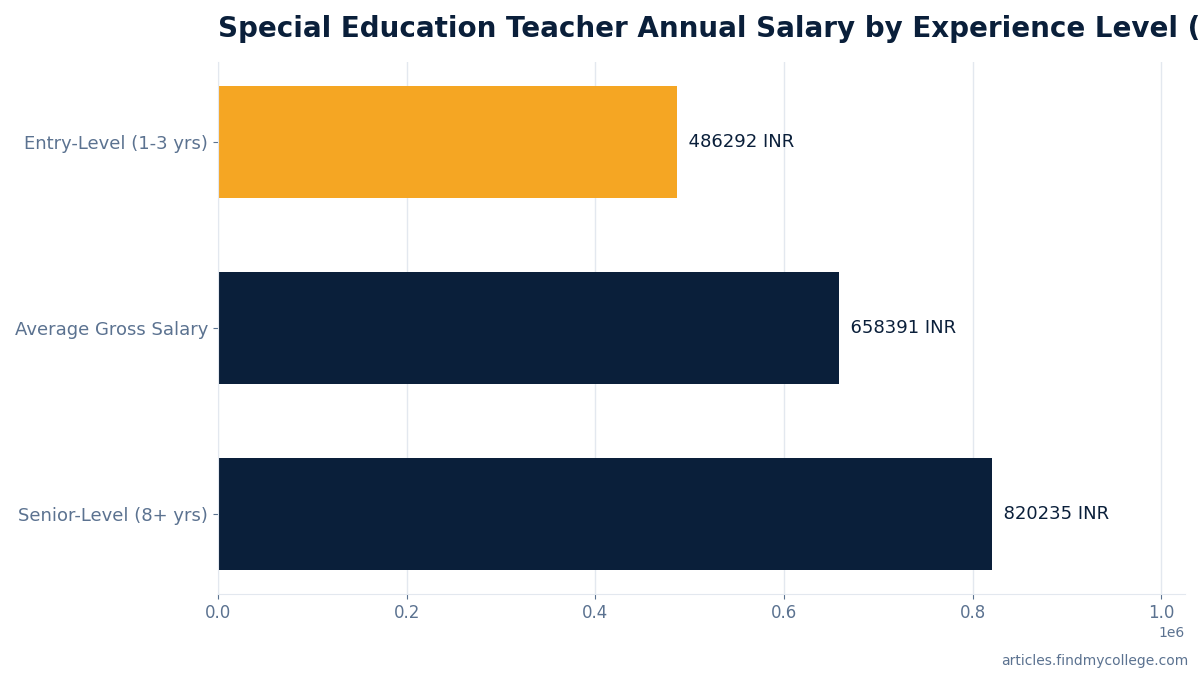
Graduates with qualifications in special education work in mainstream private and public inclusive schools, specialized rehabilitation centers, non-governmental organizations, and private remedial setups. Career advancement increases with practical experience and advanced degrees.
How to Choose
- Target Profession: Choose a 2-year B.Ed. Special Education program or a 1 to 2-year RCI-recognized Diploma in Special Education if the goal is working as a licensed teacher in formal schools or government setups.
- Caregiver & Upskilling Roles: Opt for short-term certificate programs, such as IITT’s 3-month online course or ACT’s 4-month certificate, to gain basic special needs training.
- Specialization Choice: Align the chosen stream—such as Autism Spectrum Disorder (ASD), Learning Disabilities (LD), or Multiple Disabilities (MD)—with long-term practice goals.
Selecting an appropriate special education course requires aligning target career roles with recognized professional credentials.
How to Apply for Special Education Admission in 2026: Step by Step
- Select RCI-Recognized Institute or University: Choose an RCI-recognized institution (like NIEPMD, NIEPID, or affiliated state universities) for professional licensure, or choose specialized certificate platforms for skill enhancement.
- Submit Application Form: Fill out the online or offline application form at the institute’s official portal. Ensure inclusion of marks, experience certificates, and PwD/rural quota documentation where applicable.
- Appear for Entrance Exam or Merit Evaluation: Complete the merit selection process based on Class 12 / Graduation marks, institutional entrance exam, or personal interview round (e.g., NIEPMD allocates 20 marks for interview and 50 marks for qualifying exam).
- Attend Counselling and Document Verification: Submit original academic marksheets, category certificates, identity proofs, and experience certificates during counseling rounds.
| What to do | Where | Link |
|---|---|---|
| application | NIEPMD Official Website | niepmd.nic.in |
| Compare colleges, fees and cutoffs | Special Education colleges in India | findmycollege.com |