SRMJEEE 2026 June 10 Exam Live: Question Paper Analysis, Difficulty Level, Students Reactions, Expected Cutoff
The SRM Joint Engineering Entrance Examination (SRMJEEE) 2026 Phase 2 began on June 10, with thousands of engineering aspirants appearing for the first day of the examination. Conducted by the SRM Institute of Science and Technology (SRMIST), the entrance test is one of the most popular university-level engineering examinations in India. Candidates who qualify in the examination become eligible for admission to B.Tech programmes offered across various SRM campuses. The Phase 2 examination is being conducted from June 10 to June 15, 2026, in remote proctored online mode.
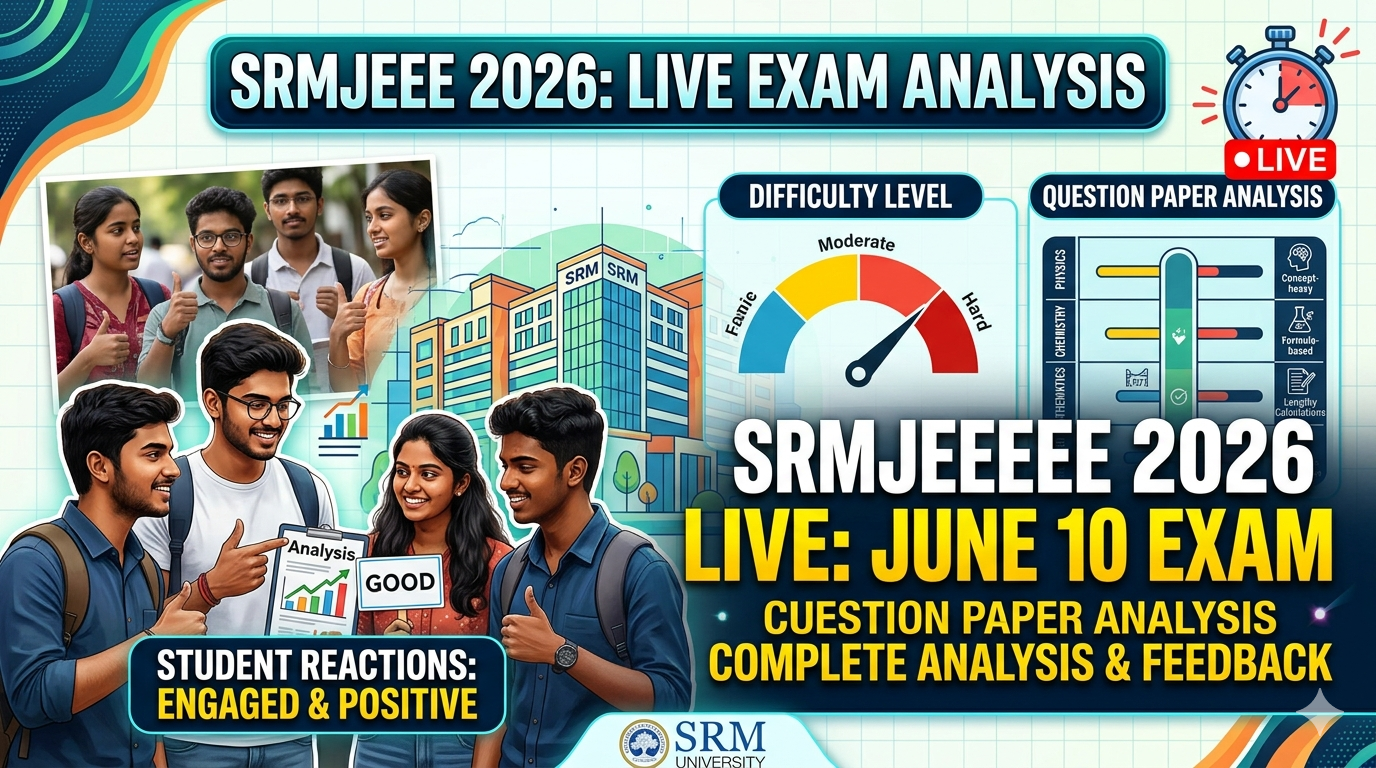
As soon as the first shifts concluded on June 10, students shared their feedback regarding the question paper, difficulty level, important topics, and overall exam experience. Based on initial reactions and expert analysis, the examination was largely rated as moderate in difficulty, with a few sections requiring additional time and careful calculation.
SRMJEEE 2026 June 10 Exam Overview
The SRMJEEE 2026 examination consists of multiple-choice questions from Physics, Chemistry, Mathematics, English, and Aptitude. Candidates are required to complete the paper within the allotted time duration. The examination follows an online remote-proctored format, allowing students to appear from their homes while being monitored through artificial intelligence and human invigilation systems.
Phase 2 is considered an important opportunity for candidates who either missed Phase 1 or are seeking better scores for admission into their preferred engineering branches.
SRMJEEE 2026 June 10 Question Paper Analysis
According to initial feedback received from candidates, the overall paper maintained the standard generally seen in previous SRMJEEE examinations. Most students reported that the questions were syllabus-based and focused primarily on Class 11 and Class 12 concepts.
Experts analysing the paper noted that the examination tested conceptual understanding rather than extremely advanced problem-solving skills. Candidates who had prepared thoroughly using NCERT textbooks and standard entrance examination material found the paper manageable.
The overall paper can be classified as moderate in difficulty, with a few challenging questions appearing in Mathematics and Physics sections. Chemistry was reported as the easiest section by a large number of candidates.
SRMJEEE 2026 June 10: Section-Wise Difficulty Level
Mathematics
Mathematics emerged as the most time-consuming section for many students. Several candidates reported lengthy calculations and multiple-step questions. Topics such as Calculus, Algebra, Coordinate Geometry, Probability, and Vector Algebra received significant weightage.
Students stated that while the questions were not extremely difficult, solving them accurately required good speed and conceptual clarity. Those who had regularly practised mock tests were able to manage the section effectively.
Difficulty Level: Moderate to Moderately Difficult.
Physics
The Physics section was considered balanced and concept-driven. Questions were asked from Modern Physics, Electrostatics, Current Electricity, Optics, Magnetism, and Semiconductor Electronics.
Many students found Physics easier than Mathematics but slightly more challenging than Chemistry. Numerical-based questions required formula application and proper understanding of concepts.
Difficulty Level: Moderate.
Chemistry
Chemistry proved to be the scoring section in the June 10 examination. Students reported a large number of direct and theory-based questions.
Organic Chemistry, Chemical Kinetics, Coordination Compounds, Biomolecules, Solutions, and Surface Chemistry featured prominently in the paper. Candidates who had revised NCERT textbooks thoroughly found the section straightforward.
Difficulty Level: Easy to Moderate.
Aptitude and English
The Aptitude and English sections were largely considered easy. Questions focused on logical reasoning, verbal ability, vocabulary, grammar, and comprehension.
Most candidates completed these sections quickly and used the saved time for Mathematics and Physics.
Difficulty Level: Easy.
Important Topics Asked on June 10
Based on student feedback, some of the major topics covered in the examination included:
Physics:
- Electrostatics
- Optics
- Nuclear Physics
- Current Electricity
- Magnetism
- Semiconductor Devices
Chemistry:
- Coordination Compounds
- Solutions
- Electrochemistry
- Chemical Kinetics
- Biomolecules
- Polymers
Mathematics:
- Calculus
- Probability
- Vector Algebra
- Matrices
- Coordinate Geometry
- Number Systems
These topics have consistently appeared in previous SRMJEEE examinations and remain important for upcoming shifts as well.
Students Reactions After the Exam
Student reactions from the June 10 examination reflected a generally positive experience.
A candidate from Chennai stated that the paper was balanced and easier than some national-level engineering entrance examinations. According to the student, Chemistry was highly scoring while Mathematics required more time.
Another candidate appearing from Hyderabad mentioned that Physics questions were mostly concept-based and did not involve excessively lengthy calculations.
Several candidates agreed that candidates with strong Class 12 fundamentals would be able to score well in the examination. Many also appreciated the smooth conduct of the remote-proctored test.
Some students, however, felt that a few Mathematics questions were tricky and demanded careful interpretation before attempting.
Overall, the majority of candidates described the paper as manageable and fair.
Comparison with Previous Phase
When compared with the Phase 1 examination conducted in April 2026, the June 10 paper appeared to maintain a similar difficulty standard.
Phase 1 was also largely rated as moderate, with Chemistry being easier and Mathematics requiring greater effort. Subject experts believe SRMIST has maintained consistency in the examination pattern across different phases.
Expected Good Score in SRMJEEE 2026
Although official cutoffs are not released immediately after the examination, educational experts have provided preliminary estimates based on previous admission trends.
A score above 120 is generally considered excellent and can improve the chances of securing admission to highly sought-after Computer Science and Engineering programmes at leading SRM campuses.
Candidates scoring between 100 and 120 may also remain competitive for several popular branches depending on seat availability and counselling outcomes.
Scores between 80 and 100 are expected to offer opportunities in various engineering programmes across SRM campuses.
These projections remain unofficial and may vary depending on the overall performance of candidates appearing in Phase 2.
Expected SRMJEEE 2026 Cutoff
The expected cutoff trends for top branches are as follows:
- Computer Science and Engineering: High cutoff expected
- Artificial Intelligence and Machine Learning: High cutoff expected
- Data Science: Moderately High cutoff expected
- Electronics and Communication Engineering: Moderate cutoff expected
- Mechanical Engineering: Moderate cutoff expected
- Civil Engineering: Relatively lower cutoff expected
Experts suggest that candidates aiming for premium branches should target scores above 110–120 to remain on the safer side during counselling. Previous analyses indicated that top-tier CSE admissions often require strong scores and ranks.
What Happens After the Examination?
Following the completion of all Phase 2 examination shifts, SRMIST will announce the results online through the official admission portal. Candidates will be able to log in using their credentials to view their rank cards and admission status. Qualified candidates will then participate in the counselling and seat allotment process based on ranks, preferences, and seat availability.
Conclusion
The SRMJEEE 2026 June 10 examination started on a positive note, with students largely rating the paper as moderate in difficulty. Chemistry emerged as the easiest section, while Mathematics demanded the most time and effort. Physics remained concept-oriented and balanced. Initial student reactions indicate that well-prepared candidates should be able to achieve strong scores.
As the Phase 2 examination continues over the next few days, candidates appearing in upcoming shifts can focus on strengthening concepts in Calculus, Algebra, Electrostatics, Modern Physics, Coordination Chemistry, and Aptitude. Based on current trends, a score above 120 is expected to provide a strong advantage during the admission and counselling process for top engineering programmes offered by SRM Institute of Science and Technology.

📰 More Education News
- DrNB Final Theory Exam April 2026 Results Declared at natboard.edu.in; Direct Link, Scorecard Download Steps and Next ProcessJun 10, 2026 • Simran
- IISER 2026 Response Sheet OUT at iiseradmission.in: Steps to Download and Answer Key Challenge ProcessJun 10, 2026 • Simran
- IIT Jodhpur Launches BS in Mathematics and Computing; Admission Through JEE Advanced 2026Jun 10, 2026 • Simran
- VITEEE 2026 Phase IV Seat Allotment Result Out: Steps to Check, Fee Payment Last DateJun 10, 2026 • Simran